Agentic AI vs Traditional Legal Automation: What's the Difference?
Agentic AI vs Traditional Legal Automation
Legal technology has come a long way over the last decade. What started as software for storing documents and managing case files has grown into powerful platforms that help law firms work faster, collaborate better, and spend less time on admin.
Most legal professionals are already familiar with traditional legal automation. It's the technology that handles repetitive work like generating documents, sending deadline reminders, managing matters, processing invoices, and tracking time. For many firms, it's become an everyday part of running an efficient practice.
Now, a new wave of technology is changing what's possible: Agentic AI.
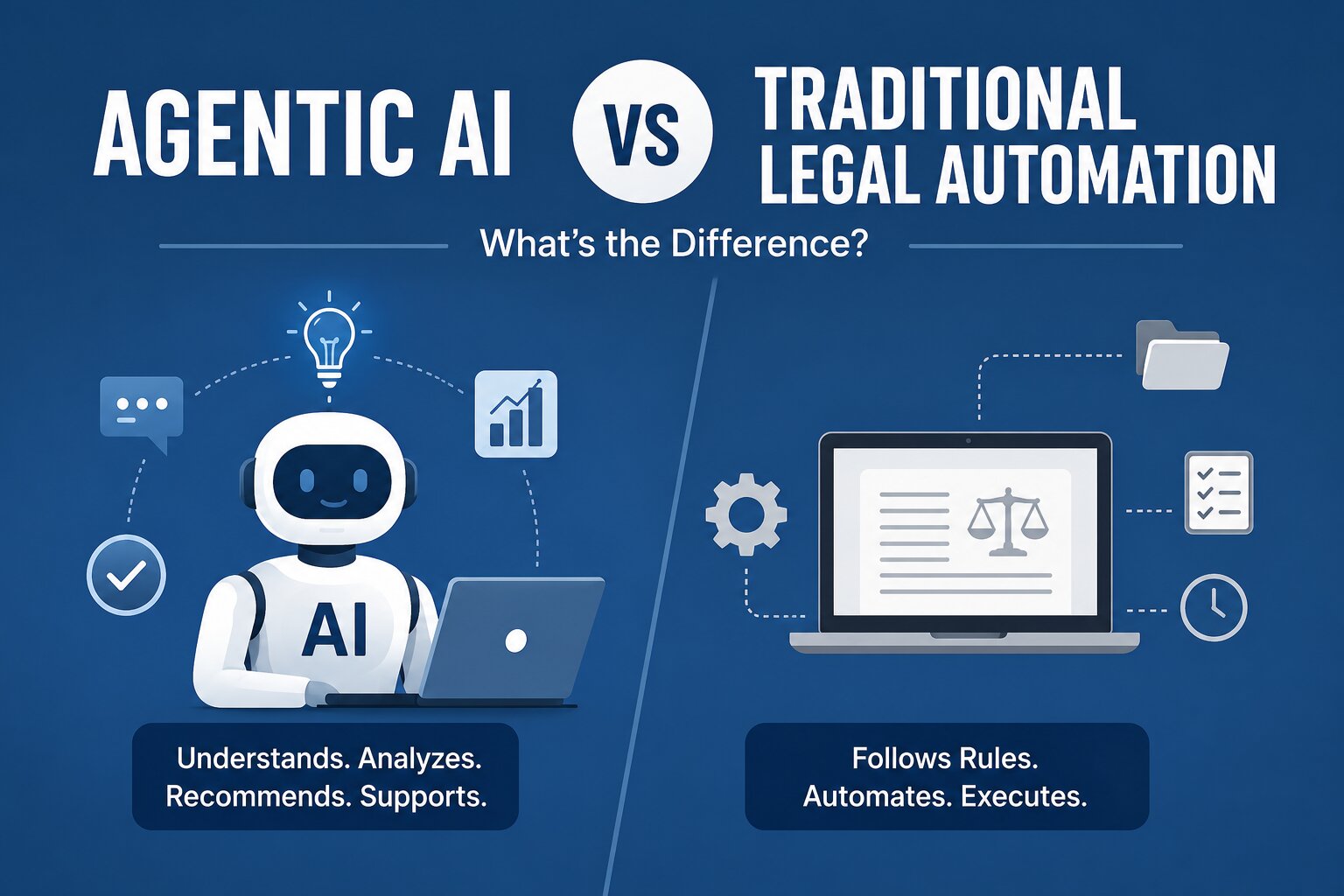
Unlike traditional automation, which simply follows a set of predefined rules, Agentic AI can understand context, analyse information, and suggest the next best step. Instead of only completing repetitive tasks, it works alongside legal professionals as an intelligent assistant, helping them make better decisions and manage their workload more effectively.
As law firms continue to modernise, understanding the difference between Agentic AI and traditional legal automation is becoming increasingly important. While traditional automation is still incredibly valuable, Agentic AI adds a new layer of intelligence that helps firms work more efficiently and respond to changing situations with greater confidence.
In this article, we'll break down how these two technologies differ, where each delivers the most value, and why they're better viewed as complementary tools rather than competing solutions.
What Is Traditional Legal Automation?
Traditional legal automation is software designed to handle repetitive tasks by following a fixed set of rules and workflows. Its purpose is simple: reduce manual work, improve consistency, and help legal teams operate more efficiently.
Think of it as giving software a detailed instruction manual. Once those instructions are in place, the system performs the same actions every time a particular condition is met. It doesn't make judgments or interpret situations—it simply follows the process it has been programmed to execute.
For example, when a new client matter is opened, the software can automatically create a matter number, set up a digital file, assign tasks to the right team members, and schedule important deadlines. Everything happens according to the predefined workflow.
Traditional legal automation is commonly used for:
- Generating documents from approved templates
- Creating and managing legal matters
- Sending reminders for court dates and filing deadlines
- Automating client onboarding
- Preparing invoices and billing records
- Tracking time and expenses
- Assigning tasks and managing approvals
- Sending status updates and email notifications
These automated processes save time, reduce repetitive work, and help ensure that everyone follows the same procedures.
How Traditional Automation Works
Traditional automation is based on simple if-then logic.
For example:
- If a new litigation matter is created, assign it to the litigation team.
- If an invoice is overdue, send a payment reminder after seven days.
- If a document is approved, move it into the client's digital matter folder.
Each action follows a predefined path. The software performs exactly what it's been told to do—nothing more and nothing less. That's what makes traditional automation reliable. For routine legal tasks, it's consistent, predictable, and efficient.
Benefits of Traditional Legal Automation
Traditional automation continues to be one of the easiest ways for law firms to improve efficiency without changing how lawyers work.
Saves Time
Administrative work can take up a large part of the day. By automating repetitive tasks, lawyers and support staff have more time to focus on clients, legal research, and case strategy.
Creates Consistent Processes
Automation ensures every matter follows the same workflow, helping teams maintain consistent standards across the firm.
Reduces Human Error
Manual data entry and repetitive administrative work often lead to mistakes. Automated workflows complete tasks the same way every time, reducing the risk of missed deadlines and inaccurate records.
Improves Productivity
When routine work happens automatically, legal teams can manage more matters without increasing their administrative workload.
Helps Maintain Compliance
Legal work often involves strict deadlines and documentation requirements. Automated reminders and workflow controls help firms stay organised and reduce the chance of important tasks being overlooked.
Where Traditional Automation Falls Short
While traditional automation offers clear efficiency benefits, it has one major limitation: it can only do what it has been programmed to do.
If something unexpected happens, the system can't adapt on its own. It either stops the workflow or waits for someone to intervene and update the rules.
For example, imagine a client submits incomplete documents during onboarding. A traditional automation system might simply send a standard email asking for the missing files because that's what the workflow says to do. It can't recognise why the documents are missing, assess how urgent the matter is, or suggest a better way forward.
The same applies when priorities suddenly change. If several matters become urgent because of new regulations or approaching court deadlines, traditional automation won't reorganise workloads or recommend which cases should be handled first. Someone still has to make those decisions.
In short, traditional automation is excellent at following instructions, but it isn't designed to interpret situations or offer guidance.
As legal work becomes more complex and data-driven, many firms are looking for technology that can do more than automate repetitive tasks. That's where Agentic AI comes in.
What Is Agentic AI?
Agentic AI represents the next step in legal technology. Instead of simply following predefined instructions, it's designed to understand goals, interpret context, and help legal professionals complete more complex work.
Unlike traditional automation, Agentic AI doesn't rely entirely on fixed workflows. It can analyse information, identify patterns, highlight potential issues, recommend actions, and assist with multi-step legal processes.
A simple way to think about the difference is this:
- Traditional automation follows instructions.
- Agentic AI works towards an objective.
- Imagine asking software to prepare a legal matter for review.
A traditional automation system might generate a checklist, assign tasks, and notify team members based on an existing workflow.
An Agentic AI system could go much further. It might review the available documents, identify missing information, flag potential risks, recommend the next steps, and suggest which matters should be prioritised—all while leaving the final decision in the hands of the lawyer.
That's an important distinction.
Agentic AI isn't designed to replace legal professionals. Instead, it supports them by reducing repetitive thinking, organising information, and surfacing insights that help them work more efficiently. Lawyers remain responsible for legal advice, strategy, negotiation, and professional judgement.
If you're new to this technology and want a deeper understanding of how it's transforming legal departments, explore our guide on The Rise of Agentic AI in Legal Operations: What Corporate Legal Teams Need to Know. It explains how Agentic AI is reshaping legal workflows, improving decision-making, and helping legal teams move beyond traditional automation.
How Agentic AI Is Different
The biggest difference is that Agentic AI understands context rather than simply following rules.
Instead of asking only, "What task should I perform?", it also considers questions like:
- What is the overall goal?
- What information is already available?
- Are any important documents missing?
- Which matters are most urgent?
- What should happen next based on the current situation?
By analysing data and providing intelligent recommendations, Agentic AI helps legal teams make faster, more informed decisions while keeping people firmly in control. While Agentic AI is still an emerging concept for many firms, AI has already begun transforming day-to-day legal operations in practical ways. From automating document review and improving matter management to providing predictive insights and streamlining workflows, AI is reshaping how legal teams work. If you'd like to see these real-world applications in more detail, explore our guide on 6 powerful ways AI in legal management systems are transforming law firms in 2026.
Agentic AI vs Traditional Legal Automation: A Side-by-Side Comparison
Both traditional legal automation and Agentic AI are designed to help law firms work more efficiently, but they do it in very different ways. Traditional automation is great at handling repetitive, rule-based tasks. Agentic AI, on the other hand, helps with work that requires context, judgement, and decision support.
Here's a quick comparison:
Traditional Legal Automation | Agentic AI |
Follows predefined rules | Understands context and objectives |
Handles repetitive tasks | Assists with complex, multi-step work |
Needs workflows to be manually configured | Adapts recommendations based on available information |
Acts only when triggered | Analyses situations before suggesting actions |
Best for structured processes | Best for work that changes and evolves |
Completes tasks | Helps people make better decisions |
Limited flexibility | Adapts to changing circumstances |
Focuses on efficiency | Combines efficiency with intelligent assistance |
At first glance, these differences might make the technologies seem like competitors. In reality, they're designed to solve different problems and work best together.
Let's take a closer look.
Rule-Based vs Context-Aware
Traditional automation follows a fixed set of rules.
For example, when a contract reaches its renewal date, the system automatically sends a reminder to the responsible lawyer. It performs exactly what it's been programmed to do. Agentic AI looks at the bigger picture.
Instead of only sending a reminder, it could review the contract, identify upcoming deadlines, flag missing approvals, assess how important the contract is, and suggest whether immediate action is needed. Rather than simply completing a task, it provides useful context that helps lawyers make informed decisions more quickly.
Fixed Workflows vs Adaptive Workflows
Traditional automation works best when the process is predictable.
That includes tasks like:
- Opening new matters
- Creating engagement letters
- Generating invoices
- Recording billable hours
- Assigning standard legal tasks
These activities follow a consistent process, making them ideal for automation. But legal work doesn't always follow a script. Client priorities change, regulations evolve, and unexpected developments can alter the course of a matter.
Agentic AI is built for these situations. Instead of relying on a fixed workflow, it analyses the information available at that moment and recommends the most appropriate next step.
Manual Triggers vs Intelligent Recommendations
Traditional automation usually needs something to trigger an action.
For example:
- A new matter is opened.
- A payment becomes overdue.
- A document is approved.
- A filing deadline is approaching.
Once the trigger occurs, the system follows the next predefined step. Agentic AI doesn't always need to wait.
It can recognise patterns, spot potential issues, and recommend actions before someone manually starts a workflow.
For example, it might notice that several matters involve similar legal questions and suggest reusing previous research. It could also detect missing client information before it delays the next stage of a case. Instead of simply reacting, it helps legal teams stay one step ahead.
Completing Tasks vs Helping Achieve Goals
Traditional automation is designed to complete individual tasks. Agentic AI focuses on helping legal professionals achieve a broader objective.
Imagine you're preparing for a client meeting. A traditional automation system might collect the relevant documents already linked to the matter.
An Agentic AI system could take it further by summarising recent case developments, highlighting outstanding actions, compiling key correspondence, and organising everything into a clear briefing.
The lawyer still decides what advice to give, but much of the preparation is already done.
Static Processes vs Learning from New Information
Traditional automation only changes when someone updates the workflow. If regulations change or the firm's internal procedures are revised, an administrator needs to manually update the rules.
Agentic AI is better equipped to work in changing environments. While it still needs proper governance and human oversight, it can analyse new information, identify emerging patterns, and make recommendations based on what's happening now instead of relying entirely on historical workflows.
That flexibility makes it especially useful in legal environments where priorities and regulations are constantly evolving.
Where Traditional Legal Automation Still Delivers Real Value
Despite all the excitement around AI, traditional legal automation remains one of the most valuable technologies in a modern law firm. Many legal tasks are repetitive and follow the same process every time. They don't require advanced intelligence—they simply need to be completed accurately and consistently.
Here are some of the areas where traditional automation continues to shine.
Document Generation
Creating standard legal documents from approved templates is one of the biggest time-savers.
This includes:
- Engagement letters
- Non-disclosure agreements (NDAs)
- Standard contracts
- Client forms
- Court filing templates
Instead of drafting the same documents repeatedly, firms can automatically populate templates with client and matter details, reducing manual work and improving consistency.
Matter Creation and File Management
Opening a new matter involves more than just creating a file. Reference numbers need to be assigned, folders created, team members allocated, and workflows started.
Automation handles these tasks in seconds, ensuring every matter begins with the same organised structure.
Managing Deadlines and Reminders
Missing an important deadline can have serious consequences.
Traditional automation helps by automatically scheduling reminders for:
- Court appearances
- Filing deadlines
- Contract renewals
- Compliance obligations
- Client meetings
Instead of relying entirely on manual calendars, legal teams receive timely notifications that help keep work on track.
Time Recording and Billing
Billing is another area where automation delivers immediate value.
It can help firms:
- Record billable hours
- Generate invoices
- Track expenses
- Send payment reminders
- Produce financial reports
The result is a smoother billing process with fewer administrative tasks for lawyers and finance teams.
Client Onboarding
Bringing on a new client usually follows a well-defined process. Collecting documents, running conflict checks, preparing engagement letters, and creating new matters are all tasks that can be automated. That means a faster, more consistent onboarding experience for both the firm and its clients.
These everyday examples show why traditional automation remains the backbone of efficient legal operations. It's dependable, accurate, and ideal for work that follows established processes.
Where Agentic AI Has the Greatest Impact
While traditional automation handles repetitive work extremely well, legal professionals also spend a significant amount of time reviewing information, making decisions, prioritising work, and searching for knowledge.
These are the areas where Agentic AI can make the biggest difference.
Smarter Document Review
Lawyers often need to work through lengthy contracts, case files, and supporting documents. Instead of manually searching through hundreds of pages, Agentic AI can identify important clauses, highlight inconsistencies, flag missing information, and bring relevant details to the surface.
That means less time searching and more time analysing the legal issues that matter. As AI continues to reshape legal operations, document review is just one of many areas seeing rapid innovation. To explore the broader trends, adoption patterns, and practical applications of AI across legal departments, read our article on AI in Legal Operations 2026: Industry Insights on Automation and Legal Technology.
Faster Knowledge Search
Finding previous matters, precedents, or internal guidance can sometimes be frustrating. Rather than relying only on keywords, Agentic AI understands the intent behind a search and can locate relevant information across the firm's knowledge base much more effectively.
This makes legal research faster and helps teams make better use of existing knowledge.
Prioritising What Matters Most
Not every legal matter is equally urgent. Agentic AI can analyse deadlines, workloads, client commitments, and matter complexity to recommend which tasks deserve immediate attention.
The lawyer remains in control, but prioritising work becomes much easier.
Recommending the Next Step
Complex matters often involve multiple teams, approvals, and stages. Instead of leaving lawyers to figure out every next step manually, Agentic AI can suggest what should happen next based on the current status of the matter.
For example, it might recommend requesting additional documents, flag missing approvals, or highlight information that still needs to be collected before work can continue.
Preparing Case Summaries
Getting ready for meetings often means reading through emails, documents, and case notes. Agentic AI can quickly summarise recent activity, highlight outstanding tasks, and present the most important updates in one place.
That reduces preparation time and allows lawyers to focus on strategy rather than administration.
Spotting Process Bottlenecks
Legal matters often pass through several teams before they're completed. Agentic AI can identify where delays regularly occur, highlight recurring bottlenecks, and provide insights that help firms improve their workflows over time.
Instead of simply automating existing processes, it helps firms make those processes better.
Bringing Both Together
One thing becomes clear when you compare the two technologies: traditional legal automation and Agentic AI aren't competing with each other—they're solving different problems. Traditional automation is the right choice for structured, repetitive work that follows clear rules. Agentic AI adds another layer by helping legal professionals analyse information, prioritise work, and make better decisions.
The firms seeing the greatest value aren't choosing one over the other. They're combining both—using automation to handle routine tasks while relying on Agentic AI to support more complex legal work. Together, they create a more efficient, connected, and intelligent way of managing legal operations.
Why Modern Law Firms Need Both Traditional Automation and Agentic AI
With all the buzz around AI, it's easy to assume that newer technology will replace everything that came before it. But that's not how legal technology is evolving. The most successful law firms aren't replacing traditional automation with Agentic AI—they're using both together.
Traditional automation is excellent at handling routine, repeatable tasks. It keeps processes consistent, helps teams meet deadlines, and reduces the time spent on administrative work.
Agentic AI builds on that foundation. It helps lawyers make sense of information, spot potential issues, recommend next steps, and support decisions when a simple set of rules isn't enough. Instead of asking which technology is better, the real question is: how can they work together? A typical legal workflow is a good example.
When a new client matter comes in, traditional automation can:
- Create the matter automatically.
- Generate onboarding documents.
- Store files in the correct location.
- Assign work to the right team members.
- Schedule important deadlines and reminders.
These are structured tasks that automation handles quickly and consistently.
As the matter progresses, Agentic AI can step in to provide additional support by:
- Spotting missing information before it causes delays.
- Summarising lengthy contracts or case files.
- Recommending the next logical step in the workflow.
- Finding relevant precedents or internal knowledge.
- Highlighting matters that may need urgent attention.
Together, these technologies create a smoother way of working. Automation handles repetitive tasks, while Agentic AI helps lawyers focus on the work that requires judgement, strategy, and legal expertise.
These capabilities become even more valuable as firms embrace hybrid and remote ways of working. Cloud-based legal platforms, secure collaboration tools, and AI-powered workflows enable legal teams to stay productive regardless of location. Learn more about how technology is reshaping distributed legal practice in our article on Legal Tech in a Remote Era: The Future for Law Firms and Clients.
How Beveron Smart Lawyer Office Supports Modern Legal Workflows
As a law firm grows, keeping track of matters, documents, deadlines, billing, and client communication across different systems can quickly become challenging.
That's why many firms are moving towards a single platform that brings everything together. Beveron Smart Lawyer Office is designed to help law firms manage their day-to-day operations from one central place, making it easier to stay organised, collaborate across teams, and keep work moving efficiently. Here's how it helps.
Centralised Matter Management
Every matter comes with documents, emails, tasks, deadlines, and conversations.
Keeping all of that information in one place makes it much easier to monitor progress, collaborate with colleagues, and find what you need without jumping between different systems.
Beyond improving organisation, modern matter management software also supports regulatory compliance, document governance, and deadline tracking. Explore these benefits in How Matter Management Software Helps Lawyers Stay Compliant and Organized
Document Management
Legal teams deal with a constant flow of contracts, pleadings, correspondence, and supporting documents.
A well-organised document management system keeps everything secure, searchable, and linked to the right matter, so lawyers spend less time looking for files and more time working on them. Modern law firms are increasingly combining case management with intelligent document management to improve collaboration, reduce administrative work, and keep case information organised. Learn how firms are adopting these technologies in our guide on How Law Firms Are Using Technology to Improve Case and Document Management.
Workflow Automation
Many administrative tasks follow the same process every time.
Creating new matters, assigning work, sending deadline reminders, and managing approvals can all be automated, helping firms save time while maintaining consistent processes. Well-designed legal workflows do more than automate routine tasks—they improve collaboration, reduce bottlenecks, and ensure work moves consistently from intake to resolution. Learn more in our guide on Best Practices for Managing Legal Workflows in Modern Law Firms.
Time Tracking and Billing
Recording billable hours and preparing invoices shouldn't become a job in itself.
Integrated time tracking and billing tools make it easier to capture work accurately, generate invoices, and keep an eye on the firm's financial performance.
Client and Contact Management
Having a complete view of every client in one place helps legal teams respond faster and provide better service.
Instead of searching through emails or separate databases, lawyers can quickly access contact details, matter history, and important communications whenever they need them.
Task and Team Collaboration
Legal matters rarely involve just one person.
With shared task management and collaboration tools, everyone knows what they're responsible for, what still needs to be done, and how work is progressing.
That keeps teams aligned and reduces unnecessary follow-ups.
A Strong Foundation for AI
AI works best when it has access to organised, structured information.
By bringing together matters, documents, workflows, and client data in one platform, Beveron Smart Lawyer Office gives firms the foundation they need to adopt AI as new capabilities become available.
Rather than treating automation and AI as separate projects, firms can improve efficiency today while preparing for the next generation of legal technology.
The Future of Legal Operations
Legal technology is no longer just about automating repetitive tasks. The next generation of legal software is bringing together workflow automation, knowledge management, analytics, and AI into connected platforms that help lawyers work more effectively.
Over the next few years, we'll likely see more firms adopting tools that can:
- Support legal research with AI.
- Review and analyse documents more intelligently.
- Recommend the next steps in a matter.
- Provide operational insights using real-time data.
- Improve collaboration across legal teams.
- Give leaders better visibility into workloads and firm performance.
None of this replaces lawyers. Legal advice, negotiation, advocacy, strategic thinking, and ethical judgement will always depend on people. Technology simply helps by reducing repetitive work, organising information, and making it easier to access the insights lawyers need to do their jobs. As more law firms adopt AI, it's equally important to consider how that AI is deployed. For firms handling confidential legal information, choosing a secure AI environment is just as critical as choosing the right technology. If you're evaluating AI for your practice, read our guide on 5 Reasons Legal Teams Should Choose Private AI Over Public AI to understand why many firms are moving towards private AI solutions. Firms that invest in connected legal operations today will be in a much stronger position to take advantage of future AI innovations as they emerge.
As AI adoption accelerates, many corporate legal departments are also creating dedicated AI Centres of Excellence to establish governance, identify high-value use cases, and encourage responsible AI adoption across the organisation. If you're interested in how legal teams are taking a more strategic approach to AI, explore our guide on Why Legal Departments Are Building AI Centres of Excellence. It explains why having the right strategy, processes, and leadership is just as important as choosing the right AI technology.
Frequently Asked Questions
What is the difference between Agentic AI and traditional legal automation?
Traditional legal automation follows predefined rules to complete routine tasks like document generation, billing, deadline reminders, and matter management. Agentic AI goes a step further by understanding context, analysing information, and recommending actions that help lawyers manage more complex work.
Can Agentic AI replace lawyers?
No. Agentic AI is designed to support legal professionals, not replace them. Lawyers are still responsible for legal advice, strategic decisions, client representation, and professional judgement. AI simply helps reduce repetitive work and speeds up access to useful information.
Is traditional legal automation still worth investing in?
Absolutely. Traditional automation continues to deliver significant value by reducing manual work, improving consistency, minimising errors, and helping firms run more efficiently. It's still one of the most important technologies in a modern law firm.
Should law firms choose traditional automation or Agentic AI?
For most firms, the best approach is to use both. Traditional automation handles structured, repetitive work, while Agentic AI provides intelligent support for more complex tasks. Together, they create a more efficient and connected way of working.
How does Beveron Smart Lawyer Office help modern law firms?
Beveron Smart Lawyer Office brings matter management, document management, workflow automation, billing, task management, and client information into one platform. It helps firms improve productivity today while creating a solid foundation for future AI-powered legal workflows.
Conclusion
The conversation around Agentic AI vs traditional legal automation isn't about choosing a winner. Each technology has its own strengths, and together they create a much more effective way of working.
Traditional automation takes care of routine, rule-based tasks with speed and consistency. It reduces administrative work, improves compliance, and helps legal teams stay organised.
Agentic AI adds another layer by helping lawyers understand information faster, prioritise work, identify potential issues, and make better-informed decisions.
For firms looking to modernise their legal operations, the smartest approach is to combine both.
Beveron Smart Lawyer Office provides the foundation by bringing together matters, documents, workflows, billing, and collaboration in one connected platform. As AI continues to evolve, firms with organised and well-managed legal operations will be ready to adopt new capabilities with confidence.
Whether your goal is to improve productivity, deliver a better client experience, or prepare your firm for the future, building on a strong legal practice management platform is the right place to start.
Ready to modernise your legal operations? Discover how Beveron Smart Lawyer Office can help your firm streamline everyday work, improve collaboration, and build a future-ready legal practice.
Best agentic AI for law firms in the UAE
Best legal AI software for law firms in the UAE
Best AI-powered legal automation software in the UAE
If you need a free demo of the best agentic AI for law firms in the UAE, please fill out the form below.