Why Legal Departments Are Building AI Centres of Excellence
AI is no longer a side project for legal teams
For a long time, AI in legal departments sat in the “interesting, but not urgent” category. Teams explored it, tested a few tools, and talked about future possibilities. That is changing quickly.
Today, AI is becoming part of how corporate legal departments actually work. It is helping with contract review, document analysis, legal research, compliance tracking, matter management, and reporting. In some teams, it is already taking pressure off repetitive work that used to consume hours each week.
That shift is happening for a simple reason: legal departments are being asked to do more than ever. They are handling larger contract volumes, more regulatory complexity, tighter turnaround expectations, and greater pressure to show efficiency to the wider business. At the same time, few teams have the luxury of unlimited headcount or budget.
AI offers real support here. But legal leaders are also realising something important: using AI in a few isolated places is not the same as building a legal function that can use it well.
That is why more legal departments are creating AI Centres of Excellence. They want a way to move beyond scattered experimentation and build a more structured, practical approach to AI adoption.
Why legal teams are looking for more structure around AI
The first phase of AI adoption in legal often looks fairly informal.
One team starts using AI for contract review. Another experiments with research support. Someone in legal operations trials a workflow tool with AI features built in. A few individuals begin using generative AI to speed up drafting or summarise documents.
None of that is necessarily a problem. In fact, it is often how innovation starts. But over time, it can create a patchwork of tools, habits, and expectations that is difficult to manage.
Different teams may be using different platforms. There may be no shared view of what counts as an approved use case, how outputs should be reviewed, or what data can safely be used. Some tools may be useful, others may be duplicative, and leadership may have no clear way to measure whether any of it is creating value.
This is where an AI Centre of Excellence starts to make sense. It gives legal departments a central way to guide AI adoption rather than letting it grow in disconnected pockets.
What is an AI Centre of Excellence?
In a legal context, an AI Centre of Excellence (CoE) is a dedicated function, working group, or internal framework that helps the department adopt AI in a controlled and useful way.
It is not just there to buy software or test the latest tools. Its role is much broader than that. A legal AI CoE typically helps with:
- setting standards for how AI should be used
- identifying the legal use cases worth investing in
- assessing vendors and technology options
- managing risk, privacy, and governance concerns
- supporting training and adoption across the team
- measuring whether AI is actually improving outcomes
In other words, it gives legal departments a practical structure for turning AI from a series of one-off experiments into something more reliable and scalable.
Why legal departments are building AI Centres of Excellence now
Growing workloads are forcing legal teams to rethink how work gets done
This is probably the biggest driver.
Most in-house legal teams are managing more work than they were a few years ago. There are more contracts to review, more internal requests to handle, more compliance obligations to track, and more pressure to respond quickly to the business.
At the same time, legal teams are still expected to be careful, accurate, and risk-aware. The work is not getting simpler, but the demand for speed keeps increasing.
AI is attractive because it can reduce the time spent on repetitive, process-heavy work. It can help legal teams review information faster, surface relevant clauses, organise data, summarise large volumes of text, and support decision-making with better visibility.
But if AI is going to become part of everyday legal operations, it needs to be introduced in a way that does not create new confusion or new risks. That is exactly the gap a Centre of Excellence is designed to fill.
Legal is under pressure to operate more like a modern business function
Legal departments are no longer judged only on legal judgement. They are also being asked to show responsiveness, efficiency, transparency, and better use of resources.
General counsel and legal operations leaders are expected to answer questions such as:
- How quickly is legal work moving?
- Where are the bottlenecks?
- Which tasks are consuming the most time?
- What is the department doing to improve productivity?
- Are technology investments actually delivering value?
AI can support some of those goals, but only if it is connected to a wider operational strategy. For many teams, that wider shift is part of a broader move towards legal technology transformation across corporate legal operations.
AI creates opportunity, but also new responsibility
Legal teams understand better than most that new technology does not just create efficiency. It also creates risk if it is used carelessly.
With AI, the concerns are familiar but significant: data privacy, confidentiality, output accuracy, intellectual property questions, bias, explainability, and the risk of people relying too heavily on content that still needs legal judgement.
That does not mean legal departments should avoid AI. It means they need a better operating model for it. A Centre of Excellence gives them a way to balance innovation with responsibility, which is exactly the position legal functions need to be in.
What a legal AI Centre of Excellence actually does
It sets the rules before AI use becomes difficult to control
One of the most valuable things a CoE does is create clarity.
It defines who can approve AI initiatives, what standards new tools need to meet, when legal teams can use AI in their workflows, and where human review remains essential. It also helps establish policies around confidentiality, data handling, record retention, and acceptable use. This matters because legal teams do not just need access to AI. They need confidence that they are using it in a way that protects the organisation.
It focuses the team on the use cases that are genuinely worth pursuing
Not every legal task needs AI, and not every AI use case will deliver meaningful value.
A good Centre of Excellence helps the department focus on practical opportunities rather than chasing every new tool that enters the market. In many legal teams, the most promising use cases tend to be the ones that involve high volumes of documents, repeatable workflows, and manual administrative effort. That is also why many legal departments are investing more heavily in workflow automation as part of wider legal operations improvement.
That might include:
- first-pass contract review
- legal intake and triage
- compliance monitoring
- matter reporting
- document summarisation
- internal knowledge retrieval
- workflow automation across routine legal processes
The aim is not to replace legal thinking. It is to reduce the amount of time lawyers and legal operations teams spend on low-value administrative work.
It gives the department a smarter way to evaluate legal AI vendors
The legal AI market is crowded, and not every solution is as mature as it looks in a product demo.
Some tools may solve one narrow problem well. Others may offer a broader platform approach. Some may be strong on functionality but weak on governance, integration, or implementation support. Without a structured evaluation process, it is easy to end up with overlapping tools or systems that do not fit the department’s long-term needs.
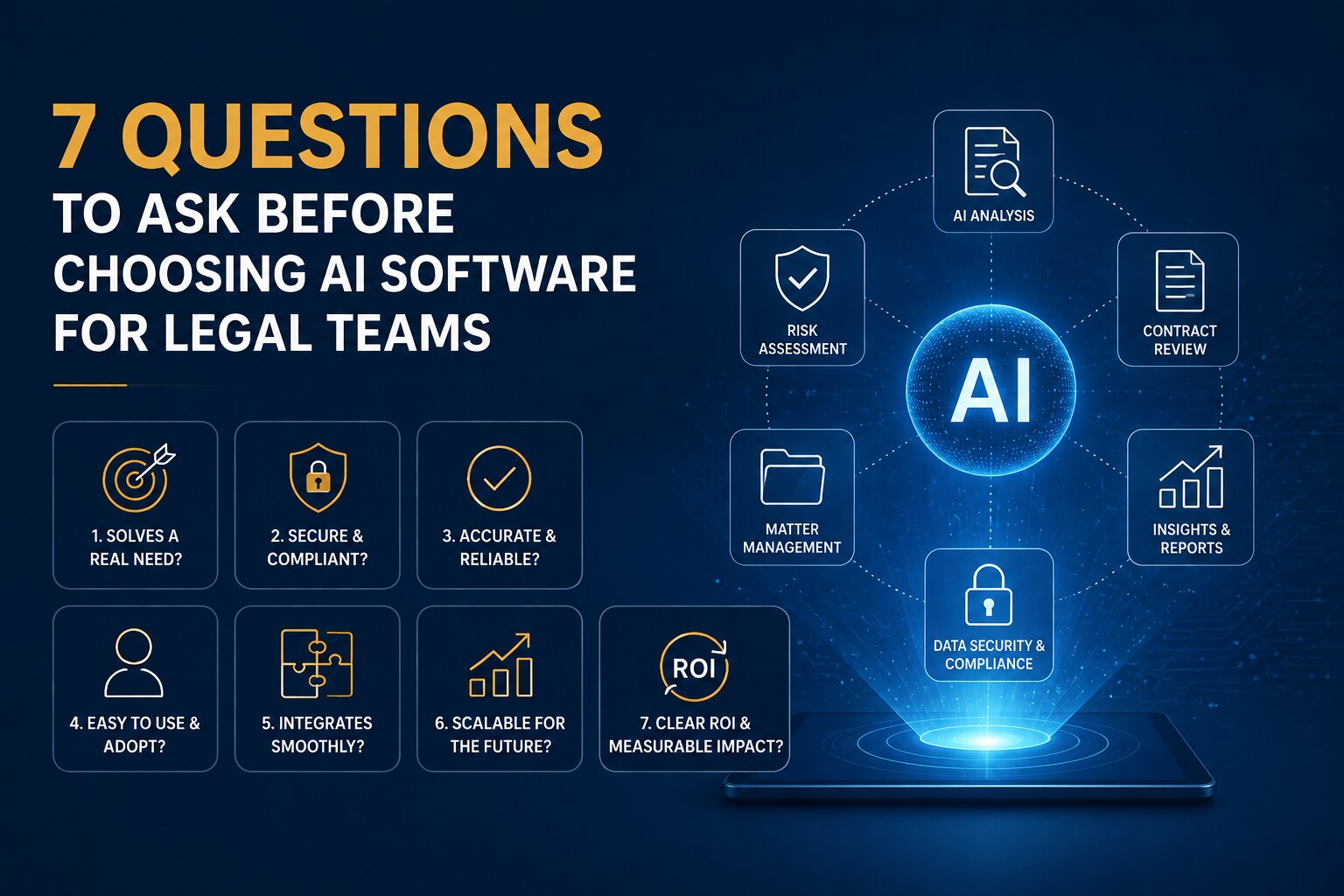
A Centre of Excellence helps legal teams assess vendors more consistently by looking at questions such as:
- Does the tool solve a real legal operations problem?
- Can it handle sensitive data appropriately?
- How transparent are its outputs?
- Will it integrate with existing legal systems?
- Is it scalable across the department?
- What level of oversight and auditability does it provide?
This is also where broader legal operations technology becomes part of the conversation. I work best when it sits on top of organised workflows, accessible legal data, and clear operational processes. In practice, that often means strengthening areas such as contract management and matter visibility before expecting AI to deliver consistent results. If legal information is fragmented across email, spreadsheets, shared drives, and disconnected systems, even the best AI tool will struggle to deliver consistent results.
That is one reason platforms like Beveron Technologies are relevant to this shift. For legal departments trying to modernise operations, the challenge is often bigger than adding one AI tool. It is about building a more connected legal environment where workflows, documents, reporting, and compliance processes are easier to manage. Once that foundation is in place, AI becomes much more useful.
It helps improve data quality, which matters more than many teams realise
AI conversations often focus on tools, but in legal operations, the quality of the underlying information matters just as much.
If contract data is incomplete, matter records are inconsistent, or documents are difficult to retrieve, AI outputs will only go so far. A Centre of Excellence can help legal teams address that by working with legal operations, IT, and compliance stakeholders to improve how legal information is stored, classified, and managed.
It is not the flashiest part of an AI strategy, but it is one of the most important. Better AI outcomes usually depend on better legal data and cleaner processes.
It supports training, adoption, and day-to-day confidence
Legal professionals do not just need new technology. They need to know how to use it well.
That means understanding where AI can genuinely help, where caution is needed, how outputs should be checked, and when human judgement must take priority. Without that support, adoption can become uneven. Some people avoid the tools entirely, while others use them without enough structure.
A CoE helps bridge that gap by providing training, usage guidance, feedback loops, and a practical framework for responsible adoption. In practice, this is why many legal teams also look beyond the software itself and invest in broader legal-tech support, whether that means practical guidance, implementation input, or access to resources that help legal professionals adopt new ways of working with more confidence.
The real benefits of a legal AI Centre of Excellence
Legal teams get more time back for work that actually needs legal judgement
This is usually the most immediate benefit.
When repetitive work is streamlined, legal professionals spend less time searching for information, reviewing routine language, managing manual workflows, or producing status updates. That creates more space for higher-value work such as negotiation, strategic advisory support, complex risk assessment, and stakeholder engagement.
Legal operations become more consistent
A Centre of Excellence does not just improve AI usage. It often improves legal operations more broadly.
Processes become more standardised. Expectations become clearer. Teams have a better understanding of approved tools, review requirements, and workflow responsibilities. Over time, that consistency can reduce friction across the department and make service delivery more predictable.
Leadership gets better visibility into legal performance
When AI is introduced as part of a structured legal operations strategy, it can improve more than productivity. It can also improve visibility.
Legal leaders can gain better insight into contract turnaround times, workload distribution, matter progress, compliance activity, and where operational bottlenecks are appearing. That matters because one of the biggest challenges in many legal departments is not simply doing the work. It is seeing the work clearly enough to improve it.
Risk becomes easier to manage because AI use is no longer informal
Perhaps the biggest advantage of a Centre of Excellence is that it replaces informal AI usage with a more accountable model.
Instead of hoping teams use AI carefully, the department has policies, oversight, review expectations, and ownership in place. That does not eliminate risk, but it does make it much easier to manage responsibly.
The challenges are real, but they are manageable
Of course, building a legal AI Centre of Excellence is not just a governance exercise on paper. It involves real change.
Some legal professionals will be sceptical of AI, especially if they worry about accuracy or professional responsibility. Some teams may already be using tools in ways leadership cannot fully see. Budget constraints, competing priorities, and varying levels of digital maturity can also slow progress.
But these challenges are exactly why a structured approach matters. A Centre of Excellence does not remove every obstacle. What it does is give the legal department a way to address them deliberately rather than reactively.
AI Centres of Excellence are becoming part of the modern legal operating model
The bigger picture is fairly clear now. Legal departments are moving away from one-off AI experiments and towards more intentional, long-term adoption.
That shift is not really about technology for its own sake. It is about building a legal function that can work more efficiently, use data more intelligently, manage risk more confidently, and support the wider business without increasing operational strain.
For many organisations, an AI Centre of Excellence is becoming the structure that makes that possible. It helps legal teams connect innovation with governance, and ambition with practical execution.
Conclusion: what this means for enterprise legal departments
For enterprise legal departments, the rise of AI Centres of Excellence reflects a wider change in how legal operations are being managed. AI is no longer being treated as an isolated experiment or a side conversation. It is becoming part of the legal operating model.
That shift matters because legal teams cannot afford fragmented adoption. They need a way to assess tools carefully, prioritise useful applications, protect sensitive data, support internal adoption, and measure whether AI is genuinely improving outcomes.
An AI Centre of Excellence gives them that structure. It helps turn AI from a collection of promising ideas into a more disciplined capability that supports legal service delivery, compliance, operational efficiency, and strategic decision-making.
The legal departments that will get the most value from AI are unlikely to be the ones adopting the most tools. They are more likely to be the ones building the clearest frameworks around how AI fits into legal work, where it creates value, and how it should be governed over time.
Frequently Asked Questions
What is an AI Centre of Excellence in legal?
An AI Centre of Excellence in legal is a central function or working group that helps manage how AI is adopted across the legal department. It typically covers governance, vendor assessment, use case prioritisation, training, risk oversight, and performance measurement.
Why are legal departments building AI Centres of Excellence?
Because AI adoption is growing, and informal experimentation can quickly become fragmented. Legal departments need a more structured way to manage AI tools, protect confidential information, reduce risk, and ensure technology investment leads to meaningful operational improvements.
What are the main benefits of a legal AI Centre of Excellence?
The main benefits include stronger governance, more consistent AI adoption, better vendor selection, improved legal efficiency, clearer operational visibility, and better alignment between AI initiatives and wider legal department goals.
Which legal processes are most suitable for AI?
Common examples include contract review, document summarisation, legal intake, compliance monitoring, matter reporting, and internal knowledge retrieval. These tend to be areas where there is a high volume of information and a significant amount of manual work.
Does every legal department need a formal AI Centre of Excellence?
Not every department needs a large formal team, but most legal functions adopting AI at scale do need some form of central governance and ownership. The structure may vary depending on the size and complexity of the organisation, but the need for clarity, oversight, and consistency is becoming increasingly important.
How does Beveron Technologies support legal departments on this journey?
Beveron Technologies helps legal departments modernise legal operations by improving workflow management, centralising legal information, and increasing visibility across legal processes. That operational foundation can make it much easier for organisations to adopt AI in a more structured and effective way.
Build a stronger foundation for legal AI adoption
AI can absolutely help legal departments work more efficiently, but the real value comes when it is supported by the right structure, workflows, and operational visibility.
If your legal team is looking at AI-enabled contract workflows, compliance processes, legal matter management, or broader legal operations modernisation, Beveron Technologies can help create the operational foundation that makes those initiatives easier to scale.
Talk to Beveron Technologies to explore how your legal department can move from scattered AI experiments to a more connected, practical, and future-ready legal operations model.
Best AI in legal operations software in the UAE
Best AI governance in corporate legal departments in the UAE
Best legal workflow automation in the UAE
If you need a free demo of the best AI in legal operations software in the UAE, please fill out the form below.