5 Reasons Legal Teams Should Choose Private AI Over Public AI
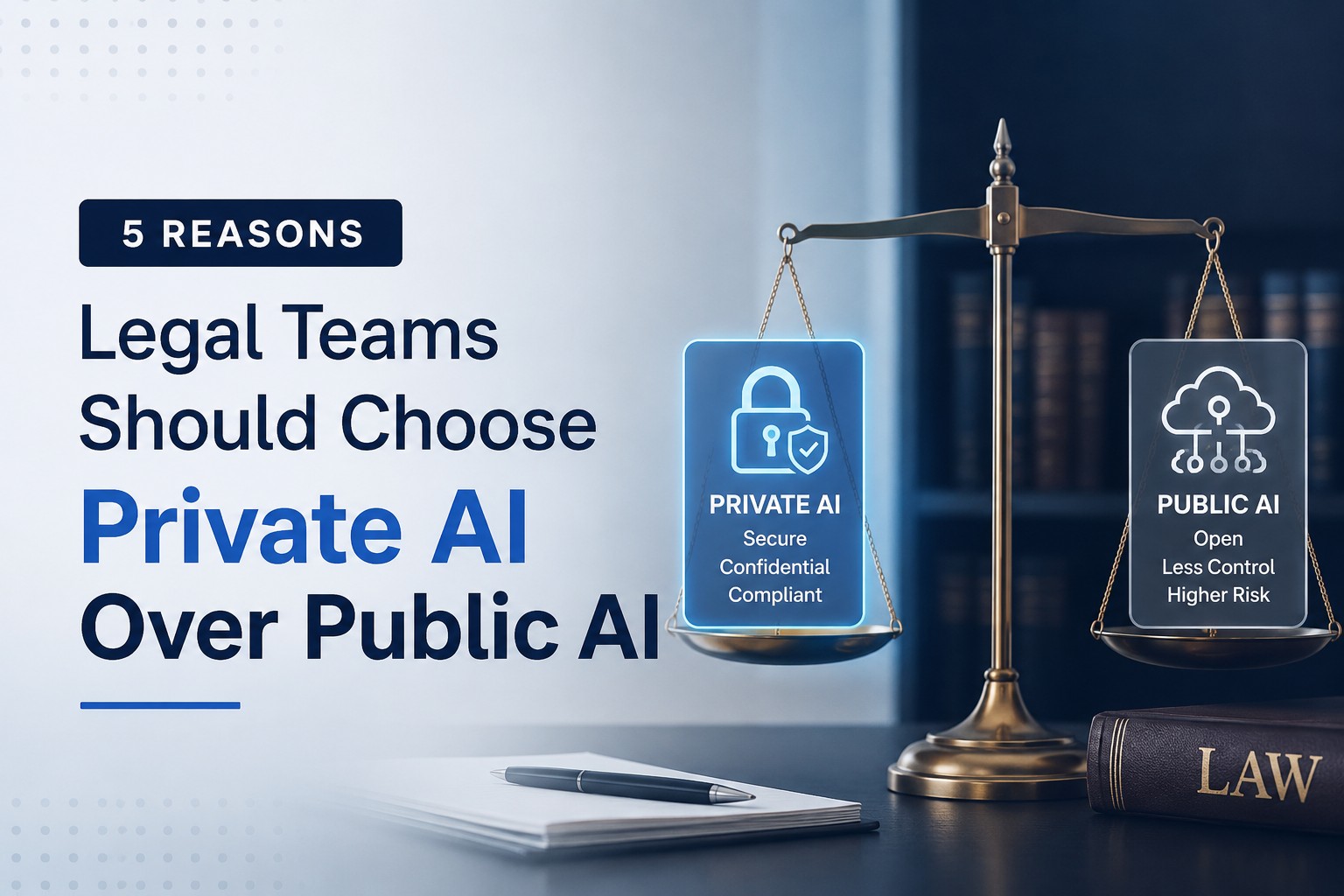
Artificial intelligence is changing the way legal teams work. Tasks that once took hours—reviewing contracts, summarising case files, organising legal documents, or conducting legal research—can now be completed much faster with AI.
It's easy to see why so many law firms and corporate legal departments are adopting AI. Used well, it helps lawyers save time, reduce repetitive work, and focus on higher-value legal tasks.
But as AI becomes part of everyday legal work, another question is becoming just as important.
Should legal teams use public AI tools, or is Private AI a better choice?
For many everyday tasks, public AI works well. It's quick, accessible, and capable of producing useful results in seconds. However, legal work is different from most business functions. Lawyers deal with confidential contracts, privileged communications, sensitive investigations, regulatory matters, and intellectual property every day. Sharing that information with AI systems outside your organisation can introduce risks that legal teams simply can't ignore.
That's why many organisations are moving towards Private AI.
Private AI offers the same productivity benefits while giving organisations greater control over security, governance, and confidential data. Instead of operating as a standalone chatbot, it becomes part of a secure legal technology environment that supports legal professionals without compromising sensitive information.
In this guide, we'll explain the key differences between Public AI and Private AI, explore why more legal teams are choosing Private AI, and look at what to consider before introducing AI into legal workflows.
Public AI vs Private AI: What's the Difference?
Not all AI platforms work in the same way. While both use artificial intelligence to help users complete tasks faster, the biggest difference lies in how they handle data and how much control your organisation has over it.
What Is Public AI?
Public AI refers to AI tools that anyone can access online. They're built for general use and can help with a wide range of tasks, including writing content, answering questions, summarising text, brainstorming ideas, and generating code.
For many businesses, these tools are incredibly useful. They improve productivity and require little or no setup.
However, they aren't designed specifically for legal work.
Legal teams often need to work with confidential contracts, client communications, internal policies, litigation documents, and other sensitive information. Before using any public AI platform for these tasks, organisations should clearly understand how their data is handled and whether it complies with internal security policies and legal obligations.
That doesn't mean public AI has no place in a legal department. It can still be helpful for low-risk activities, such as drafting presentation outlines, explaining publicly available legal concepts, or creating first drafts of internal communications. The risk arises when confidential legal information is entered into systems that aren't designed for enterprise-level governance.
What Is Private AI?
Private AI is built for organisations that need stronger security, greater control, and better governance over their data. Instead of relying on a shared public environment, Private AI operates within infrastructure that the organisation controls. Depending on business requirements, it may be deployed on-premises, in a private cloud, or within a dedicated enterprise environment.
For organisations that require complete control over sensitive legal information, Beveron's Secure On-Premise AI for Legal Teams provides an enterprise-grade AI environment designed specifically for legal operations, enabling organisations to adopt AI while maintaining data sovereignty, security, compliance, and governance.
A typical Private AI solution includes features such as:
- Role-based access controls
- Enterprise authentication
- Data encryption
- Audit logs
- AI governance policies
- Administrative controls
- Integration with legal systems
Rather than functioning as another standalone AI tool, Private AI becomes part of the legal team's existing workflow, helping lawyers work more efficiently while keeping confidential information protected.
Public AI vs Private AI at a Glance
Feature | Public AI | Private AI |
|---|---|---|
Data control | Limited organisational control | Greater organisational control |
Confidential information | Better suited for non-sensitive tasks | Designed for confidential legal work |
Compliance | Depends on the platform | Can support internal compliance requirements |
Audit trails | Often limited | Comprehensive activity logging |
Customisation | General-purpose | Tailored to organisational workflows |
Integration | Usually standalone | Integrates with enterprise legal systems |
Governance | Limited | Organisation-controlled policies and permissions |
The choice isn't about deciding which technology is better overall. It's about choosing the right AI for the type of work you're doing. For legal teams handling confidential information every day, that distinction matters.
1. Better Protection for Confidential Legal Information
Protecting confidential information is one of the legal department's most important responsibilities.
Whether it's merger agreements, employment disputes, intellectual property, litigation files, or regulatory investigations, lawyers regularly work with information that could have serious legal and commercial consequences if exposed.
This is where Private AI offers a clear advantage.
Instead of sending sensitive documents to a public AI platform, Private AI allows organisations to analyse and process legal information within a secure environment that follows their own security policies. Access can be limited to authorised users, activity can be monitored, and organisations retain much greater visibility over how information is handled.
Imagine a legal team reviewing hundreds of supplier contracts before a major acquisition. Those agreements may contain confidential pricing, commercial terms, intellectual property clauses, and business strategies. Uploading them to an uncontrolled AI platform could create unnecessary risks.
With Private AI, lawyers can use AI to review and analyse contracts without moving sensitive information outside the organisation's secure environment. Beyond protecting documents, this also helps maintain something every legal department depends on—trust. Clients trust lawyers to keep their information confidential. Business leaders expect legal teams to minimise organisational risk. Regulators increasingly expect organisations to demonstrate responsible handling of sensitive data.
Private AI helps legal teams meet those expectations while still benefiting from AI-powered productivity.
2. Easier Compliance with Security and Regulatory Requirements
Legal departments don't just advise the business on compliance—they're expected to set the standard.
As organisations expand across regions and industries, they must comply with an increasing number of privacy laws, industry regulations, and internal governance policies. Introducing AI into legal work adds another layer of responsibility.
Before adopting any AI platform, legal teams should ask questions like:
- Where is our data processed?
- Who has access to sensitive legal information?
- Can AI activity be monitored?
- Is there an audit trail?
- Does the platform support our internal governance policies?
These questions are especially important for organisations in highly regulated industries such as banking, healthcare, insurance, telecommunications, and government. Private AI gives organisations the flexibility to configure AI around their own security and compliance requirements rather than relying on default settings.
For example, access can be restricted to specific legal teams, AI activity can be logged for future audits, and administrators can apply governance rules that reflect internal policies. Private AI doesn't remove an organisation's compliance responsibilities, but it provides the controls needed to manage AI more confidently and responsibly.
As AI becomes more common across legal operations, organisations that combine innovation with strong governance will be in a much better position than those focused only on speed.
3. Greater Control Over AI Governance
Bringing AI into a legal department isn't just a technology decision—it's a governance decision. Legal leaders need to know who is using AI, what information is being processed, and whether the organisation's security policies are being followed. Without clear oversight, even a useful AI tool can create unnecessary risks.
That's where Private AI stands apart.
It allows organisations to set clear rules before AI becomes part of everyday legal work. Instead of giving everyone the same level of access, administrators can decide who can use AI, what documents they can access, and how AI-generated content should be reviewed.
Some of the most valuable governance features include:
Role-Based Access
Not every employee needs access to every legal document.
Private AI lets organisations assign permissions based on job roles. For example, an in-house lawyer may access litigation files, while a procurement manager can only work with supplier contracts. This reduces unnecessary exposure to confidential information and supports existing security policies.
Audit Trails
Transparency is essential in legal operations.
Private AI platforms can record user activity, document access, and AI interactions. If questions arise later, organisations have a clear record of what happened and when it happened. These audit logs are especially useful during compliance reviews, internal investigations, and demonstrating accountability during regulatory audits. To learn how legal departments can prepare for AI-related regulatory scrutiny, read our guide on AI Audit Readiness: What Legal Teams Should Document Before Regulators Ask.
Human Oversight
AI should support lawyers—not replace them.
Whether AI is summarising contracts or highlighting potential risks, legal professionals should always review the output before making important decisions. Human judgement remains essential, especially when dealing with complex legal matters.
Consistent AI Policies
Many organisations are introducing formal AI policies that cover topics such as:
- Acceptable AI use
- Handling confidential information
- Approval processes
- Employee responsibilities
- Data retention
- Risk management
Private AI makes it much easier to apply these policies consistently across the organisation. At its core, governance is about building trust. When legal teams have clear controls in place, they're far more confident about using AI in their day-to-day work.
4. AI That Understands Your Legal Environment
Public AI is designed for millions of users across different industries. While it's highly versatile, it doesn't understand how your legal department works. Every organisation has its own way of managing legal work.
That includes:
- Contract templates
- Clause libraries
- Internal policies
- Compliance procedures
- Approval workflows
- Preferred drafting styles
- Industry-specific terminology
A general AI platform can't automatically understand these internal standards. Private AI can.
Instead of providing generic responses, it can be configured to work alongside your legal knowledge and existing processes.
For example, when reviewing supplier agreements, Private AI can compare contracts against your approved templates, identify clauses that don't meet company standards, and highlight potential risks based on your internal policies.
Similarly, when summarising legal matters, AI can present information using formats your legal team already follows, reducing the time spent editing reports. Another advantage is knowledge retention. Many organisations have years of valuable legal knowledge stored across contracts, legal opinions, compliance documents, and previous matters. Unfortunately, that information is often scattered across different systems.
Private AI helps bring that knowledge together, making it easier for lawyers to find relevant information while keeping everything inside a secure environment. Rather than replacing legal expertise, Private AI helps legal professionals make better use of it.
5. Building Long-Term Trust in AI
Technology alone isn't enough to encourage AI adoption. People need to trust it. Lawyers are naturally cautious when it comes to new technology, especially if it involves confidential information or legal decision-making. They need confidence that AI is secure, transparent, and being used responsibly.
Private AI helps build that confidence.
With stronger security controls, better governance, and greater transparency, legal teams know they aren't relying on a system they can't oversee. Instead, they're using AI within an environment designed to support responsible legal practice. That confidence benefits everyone. Lawyers are more willing to use AI for document reviews, legal research, and contract analysis.
Executives are more comfortable investing in AI because risks are easier to manage. Clients gain reassurance that their confidential information is being handled responsibly. As AI becomes more common in legal operations, trust will play an increasingly important role. Organisations that build strong governance today will be better prepared for the future.
Common Risks of Using Public AI for Legal Work
Public AI can be extremely useful, but legal teams should understand where its limitations begin.
Some of the biggest risks include:
Confidential Information
Legal documents often contain privileged communications, commercially sensitive information, financial data, and confidential business strategies. Before uploading any legal document, organisations should understand how that information is processed and whether doing so complies with internal security policies.
Limited Control Over Data
Public AI platforms may not always provide organisations with the level of visibility they need over data processing, storage, or governance. For legal departments, that lack of control can create compliance concerns.
AI Hallucinations
AI can occasionally generate incorrect or completely fabricated information while presenting it confidently. That's why AI-generated content should always be reviewed by a legal professional before it's relied upon. Hallucinations, bias, and the potential exposure of privileged information are among the key ethical challenges facing legal AI adoption. Learn more in our article AI Hallucinations, Bias and Privilege: The Ethical Minefield of Legal Tech.
Limited Audit Capabilities
Legal teams often need clear records showing who accessed information and how decisions were made. Many consumer AI platforms don't offer the audit features organisations expect in enterprise environments.
Generic Responses
Public AI provides broad answers based on general information rather than your organisation's legal standards. That means contract language, legal summaries, or recommendations may not match your preferred drafting style or internal policies.
A Quick Checklist Before Adopting AI
Before introducing AI into legal workflows, ask these questions:
- Does the platform meet our security requirements?
- Can confidential legal information be protected?
- Are role-based permissions available?
- Is AI activity recorded through audit logs?
- Can it integrate with our existing legal systems?
- Will lawyers review AI-generated work before it's used?
- Does the platform support our governance and compliance policies?
If the answer to several of these questions is "no" or "we're not sure," it's worth exploring a Private AI solution designed for enterprise legal teams.
What Should Legal Teams Look for in a Private AI Platform?
Not every Private AI platform is built with legal work in mind. When comparing solutions, look beyond AI features and consider how well the platform fits into your existing legal operations.
Key capabilities include:
- Enterprise-grade security with encryption and role-based access
- Audit trails and governance controls
- Integration with matter management and document management systems
- Workflow automation for routine legal tasks
- Customisation based on your legal processes and templates
- Scalability to support future business growth
The right platform should help lawyers work more efficiently while strengthening security, consistency, and compliance—not adding more complexity to their day.
Private AI is just one part of a modern legal technology ecosystem. To understand how it works alongside solutions such as legal document management, matter management, contract lifecycle management and workflow automation, read our guide The Types of Legal Software Every Modern Law Firm Needs – Complete Guide 2026.
Why Legal Teams Choose Beveron for Secure Enterprise AI
Choosing the right AI platform isn't just about finding the latest features. It's about finding a solution that fits the way legal teams work while keeping sensitive information secure.
That's where Beveron stands out.
Instead of offering AI as a separate tool, Beveron Technologies brings AI into a connected legal technology platform. This allows legal teams to automate routine work while keeping contracts, legal matters, documents, and compliance activities in one secure place. Whether you're managing contracts, handling legal cases, tracking compliance, or organising documents, AI becomes part of your existing workflow rather than another application to manage.
AI Built for Real Legal Work
General-purpose AI is designed for everyone. Beveron's AI is designed specifically for legal operations.
It helps legal teams:
- Manage legal matters more efficiently
- Organise legal documents in one place
- Streamline contract management
- Automate repetitive legal tasks
- Improve collaboration across teams
- Track legal performance with reports and dashboards
By embedding AI into everyday legal processes, lawyers spend less time on administrative work and more time providing legal advice.
Security Comes First
Legal departments handle highly confidential information every day.
Beveron's platform is designed with enterprise security in mind, giving organisations greater control over user access, governance, and workflow visibility. This allows legal teams to adopt AI while staying aligned with internal security policies and compliance requirements.
A Connected Legal Platform
Many organisations still rely on separate tools for contracts, legal matters, document storage, and compliance. That often leads to duplicated work, scattered information, and inefficient processes.
Beveron brings these functions together in a single platform, making it easier to:
- Centralise legal information
- Improve collaboration
- Standardise legal processes
- Reduce manual administration
- Gain better visibility into legal operations
With everything connected, legal teams can work more efficiently while maintaining better control over their information.
The Future of Legal AI
AI is no longer an emerging technology in the legal industry. It's becoming part of everyday legal operations. But success isn't about using the most AI tools. It's about using AI responsibly. Several trends are shaping the future of legal AI.
Responsible AI Will Become the Standard
As organisations continue adopting AI, governance will become just as important as the technology itself.
Legal teams will increasingly develop clear policies covering AI usage, human oversight, risk management, and data protection. Responsible AI won't be a competitive advantage—it will become a business expectation.
Lawyers Will Continue to Make the Final Decision
AI can speed up document reviews, summarise lengthy files, and automate repetitive tasks. But it can't replace legal judgement.
Negotiations, legal strategy, client advice, and complex decision-making will always require experienced legal professionals. AI works best when it supports lawyers rather than replacing them.
Integrated Platforms Will Replace Standalone AI Tools
Many organisations started using AI as a separate productivity tool. Now they're moving towards integrated platforms where AI works alongside matter management, contract lifecycle management, document management, and compliance systems.
As organisations mature their AI strategy, many are also exploring Agentic AI—AI systems capable of coordinating multi-step legal workflows while operating within enterprise governance frameworks. Unlike traditional AI assistants that respond to individual prompts, Agentic AI can proactively support complex legal processes under human oversight. To learn more about this next phase of legal innovation, read our guide on The Rise of Agentic AI in Legal Operations: What Corporate Legal Teams Need to Know.
This connected approach reduces duplicate work, improves collaboration, and creates a smoother experience across legal operations.
Trust Will Drive AI Adoption
Technology alone doesn't build confidence. Lawyers, business leaders, and clients all want to know that AI is secure, transparent, and being used responsibly. Organisations that invest in governance, security, and accountability today will be better positioned to adopt AI successfully in the years ahead.
Conclusion
Artificial intelligence is helping legal teams work faster, reduce repetitive tasks, and manage growing workloads more effectively.
However, not every AI solution is suitable for legal work. Public AI can be useful for general research, brainstorming, and other non-confidential tasks. But when lawyers handle sensitive contracts, privileged communications, or confidential business information, stronger safeguards become essential.
That's where Private AI makes the difference. It combines the productivity benefits of AI with the security, governance, and control that legal teams need. Lawyers can take advantage of AI while protecting confidential information, supporting compliance, and maintaining professional responsibility.
As AI continues to evolve, organisations that prioritise responsible adoption will be better prepared for the future. They'll be able to innovate with confidence without compromising trust or security. Platforms like Beveron Technologies support that approach by combining AI with secure legal workflow management, helping legal teams modernise the way they work while keeping governance at the centre of every process.
The future of legal AI isn't just about working faster—it's about working smarter, more securely, and with greater confidence.
Ready to Adopt AI Securely?
If your legal team is exploring AI, choosing the right platform is just as important as choosing the right technology. Beveron Technologies helps legal departments modernise their operations with AI-powered automation, secure legal workflows, matter management, document management, and compliance solutions—all within a single connected platform.
Whether you're beginning your AI journey or looking to strengthen your existing legal technology, Beveron Technologies provides the tools to help your team work more efficiently while keeping sensitive information protected.
Book a personalised demo today and discover how Beveron can help your legal team adopt AI with confidence.
Frequently Asked Questions
1. What's the difference between Public AI and Private AI?
Public AI is designed for general use and works well for everyday tasks like drafting content or brainstorming ideas. Private AI operates within a secure enterprise environment, giving organisations greater control over security, governance, and confidential legal information.
2. Is it safe to upload confidential legal documents to Public AI?
Legal teams should be cautious when using any AI platform with confidential information. Before uploading sensitive documents, organisations should understand how their data is processed and ensure it complies with internal security policies. For highly confidential legal work, Private AI is generally the safer choice.
3. Why are legal departments investing in Private AI?
Private AI helps legal teams improve productivity while maintaining control over confidential information. It supports secure document review, legal research, workflow automation, and knowledge management within an enterprise environment.
4. What features should a Private AI platform include?
Look for features such as enterprise-grade security, role-based access, encryption, audit trails, AI governance, workflow automation, integration with legal systems, and configurable workflows. These capabilities help legal teams use AI more securely and efficiently.
Best private AI platform for legal teams in the UAE
Best AI for legal departments in the UAE
Best enterprise AI solutions for law firms in the UAE
If you need a free demo of the best private AI platform for legal teams in the UAE, please fill out the form below.