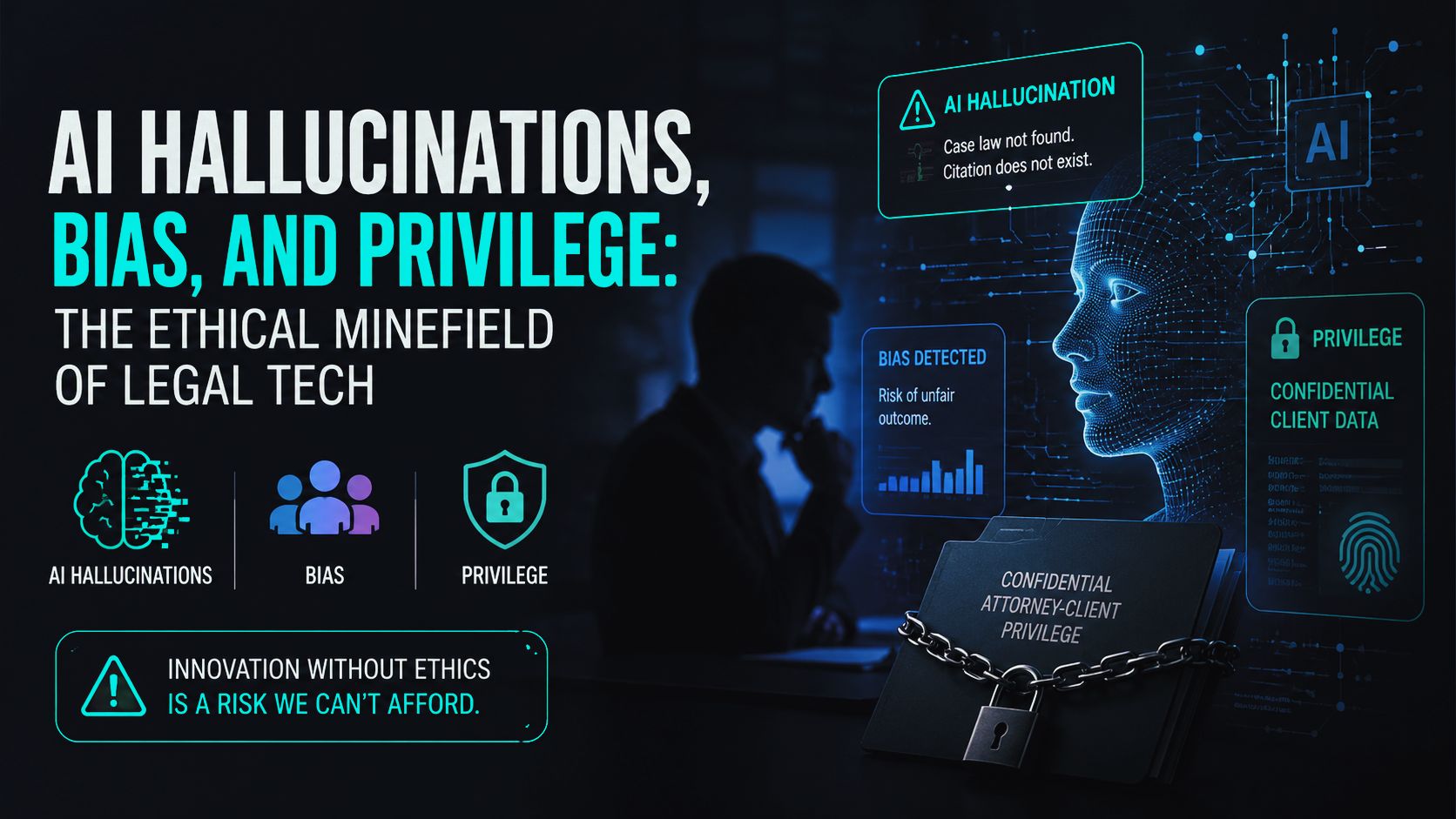
AI Hallucinations, Bias, and Privilege: The Ethical Minefield of Legal Tech
Introduction: Why Ethical AI Matters in Legal Technology
Artificial intelligence is quickly becoming part of everyday legal work.
From reviewing contracts and conducting legal research to monitoring compliance obligations and analysing large volumes of documents, AI-powered tools are helping legal teams work faster and more efficiently than ever before. The appeal is clear. Legal departments are under constant pressure to handle increasing workloads, support business objectives, and keep pace with evolving regulations. AI offers a way to reduce repetitive work, improve access to information, and help legal professionals focus on higher-value tasks.
However, alongside these benefits comes an important question: how much trust should legal teams place in AI?
As AI becomes more deeply embedded in legal workflows, concerns about accuracy, fairness, transparency, and confidentiality are becoming harder to ignore.
Legal professionals are increasingly asking:
- Can AI-generated legal information always be trusted?
- What happens when an AI tool provides incorrect information?
- Could AI unintentionally introduce bias into legal decision-making?
- How can confidential and privileged information be protected?
These concerns are not simply theoretical. They reflect genuine challenges that legal teams are beginning to encounter as AI adoption grows.
While AI-powered legal software can deliver significant efficiency gains, responsible adoption requires more than implementing new technology. It requires understanding the risks, establishing safeguards, and ensuring that human judgement remains central to legal decision-making.
The Growing Dependence on AI in Legal Workflows
The legal profession has traditionally been cautious when adopting new technologies. However, recent advances in artificial intelligence have accelerated digital transformation across law firms, corporate legal departments, and compliance teams.
Today, AI is being used to support a wide range of legal activities, including:
- Contract review and analysis
- Legal research
- Due diligence
- Litigation preparation
- Regulatory monitoring
- Knowledge management
- Document classification
Many of these tasks involve reviewing large amounts of information, making them well suited to automation and machine-assisted analysis.
For example, an in-house legal team managing hundreds of contracts may use AI to quickly identify key clauses, renewal dates, or potential risks. A law firm handling a complex dispute may use AI-assisted tools to organise evidence and surface relevant documents more efficiently. These capabilities can save significant amounts of time.
This growing reliance on AI reflects a wider trend across the legal sector. Recent developments in AI adoption across the legal profession show that legal teams are increasingly using technology to automate routine tasks and improve operational efficiency.
However, they also create a new responsibility. The more legal professionals rely on AI-generated outputs, the more important it becomes to ensure those outputs are accurate, reliable, and properly reviewed.
What Are AI Hallucinations, Bias, and Privilege Risks?
Before organisations can effectively manage AI-related risks, it is important to understand what those risks look like in practice.
AI Hallucinations Explained
One of the most widely discussed concerns surrounding generative AI is the phenomenon known as an AI hallucination.
An AI hallucination occurs when a system generates information that appears convincing but is actually incorrect, misleading, or entirely fabricated.
In a legal context, hallucinations may include:
- Non-existent case citations
- Incorrect interpretations of legislation
- Fabricated legal precedents
- Inaccurate document summaries
The challenge is that these errors often look credible.
AI systems are designed to generate plausible responses, which means inaccurate information can sometimes appear professional and authoritative. Without careful review, it can be difficult to distinguish between genuine legal information and AI-generated inaccuracies.
For legal professionals, the consequences can be significant. An incorrect citation or flawed legal analysis can affect advice, litigation strategies, compliance decisions, and ultimately client outcomes.
Understanding Algorithmic Bias
Bias is another important concern. AI systems learn from data. If the data used to train a model contains historical biases, those patterns may influence future outputs.
In legal environments, bias can potentially affect:
- Contract risk assessments
- Litigation analytics
- Compliance recommendations
- Decision-support systems
For example, an AI model trained on historical legal decisions may unintentionally replicate patterns that reflect outdated assumptions or systemic biases. This does not mean AI is inherently unfair. However, it does highlight the importance of understanding how AI systems are trained, monitored, and validated. Without appropriate oversight, organisations may find themselves relying on recommendations that are neither objective nor consistent.
Privilege and Confidentiality Risks
Confidentiality sits at the heart of legal practice. Law firms and corporate legal departments routinely manage sensitive information, including client communications, commercial agreements, litigation strategies, internal investigations, and regulatory matters.
When AI enters the workflow, new questions arise.
- Where is the data stored?
- Who can access it?
- Is information shared with third-party providers?
- How are cross-border data transfers managed?
- What happens to uploaded documents after processing?
Without appropriate controls, organisations may expose privileged or confidential information to unnecessary risk. As AI adoption increases, data governance and information security are becoming critical components of legal technology strategies.
Understanding the Ethical Minefield of Legal Tech
Legal professionals operate within a framework of ethical obligations and professional responsibilities. Unlike many business functions, legal decisions can directly affect rights, obligations, liabilities, and regulatory outcomes.
As a result, even relatively small AI-generated errors can have serious consequences. A missed clause during contract review could expose a business to unnecessary risk. An inaccurate compliance recommendation could result in regulatory issues. A fabricated legal authority could undermine a legal argument before a court or tribunal.
The issue is not that AI makes mistakes while humans do not.
Human professionals make mistakes too. The difference is that AI systems can produce errors at scale. If a flaw goes unnoticed, it may influence hundreds of documents, matters, or decisions before anyone identifies the problem. This is what makes the ethical challenges surrounding legal AI so important. Legal teams must balance the efficiency benefits of AI with the responsibility to maintain accuracy, fairness, and professional judgement.
How Ethical AI Risks Impact Legal Professionals
Contract Review and Drafting
AI tools are increasingly used to review contracts, identify key clauses, and flag potential risks. While these capabilities can significantly improve efficiency, legal professionals still need to review the results carefully.
An AI system may:
- Misinterpret contractual language
- Miss context-specific provisions
- Overlook unusual clauses
- Incorrectly assess risk levels
Without human oversight, these errors could affect negotiations, obligations, or commercial outcomes.
Legal Research and Knowledge Management
Legal research is another area where AI is becoming increasingly common. Modern AI tools can summarise large volumes of information and help identify relevant legal materials within seconds. However, speed should never replace verification. Legal professionals must continue to validate citations, review source materials, and confirm conclusions before relying on AI-generated research. While AI can dramatically improve efficiency, understanding both its strengths and limitations is essential when using AI in legal research.
Litigation and Case Preparation
AI can help legal teams organise evidence, review documents, and identify relevant information during litigation. However, litigation often requires nuanced legal reasoning, strategic judgement, and contextual understanding. AI can support these activities, but it cannot replace the experience and judgement required to develop legal arguments or assess litigation risks.
Compliance and Regulatory Monitoring
Many organisations now use technology to monitor changing regulations and compliance obligations. AI can help identify developments and highlight potential areas of concern. However, regulatory compliance often requires interpretation and business context that AI alone cannot provide. Technology should assist compliance efforts—not make final decisions on behalf of legal professionals.
Why Legal Teams Are Increasingly Concerned About AI Governance
As AI adoption grows, governance is becoming a major focus for legal teams. The conversation is no longer simply about what AI can do. It is increasingly about how AI should be used responsibly. Clients, regulators, and business leaders want assurance that AI systems operate in a secure, transparent, and accountable manner. This is particularly important in legal environments where decisions may influence compliance, litigation, contracts, or regulatory outcomes.
Effective AI governance typically focuses on several key principles:
- Transparency in AI-generated outputs
- Accountability for AI-assisted decisions
- Security controls for sensitive information
- Auditability of workflows
- Human oversight of legal judgement
Strong governance helps organisations benefit from innovation while maintaining professional and ethical standards. As the use of AI in legal operations continues to expand, governance frameworks are becoming increasingly important for managing risk and maintaining accountability.
The Limitations of Uncontrolled AI Adoption in Legal Departments
The popularity of generative AI has encouraged many organisations to experiment with new tools. While innovation is valuable, uncontrolled adoption can create significant risks.
In some organisations, employees may begin using publicly available AI platforms to assist with drafting, research, or document review without formal approval. This practice is often referred to as "shadow AI".
Shadow AI can introduce challenges such as:
- Uploading confidential documents into unauthorised systems
- Relying on unverified AI-generated information
- Limited visibility into data handling practices
- Inconsistent quality control
- Lack of audit trails
What starts as an attempt to improve efficiency can quickly create confidentiality, compliance, and governance concerns. Technology is most effective when it supports legal professionals rather than replacing their judgement.
Building Ethical and Responsible Legal AI Frameworks
Choosing the right software is only one part of responsible AI adoption. Legal teams also need governance structures that help ensure AI is used appropriately and consistently.
Organisations should consider frameworks that address:
Human Review Requirements
AI-generated outputs should be reviewed by qualified legal professionals before influencing important decisions.
Data Governance Policies
Legal teams should establish clear policies covering:
- What information can be processed using AI
- Data retention requirements
- Access permissions
- Security standards
Validation Procedures
AI-generated outputs should be verified against trusted legal sources and organisational policies.
Audit and Monitoring Controls
Maintaining records of AI-assisted activities can improve transparency and support accountability. When implemented effectively, these measures help reduce risk while allowing organisations to benefit from technological innovation.
How Purpose-Built Legal Technology Reduces Ethical Risks
Not all AI tools are designed for legal environments. General-purpose AI platforms may offer broad functionality, but they often lack the controls and safeguards required for legal work. Purpose-built legal technology platforms are designed with governance, security, and accountability in mind.
Key Safeguards Legal Software Should Provide
When evaluating legal technology, organisations should look for capabilities such as:
- Role-based access controls
- Matter-centric permissions
- Audit trails
- Document version control
- Approval workflows
- Centralised knowledge management
- Secure document repositories
These safeguards help ensure that legal information remains organised, traceable, and protected.
Practical Example: Detecting an AI Hallucination Before Client Advice Is Issued
Imagine a corporate legal department reviewing a complex commercial dispute. An AI research tool identifies what appears to be a relevant legal precedent and generates a summary for the legal team. Before the information is included in client advice, the assigned lawyer reviews the source and discovers that the cited case does not actually exist.
The AI-generated authority was a hallucination.
Because the organisation has implemented review procedures and approval workflows, the error is identified before any advice is delivered. This example highlights why human oversight remains essential, regardless of how sophisticated AI technology becomes.
Practical Example : Managing Bias Risks During Contract Risk Assessment
Consider an organisation using AI to assess risk across a portfolio of supplier agreements. The system consistently categorises contracts from certain industries as higher risk based on historical data patterns.
A legal operations team notices the trend and investigates further. After reviewing the results, they determine that the model is relying on assumptions that no longer align with the organisation's current risk framework. Because the assessments are subject to human review, the issue is identified and corrected before it influences procurement decisions. This illustrates how governance and oversight can help prevent biased recommendations from affecting business outcomes.
Benefits of Responsible AI Governance in Legal Operations
When organisations combine AI capabilities with strong governance practices, they can achieve meaningful benefits while reducing risk.
Improved Accuracy
Human review processes help identify errors and improve decision quality.
Enhanced Compliance
Clear governance policies support regulatory compliance and risk management efforts.
Increased Transparency
Audit trails and workflow controls provide greater visibility into legal processes.
Better Risk Management
Potential issues can be identified and addressed before they develop into larger problems.
Greater Trust
Clients, executives, and stakeholders are more likely to trust legal technology when appropriate safeguards are in place. Responsible governance enables organisations to embrace innovation without compromising professional standards.
Best Practices for Using AI Responsibly in Legal Teams
Organisations seeking to use AI responsibly should consider several practical measures.
Human Oversight and Validation
Legal professionals should remain responsible for reviewing and approving AI-assisted outputs.
Data Privacy and Security Controls
Sensitive information should only be processed within secure environments that provide appropriate access controls.
Transparency and Auditability
Organisations should maintain clear records of AI-assisted activities and decisions.
Continuous Monitoring and Training
AI systems should be regularly evaluated to ensure they remain accurate, fair, and aligned with organisational requirements.
Clear AI Usage Policies
Employees should understand when AI can be used, how it should be used, and what review processes must be followed.
The Future of Ethical AI in the Legal Profession
AI will continue to play an increasingly important role in legal operations. Many industry experts believe that the future of AI-powered legal workflows will involve greater automation of routine work, allowing legal professionals to focus more on strategy, risk management, and advisory services.
However, the future of legal AI is unlikely to be defined solely by automation. Instead, it will be shaped by trust, governance, accountability, and responsible implementation. As AI becomes more deeply embedded in legal workflows, organisations will need to ensure that efficiency gains are balanced with transparency, oversight, and professional judgement.
Legal teams are increasingly recognising the importance of:
- Explainable AI
- Human-in-the-loop decision-making
- AI governance frameworks
- Responsible data management
- Regulatory compliance
The most successful organisations will not simply adopt AI faster than others. They will adopt it more responsibly. The goal is not to replace legal professionals. The goal is to equip them with tools that support better, faster, and more informed decision-making.
How Beveron's Smart Legal Platforms Support Responsible AI Adoption
As legal teams modernise their operations, governance and accountability remain essential. Beveron's legal technology helps organisations build structured, secure, and transparent workflows that support responsible innovation.
Smart Legal Counsel
Designed for corporate legal departments, Smart Legal Counsel centralises matter and document management, legal workflows, and reporting, providing greater visibility and control across legal operations.
Smart Lawyer Office
Smart Lawyer Office helps law firms manage cases, documents, deadlines, billing, and client information through a centralised platform that promotes consistency, accountability, and operational efficiency.
Smart Contract Management
Smart Contract Management streamlines contract lifecycle processes while maintaining visibility into approvals, obligations, risks, and compliance requirements.
By combining workflow automation, document governance, and centralised legal operations, Beveron's solutions help legal teams maintain control over information while supporting responsible technology adoption.
Frequently Asked Questions
What is an AI hallucination in legal technology?
An AI hallucination occurs when an AI system generates information that appears credible but is inaccurate, misleading, or entirely fabricated. In legal settings, this may include non-existent case citations or incorrect legal interpretations.
Can AI introduce bias into legal decision-making?
Yes. AI systems learn from historical data, and biases present within that data may influence recommendations, classifications, or risk assessments if appropriate safeguards are not in place.
How can legal teams reduce AI-related risks?
Legal teams can reduce risks through human oversight, governance policies, validation procedures, audit controls, and secure legal technology platforms.
Why is human oversight important when using legal AI?
Human review helps identify inaccuracies, contextual issues, ethical concerns, and other factors that AI systems may not recognise independently.
What should organisations look for in ethical legal technology platforms?
Important considerations include security controls, auditability, workflow governance, transparency, role-based permissions, and support for human review processes.
Conclusion
Artificial intelligence is reshaping the legal profession and creating new opportunities to improve efficiency, productivity, and knowledge management. At the same time, AI hallucinations, algorithmic bias, and confidentiality risks highlight the need for caution.
Legal teams cannot afford to treat AI as a replacement for professional judgement. Instead, AI should be viewed as a powerful tool that supports legal expertise while operating within clear governance and oversight frameworks.
As legal operations continue to evolve, ethical AI will become a business requirement rather than a competitive advantage. Organisations that establish strong governance foundations today will be better positioned to embrace innovation, manage risk, and build trust in the years ahead.
Ready to Modernise Your Legal Operations?
AI can help legal teams work faster and manage increasing workloads, but long-term success depends on more than technology alone. Effective legal operations require clear governance, structured workflows, and secure systems that support accountability and oversight.
Beveron's Smart Legal Counsel, Smart Lawyer Office, and Smart Contract Management solutions help organisations centralise legal operations, improve visibility across matters and contracts, and maintain greater control over critical legal information.
Whether you're looking to strengthen legal governance, streamline workflows, or modernise legal operations, Beveron's solutions are designed to help legal teams work more efficiently while maintaining compliance, transparency, and confidence.
Book a personalised demonstration today to discover how Beveron can support your legal operations strategy.
Best AI for in-house legal teams in the UAE
Best AI compliance and legal operations in the UAE
Best legal automation software for legal teams in the UAE
If you need a free demo of the best AI for in-house legal teams in the UAE, please fill out the form below.