How AI Is Transforming Legal Drafting for Lawyers
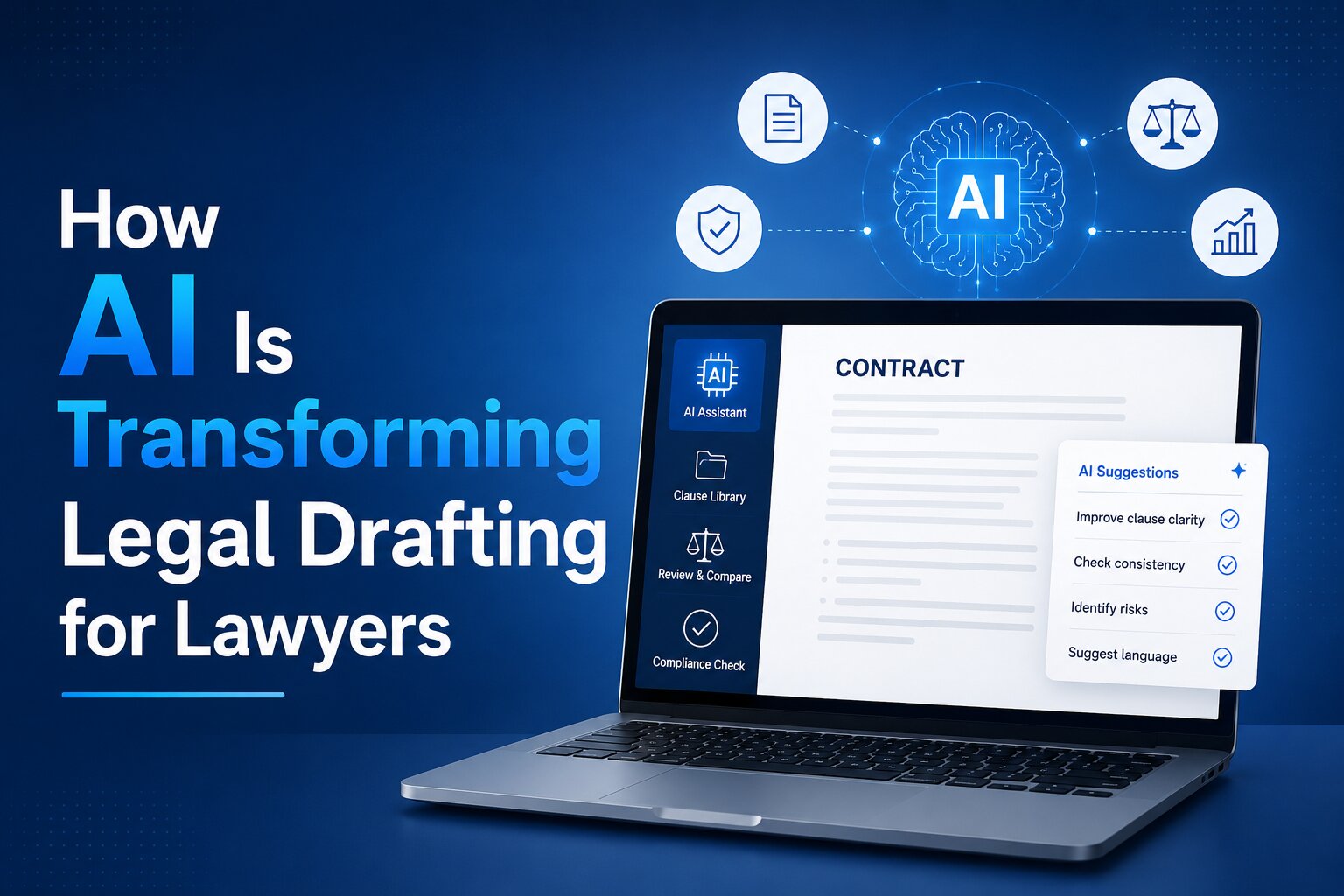
Legal drafting has always demanded more than putting words on a page.
A lawyer needs to understand what the client is trying to achieve, choose appropriate clauses, assess commercial and legal risks, consider the governing law and make sure the final document reflects the specific circumstances of the matter. The difficulty is that a significant part of the drafting process can also be repetitive.
A lawyer may spend hours searching for a previous agreement, adapting a standard template, checking definitions, comparing versions, reviewing redlines and preparing similar documents for different clients or business teams. When this happens across dozens or hundreds of contracts, routine drafting work can consume time that could otherwise be spent on negotiation, strategic advice and complex legal analysis.
This is where artificial intelligence (AI) is beginning to change legal work.
AI-powered legal drafting tools can help lawyers create first drafts, identify differences between documents, review clauses, flag potential inconsistencies and organise document workflows. But for UAE legal professionals, adopting AI is not simply a question of finding the latest technology.
The more important question is how AI can be introduced into the legal drafting process without compromising professional judgement, confidentiality, data protection or jurisdiction-specific requirements.
The most practical approach is not to ask AI to "do the legal work". It is to identify the parts of the drafting workflow that are repetitive and time-consuming, then use technology to support those tasks while keeping qualified lawyers responsible for interpretation, negotiation and final approval.
The Shift From Manual to AI-Assisted Legal Drafting
Why traditional drafting workflows are under pressure
Traditional legal drafting workflows can become inefficient when legal teams manage a high volume of similar documents. Consider a routine vendor agreement.
A lawyer may need to:
- Find an appropriate previous agreement or template.
- Check whether it is the latest approved version.
- Update the parties and commercial terms.
- Adapt the relevant clauses.
- Review definitions and cross-references.
- Compare the document against internal standards.
- Send it to stakeholders for review.
- Manage multiple rounds of amendments.
- Confirm that the final version reflects all agreed changes.
- Store the executed document correctly.
None of these tasks is necessarily complicated. The problem is the cumulative amount of time they require when repeated across a busy legal department. Version control can create another challenge. A contract may move between the legal team, procurement, finance, management and an external counterparty. Multiple versions can quickly appear, making it difficult to determine which document contains the latest changes or whether an important amendment has been missed.
AI does not eliminate these responsibilities. Instead, it can help reduce the manual effort involved in managing them.
What does AI-assisted legal drafting actually mean?
AI-assisted legal drafting refers to using AI technology to support specific stages of drafting and review while keeping legal professionals responsible for decisions and final sign-off. That distinction is important.
A general-purpose AI chatbot can generate text based on a prompt. A legal technology platform, on the other hand, can be designed around structured legal workflows, approved templates, clause libraries, document repositories, review processes and matter management.
For UAE legal teams, the local context also matters.
Contracts may need to be prepared or reviewed in Arabic and English. Businesses may operate across multiple jurisdictions. A transaction involving a UAE mainland entity may raise different considerations from one involving an entity operating within the Dubai International Financial Centre (DIFC) or Abu Dhabi Global Market (ADGM).
The practical goal of AI-assisted drafting is therefore not to replace legal expertise. It is to make the processes surrounding that expertise faster, more consistent and easier to manage.
How AI Can Support the Legal Drafting Workflow
AI is most useful when it is applied to specific steps in the drafting process rather than treated as a replacement for the lawyer. Here are some of the areas where AI can provide practical support. Lawyers exploring the wider role of AI in legal work can also learn more about AI tools for drafting and legal research, including the types of software capabilities that can improve efficiency and support day-to-day legal work.
1. Finding the right template and starting point
The first challenge in many drafting assignments is simply finding the right starting document. Legal teams may have years of contracts stored across shared drives, document management systems and email threads. Finding the most relevant precedent can take considerable time. An AI-enabled legal platform can help teams work with structured document repositories and approved templates, making it easier to identify relevant starting points.
For example, a lawyer preparing a new supplier agreement may be able to begin with an approved vendor contract rather than searching manually through dozens of previous documents. This can reduce the time spent searching and help improve consistency across routine agreements.
The lawyer still decides whether the selected template is appropriate. AI simply helps reduce the administrative work involved in getting started.
2. Generating a first draft
One of the most visible applications of AI in legal drafting is first-draft generation.
For routine documents such as:
- Non-disclosure agreements (NDAs)
- Vendor agreements
- Employment documents
- Standard commercial contracts
- Service agreements
- Internal legal documents
AI can help generate an initial version based on approved templates, predefined instructions and relevant information about the matter. The important point is that the output should be treated as a first draft, not a final legal document. A lawyer still needs to review the document, confirm that the commercial terms are accurate, check the applicable law and determine whether the language adequately protects the client's or organisation's interests.
The benefit is that the lawyer does not necessarily have to start from a blank page.
3. Assisting with clause selection
Not every contract requires the same combination of clauses. The appropriate provisions may depend on the transaction, industry, parties, risk profile and governing law. AI can help legal teams identify relevant clauses from approved clause libraries or suggest provisions based on predefined drafting requirements.
For example, a legal team may have different approved clauses for:
- Confidentiality
- Limitation of liability
- Indemnification
- Intellectual property
- Data protection
- Termination
- Dispute resolution
- Governing law
AI can help surface potentially relevant provisions, while the lawyer decides which clause is appropriate for the specific matter. This can make drafting more efficient without removing the need for legal judgment.
4. Reviewing contracts and flagging potential risks
AI can also assist during contract review.
Depending on the system, it may identify:
- Missing information
- Unusual or inconsistent language
- Clauses that differ from approved wording
- Missing provisions
- Inconsistent definitions
- Potentially unusual liability terms
- Changes to key commercial provisions
For example, an AI system might flag a limitation-of-liability clause that differs substantially from the organisation's standard position. This does not automatically mean that the clause is unacceptable. The counterparty may have negotiated the change deliberately. The transaction may justify a different risk position. The business may have approved the exception.
AI can identify something for review. The lawyer decides what it means and what action to take. That distinction is central to responsible AI adoption in legal practice.
5. Comparing versions and managing redlines
Contract negotiations rarely happen in a single round. A document may go through several iterations before the parties reach agreement. Lawyers often need to compare versions, understand what changed and determine whether the latest document reflects the negotiated position. AI-powered legal workflows can help make this process more manageable by supporting document comparison and change identification.
This can be particularly useful for in-house legal teams dealing with multiple business stakeholders. Instead of spending excessive time manually searching for every change, lawyers can focus their attention on the provisions that have actually changed and assess whether those changes create legal or commercial consequences.
6. Checking consistency across documents
Large legal departments may manage thousands of contracts. Over time, inconsistent terminology and drafting positions can become difficult to avoid.
AI can help identify differences in:
- Definitions
- Party names
- Dates
- Key commercial terms
- Contractual obligations
- Clause language
- Referenced documents
For example, a system may identify that the same defined term has been used differently in two sections of a contract. These checks can be particularly valuable during high-volume drafting and review.
However, AI should be viewed as an additional review layer rather than a substitute for legal quality control.
A Practical AI-Assisted Legal Drafting Workflow
For UAE legal teams considering AI, it can be helpful to think about the technology as part of a workflow rather than as a standalone drafting tool.
A practical process might look like this:
Step 1: Identify the legal requirement
The lawyer first defines what the document needs to achieve. This includes understanding the parties, commercial objectives, transaction structure, applicable law and key risks. Human judgement remains essential at this stage.
Step 2: Select an approved template
The legal team chooses the appropriate template or precedent. AI can help locate relevant documents within an organised repository, but the lawyer should confirm that the template is suitable.
Step 3: Generate or adapt the first draft
AI can assist with populating standard information and adapting approved language to the specific matter. The output becomes a working draft for professional review.
Step 4: Review clauses and identify exceptions
The system can help compare the draft against approved clauses, internal policies or predefined drafting standards. Potential deviations can be highlighted for the lawyer's attention.
Step 5: Conduct legal and commercial review
The lawyer assesses whether the draft actually works for the transaction. This is where context matters most. A clause that appears unusual to an AI system may be entirely appropriate for a particular commercial arrangement.
Step 6: Manage negotiation and redlines
As the document moves between parties, technology can help track versions and identify changes. The lawyer remains responsible for understanding the implications of negotiated amendments.
Step 7: Obtain internal approvals
Depending on the organisation, certain contracts may require approval from management, finance, procurement, compliance or other teams. A connected legal workflow can help make these approvals easier to track.
Step 8: Finalise, execute and store
Once the document is approved and executed, the final version should be stored in the appropriate system with relevant metadata and document history. This creates a more complete record of the contract lifecycle.
The value of AI, therefore, is not limited to generating words. Its greater potential lies in helping legal teams connect drafting, review, collaboration, approval and document management into a more efficient workflow.
Benefits of AI-Assisted Drafting for UAE Legal Teams
Faster turnaround for routine documents
When legal teams have approved templates and standard drafting positions, AI can reduce the time required to prepare routine documents. This can be particularly valuable for organisations handling a high volume of contracts with relatively small legal teams.
Greater consistency
Using approved templates and clause libraries can help legal teams maintain greater consistency across documents. AI-supported review can also help identify deviations that might otherwise be overlooked.
Reduced administrative workload
Lawyers often spend considerable time on tasks surrounding legal drafting rather than on legal analysis itself. Searching for documents, comparing versions and checking repetitive information are all examples of work that technology can help streamline.
More time for higher-value legal work
The most important benefit may be the time that AI gives back to lawyers.
When routine work becomes more efficient, legal professionals can dedicate more attention to:
- Complex negotiations
- Strategic legal advice
- Risk assessment
- Business partnering
- Dispute management
- Regulatory issues
- Client relationships
AI is therefore most valuable when it helps lawyers spend more time on work that requires human expertise.
Where Human Oversight Still Matters
AI can make legal drafting more efficient, but there are important limits to what technology should be expected to do.
Legal and commercial judgment
A contract is more than a collection of clauses. Two organisations may use the same type of agreement but have very different commercial priorities. One business may be comfortable accepting a particular liability exposure. Another may consider the same risk unacceptable. AI can suggest language or identify deviations. It cannot independently determine the right commercial position for every client or business.
That decision belongs to the lawyer and the organisation.
Jurisdiction-specific considerations
The UAE legal environment is not completely uniform. Depending on the parties and transaction, legal teams may need to consider UAE federal laws, local regulations or the legal frameworks applicable in specialised jurisdictions such as DIFC and ADGM. This makes jurisdictional awareness particularly important when using AI for legal drafting.
A system that produces a plausible-looking clause does not necessarily mean that the clause is appropriate for the governing law or specific circumstances. AI-generated content should therefore be reviewed by professionals with the relevant legal expertise.
Data confidentiality and privacy
Legal documents often contain highly sensitive information.
Before introducing an AI system into a legal drafting workflow, organisations should understand:
- Where data is processed
- Where information is stored
- Who can access it
- How access is controlled
- Whether data is retained
- How information is protected
- Whether data may be used for model training
- How the vendor handles data deletion
- What security and privacy documentation is available
For UAE legal teams, these questions are not optional. The use of AI in legal practice is also a data governance issue. A tool may be highly capable from a drafting perspective but unsuitable for an organisation if its data handling practices do not meet the team's requirements.
How Legal Teams Can Adopt AI Without Losing Control
The most effective AI adoption strategy is usually gradual. Instead of introducing AI across every legal process at once, legal teams can start with clearly defined, lower-risk use cases.
For example, a team might begin with:
- Searching approved templates.
- Summarising long documents.
- Comparing contract versions.
- Identifying drafting inconsistencies.
- Assisting with routine first drafts.
- Checking documents against internal drafting standards.
The team can then measure whether the technology actually improves turnaround time, consistency and workload. It is also important to establish clear internal rules.
A legal department may need policies covering:
- Which AI tools employees can use
- What information can be entered into AI systems
- Which documents require human review
- Who is responsible for final approval
- How AI-generated content should be verified
- How sensitive information should be handled
This turns AI adoption from an informal experiment into a controlled legal workflow.
What to Look for in an AI Legal Drafting Platform in the UAE
Not every AI-powered legal technology platform will be suitable for every organisation. Before adopting a solution, UAE legal teams should look beyond the word "AI" and assess how the technology works in practice.
1. Data protection and security controls
Ask how the platform handles sensitive legal information. Consider data processing, storage, access controls, encryption, retention practices and vendor security policies. Legal teams should also understand how the platform aligns with their organisation's privacy and compliance requirements.
2. Integration with existing legal workflows
AI should simplify the legal team's work rather than create another disconnected system.
Consider whether the platform can support or integrate with existing processes for:
- Legal matter management
- Contract management
- Document management
- Approvals
- Collaboration
- Reporting
The easier it is to move from a first draft through review, approval, execution and storage, the greater the practical value of the technology.
3. Support for relevant languages and jurisdictions
For organisations operating in the UAE and wider GCC, language and jurisdictional requirements should be considered carefully. If a team works with Arabic and English documents, it should assess the quality of bilingual workflows rather than assuming that every AI platform handles both languages equally well.
Teams should also consider whether the solution can accommodate the jurisdictions relevant to their work.
4. Human-in-the-loop controls
The platform should make it easy for lawyers to review, edit, approve and override AI-generated suggestions. Legal professionals should remain in control of important decisions.
A useful AI system should support professional judgement, not make it harder to exercise.
5. Auditability and document history
Legal teams need to understand how documents change over time. Look for features that support version history, document tracking and clear records of changes and approvals. These capabilities become increasingly important when contracts involve multiple reviewers and stakeholders.
How Beveron Technologies Supports AI-Assisted Legal Workflows
AI becomes most useful in legal environments when it is connected to the wider workflow. Drafting is only one part of legal work. Depending on the organisation, legal teams may also need to manage cases, matters, documents, reviews, approvals and ongoing legal activities.
This is where Beveron Technologies approaches legal technology with a focus on supporting the broader needs of legal professionals and organisations.
Beveron develops legal technology solutions that help streamline different areas of legal work, including legal case management, matter management, document workflows and other legal operations. Through its legal technology solutions for the legal sector, the company supports organisations looking to bring greater structure and efficiency to their legal workflows.
For UAE and GCC organisations, adopting AI in this way can help reduce repetitive administrative work while keeping lawyers and legal professionals involved in review, interpretation, negotiation and final decision-making.
The goal is straightforward: use technology to make legal work more organised and efficient while keeping professional legal expertise at the centre of the process.
The Future of AI in Legal Drafting in the UAE
AI is unlikely to eliminate the need for lawyers. Instead, it is changing where lawyers spend their time.
Routine drafting, document comparison, clause checking and administrative tasks are increasingly suitable for technology-assisted workflows. At the same time, negotiation, interpretation, strategic advice, professional responsibility and complex risk assessment remain areas where human expertise is essential.
For UAE law firms and in-house legal teams, the opportunity is not to hand legal drafting over to AI. It is to use AI selectively and responsibly where it can remove unnecessary manual work. The legal teams that approach AI adoption this way can gain more than faster document generation. They can build more organised, consistent and scalable legal operations.
The strongest model for AI-assisted legal drafting is therefore not AI instead of lawyers.
It is AI supporting lawyers.
When combined with sound legal judgement, appropriate data governance and well-designed workflows, AI can help legal professionals spend less time on repetitive drafting tasks and more time on the work where their expertise creates the greatest value.
Bring AI-Assisted Legal Drafting Into Your Legal Workflow
AI can help legal teams reduce repetitive work, improve drafting efficiency and streamline document review. The key is to use it alongside professional legal judgement rather than as a replacement for it.
Explore how Beveron Technologies supports modern legal workflows with AI-powered technology. [Learn More].
Frequently Asked Questions
Is AI-generated legal drafting reliable for UAE contracts?
AI can help prepare first drafts and identify potential issues, but its output should always be reviewed by a qualified legal professional before a contract is finalised or executed.
Can AI drafting tools handle bilingual Arabic-English contracts?
Some AI legal platforms support Arabic and English workflows, but quality varies. Legal teams should check terminology, meaning and formatting in both languages, with human review for important documents.
Will AI replace lawyers in the UAE?
No. AI can assist with repetitive drafting, document review and administrative tasks, while lawyers remain responsible for legal interpretation, negotiation, risk assessment and final decisions.
Can lawyers use ChatGPT for legal drafting?
General-purpose AI tools can assist with drafting and research-related tasks, but lawyers should consider confidentiality, data protection, accuracy and professional obligations before using them for sensitive legal work.
How is an AI legal drafting platform different from a general AI tool?
A general AI tool handles a wide range of tasks, while legal AI platforms can support structured workflows such as drafting, document management, review, version control and internal approvals.
What is the biggest benefit of AI-assisted legal drafting?
AI can reduce repetitive work across the drafting process, from preparing first drafts and comparing clauses to reviewing documents and managing versions. This gives lawyers more time for legal judgement and strategic work.
Best AI legal drafting software for legal teams in the UAE
Best AI for legal professionals in the UAE
Best AI legal technology for law firms in the UAE
If you need a free demo of the best AI legal drafting software for legal teams in the UAE, please fill out the form below.