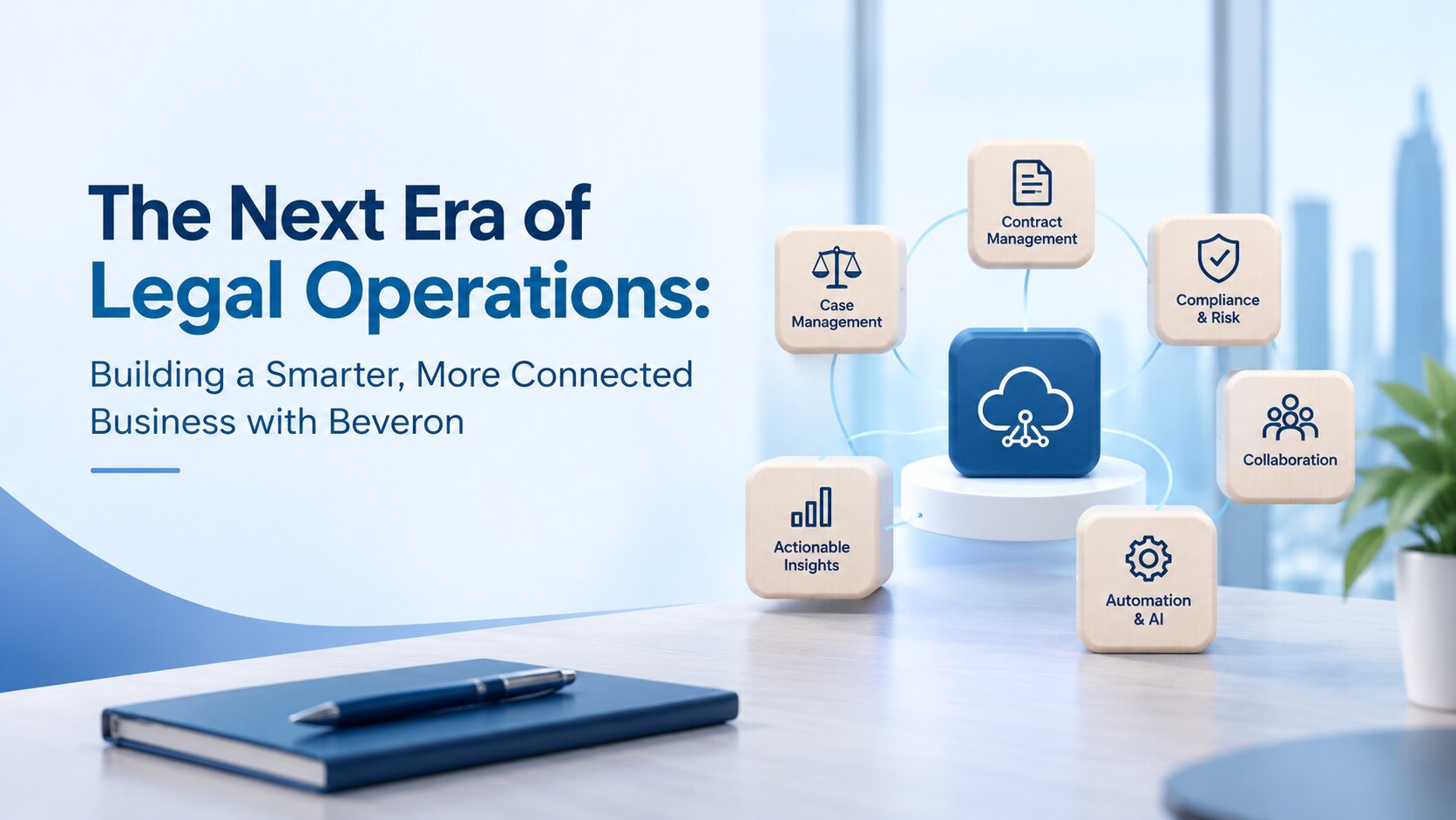
The Next Era of Legal Operations: Building a Smarter, More Connected Business with Beveron
Legal teams play an increasingly important role in helping businesses manage risk, control costs, and make informed decisions. Their responsibilities extend beyond reviewing documents and handling disputes to supporting contracts, internal requests, compliance activities, and relationships with external advisers.
As organisations grow, managing these responsibilities becomes more demanding. Information may be spread across emails, spreadsheets, and separate applications, making it difficult to track progress or identify outstanding tasks. These challenges can affect turnaround times and limit the visibility business leaders need.
The next era of legal operations focuses on making legal work more organised, responsive, and aligned with business priorities. By improving processes and adopting suitable technology, organisations can reduce avoidable administrative work and help legal teams contribute more effectively. Beveron supports this approach through solutions designed for law firms, corporate legal departments, contract management, debt collection, and intellectual property management.
Why Legal Operations Matter to Modern Businesses
Legal operations provide the structure needed to manage legal work efficiently. They bring together the people, processes, and tools involved in handling legal responsibilities, helping organisations maintain control as workloads increase.
For example, a supplier agreement may require input from procurement, legal counsel, finance, and management. Without a clear approval process, the agreement can remain pending while employees wait for information or clarification. Defined responsibilities and agreed procedures help each department understand its role and move the work forward.
The same applies to internal legal requests, disputes, external counsel engagements, and compliance activities. When processes are difficult to follow, legal teams may spend too much time on administrative tasks instead of providing advice and supporting business decisions.
Effective legal operations help address these issues by establishing a consistent way to manage work, monitor responsibilities, and maintain reliable records.
The Foundations of Connected Legal Operations
A well-organised legal function needs three essentials: dependable information, clear responsibilities, and processes that employees can follow.
Reliable information helps legal professionals find the latest documents, review relevant records, and understand the status of ongoing matters. Keeping information organised also reduces the risk of relying on outdated versions or incomplete records. Access should remain restricted according to each employee's responsibilities.
Clear ownership ensures that every request, approval, and outstanding task has someone responsible for moving it forward. Employees should understand what action is required, who must approve it, and when it needs to be completed.
Consistent processes make recurring activities easier to manage. Standard procedures for legal requests, document reviews, and approvals reduce uncertainty while allowing additional steps when a matter requires special attention.
Together, these foundations help legal teams manage their work without introducing unnecessary complexity.
Emerging Developments Reshaping Legal Operations
New technology and changing business expectations are influencing how legal teams organise their work. Three developments are particularly relevant.
AI-Assisted Legal Work
Artificial intelligence (AI) can support tasks such as finding information in documents, summarising lengthy material, and extracting relevant contract details. These capabilities may reduce the time spent on certain repetitive activities and help legal professionals work through large volumes of information.
However, AI-generated results can contain errors or miss important context. Legal professionals must review significant findings, protect confidential information, and retain responsibility for decisions that require professional judgement.
Greater Integration Between Business Systems
Legal teams often depend on information held in finance, procurement, customer management, and document storage systems. When these systems do not work together, employees may need to enter the same details repeatedly or search across several applications.
Suitable integrations can reduce unnecessary manual work and make relevant information easier to access. Businesses should assess which connections are genuinely useful and ensure that information is shared securely.
More Proactive Risk Management
Organisations increasingly need to identify important dates, outstanding obligations, and potential issues before they become urgent. Digital reminders and tracking tools can help teams monitor contract renewals, filing deadlines, pending approvals, and other time-sensitive responsibilities. These tools support timely action but do not replace professional oversight. Their effectiveness depends on accurate records, assigned responsibility, and regular review.
Practical Steps to Modernise Legal Operations
Modernisation works best when organisations address specific problems rather than introducing technology for its own sake.
The first step is to review existing processes. Examine how legal requests are received, assigned, reviewed, and completed. Identify delays, unnecessary approvals, duplicated work, and tasks that depend too heavily on manual reminders. Feedback from employees who perform these activities can help reveal where improvements are needed.
Next, simplify recurring tasks. Establish standard procedures for activities such as legal intake, contract review, and document collection. Remove unnecessary steps while preserving the checks required for legal accuracy, security, and compliance.
Organisations should then select technology based on their actual requirements. Identify the problems a platform needs to solve, the systems it must work with, and the information employees need to access. Involve relevant users in the evaluation process and provide training before introducing new procedures across the organisation.
Finally, review the results. Compare performance before and after implementation to understand whether the changes are reducing delays, improving accuracy, or making workloads easier to manage.
Connecting Legal Work Across Business Functions
Legal teams rely on input from other departments, but each relationship serves a different business purpose.
Finance works with legal teams on budgets, external legal costs, expense approvals, and payments. Accurate records help organisations understand spending and plan resources.
Procurement coordinates with legal counsel on supplier agreements, commercial terms, approvals, and contractual obligations. A defined process helps both teams complete reviews and monitor important dates.
Human resources may require legal input on employment agreements, workplace policies, and sensitive employee matters. Clear review procedures help ensure that documents receive the necessary attention while maintaining appropriate confidentiality.
Business management relies on legal teams for information about significant disputes, operational risks, external adviser costs, and unresolved matters. Relevant reporting helps decision-makers understand issues that may affect business plans.
The aim is to establish effective working relationships without giving every department unrestricted access to confidential legal information.
How Beveron Supports Connected Legal Operations
Beveron Technologies provides digital solutions for different legal and business requirements. Each product addresses a specific area of work, allowing organisations to identify the platform that best fits their needs.
Smart Lawyer Office: Law Firm Management
Smart Lawyer Office is designed for law firms and legal consultancies. It supports client enquiries, document collection, matter and case management, hearing schedules, lawyer profiles, timesheets, billing, payment tracking, and client communication. By organising these activities within a structured platform, firms can maintain clearer records of client matters and manage their day-to-day operations more effectively.
Smart Legal Counsel: In-House Legal Management
Smart Legal Counsel supports corporate legal departments managing internal requests, corporate cases, litigation, external law firm relationships, legal expenses, and related activities. It helps in-house teams organise their workload and monitor matters that require attention, supporting better oversight of legal responsibilities across the organisation.
Smart Legal Contract: Contract Management
Smart Legal Contract supports the contract process from initial requests and drafting to collaboration, approvals, electronic signatures, storage, and renewal reminders. For organisations managing numerous agreements, it provides a structured way to maintain contract records and track progress throughout the contract lifecycle.
Smart Debt Collection: Recovery Management
Smart Debt Collection is designed for organisations managing overdue accounts and payment recovery. Its capabilities include account tracking, payment arrangements, collection workflows, communication activities, litigation-related processes, and performance reporting. These features help collection teams organise follow-up activities and monitor recovery performance.
Smart IP: Intellectual Property Management
Smart IP helps organisations manage intellectual property records relating to trademarks, patents, copyrights, industrial designs, and other assets. It supports record management and renewal tracking, helping teams maintain relevant information and monitor important dates. The appropriate solution depends on the organisation's operational requirements, existing processes, and technology environment. Businesses should evaluate each platform against their specific needs rather than assume that every product is necessary.
Choosing Technology That Fits Your Legal Operations
Selecting legal technology requires more than comparing available features. Organisations should consider whether a platform addresses their main challenges and fits their existing working environment. Integration is important when legal teams depend on information held in other business applications. Businesses should establish which connections are available and whether any manual steps will remain.
Security also requires careful evaluation. Legal records may contain confidential agreements, sensitive business information, and personal data. Organisations should understand how access is controlled, how information is protected, and whether the platform supports their internal policies and applicable requirements. Ease of use can influence whether employees adopt a new system successfully. Businesses should consider the everyday tasks users will perform, the training they will need, and the support available during implementation.
Where AI features are offered, organisations should verify their actual capabilities, review processes, and approach to handling confidential information. A clear understanding of these factors helps businesses choose technology that offers practical value rather than unnecessary complexity.
Measuring Progress in Legal Operations
Organisations need relevant measures to determine whether changes are producing the intended results. The most useful indicators depend on the type of legal work being managed. Legal departments may monitor request completion times, outstanding tasks, legal spending, and the time required to obtain approvals. Contract teams may track turnaround times, pending reviews, and missed renewal dates. Law firms may focus on matter progress, billing, and payment collection, while debt collection teams may measure recovery rates and overdue balances.
Establishing a baseline before introducing changes makes it easier to assess progress. Regular reviews can then identify areas that need further improvement. Measures should remain practical and connected to business objectives. Faster processing, for example, is valuable only when the quality of legal review and the necessary safeguards are maintained.
Building a More Connected Future with Beveron
The future of legal operations depends on more than adopting new technology. It requires organisations to establish clear processes, maintain reliable information, and give legal teams the tools they need to manage their responsibilities effectively. Businesses can begin by identifying their most pressing operational challenges, improving the processes involved, and selecting technology that supports their goals. Measuring the results helps ensure that these changes deliver lasting value.
Beveron's solutions address different needs across law firm management, in-house legal operations, contracts, debt collection, and intellectual property. Exploring the relevant platform can help organisations identify practical ways to improve their legal workflows.
Explore Beveron's solutions to find the right fit for your organisation's legal operations.
Best legal operations management software in the UAE
Best legal operations software for legal teams in the UAE
Best Legal technology solutions in the UAE
If you need a free demo of the best legal operations management software in the UAE, please fill out the form.