7 AI Opportunities Small Businesses Can Explore to Improve Workflow Automation and Productivity
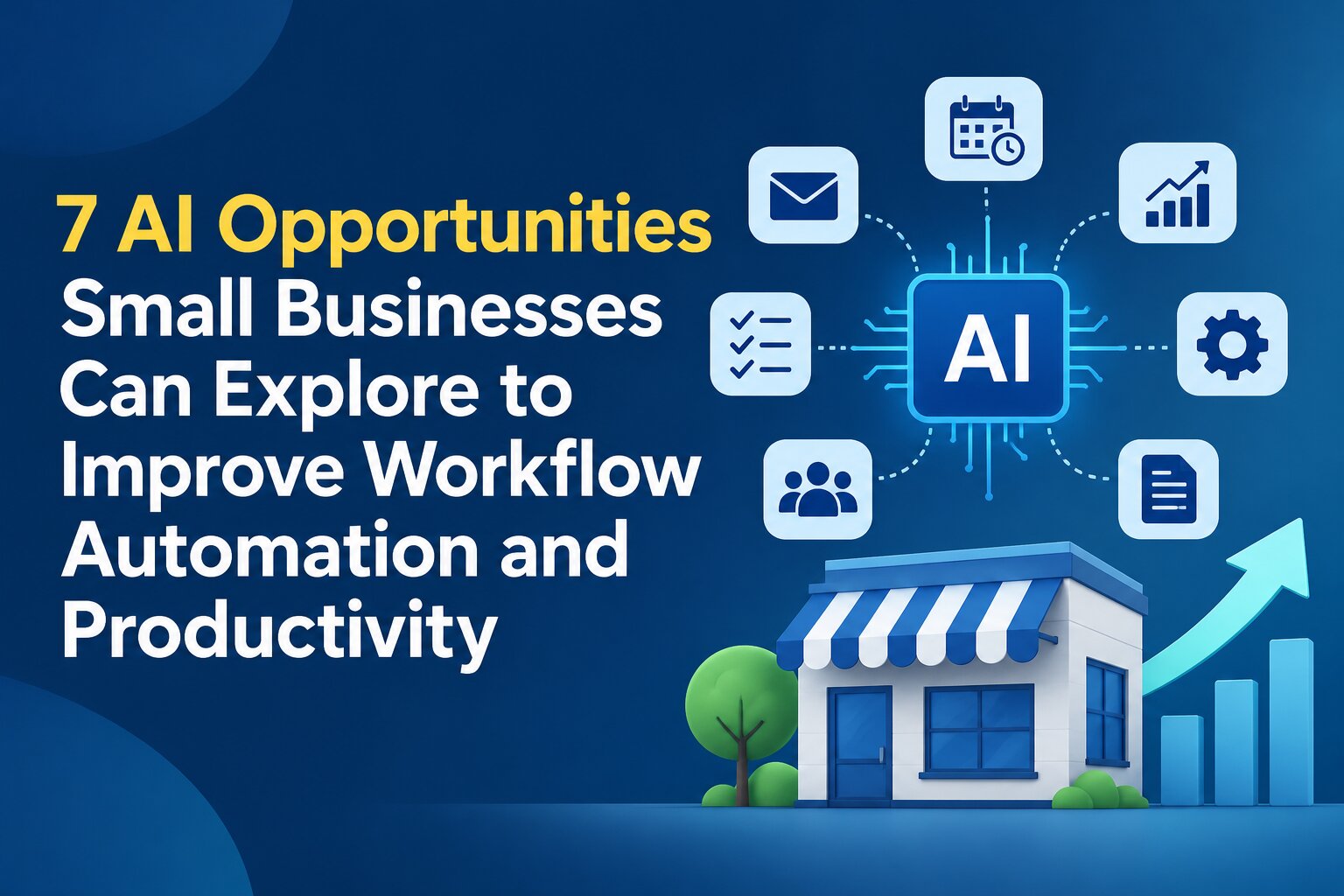
Artificial intelligence (AI) is becoming an increasingly useful part of everyday business operations. What was once considered a technology mainly suited to large organisations is now finding its way into small businesses, helping them manage routine activities, organise information and make better use of their available resources. From handling customer enquiries to reviewing documents and analysing business data, AI offers several ways to reduce the time spent on repetitive work and improve how different tasks are managed.
For small businesses, the need for greater efficiency is particularly important. Teams often work with limited staff, manage several responsibilities at once and rely on manual processes to keep daily operations running. Activities such as updating records, tracking payments, searching for documents and coordinating approvals can take up valuable working hours. When these processes are handled separately or depend heavily on manual effort, delays and mistakes become more likely.
AI, combined with workflow automation, can help address some of these challenges. Businesses can use it to organise information, identify patterns, simplify routine activities and support employees in making informed decisions. However, adopting AI does not mean changing every existing process or replacing human involvement. A more practical approach is to identify areas where technology can make everyday work easier and introduce suitable solutions gradually. Here are seven opportunities small businesses can explore.
1. Automating Repetitive Administrative Tasks
Administrative work is a regular part of running any business, but many of these activities do not require complex decision-making. Entering information into spreadsheets, updating customer records, sorting emails, preparing routine reports and organising incoming documents can consume a significant amount of time. When employees handle these tasks manually throughout the day, they have less time available for customer service, planning and other important responsibilities.
AI and workflow automation can help reduce this workload by handling repetitive activities more efficiently. For example, AI tools can extract relevant information from documents, organise incoming requests, classify emails and assist with preparing routine summaries. Automated workflows can also move information between connected systems, notify the appropriate team members and update records when certain actions are completed. This reduces the need for employees to repeatedly enter the same information or manually track every stage of a process.
Small businesses can begin by identifying tasks that follow a predictable pattern and occur frequently. Invoice processing, appointment confirmations, document classification and routine email responses are possible starting points. Rather than attempting to automate everything at once, businesses can focus on one process, assess the time saved and gradually extend automation to other areas. The objective is not simply to complete more tasks but to create a smoother working environment where employees can concentrate on responsibilities that need their experience and attention.
2. Improving Document Management and Information Retrieval
As a business grows, the volume of information it handles also increases. Contracts, invoices, customer records, employee documents, correspondence and internal reports may be stored across different folders, email accounts and shared drives. Finding a particular document or checking the latest version can become difficult when there is no consistent system for organising information. This is especially challenging when several employees need access to the same records to complete their work.
AI can make document management more efficient by helping businesses extract information, classify files and locate relevant content. Instead of manually opening multiple documents to find a particular detail, employees can use search functions that help identify records based on names, dates, keywords or other relevant information. Some AI-enabled systems can also summarise lengthy documents and highlight important details, reducing the time required for an initial review.
However, AI tools alone cannot solve every document management problem. Businesses also need a centralised system where records can be stored, organised, accessed according to permissions and updated when necessary. This helps prevent duplicate files, reduces confusion over document versions and makes information easier to retrieve. For businesses handling legal records, client documents and matter-related information, specialised platforms such as Beveron's Smart Lawyer Office and Smart Legal Counsel provide structured ways to manage these records as part of their wider workflows. Combining organised document storage with suitable AI capabilities can help employees spend less time searching for information and more time using it effectively.
3. Making Contract Management and Approvals More Efficient
Contracts are an important part of many business relationships. Whether a company is working with suppliers, customers, employees or service providers, agreements often need to be prepared, reviewed, approved, signed and stored. Managing these stages through emails and separate documents can create unnecessary delays, particularly when several people need to review the same agreement. Businesses may also find it difficult to track contract changes, identify important obligations or remember upcoming renewal dates.
AI offers opportunities to simplify some of these activities. It can assist with reviewing contract content, extracting important clauses, identifying specific terms and summarising lengthy agreements. For example, a business reviewing a supplier agreement may use AI-assisted tools to locate payment conditions, renewal provisions or termination clauses more quickly. This can help the person responsible for the review understand the document before carrying out a more detailed assessment. However, AI-generated findings should always be checked by an authorised person, especially when the agreement involves legal or financial obligations.
Workflow automation can support the wider contract process by routing agreements to the relevant people, recording approval decisions, maintaining document versions and sending reminders when action is required. A contract management platform such as Beveron's Smart Legal Contract supports structured contract handling through features such as document repositories, review workflows, clause extraction and renewal alerts. Although these capabilities are particularly relevant to legal and contract management teams, the wider lesson applies to small businesses as well: agreements should be easy to locate, review and track throughout their lifecycle. A clear process helps reduce administrative delays and makes it less likely that important contractual responsibilities will be overlooked.
4. Streamlining Customer Communication and Follow-Ups
Maintaining consistent communication with customers is essential for small businesses, but it can become difficult when a limited team is responsible for handling enquiries, appointments, service updates and follow-ups. Messages may arrive through email, websites, phone calls and messaging platforms, making it challenging to keep track of every conversation. When employees are occupied with other responsibilities, responding to customers or following up on pending enquiries may take longer than expected.
AI can support customer communication by helping businesses organise incoming enquiries, suggest responses, summarise conversations and identify the type of assistance a customer may need. For instance, an AI-based system can help distinguish between a general product enquiry, a service request and a question about an existing order. This allows the business to direct the request to the appropriate person instead of making every employee review every message. Automated responses can also provide basic information outside normal working hours, while employees can take over when a conversation requires personal attention.
Automated follow-ups are another useful application. Businesses can schedule reminders for unanswered enquiries, pending appointments, service renewals or customer feedback requests. These reminders help teams maintain regular communication without relying entirely on individual memory. Nevertheless, automation should not make customer interactions feel impersonal. Sensitive complaints, complex questions and important business discussions still benefit from direct human communication. The most effective approach is to use AI and automation to support employees with routine communication while allowing them to focus on building stronger customer relationships.
5. Improving Financial Tracking and Overdue Payment Management
Managing cash flow is one of the practical challenges small businesses face, particularly when payments from customers do not arrive on time. Delayed payments can affect the ability to pay suppliers, manage operating expenses and plan future activities. In many businesses, finance teams or business owners still rely on spreadsheets, email reminders and manual calls to monitor outstanding invoices. As the number of customers and transactions increases, keeping these records updated becomes more demanding.
AI and automation can help make payment tracking more organised. Businesses can use automated systems to monitor outstanding balances, categorise accounts based on payment status and identify invoices that require attention. AI-assisted analysis may also help identify patterns in payment behaviour, such as accounts that regularly pay late or customers who respond positively to particular reminder schedules. These insights can help businesses decide where follow-up efforts should be prioritised.
Automated reminders can further reduce the workload involved in managing overdue payments. For example, a system can send a notification when an invoice approaches its due date and trigger additional reminders when payment remains outstanding. More specialised debt collection platforms can support account allocation, payment tracking, communication history and collection performance reporting. Beveron's Smart Debt Collection is designed to help organisations manage collection activities through structured workflows, account monitoring and communication processes. While a small business may not require a dedicated debt collection platform at an early stage, the underlying principle is useful: maintaining accurate payment records and following a consistent reminder process can make receivables easier to manage.
6. Supporting Better Business Decisions Through Data Analysis
Small businesses generate useful information through their everyday activities. Sales records, customer enquiries, payment histories, employee workloads and operational reports can reveal how the business is performing. However, collecting information does not automatically make it useful. When records are spread across different systems or reviewed only occasionally, business owners may struggle to identify important patterns and understand where improvements are needed.
AI can help businesses analyse larger volumes of information and present findings in a more accessible way. For example, an AI tool may help identify changes in sales activity, highlight frequently reported customer concerns or summarise payment trends. Business owners can use these insights to understand which products receive greater interest, where delays occur and which operational activities require additional attention. AI tools can also assist with preparing summaries from reports, making it easier for decision-makers to review relevant information without manually examining every entry.
The value of AI-based analysis depends heavily on the quality of the information being used. Incomplete, outdated or inconsistent records can produce misleading results, so businesses should maintain accurate data and review important findings before making decisions. It is also important to distinguish between identifying a pattern and understanding the reason behind it. AI may show that customer enquiries have decreased over a particular period, but the business still needs to investigate the underlying cause. Used carefully, data analysis can help small businesses make more informed decisions about resources, customer service and future planning.
7. Managing Compliance, Deadlines and Business Responsibilities
Small businesses often have several important dates and responsibilities to manage, including contract renewals, licence expirations, regulatory requirements, employee documentation and intellectual property deadlines. These activities may be handled by different employees or departments, and the relevant information may be stored in separate records. When there is no central process for tracking these responsibilities, important dates can be overlooked, potentially resulting in operational disruption, additional costs or compliance concerns.
AI-assisted systems and automated reminders can help businesses maintain better oversight of these responsibilities. For example, a system can identify dates recorded in documents, organise relevant information and notify the responsible employee when an action is approaching. Automated alerts can also help teams monitor contract renewals, document expiry dates and pending approvals. Centralised records make it easier to understand which responsibilities are completed, which are pending and who is responsible for the next action.
For businesses with more complex legal and compliance requirements, specialised software can provide a more structured approach. Beveron's Smart Legal Counsel helps corporate legal teams manage legal matters, contracts, compliance activities and related responsibilities. Its Smart IP solution supports the management of intellectual property records, including patents, trademarks and important renewal deadlines. These products address specific legal and intellectual property requirements rather than general business administration, but they demonstrate how organised information and automated tracking can support better oversight. Businesses should also remember that AI-generated alerts and summaries do not replace professional legal advice or the responsibility to verify applicable requirements.
Making AI Work for Small Business Operations
AI offers small businesses several opportunities to improve productivity, but the results depend on how thoughtfully the technology is introduced. Automating a poorly organised process may simply make the same problems happen faster. Before adopting any new tool, businesses should understand where employees spend the most time, which activities cause recurring delays and what information is difficult to manage. Starting with a clearly defined problem makes it easier to identify whether AI, basic automation or a combination of both is the right solution.
Data security, employee involvement and human oversight should also be part of the decision. Businesses need to understand how a tool handles their information, who can access stored records and whether its features are suitable for their operational requirements. Employees should be given enough guidance to use the technology correctly, particularly when it supports financial, contractual or compliance-related activities. Important decisions should continue to involve appropriate human review rather than relying entirely on automated recommendations.
The right technology will also depend on the nature and size of the business. Some companies may benefit from simple tools that automate routine communication, while others may need specialised systems to manage contracts, legal matters, intellectual property or overdue accounts. Solutions such as Beveron's Smart Lawyer Office, Smart Legal Counsel, Smart Legal Contract, Smart Debt Collection and Smart IP address specific legal and business management requirements. Evaluating software based on actual business needs, rather than adopting AI simply because it is gaining attention, can help organisations make more practical technology decisions.
Ultimately, AI is most valuable when it helps people work more effectively. By reducing repetitive tasks, improving access to information and supporting better coordination, small businesses can create more organised operations and make better use of their available resources. A gradual approach, focused on measurable improvements and supported by appropriate software, can help businesses build a stronger foundation for future growth.
Explore how Beveron Technologies helps businesses streamline legal workflows, manage information and improve operational efficiency with specialised software solutions.
Visit Beveron Technologies to learn more.
1. How can AI help small businesses improve productivity?
AI can help small businesses improve productivity by reducing the time spent on repetitive activities such as data entry, document processing, customer communication and report preparation. It can also help organise information, identify patterns in business data and support employees with routine tasks. This allows teams to spend more time on customer relationships, planning and other activities that require human judgement.
2. What business tasks can small businesses automate using AI?
Small businesses can explore AI and automation for tasks such as sorting emails, extracting information from documents, preparing report summaries, responding to common customer enquiries, tracking invoices and sending reminders. The most suitable tasks are usually those that occur frequently and follow predictable steps. Businesses should assess each process before deciding whether AI or standard automation is more appropriate.
3. Is AI affordable for small businesses?
AI can be affordable for small businesses when adoption is based on specific operational needs. Many businesses can begin with accessible tools for writing assistance, document processing and customer communication rather than investing in complex systems immediately. Costs vary depending on the software, number of users, features and level of support required. Businesses should compare these costs with the time saved and the practical value the technology provides.
4. Can AI help small businesses manage contracts and documents?
Yes. AI can assist with extracting information from documents, locating relevant clauses, summarising contract content and organising records. When combined with a contract or document management system, it can also support version tracking, approval workflows and renewal reminders. However, important contractual information and AI-generated findings should be reviewed by an authorised person before action is taken.
5. How can small businesses implement AI without technical expertise?
Small businesses can begin by identifying one repetitive or time-consuming activity and selecting a tool designed to address that specific requirement. They can start with straightforward applications such as automated reminders, document organisation or customer enquiry management. Choosing user-friendly software, providing basic employee training and reviewing the results regularly can make adoption easier without requiring a dedicated technical team.
Best AI for small businesses in the UAE
Best AI workflow automation in the UAE
Best AI productivity tools in the UAE
If you need a free demo of the best AI for small businesses in the UAE, please fill out the form.