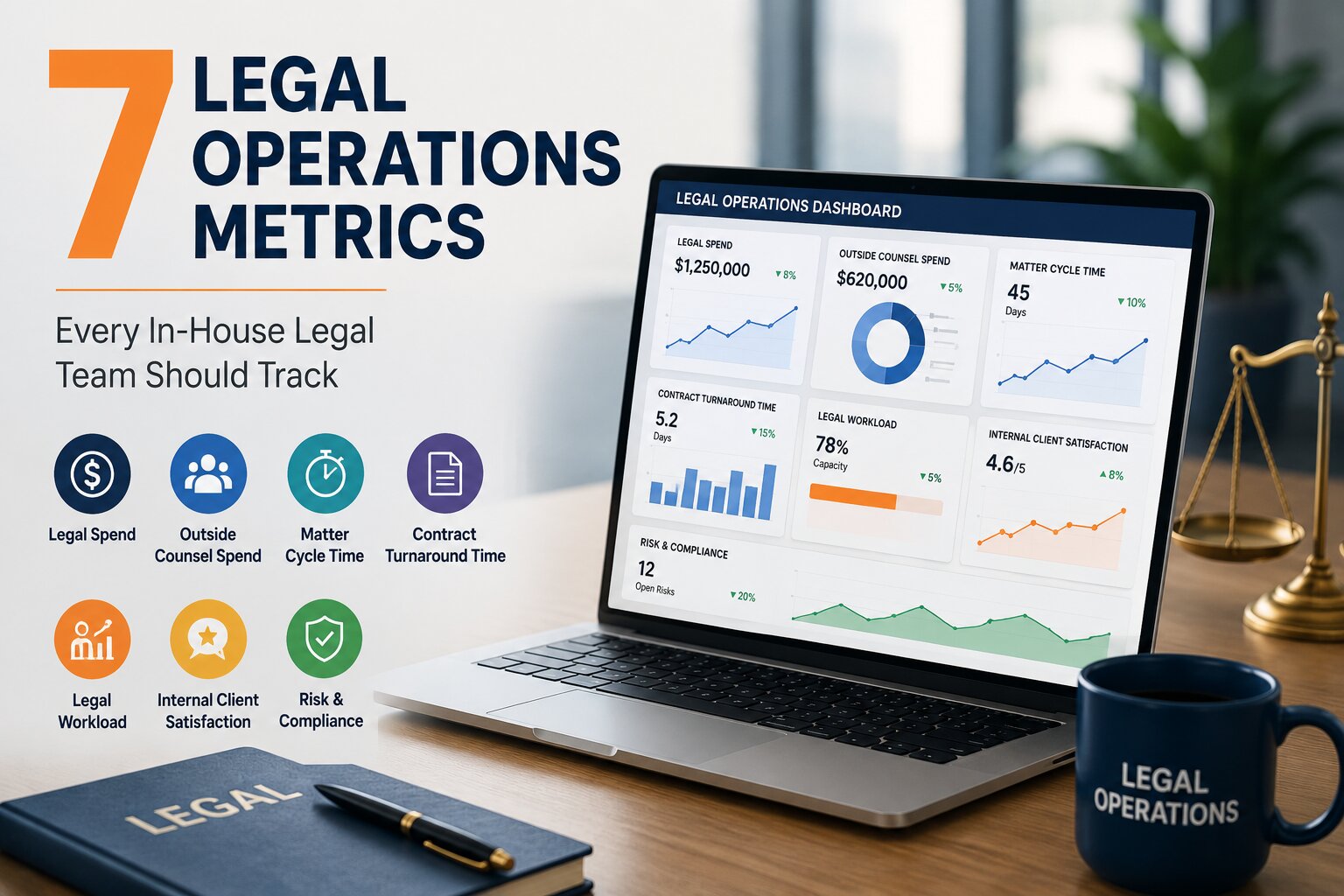
7 Legal Operations Metrics Every In-House Legal Team Should Track
Legal teams are often expected to do more with less. They manage contracts, support business teams, handle disputes, monitor compliance and advise leadership, all while keeping legal spending under control. But when leadership asks, “How is the legal team performing?”, giving a clear answer is not always easy.
Many in-house legal teams still depend on spreadsheets, email threads and manually prepared reports to understand their workload, costs and performance. This can make it difficult to spot bottlenecks, demonstrate the team's value or build a strong case for additional resources.
This is where legal operations metrics can make a difference.
The right metrics help General Counsel and legal operations leaders understand more than just how busy the legal team is. They can provide visibility into cost, workload, turnaround times, internal client experience and risk. More importantly, they can turn everyday legal activity into information that supports better operational decisions.
You do not need a complicated dashboard with dozens of measurements to get started. A small set of well-chosen metrics can often provide a much clearer picture of how the legal function is performing. In this article, we look at seven legal operations metrics that can help in-house teams measure performance, identify areas for improvement and make more informed decisions.
Why Measuring Legal Operations Matters
The role of an in-house legal team has changed considerably. Legal is no longer simply expected to review documents or step in when a dispute arises. In many organisations, legal teams are involved in commercial decisions, contract negotiations, compliance, risk management and wider business planning.
That makes it increasingly important to understand how the function is performing.
Reliable operational data can help a General Counsel explain why additional headcount may be needed, support a budget request or understand whether the team is using external counsel efficiently. It can also reveal where work is taking longer than expected, where demand is increasing and which activities may be consuming valuable legal capacity.
It is also useful to distinguish between a metric and a KPI. A metric is simply something you can measure, such as the number of contracts reviewed in a month. A KPI, or key performance indicator, connects that measurement to a specific business objective. Not every number needs to become a KPI. The goal is not to measure everything. It is to identify the information that helps answer the questions the legal team and the wider business actually care about.
For example, if leadership is concerned about rising legal costs, spend-related metrics may be the priority. If business teams are complaining about delays, contract turnaround and matter cycle time may provide more useful insight. If the legal team is struggling with capacity, workload and matter volume may be more relevant.
1. Legal Spend as a Percentage of Revenue
Legal spend as a percentage of revenue offers a simple way to understand legal costs relative to the organisation's overall size. The basic calculation is total legal spend divided by company revenue, multiplied by 100.
For example, if a company spends $2 million on legal activities and generates $500 million in revenue, the calculation would be $2 million divided by $500 million, multiplied by 100, giving a result of 0.4%. What counts as legal spend will depend on how the organisation defines its legal budget. It may include internal legal costs, outside counsel fees, legal technology, regulatory support and other related expenses.
Looking at legal spend in isolation does not always provide much context. A large legal department may have significant costs because it supports a large and complex organisation. A smaller team may appear inexpensive but still be struggling with an unsustainable workload. Expressing legal spend relative to revenue gives leadership another way to understand how costs are changing as the business grows.
The number itself should not automatically be treated as good or bad. Industry, company size, regulatory exposure, litigation activity and business model can all affect legal spending. Historical performance and relevant benchmarks are usually more useful than an arbitrary target. A significant change in the ratio should prompt a closer look. An increase could be explained by major litigation, an acquisition, a regulatory issue or business expansion. If there is no clear explanation, it may indicate that spending needs further review.
The objective should not simply be to reduce the percentage. Cutting legal costs too aggressively can create additional risk elsewhere. Instead, legal leaders should examine where money is being spent, which work can be handled internally, where outside counsel is being used and whether technology can reduce repetitive administrative work.
2. Outside Counsel Spend vs. Budget
Outside counsel can represent a significant part of an organisation's legal budget, particularly when the business is involved in litigation, major transactions or complex specialist work. Comparing actual external legal spending with the approved budget can help legal leaders identify potential cost issues before they become difficult to manage. The basic variance can be calculated as actual outside counsel spend minus budgeted spend. It can also be expressed as a percentage by dividing the difference between actual spend and budget by the budget and multiplying it by 100.
For example, a matter that was initially expected to cost $100,000 but has already reached $130,000 represents a $30,000 variance, or 30% above the original budget.
The purpose of this metric is not to expect every matter to remain exactly within budget. Legal work can be unpredictable, particularly in litigation. Scope can change, new issues can arise and matters can take longer than expected. What matters is understanding why significant variances occur and identifying them early enough to respond. A useful report should ideally allow legal leaders to see spending by law firm, matter, practice area or business unit. This makes it easier to identify where external legal costs are concentrated and whether particular matters require additional oversight.
Clear matter budgets, regular spend reviews and better invoice oversight can all help. Organisations may also consider alternative fee arrangements or preferred panels of outside counsel where appropriate. Over time, historical spending data can make future budgets more realistic.
3. Matter Cycle Time
Matter cycle time measures how long a legal matter takes to move from intake to closure. A simple calculation is the matter closure date minus the matter intake date. At first glance, an average cycle time may seem like a useful number. However, a single average across every matter can hide important differences. A commercial contract issue, an employment matter and a complex dispute may naturally require very different amounts of time.
For that reason, it is more useful to examine cycle time by matter type, complexity or risk. If commercial matters are generally completed quickly while employment matters remain open for significantly longer, the legal team can investigate what is causing the difference. There is also no universal cycle-time target that applies to every legal department. The more useful goal is predictability. When similar matters tend to take similar amounts of time, legal teams can plan resources more effectively and set clearer expectations with internal stakeholders.
When cycle times begin increasing, the next step is to identify where matters are getting stuck. Information may be missing at intake, approvals may be delayed, documents may be difficult to locate or lawyers may be manually updating several systems. Clear intake processes, defined workflows, automated reminders and centralised matter information can reduce many of these avoidable delays.
4. Contract Turnaround Time
Contract turnaround time measures how long it takes for a contract request to move from initial submission to completion, usually when the agreement is signed. It can be calculated as the contract signature date minus the contract request date. Legal teams can also examine the individual stages within that period, such as the time from request to first review, first review to approval and approval to signature. This can make it easier to identify exactly where delays are occurring.
Contract turnaround is one of the legal metrics most visible to the wider business. Sales teams waiting for agreements to be reviewed may experience legal as a bottleneck. Procurement teams may face similar delays when supplier agreements remain in an approval queue. However, faster is not always better. A high-risk strategic agreement may require considerably more legal review than a standard non-disclosure agreement. The objective should be to make routine work more efficient while giving complex and high-risk agreements the attention they require.
For that reason, contract turnaround should ideally be measured by contract type and risk level rather than through one overall average.
Templates, approved clause libraries and self-service workflows can reduce unnecessary legal involvement in routine agreements. Contract lifecycle management technology can also provide visibility into where contracts are waiting, who needs to act and how long each stage is taking.
5. Legal Workload and Matter Volume per Attorney
Workload data can help legal leaders understand the amount and type of work being handled by individual lawyers and by the legal function as a whole. It can include open matters per attorney, new matters received each month, contracts reviewed, legal requests handled and active matters classified by complexity or risk. This becomes particularly useful during headcount discussions. Saying that the legal team is extremely busy may accurately describe the situation, but leadership may need more evidence before approving another position.
Workload data provides a more concrete picture. It can show whether one lawyer is carrying a disproportionate number of matters, whether demand is increasing and whether a significant amount of time is being spent on repetitive administrative work. There is no universal number of matters that one lawyer should handle. Ten straightforward contract reviews are not equivalent to ten complex disputes. Workload therefore needs to be considered alongside complexity, urgency, risk and matter type.
The value of this metric is not simply in proving that the team is busy. It can help legal leaders redistribute work, identify capacity constraints and make better decisions about hiring, outsourcing or technology investment. It may also reveal areas where processes could be standardised or automated instead of simply adding more people to handle increasing volumes.
6. Internal Client Satisfaction
Legal teams can complete a large amount of work and still have a perception problem within the wider organisation. Internal client satisfaction helps capture how business stakeholders experience the legal team's service. A short survey can ask stakeholders about responsiveness, clarity of advice, ease of working with legal, understanding of business needs and overall satisfaction. Some organisations may also use an NPS-style question to understand how likely stakeholders are to recommend the legal team's support.
This metric adds a perspective that financial and operational measurements cannot capture on their own. A business stakeholder may not know how many matters the legal team closed during the quarter, but they are likely to remember whether legal helped them solve a problem efficiently and whether the advice was clear. The goal should not be to achieve a perfect satisfaction score. A useful survey should identify patterns and areas where the experience differs between business functions.
For example, if procurement consistently reports that legal is slow to respond while sales reports a positive experience, that difference is worth investigating. It may point to differences in workload, intake processes or expectations between the two groups.
Surveys should be short enough that stakeholders are willing to complete them and can be conducted periodically, such as quarterly or twice a year. Most importantly, the results should lead to action. If stakeholders repeatedly mention unclear intake processes or slow responses, the legal team should use that feedback to improve the underlying process.
7. Legal Risk and Compliance Indicators
Legal operations should not focus only on what has already happened. Good reporting should also help leadership see where legal and compliance risks may be developing. Depending on the organisation and its risk profile, useful indicators may include open disputes, litigation exposure, overdue regulatory filings, policy attestation rates, contract renewal risks, unresolved compliance issues and high-risk matters without an assigned owner.
The exact indicators will vary considerably between industries. A financial services organisation may need to monitor different compliance risks from a construction company or technology business. What matters is choosing indicators that provide useful early warnings.
For example, the number of unresolved compliance actions may tell leadership more about emerging risk than simply reporting how many compliance incidents occurred during the previous quarter.
Good risk reporting should make three things clear: what could happen, how serious the potential impact could be and what is being done about it. A dashboard filled with numbers is not particularly useful if none of those numbers leads to a decision. Clear ownership is therefore important. Risk items should have responsible owners, review dates and a way to monitor whether the situation is improving or getting worse.
Where possible, risk information should also connect with matters, contracts and compliance workflows. This gives legal leaders a broader view instead of forcing them to review information across disconnected spreadsheets and systems.
A Quick Reference: 7 Legal Operations Metrics
The most useful legal operations metrics are the ones that help answer a business question. The table below provides a starting point for deciding what to track and how frequently it should be reviewed.
| Metric | What it tells you | Key business question | Typical data source | Review frequency |
|---|---|---|---|---|
| Legal spend as % of revenue | Overall legal cost relative to business size | Are legal costs growing appropriately? | Finance system, legal budget | Quarterly |
| Outside counsel spend vs. budget | Whether external legal costs are on track | Are external legal costs under control? | E-billing, finance system | Monthly |
| Matter cycle time | How quickly matters move to closure | Where is legal work slowing down? | Matter management system | Monthly |
| Contract turnaround time | How long contracts take to reach signature | How quickly can legal support business activity? | Contract management system | Monthly |
| Workload per attorney | Capacity, demand and workload distribution | Do we have enough capacity? | Matter management system | Monthly |
| Internal client satisfaction | How business teams experience legal support | Is legal delivering a good internal service? | Stakeholder surveys | Quarterly |
| Legal risk and compliance indicators | Emerging legal and compliance exposure | Where is legal risk increasing? | Compliance and matter systems | Monthly or quarterly |
How to Start Tracking Legal Operations Metrics
You do not need a sophisticated dashboard on day one. A better starting point is to identify the business questions your legal team is already struggling to answer. If outside counsel costs are a concern, start with legal spend and budget variance. If business teams are complaining about delays, contract turnaround and matter cycle time may be more useful. If capacity is becoming an issue, workload and matter volume can provide a clearer picture.
Once you know what you want to understand, identify where the data currently lives. It may be spread across matter management systems, contract tools, finance platforms, email, spreadsheets and shared folders. Mapping these sources can help reveal where information is missing, duplicated or difficult to access.
The next step is to establish a baseline. Before setting targets, understand your current position. If the average contract turnaround time is currently 18 days, for example, that number becomes the starting point against which future performance can be measured. It is also important to establish a reporting rhythm. Some metrics may need monthly review, while others may be more useful quarterly. A dashboard only creates value when someone reviews the information and uses it to make a decision.
Teams should also watch for common problems. Inconsistent matter categories can make reporting unreliable. Manual data entry can create gaps. Tracking too many metrics can make dashboards difficult to use. Most importantly, measuring activity without connecting it to a business decision can result in a lot of reporting with very little value.
Common Mistakes When Tracking Legal Operations Metrics
One of the most common mistakes is trying to measure everything at once. A dashboard containing dozens of numbers may look impressive, but it can make it harder to see what actually requires attention. A smaller set of relevant metrics is usually more useful. Another problem is comparing figures without considering context. A lawyer handling ten high-risk disputes may have a very different workload from someone handling twenty routine contract requests. Similarly, a contract that takes ten days to complete may be perfectly reasonable if it is complex and high risk.
Legal teams should also avoid measuring speed at the expense of quality. Reducing contract turnaround time means little if important risks are missed during review. Likewise, reducing legal spend should not become the objective if it creates greater exposure elsewhere. Finally, metrics should not become a reporting exercise that sits outside everyday legal work. If lawyers have to maintain separate spreadsheets simply to produce management reports, the data is more likely to become outdated or inconsistent.
The best measurement systems capture useful information as part of the work that is already happening.
The Role of Technology in Legal Operations Metrics
Manual tracking can work when a legal team handles a relatively small number of matters. As the volume of work increases, however, maintaining accurate information across spreadsheets, email threads and shared folders becomes much harder. Legal technology can make this process more practical by capturing operational information as part of normal workflows.
Matter management systems can record requests, matters, owners, deadlines and outcomes. Contract lifecycle management systems can track contract stages, approvals, obligations and turnaround times. Finance and e-billing systems can provide more detailed information about outside counsel spending, while analytics and reporting tools can bring different data points together for management reporting.
The important point is that technology should not exist simply to create another dashboard. The real value comes when useful information is captured as part of the work lawyers are already doing. When a matter is opened, a contract moves through an approval stage or a risk item is assigned to an owner, the resulting information can contribute to reporting without requiring the legal team to maintain another separate spreadsheet.
This is where the combination of matter management, contract management, legal spend management and legal analytics can become valuable. The technology supports the underlying process, while the metrics help legal leaders understand what is happening and decide what needs attention.
AI-powered legal analytics can also help in-house teams turn operational data into useful insights across workload, contract turnaround, matter volumes, compliance and legal spend. For a broader look at these applications, see Beyond Contract Review: AI Use Cases for Corporate Legal Teams.
Legal Operations Solutions from Beveron Technologies
Tracking legal operations metrics becomes more useful when the information behind those metrics is organised in one place. Beveron Technologies offers legal technology solutions designed to help teams manage the workflows, matters and contracts that generate this operational data.
Smart Legal Counsel supports in-house legal teams with centralised matter management, workflows, requests and legal work tracking. This can help teams gain clearer visibility into workload, matter volumes, turnaround times and operational performance.
For law firms, Smart Lawyer Office brings case management, hearings, clients, documents and billing into one platform, helping teams manage day-to-day legal operations more efficiently. Smart Legal Contract focuses on contract lifecycle management, giving teams greater visibility into contracts, approvals, obligations, renewals and turnaround times.
Together, these solutions can help legal teams move beyond manually collecting figures in spreadsheets and build a more consistent view of legal operations, performance and risk.
Conclusion
The right legal operations metrics can help an in-house legal team move beyond simply reporting how busy it is. They can provide a clearer view of how the legal function is supporting the wider organisation.
Legal spend shows where money is going. Outside counsel variance helps identify unexpected external costs. Matter cycle time and contract turnaround reveal how efficiently work moves through the legal function. Workload data provides visibility into capacity, while internal client satisfaction shows how business teams experience legal support. Risk and compliance indicators help leadership understand where potential exposure may be developing. There is no need to introduce all seven metrics at once. Start with the three or four that answer your most important business questions, establish reliable baselines and build a reporting rhythm around them.
For legal teams looking to turn everyday work into clearer operational insight, the right technology can make the process much easier.
Talk to Beveron Technologies to explore how legal technology can help your team centralise matters, contracts, workflows, workload and risk information and turn that data into clearer operational insight.
Frequently Asked Questions
What are legal operations metrics?
Legal operations metrics are measurements used to understand how an in-house legal function is performing. They can cover areas such as legal spend, matter volume, contract turnaround time, workload, stakeholder satisfaction and legal risk.
What are the most important legal operations KPIs?
The most useful KPIs depend on the priorities of the legal team. Common areas include legal spend, outside counsel costs, matter cycle time, contract turnaround, workload, internal client satisfaction and risk or compliance indicators. The best KPIs are the ones that help answer an important business question and support a decision.
What is a good legal spend-to-revenue ratio?
There is no single legal spend-to-revenue ratio that is considered good for every organisation. Legal costs vary according to industry, company size, regulatory requirements, litigation exposure and business complexity. Comparing current results with historical performance and relevant benchmarks is generally more useful than relying on one universal target.
How often should an in-house legal team review its metrics?
It depends on the metric. Financial and workload metrics may be reviewed monthly, while broader measures such as internal client satisfaction may be reviewed quarterly. The important thing is to establish a consistent reporting schedule and use the results to guide decisions.
What tools help track legal department KPIs?
Matter management, contract lifecycle management, finance, e-billing and analytics tools can all contribute to legal KPI tracking. The right combination depends on the size of the legal team, its workflows and the systems it already uses.
Why should legal teams track operational metrics?
Metrics help legal leaders understand cost, workload, efficiency, service quality and risk. They can provide evidence for budget and headcount decisions, identify operational bottlenecks and help demonstrate how the legal function contributes to the wider business.
Best legal operations management in the UAE
Best legal operations performance metrics in the UAE
Best legal operations analytics in the UAE
If you need a free demo on the best legal operations management in the UAE, please fill out the form.