Rethinking Legal Work with Agentic AI: The Case for Human-Led Automation
Legal teams are moving quickly towards AI. Tasks that once required hours of manual work can now be completed, reviewed, or prepared in a fraction of the time. With the rise of agentic AI, the conversation is moving beyond simple task automation. AI systems can increasingly plan steps, use connected tools, interpret information and carry out several actions with limited human input.
That creates an important question for legal teams: just because AI can perform more work independently, should it?
In legal work, speed is only one part of the equation. Decisions often depend on context, professional judgement, risk tolerance and an understanding of circumstances that may not be captured in a dataset or workflow.
This is why the next stage of legal AI may not be about removing people from workflows. It may be about designing better workflows around people.
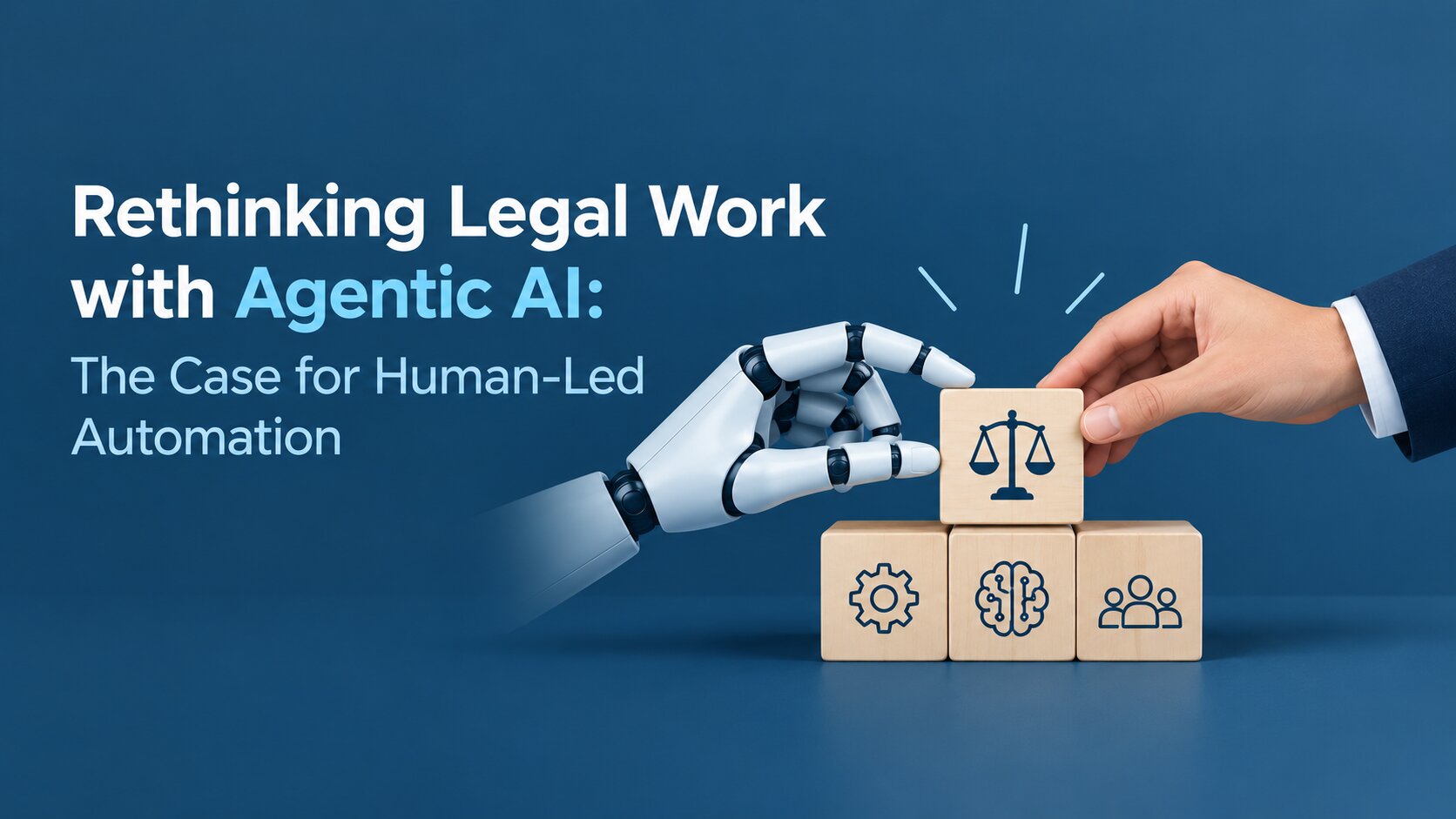
The idea of human-led automation puts human judgement at the centre while allowing agentic AI to handle the repetitive, time-consuming work around it. Instead of asking AI to replace the legal professional, this approach asks a more useful question: What should AI handle, and where should humans remain firmly in control?
The Current Trajectory: Autonomy-First Automation
Much of the excitement around agentic AI comes from its ability to operate with greater independence than traditional software.
A conventional automation system may follow a fixed rule: receive a document, extract information and send it to another system. An agentic AI system can potentially take a broader objective, break it into steps, gather information, perform actions and adjust its approach based on what it finds.
For legal teams, the appeal is obvious.
An AI agent could potentially review a group of contracts, identify unusual clauses, compare provisions against an internal standard, flag potential risks and prepare a summary for a lawyer. In another workflow, it might collect information for a matter, organise documents and prepare an initial status report.
The problem begins when autonomy becomes the goal rather than a means to an end.
Legal work involves situations where there may be no single correct answer. A clause that looks unusual may be perfectly acceptable in one commercial context but create significant risk in another. A legal research result may appear relevant while missing an important distinction in the facts. A drafting suggestion may sound reasonable but fail to reflect the client's actual position.
The more independently an AI system acts, the more important it becomes to define where responsibility sits.
For legal teams, the objective should therefore not simply be to maximise the number of tasks an AI system can complete without human involvement. It should be to create workflows where automation improves efficiency without weakening oversight.
Why Legal Work Resists Full Autonomy
Legal work is not made up entirely of repeatable processes.
There are certainly tasks that are structured and predictable. Searching documents, extracting information, organising matter records, generating summaries and checking dates can often be supported effectively by software.
But legal decisions frequently depend on context.
Consider contract review. An AI system may identify a limitation-of-liability clause and flag it as potentially problematic. That is useful. But deciding whether the clause should actually be changed requires more than identifying the clause.
What is the value of the contract? What is the organisation's risk appetite? What is the relationship with the other party? Are there commercial reasons for accepting the provision? Does another clause provide protection elsewhere in the agreement?
These are judgement questions.
The same applies to legal research. AI can help locate relevant material and organise findings, but a lawyer still needs to assess whether the authority applies to the specific facts and whether there are competing interpretations.
This distinction matters because legal accuracy is not simply about producing a technically correct output. It is also about understanding whether that output makes sense in its particular context.
Full autonomy can create challenges in areas such as:
- Accountability: Someone must remain responsible for consequential legal decisions.
- Context: AI may not fully understand commercial, factual or organisational circumstances.
- Interpretation: Legal language can depend heavily on facts and jurisdiction.
- Risk management: Not every identified risk should automatically lead to the same action.
- Trust: Lawyers, clients and business stakeholders need to understand how important decisions are reached.
None of this means agentic AI has little value in legal work. Quite the opposite. It means its greatest value may come from using its capabilities in the right parts of the workflow.
Reframing the Model: Human-Led Automation
Human-led automation starts from a different assumption.
Instead of designing a workflow around the question, "How much of this can AI do on its own?", legal teams can ask, "Which parts should AI handle, and where does human judgement create the most value?"
In this model, agentic AI acts as a force multiplier.
It can gather information, prepare work, identify patterns, suggest next steps and manage routine actions. The legal professional remains responsible for reviewing important outputs, resolving exceptions and making decisions that require professional judgement.
This does not mean putting a human in front of every AI action. That would simply recreate manual work under a different name.
The goal is to place human oversight where it matters most.
For example, a workflow might allow AI to review hundreds of documents without requiring a lawyer to examine every page. The system could identify potentially relevant clauses and rank them by risk. The lawyer then focuses on the exceptions and higher-risk items rather than manually searching the entire document set.
This approach can include:
Review checkpoints - Important outputs are routed to a legal professional before they are finalised or acted upon.
Escalation rules - Certain conditions automatically require human review. For example, an unusual clause, high-risk issue or low-confidence result could trigger an escalation.
Clear decision boundaries - The workflow defines what AI can do independently and what requires approval.
Auditability - Actions and decisions can be recorded so teams can understand what happened, what the system produced and where human intervention occurred.
Continuous feedback - Human reviewers can correct AI outputs and improve the workflow over time.
The result is not less automation. It is better-structured automation.
What Human-Led Automation Looks Like in Practice
The concept becomes clearer when applied to everyday legal work.
Contract review
Imagine a legal team receives a large set of supplier agreements. Instead of manually opening each document and searching for key provisions, an agentic AI workflow could identify relevant clauses, extract important terms and highlight provisions that fall outside the organisation's preferred position. For more examples, explore AI use cases for corporate legal teams beyond contract review.
The lawyer does not have to start from a blank page. They receive a structured review that points them towards the areas that deserve attention. They can accept the findings, reject them or investigate further before making a decision.
AI does the searching and preparation. The lawyer makes the call.
Drafting support
Drafting is another area where AI can reduce repetitive work. An AI system can prepare a first draft based on approved information, previous documents or defined instructions. It can also identify missing information or suggest alternative wording. For a deeper look at this use case, see our article on AI transforming legal drafting for lawyers. .
But a first draft is not a final legal position.
The lawyer still needs to assess whether the language reflects the client's objectives, protects the organisation appropriately and fits the circumstances of the matter. The value lies in reducing the time spent producing the first version so that more attention can be given to improving the final one.
Legal research
Legal research can involve searching large volumes of information before identifying the material that actually matters. Agentic AI can assist by gathering potentially relevant sources, organising findings and preparing an initial summary. Human review remains important because relevance is not the same as applicability. A lawyer needs to assess the authority, jurisdiction, facts and interpretation before relying on the result.
Again, the role of AI is to reduce the amount of routine searching and preparation rather than remove professional judgement from the process.
From Legal Executers to Workflow Supervisors
Human-led automation also changes the role of legal professionals. Traditionally, a significant amount of legal operations work has involved moving information between systems, checking documents, following up on tasks and preparing routine updates.
As these activities become increasingly automated, legal professionals can spend less time acting as workflow executors and more time supervising how work gets done.
That means asking different questions:
- Is the workflow producing reliable results?
- Where should human approval be required?
- Which exceptions need escalation?
- Are certain tasks being automated simply because they can be?
- Is the system capturing the information needed for a sound decision?
- What happens when the AI is uncertain?
This shift requires a different kind of operational thinking. Legal teams will increasingly need to understand not only legal processes but also how automated workflows are designed, monitored and improved.
The lawyer does not disappear from the process. Their role becomes more focused on judgement, supervision and accountability.
The Strategic Case for Human-Led Automation
At first glance, keeping people involved may appear to reduce the efficiency gains promised by agentic AI. If an AI system can complete a workflow independently, why introduce human review? Because the cost of a mistake can be much higher than the time saved.
A legal team may be able to process a contract faster with complete automation. But if an important risk is missed and the agreement is approved without proper review, the resulting commercial or legal consequences could outweigh the original efficiency gain. Human-led automation takes a different view of efficiency.
The objective is not to minimise human involvement at every stage. It is to use human attention where it has the greatest value. That can create a more sustainable model for scaling legal operations. AI handles volume and repetition. People handle exceptions, interpretation and important decisions. It also provides a clearer path for organisations that need to demonstrate oversight of AI-assisted work.
This matters as legal teams become more dependent on AI and organisations place greater emphasis on responsible technology use. Strong governance is easier to build when teams know which decisions are automated, which require approval and how those decisions can be reviewed afterwards.
A Practical Approach to Human-Led Legal Automation
Beveron Technologies supports legal teams that want to bring greater structure and automation to their day-to-day operations without losing visibility and control.
Its legal technology portfolio includes Smart Lawyer Office (SLO) for law firm operations, Smart Legal Counsel (SLC) for corporate legal departments, and Smart Legal Contract (SLCm) for contract lifecycle management. These platforms help organise matters, contracts, compliance activities, workflows and related legal operations in one environment.
The broader opportunity is not simply to automate individual legal tasks. It is to connect automation with clearly defined workflows, information, permissions and human review. That gives legal teams a practical foundation for adopting AI while keeping important decisions under appropriate human control.
Rethinking What "Automation" Should Mean
The legal industry's AI conversation is likely to become less about whether machines can perform a task and more about whether they should perform it independently. That is an important shift.
Agentic AI can make legal workflows faster and more capable. It can search, organise, prepare, compare and recommend at a scale that would be difficult to achieve through manual work alone. But capability does not automatically equal authority. The strongest legal AI strategies will recognise the difference.
Human-led automation does not reject agentic AI. It puts it to better use. It allows AI to take on repetitive work, handle large volumes of information and support complex workflows while leaving professional judgement where it belongs. The future of legal work may therefore not be about AI replacing lawyers. It may be about AI changing where lawyers spend their time and how they exercise judgement.
The real opportunity is not to automate everything.
It is to rethink the workflow so that machines handle what they are good at, people focus on what requires judgement, and the two work together by design.
Conclusion
The real opportunity with agentic AI is not to remove humans from legal workflows. It is to make their time and judgement more valuable. Legal teams can use AI to handle repetitive work, organise information, identify potential issues and support complex workflows. But important decisions still need context, experience and accountability. That is why human-led automation offers a more practical path forward.
Instead of asking how much legal work can be handed over to AI, teams should ask where automation can create the most value while keeping people in control of decisions that matter.
The future of legal work will not be defined by how autonomous AI becomes. It will be defined by how thoughtfully legal teams combine AI capabilities with human judgement.
Ready to rethink your legal workflows? Explore how modern legal technology can help your team automate routine work, improve visibility and keep human oversight at the centre.
Best agentic AI legal workflows in the UAE
Best AI automation for legal teams in the UAE
Best agentic AI in legal work in the UAE
If you need a free demo of the best agentic AI legal workflows in the UAE, please fill out the form.