Beyond Contract Review: AI Use Cases for Corporate Legal Teams
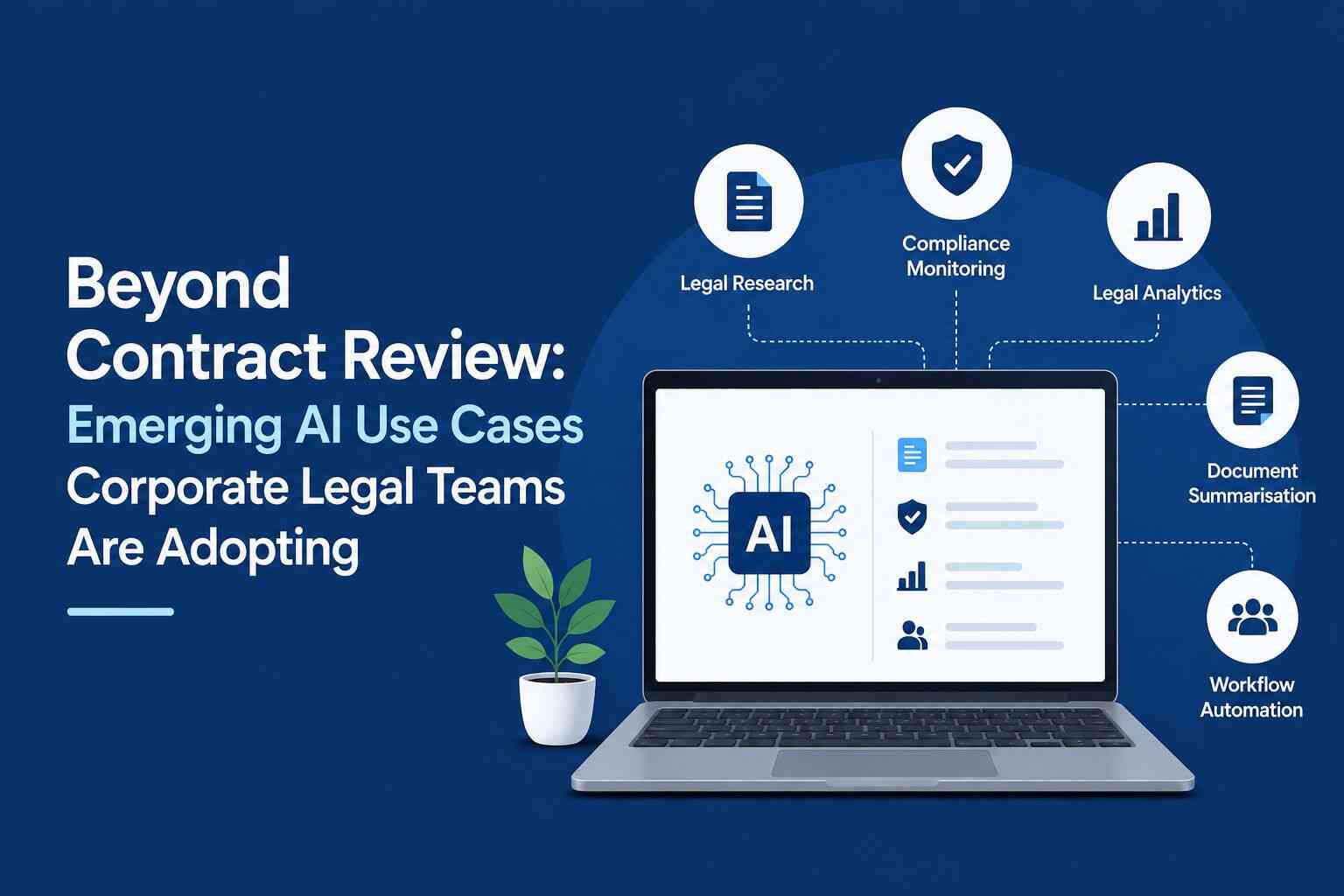
Beyond Contract Review: Emerging AI Use Cases for Corporate Legal Teams
Artificial intelligence is rapidly becoming part of everyday legal work. While contract review often dominates conversations around legal AI, it represents only a small part of how modern legal departments are using the technology.
Today's corporate legal teams face growing workloads, evolving regulations, increasing business expectations, and pressure to deliver strategic value with limited resources. Legal professionals are expected to respond quickly, manage risk effectively, and collaborate seamlessly with multiple business functions—all while maintaining high standards of governance and compliance.
This shift has accelerated interest in AI use cases for corporate legal teams that extend well beyond document review. From legal intake and compliance monitoring to knowledge management and predictive analytics, AI is helping legal departments streamline operations, improve visibility, and make better-informed decisions.
In this article, you'll explore practical AI applications transforming in-house legal teams, understand the business benefits, learn implementation best practices, and discover how integrated legal operations platforms such as Beveron Smart Legal Counsel can support AI-enabled legal operations.
Why AI Is Expanding Beyond Contract Review
Contract analysis was one of the earliest and most visible applications of AI in legal practice. However, legal departments have recognised that many other processes involve repetitive, time-consuming tasks that can also benefit from automation and intelligent assistance.
Several factors are driving this expansion.
First, legal teams are handling significantly higher workloads. Requests from procurement, HR, finance, sales, and executive leadership continue to grow, yet headcount often remains unchanged.
Second, regulatory requirements continue to evolve across industries and jurisdictions. Keeping policies, procedures, and compliance obligations up to date requires continuous monitoring and coordination.
Third, business leaders increasingly expect legal departments to operate as strategic partners rather than administrative support functions. This means delivering faster advice, clearer insights, and measurable business value.
Finally, advances in Generative AI have made intelligent legal assistance far more accessible. Modern AI solutions can summarise complex documents, retrieve organisational knowledge, assist with legal research, automate workflows, and generate first drafts while allowing legal professionals to retain full oversight.
The result is broader adoption of AI in corporate legal departments across nearly every stage of legal operations.
AI Use Cases for Corporate Legal Teams
Legal Intake and Matter Triage
Legal intake often begins with emails, spreadsheets, or informal conversations that make requests difficult to prioritise and track. AI helps by automatically categorising requests, identifying urgency, routing matters to the appropriate legal specialist, and capturing essential information at the beginning of the process. This reduces delays, improves visibility, and ensures legal resources are allocated more effectively.
For example, an AI-powered intake portal can identify whether a request relates to employment, procurement, compliance, or litigation and automatically assign it to the appropriate legal team. Organisations looking to modernise their intake process can also explore how AI-powered legal intake is replacing traditional email-based request management to improve responsiveness and create a more structured legal workflow.
Legal Research Assistance
Legal research can be time-consuming, particularly when lawyers need to review internal policies alongside external legal resources. AI can quickly retrieve relevant clauses, prior advice, internal precedents, and organisational knowledge to assist lawyers with preliminary legal research.
Rather than replacing professional judgement, AI accelerates information discovery so lawyers can focus on legal analysis and strategic decision-making.
Compliance Monitoring
Maintaining compliance requires continuous oversight of internal obligations, approvals, certifications, and regulatory requirements.
AI compliance management solutions can monitor deadlines, identify potential compliance gaps, generate alerts, and assist with tracking organisational obligations.
For example, if mandatory compliance documentation has not been submitted before a deadline, AI can automatically notify responsible stakeholders before the issue escalates. Organisations looking to strengthen their compliance processes can also explore why compliance programmes fail and how proactive monitoring helps identify risks before they become costly issues.
Policy Management
Corporate policies frequently require updates to reflect new legislation, business practices, or organisational changes. AI supports policy management by identifying outdated content, recommending revisions, highlighting inconsistent language, and notifying employees when policies require acknowledgement.
This helps organisations maintain consistent governance while reducing manual administrative effort.
Knowledge Management
Legal departments generate valuable knowledge every day through contracts, legal opinions, templates, negotiations, and advisory work. Unfortunately, much of this knowledge remains scattered across folders, emails, and shared drives. AI-powered knowledge management enables lawyers to locate relevant precedents, templates, legal advice, and historical matters within seconds.
Instead of recreating work, legal teams can reuse institutional knowledge more effectively.
Litigation and Dispute Management
Managing litigation involves coordinating documents, deadlines, legal counsel, budgets, evidence, and communications. AI can assist by organising litigation records, identifying upcoming milestones, summarising case files, and highlighting potential risks that require attention.
Legal professionals gain better visibility into ongoing disputes while reducing administrative workload.
Legal Spend Analysis
Managing external legal spend has become increasingly important for corporate legal departments.
AI legal analytics can categorise invoices, identify unusual billing patterns, compare law firm performance, and highlight opportunities to optimise legal expenditure.
Instead of reviewing thousands of invoice entries manually, legal operations teams receive meaningful insights that support informed budgeting decisions. Organisations looking to gain greater visibility into outside counsel costs can also explore how AI is reshaping external counsel management and legal spend control to improve financial oversight and optimise legal budgets.
Risk Assessment
Every legal matter carries some degree of business risk. AI assists by analysing contracts, policies, historical disputes, and legal data to identify potential risk indicators before issues become significant.
For instance, recurring contractual deviations or repeated approval exceptions can be flagged for legal review, allowing teams to address risks proactively.
Regulatory Change Tracking
Regulatory requirements continue to evolve rapidly across industries. Monitoring multiple regulators, jurisdictions, and industry-specific obligations manually is becoming increasingly challenging. AI can monitor regulatory updates, identify changes relevant to the organisation, notify legal teams, and support impact assessments.
This enables faster compliance planning and reduces the likelihood of overlooking important regulatory developments. Organisations looking to strengthen their regulatory monitoring capabilities can also learn how AI-powered regulatory change tracking helps legal and compliance teams stay ahead of evolving requirements and respond more efficiently.
Board and Governance Support
Preparing board papers and governance documentation often requires extensive coordination between legal, compliance, finance, and executive teams. AI can summarise governance materials, organise supporting documents, highlight outstanding actions, and assist with preparing board meeting packs.
This reduces preparation time while improving consistency and accuracy.
Document Summarisation
Legal professionals frequently review lengthy agreements, reports, investigation findings, and regulatory documents. AI can generate concise summaries that highlight key obligations, risks, deadlines, and important provisions.
This enables lawyers to review information more efficiently while still conducting detailed analysis where necessary.
Internal Legal Self-Service
Business users often ask legal departments similar questions repeatedly. AI-powered self-service portals allow employees to obtain approved legal guidance, access templates, and submit requests without waiting for routine responses.
For example, an employee seeking an NDA template or guidance on procurement approvals can obtain relevant resources immediately while more complex matters continue through legal review.
Workflow Automation
Many legal processes involve repetitive administrative activities. AI legal workflow automation helps automate approvals, reminders, document generation, notifications, escalations, and task assignments. This reduces manual intervention while improving consistency across legal operations.
For example, a contract approval workflow can automatically move through predefined review stages while notifying stakeholders when action is required. Organisations looking to modernise their processes can also explore the future of AI-powered legal workflows and how automation is expected to transform routine legal tasks over the coming years.
Reporting and Legal Analytics
Legal leaders increasingly require operational insights rather than static reports. AI legal analytics can analyse workload distribution, contract turnaround times, matter volumes, compliance performance, and legal spend trends.
These insights support better planning, resource allocation, and strategic decision-making across the legal function.
Traditional vs AI-Enabled Legal Operations
Traditional Legal Workflow | AI-Enabled Legal Workflow |
|---|---|
Manual legal intake | Intelligent request routing and automated triage |
Email-based matter management | Centralised legal operations platform |
Manual compliance tracking | Automated compliance monitoring and alerts |
Time-consuming legal research | AI-assisted knowledge retrieval |
Static reports | Real-time legal analytics dashboards |
Manual document review | AI-assisted document summarisation |
Spreadsheet-based legal spend tracking | AI-driven spend analysis |
Disconnected legal processes | Integrated workflow automation |
Reactive risk management | Proactive AI-supported risk identification |
Limited operational visibility | Centralised reporting and performance insights |
Business Benefits of AI in Corporate Legal Departments
The growing adoption of AI in corporate legal departments is delivering measurable operational improvements.
Legal teams can respond more quickly because routine tasks are completed automatically or significantly accelerated through AI assistance. Operational visibility improves as legal matters, approvals, compliance obligations, and reporting become centralised within a single environment. Manual administrative work decreases, allowing legal professionals to dedicate more time to strategic advisory work and complex legal analysis. Compliance becomes easier to manage through automated reminders, monitoring, and standardised workflows. Cross-functional collaboration improves because business stakeholders can access structured legal processes rather than relying solely on email communication. AI-generated analytics provide leaders with clearer insights into workloads, legal risks, operational performance, and resource allocation.
Over time, these efficiencies contribute to lower operating costs while improving service delivery across the organisation.
Challenges Organisations Should Consider
Although AI offers considerable opportunities, successful implementation requires careful planning. Data privacy should remain a top priority. Organisations must understand how legal information is processed, stored, and protected. AI governance is equally important. Clear policies should define acceptable AI use, accountability, validation processes, and ethical considerations.
Human oversight remains essential. AI should support legal professionals rather than replace legal judgement, particularly when dealing with complex legal advice or high-risk matters. Change management also plays a significant role. Employees need training, confidence, and clear guidance to integrate AI into their daily work effectively. Integration with existing systems is another important consideration. AI solutions should work seamlessly alongside document management systems, contract lifecycle management platforms, compliance tools, and enterprise applications.
Finally, user adoption determines long-term success. Even the most advanced technology delivers limited value if employees do not actively use it.
Best Practices for Successful AI Adoption
Organisations can maximise the value of AI for legal operations by following a structured implementation approach.
- Begin with clearly defined business objectives rather than adopting AI simply because it is available.
- Prioritise high-volume, repetitive processes where automation can deliver immediate operational improvements.
- Maintain human review for legal advice, strategic decisions, and high-risk matters.
- Establish governance policies covering data security, AI usage, transparency, and accountability.
- Invest in employee training so legal professionals understand both the capabilities and limitations of AI.
Continuously measure outcomes using operational metrics such as turnaround time, matter volume, compliance performance, and user satisfaction.
Future Trends
The next generation of corporate legal technology is expected to become increasingly intelligent and interconnected. Generative AI will continue improving document drafting, legal research, summarisation, and knowledge discovery.
AI agents may increasingly coordinate multiple legal workflows by managing tasks, monitoring obligations, initiating approvals, and supporting legal operations with minimal manual intervention.
Predictive legal analytics will help legal leaders identify emerging risks, forecast workloads, and allocate resources more effectively. As predictive capabilities continue to mature, they are also transforming dispute resolution. Organisations can explore how predictive analytics in litigation strategy helps legal teams make more data-driven decisions and improve case outcomes.
Autonomous legal workflows will automate increasingly complex processes while maintaining human approval for critical decisions.
Alongside these innovations, responsible AI governance will become a core capability as organisations strengthen transparency, accountability, and regulatory compliance in AI adoption.
Supporting AI-Enabled Legal Operations with Beveron Smart Legal Counsel
Technology delivers the greatest value when AI capabilities are integrated into everyday legal operations rather than operating as isolated tools. An integrated legal operations platform enables organisations to centralise legal requests, manage matters, automate workflows, monitor compliance activities, organise legal knowledge, and generate actionable reporting from a single environment.
Beveron Smart Legal Counsel supports this approach by bringing together legal operations software, workflow automation, matter management, compliance oversight, reporting, and collaboration capabilities. To learn more about how Beveron supports corporate legal departments with AI-enabled legal solutions, explore our legal sector solutions. Instead of managing disconnected systems and manual processes, legal teams gain a more structured, transparent, and scalable way to support business operations while maintaining appropriate governance and human oversight.
Key Takeaways
- AI adoption is expanding far beyond contract review across modern legal departments.
- AI use cases for corporate legal teams include legal intake, compliance monitoring, knowledge management, workflow automation, legal analytics, and governance support.
- AI improves efficiency by reducing repetitive work while enabling lawyers to focus on strategic legal advice.
- Successful implementation requires strong governance, data privacy, employee training, and ongoing human oversight.
- Integrated legal operations platforms help organisations maximise AI by connecting workflows, compliance, reporting, and legal knowledge in one place.
- Beveron Smart Legal Counsel supports AI-enabled legal operations by helping organisations streamline legal processes, improve visibility, and strengthen operational efficiency.
Frequently Asked Questions
What are the most valuable AI use cases for corporate legal teams?
The most valuable AI use cases include legal intake and matter triage, compliance monitoring, legal research assistance, document summarisation, workflow automation, legal analytics, regulatory change tracking, knowledge management, and legal spend analysis. These applications reduce manual work while improving operational efficiency.
How does AI improve legal operations?
AI improves legal operations by automating repetitive administrative tasks, accelerating document processing, providing operational insights, improving compliance monitoring, and supporting faster decision-making. Legal professionals retain responsibility for legal judgement while AI enhances productivity.
Can AI replace in-house legal counsel?
No. AI is designed to support legal professionals rather than replace them. It assists with information retrieval, drafting, automation, and analysis, while qualified lawyers continue to provide legal advice, interpret regulations, assess risk, and make strategic decisions.
What should organisations consider before implementing legal AI?
Organisations should evaluate data privacy, governance policies, system integration, employee training, human oversight, and clearly defined business objectives. Starting with targeted use cases often leads to more successful adoption.
How can Beveron Smart Legal Counsel support AI-enabled legal operations?
Beveron Smart Legal Counsel helps organisations centralise legal work, automate workflows, manage compliance activities, improve visibility into legal operations, and strengthen collaboration across the business. When combined with AI capabilities, it provides a structured foundation for more efficient and scalable corporate legal operations.
Conclusion
The future of legal operations extends well beyond automated contract review. The most impactful AI use cases for corporate legal teams now span compliance management, legal research, workflow automation, governance support, knowledge management, reporting, and strategic analytics.
When implemented thoughtfully, AI enables legal departments to reduce administrative burden, improve visibility, strengthen compliance, and provide faster, higher-value support to the wider business. Success, however, depends on combining intelligent technology with robust governance, skilled legal professionals, and well-designed processes.
As organisations continue modernising their legal functions, integrated platforms will play a vital role in bringing people, processes, and AI together. If you're exploring ways to streamline legal operations while maintaining control and compliance, Beveron Smart Legal Counsel offers a practical foundation for building a more efficient, AI-enabled corporate legal department.
Best legal AI automation for legal firms in the UAE
Best corporate legal technology automation in the UAE
Best AI compliance management software in the UAE
If you need a free demo of the best legal AI automation for legal firms in the UAE, please fill out the form below.