7 Questions to Ask Before Choosing AI Software for Legal Teams
Choosing AI software for a legal team involves more than comparing features or watching product demonstrations. The right solution should address real legal workflows, protect sensitive information, integrate with existing systems and deliver measurable improvements. For legal teams in the UAE, the evaluation may also involve Arabic and English document handling, data protection, access controls and the requirements of different business units.
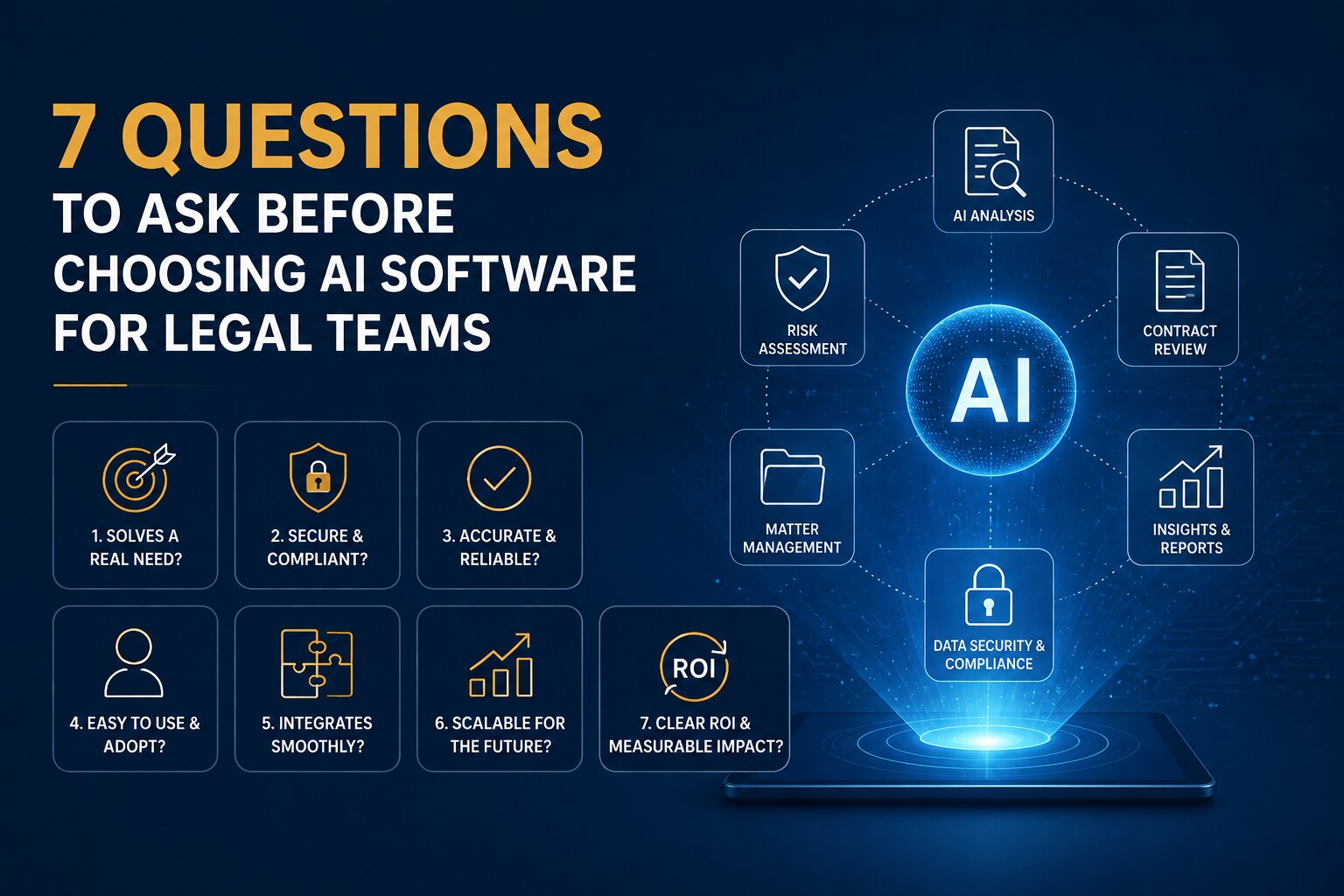
A platform that works well in a demonstration may not perform as expected with your contracts, matter records or approval processes. Before committing to a solution, it is important to understand what your team needs and how the software will support its day-to-day work. These seven questions can help legal teams assess AI software more systematically, compare vendors and make a more informed purchasing decision.
Start With Your Legal Team’s Actual Needs
Before approaching vendors, identify the legal processes that need improvement. For example, your team may spend too much time searching for documents, reviewing similar contract clauses, following up on approvals or updating matter records. Alternatively, legal information may be spread across email, spreadsheets and shared folders, making it difficult to understand the status of ongoing work.
These problems require different approaches. A tool designed for document summarisation may not provide the matter tracking, approval workflows or reporting your team needs.
Start by asking:
- Which legal tasks consume the most time?
- Where do delays or bottlenecks occur?
- Which teams or departments will use the software?
- What improvements would make the biggest difference?
- How will we measure whether the solution is working?
Documenting these requirements gives you a clear starting point. Instead of comparing platforms based on the number of AI features they offer, you can assess how well each solution addresses your actual needs.
Question 1: What Legal Problem Does the Software Solve?
The first question is whether the software addresses a specific legal or operational problem. General-purpose AI tools can assist with tasks such as drafting, summarising and generating ideas. However, legal teams may also need structured processes for managing matters, contracts, documents, deadlines, approvals and reporting. Before choosing a platform, establish what it can do within your intended workflow.
For example, if contract reviews are delayed because requests arrive through different channels, the team may need more than an AI document review feature. It may also need a way to receive requests, assign responsibility, track progress, manage approvals and store the final agreement.
Ask the vendor to demonstrate a complete process rather than presenting a list of individual features.
Consider whether the software can:
- Address the legal tasks identified during your initial assessment.
- Organise relevant documents and matter information.
- Support the approval and review process.
- Track responsibilities, deadlines and activities.
- Provide visibility into ongoing work.
A useful test is to select one process that currently causes difficulty and ask the vendor to demonstrate how the software would manage it from beginning to end. This helps you evaluate practical value rather than relying on general product claims.
The right platform should offer capabilities that match the team's actual requirements. If you are still defining those requirements, this overview of features to look for in a legal AI platform can help you identify the areas worth evaluating.
Question 2: Where Is Our Legal Data Stored and Who Can Access It?
Legal teams regularly handle confidential contracts, client information, business records and commercially sensitive documents. Understanding how an AI platform processes and protects this information should be part of the initial evaluation. Do not stop at asking whether the software is secure. Ask the vendor to explain its data-handling arrangements.
Important questions include:
- Where is the data stored and processed?
- Who can access documents and system records?
- How are user permissions assigned and reviewed?
- Is customer data used to train AI models?
- What records are maintained of user activities?
- How is information retained, exported or deleted when the contract ends?
- Which third-party providers process the data?
- How are international data transfers handled?
For UAE organisations, the applicable legal framework should also be considered. The UAE Personal Data Protection Law, Federal Decree-Law No. 45 of 2021, establishes a federal framework for personal data protection, including obligations relating to data processing, security and cross-border transfers.
Organisations operating in the Abu Dhabi Global Market (ADGM) or Dubai International Financial Centre (DIFC) should also assess the relevant data-protection frameworks applicable to their activities. ADGM has its Data Protection Regulations 2021, while DIFC operates under Data Protection Law No. 5 of 2020. Official guidance is available from the ADGM Office of Data Protection and the DIFC Commissioner of Data Protection.
The requirements that apply will depend on the organisation, the data involved and the circumstances of processing. Legal, IT, security and compliance teams should review the relevant obligations before confidential information is introduced into a new platform.
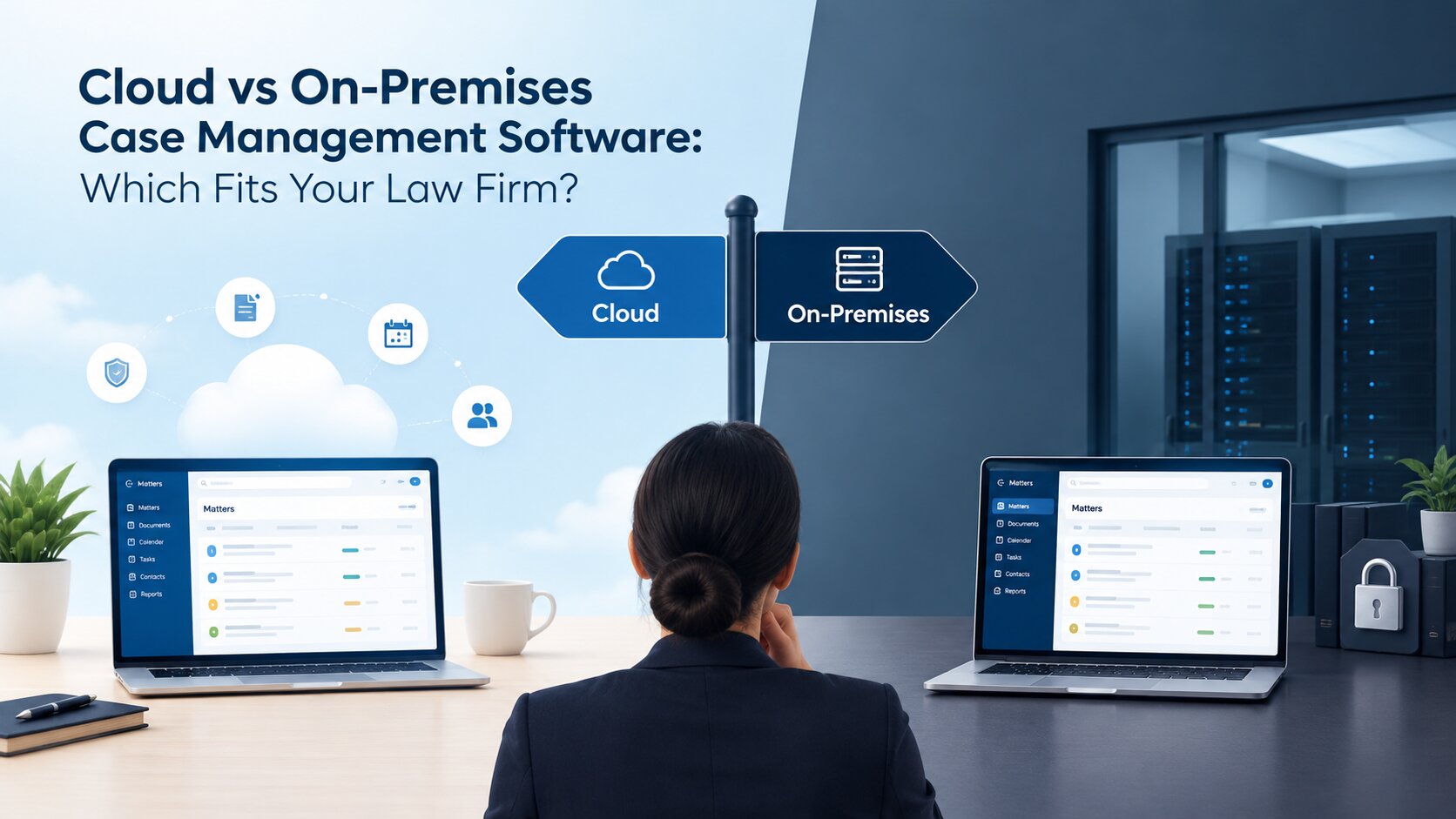
Where data residency or greater control over deployment is important, ask vendors to explain their available hosting and deployment options. For more information, see secure on-premise AI for legal teams.
Question 3: Can It Handle Arabic, English and UAE Legal Documents?
A software demonstration may look impressive when it uses English-language sample documents. Your legal team, however, may work with bilingual agreements, Arabic correspondence, amendments, tables, scanned documents and documents containing different formatting styles. The ability to process these materials should be tested before purchasing the software.
Ask vendors to demonstrate:
- Arabic and English document processing.
- Right-to-left text handling.
- Search across Arabic and English content.
- Extraction of relevant clauses and key information.
- Preservation of document structure and formatting.
- Handling of amendments and different contract versions.
- The ability to identify information accurately within your actual documents.
It is also important to distinguish between recognising text, understanding its context and interpreting its legal significance. A platform may extract a clause successfully without fully understanding the commercial implications of that clause. Where confidentiality requirements permit, test the software with representative documents from your team's workflow. Have legal professionals compare the results with the original documents and identify errors, omissions or formatting issues.
This provides a more useful assessment than relying solely on a vendor's demonstration.
Question 4: Will It Fit Into Our Existing Legal Workflow?
Introducing a new AI tool should simplify legal work rather than create another disconnected system. Before selecting a platform, map how your team currently handles legal requests, contracts, approvals, documents and matter records. Consider where information is stored, how work is assigned, how departments communicate and how management obtains updates on ongoing matters.
Then assess whether the proposed software can support these processes.
Depending on your requirements, useful capabilities may include:
- Integration with document repositories and email systems.
- Structured request and approval workflows.
- Centralised matter and contract records.
- Deadline reminders and task tracking.
- Reporting on workload, progress and outstanding actions.
- Integration with relevant business systems.
For example, improving contract review involves more than analysing the document. The process may also include requesting a review, assigning the responsible lawyer, collecting feedback, approving amendments, storing the final agreement and tracking renewal dates. If the AI tool addresses only the review stage, the remaining work may still depend on manual follow-ups and disconnected records.
Ask vendors to explain where their software fits before, during and after the task. Also clarify which integrations are available, which require additional configuration and whether any extra fees apply. A solution that fits the wider workflow may be easier to adopt and manage than a tool that addresses only one isolated activity.
Question 5: How Accurate Is the AI, and Who Reviews Its Output?
AI can help legal teams search, summarise and analyse information, but its output should not automatically be treated as correct. This matters particularly when the results influence contract reviews, legal matters, client communications or business decisions. Ask vendors how users can review AI-generated results, verify the underlying information and identify potential limitations. Establish whether the system provides references to source documents and whether users can correct or reject its output.
A structured pilot can help you assess performance. Choose a defined set of representative documents and agree on the criteria against which the results will be evaluated. Where possible, compare the AI-assisted process with the team's existing method.
Useful measures include:
- Whether relevant information was identified.
- Whether important clauses or obligations were missed.
- Whether summaries accurately reflected the source documents.
- How much correction or verification was required.
- How long the task took compared with the existing process.
- Whether users could understand and review the results.
Record the findings rather than relying on general statements about accuracy or productivity. Human oversight should remain part of workflows where professional judgement is required. The aim is to understand which tasks AI can assist with, where additional review is necessary and how responsibility for the final decision is maintained.
Question 6: What Happens After We Buy It?
Selecting the software is only one part of implementation. The organisation must also configure the system, prepare users, establish processes and provide ongoing support.
Before signing a contract, ask the vendor about:
- Implementation timelines and responsibilities.
- Data migration and system configuration.
- User onboarding and training.
- Integration with existing systems.
- Technical support and service arrangements.
- Future updates and maintenance.
- Assistance with pilot testing and rollout.
It is equally important to identify an internal owner who can coordinate implementation, collect feedback and monitor whether the software is meeting the team's needs. A phased rollout can make the process easier to manage. Start with one workflow and a defined group of users, then evaluate the results before extending the software to additional teams. For example, a legal department might begin with contract intake and approval tracking before introducing AI-assisted review across a broader range of agreements. This approach gives the team an opportunity to identify usability issues, refine processes and establish appropriate controls before expanding adoption.
Question 7: What Will It Cost, and How Will We Measure Its Value?
The subscription price is only one part of the total cost of legal software. Depending on the platform, additional expenses may include implementation, training, integrations, storage, additional users, customisation and ongoing support. Ask vendors to provide a clear explanation of the pricing structure and any limitations that could affect future costs.
Then identify the improvements the organisation expects to achieve.
These might include reducing time spent on repetitive administrative work, improving visibility into legal matters, reducing manual follow-ups or making documents easier to locate. Before implementation, record how the current process works. This baseline will help you assess whether the new software delivers meaningful improvements.
For example, you could track:
- Average time required to complete a defined task.
- Time spent on manual follow-ups.
- Number of overdue actions or outstanding approvals.
- Time required to locate relevant documents.
- Amount of human correction required for AI-generated results.
- User adoption and feedback.
Compare these measurements after implementation, using the same definitions and comparable workflows wherever possible. The objective is not to assume that software will automatically deliver savings. It is to determine whether the solution produces measurable improvements that justify its total cost.
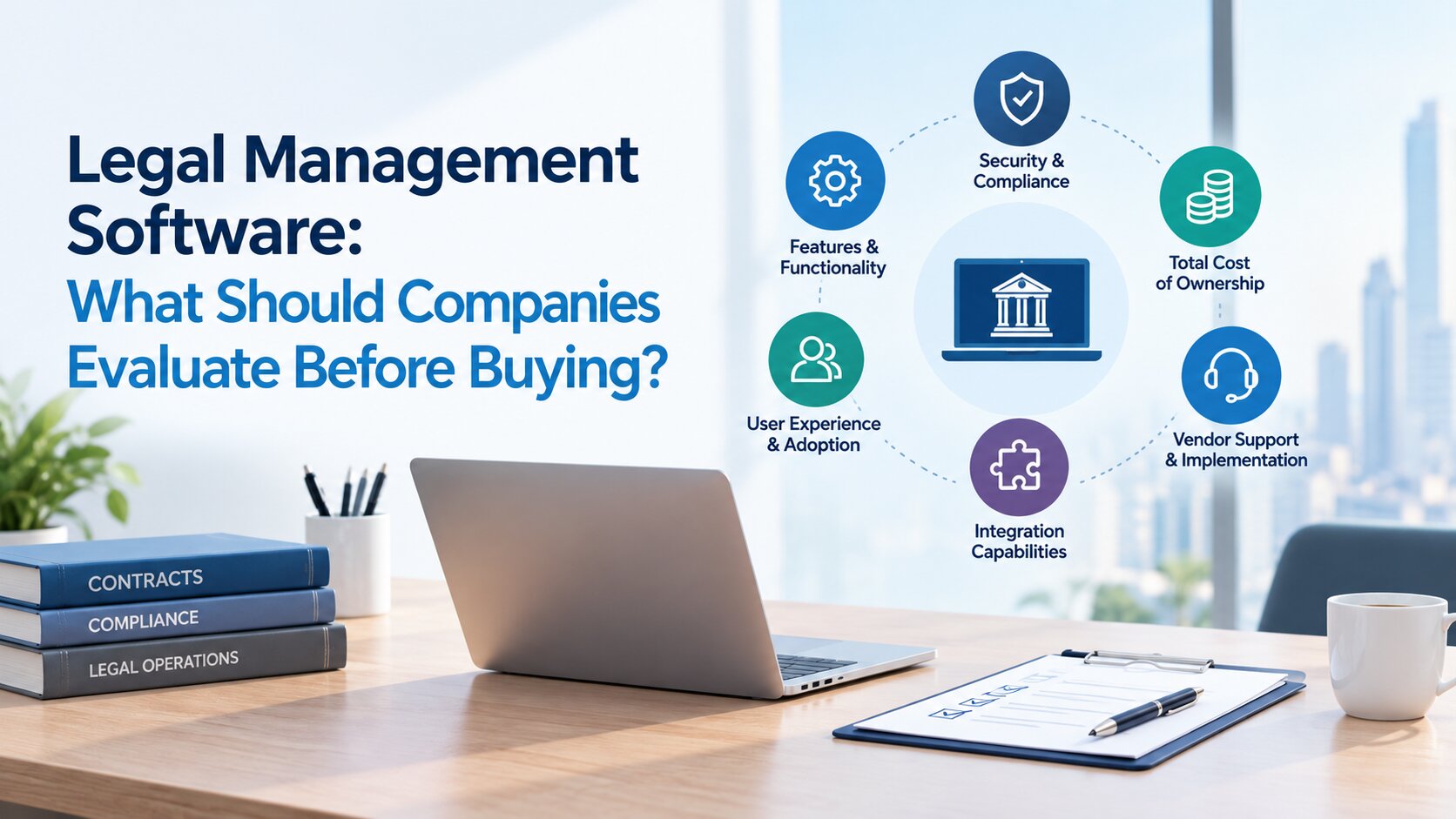
A Practical Scorecard for Comparing AI Software
After speaking with multiple vendors, a scorecard can help your team compare the available options consistently.
| Evaluation criterion | What to check |
|---|---|
| Legal use case | Does the platform address a clearly defined legal problem? |
| Data protection | Are storage, access, retention and data processing arrangements appropriate? |
| Arabic and English | Can it handle the team's actual documents and languages? |
| Workflow integration | Does it support existing processes and relevant systems? |
| AI accuracy and control | Can users verify, correct and approve the output? |
| Implementation | Are training, configuration and support clearly defined? |
| Total cost | Are subscription, implementation and ongoing expenses understood? |
| Measurable value | Can the team compare results against an established baseline? |
You can also divide requirements into two categories: must-have and nice-to-have. For instance, bilingual document processing may be essential for one legal team, while integration with a particular business system may be a priority for another. Use the scorecard alongside practical testing. A platform should be assessed against your team's requirements, not simply against the number of features it advertises.
Common Mistakes to Avoid When Choosing Legal AI Software
Even with a structured evaluation process, several mistakes can complicate the decision.
Choosing based only on a demonstration: Sample documents and prepared scenarios may not reflect your team's actual workload. Test realistic workflows wherever confidentiality requirements allow.
Overlooking data protection and security: Involve the relevant legal, IT, security and compliance stakeholders before sensitive information is introduced into a new system.
Expecting AI to operate without review: Assess where human verification is necessary, particularly for outputs that could affect legal or commercial decisions.
Rolling out the software without a pilot: A limited trial can reveal document-handling, integration and usability issues before wider deployment.
Ignoring the total cost: Evaluate implementation, training, integrations and ongoing support alongside the subscription price.
Buying without an internal owner: Assign responsibility for implementation, feedback, adoption and measuring outcomes.
Addressing these issues early can help your organisation make a more informed decision and establish realistic expectations.
How Beveron Supports Legal Teams
Choosing legal technology is not only about finding an AI feature that looks useful in a product demo. The platform should also fit the way legal teams manage matters, contracts, documents, compliance and day-to-day workflows. Beveron Technologies provides legal technology solutions designed for law firms and corporate legal teams. Its platforms include Smart Legal Counsel, which supports corporate legal operations, and Smart Lawyer Office, which is designed for law firms.
To understand how these solutions can support different legal processes, explore Beveron's legal sector solutions. This provides a broader view of how legal technology can be applied across different areas of legal work.
For teams evaluating AI and legal management software, the same questions discussed in this article can be applied to Beveron: Does it fit the team's workflow? Can it support the documents and processes users deal with every day? Can it improve visibility and reduce unnecessary manual work?
The focus should ultimately be on finding technology that supports the way the legal team actually works, rather than choosing software simply because it has an impressive list of AI features.
What Should You Do Before Choosing AI Legal Software?
Choosing AI software does not need to start with a long list of vendors. Start by identifying one legal workflow that needs improvement. Document the current process, identify where delays or manual work occur, and establish the outcomes you want to achieve. Then shortlist platforms based on those requirements. During vendor discussions, ask the seven questions outlined in this article. Test the software using realistic scenarios, review its data-handling arrangements, assess the integration requirements and measure the results against your baseline.
For UAE legal teams, this process should also consider applicable data-protection requirements, Arabic and English document handling, workflow compatibility and appropriate human oversight. If you are evaluating a legal management platform, contact Beveron to discuss your requirements and arrange a demonstration of the relevant solution. Use the same evaluation criteria to understand how the platform fits your existing legal workflows.
Ready to improve your legal workflows?
Explore how Beveron Smart Legal Counsel can support your corporate legal operations, or contact Beveron to discuss your requirements and arrange a personalised demonstration.
FAQs
Is AI software safe for confidential legal documents in the UAE?
It depends on how the specific platform processes, stores and protects information. Before using AI with confidential legal documents, assess data access, storage, retention, model-training practices, third-party processing and international transfers. Organisations should also consider the data-protection framework applicable to their activities.
How should a legal team test AI software before purchasing it?
Choose a specific workflow, establish a baseline and test the software with representative documents. Have legal professionals review the results, measure the amount of correction required and compare completion times and usability against the existing process.
Can small and mid-sized law firms benefit from AI software?
Potentially, yes. Legal software may help smaller firms organise matters and documents, reduce repetitive administrative work and improve follow-ups. The relevant consideration is whether the platform addresses the firm's actual needs and fits its available budget and resources.
Will AI replace lawyers or change how they work?
AI can assist with tasks such as searching, summarising and organising information. However, legal advice, professional judgement, verification and decisions requiring legal expertise still require appropriate human involvement. The impact depends on the task, the software and how the organisation uses it.
What is the difference between AI legal software and a legal management system?
AI legal software uses artificial intelligence to assist with specific tasks, such as document summarisation, information extraction or clause review. A legal management system can provide a broader structure for managing matters, contracts, documents, deadlines, approvals and reporting. Some platforms combine both capabilities within a wider legal workflow.
Best AI software for legal teams in the UAE
Best AI tools for legal teams in the UAE
Best legal technology software in the UAE
If you need a free demo of the best AI software for legal teams in the UAE, please fill out the form.