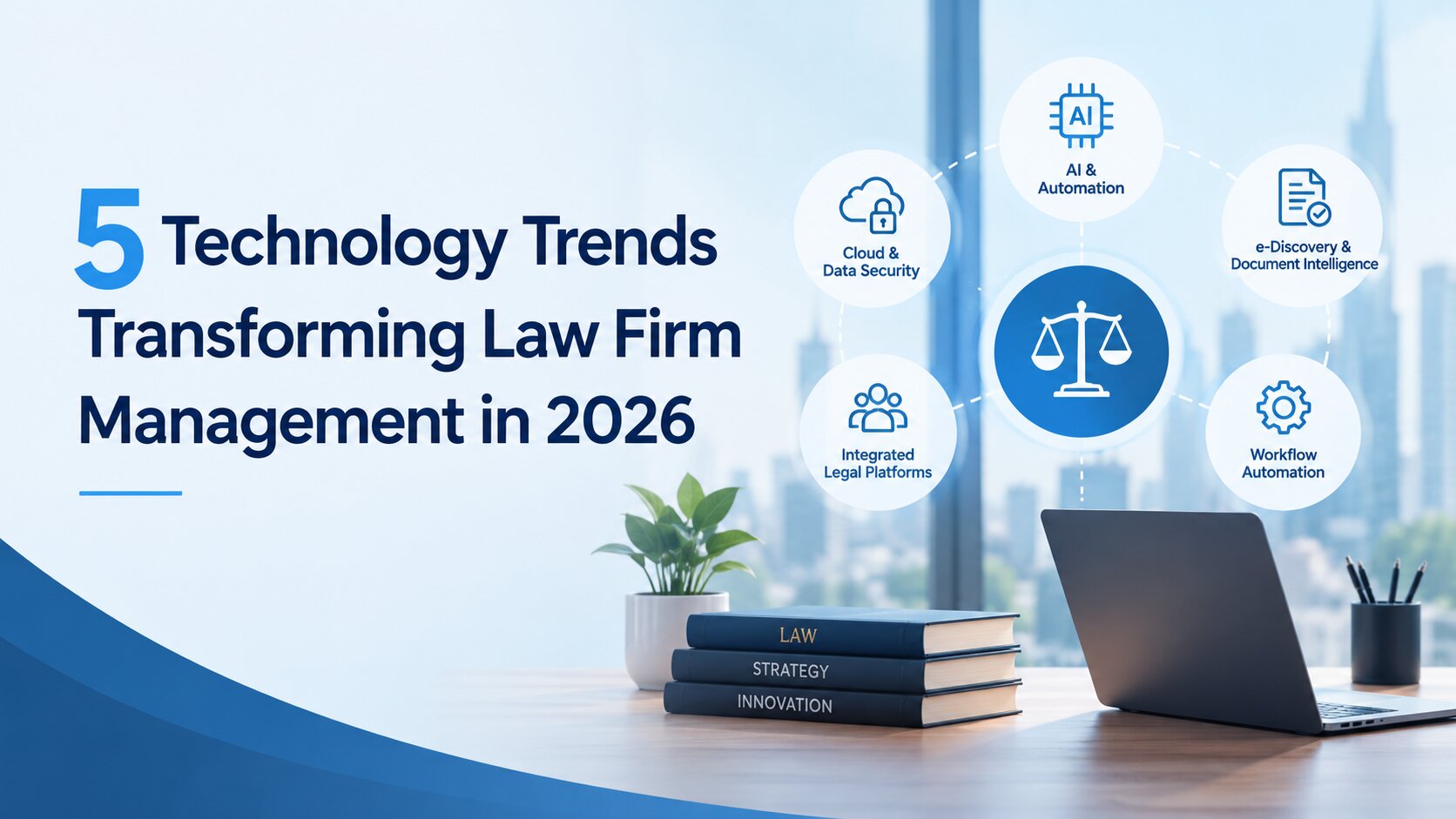
5 Technology Trends Transforming Law Firm Management in 2026
Law firm management involves much more than handling cases and preparing legal documents. Lawyers and managing partners must also coordinate workloads, monitor deadlines, maintain client records, manage billing, and protect confidential information. When these responsibilities depend on disconnected systems or manual processes, even a well-organised firm can struggle to keep everything running smoothly.
Technology is changing how law firms approach these challenges. Artificial intelligence (AI), cloud-based platforms, legal analytics and integrated workflows are creating new ways to organise legal work and manage day-to-day operations. At the same time, cybersecurity and responsible technology adoption have become essential considerations.
In 2026, the question is no longer simply whether a law firm should adopt digital tools. It is about choosing the right technology, understanding where it adds value and making sure it supports the way the firm actually works.
Here are five technology trends transforming law firm management and what they mean for legal professionals.
1. AI-Powered Legal Workflows and Intelligent Automation
Artificial intelligence is becoming a more practical part of legal work. Rather than being used only for research or drafting, AI can support several activities involved in managing legal matters and processing information. Consider a law firm that receives a large volume of documents for new cases. Manually reviewing each file, identifying relevant information, and organising records can take considerable time. Depending on the tools used, AI can assist with document classification, information extraction, summarisation and locating relevant details within large collections of files.
Automation can also help with routine administrative activities. For example, a system may assign tasks based on predefined rules, send reminders about upcoming deadlines or trigger the next step in a matter workflow when a particular action is completed. As discussed in the future of legal workflows and why AI will replace 40% of routine tasks by 2030, AI-driven automation is expected to reshape how law firms handle repetitive activities and manage everyday processes. These capabilities can reduce the need for staff to monitor every process manually.
However, AI should not be treated as a replacement for legal expertise. Generated summaries may miss important details, extracted information may be inaccurate, and automated outputs may lack the context needed for a sound legal decision. Law firms should establish clear review procedures and ensure that confidential information is handled appropriately. The most useful approach is to identify repetitive tasks that consume time, determine whether AI or automation can handle them reliably, and introduce the technology with suitable human oversight.
2. Cloud-Based Law Firm Management Systems
A law firm's information is often spread across case files, email accounts, spreadsheets, shared folders and individual computers. As the team grows, keeping these records organised and accessible becomes increasingly difficult. Cloud-based law firm management systems offer a way to bring relevant information into a more centralised working environment. For a closer look at how this technology works, read our guide to cloud-based law automation software. Depending on the platform, authorised users can access case records, documents, schedules and other matter-related information without relying on files stored on a particular office computer.
This can be especially useful for firms with multiple offices or lawyers who work outside the main office. Team members can refer to the same matter records, check updates and coordinate responsibilities without repeatedly exchanging document copies or requesting information from colleagues. Centralisation can also make routine management easier. Instead of searching through several folders to understand the status of a case, a lawyer may be able to review the relevant information from one system.
Cloud adoption, however, requires more than moving files online. Firms need to understand how their provider stores and protects information, how user access is managed, what backup and recovery arrangements are available, and where data is hosted. These considerations are particularly important when client confidentiality and jurisdiction-specific requirements are involved. A cloud-based platform is most valuable when it makes everyday work more accessible and organised without compromising the firm's security obligations.
3. Data-Driven Decision-Making and Legal Analytics
Law firm leaders make decisions every day about staffing, deadlines, billing, resource allocation and business performance. Without reliable operational information, these decisions may depend largely on individual observations or incomplete reports. Legal analytics can help firms understand what is happening across their operations by turning routine activity into useful management information.
For example, a managing partner may want to know why certain matters consistently take longer than expected. By reviewing matter turnaround times, task completion records and workload distribution, the firm may identify recurring bottlenecks. The issue could be an uneven allocation of work, delays in document preparation or a process that requires unnecessary approvals.
Financial reporting can provide another perspective. Metrics such as billable hours, realisation rates and matter profitability can help partners understand how the firm's resources are being used. These measures are more useful when considered alongside client needs, work quality and the complexity of individual matters. Dashboards can make this information easier to review. Rather than compiling separate spreadsheets for every reporting period, managers may be able to view relevant performance indicators in one place, depending on the capabilities of their systems.
Still, having more data does not automatically lead to better decisions. Inconsistent records, poorly chosen metrics and misleading comparisons can create the wrong impression. A firm should begin by identifying the questions it needs to answer and then select a small set of meaningful indicators. The aim is to use information to understand and improve the firm's operations, not simply to produce more reports.
4. Integrated Legal Technology and Connected Workflows
Even when a law firm uses several capable software applications, its overall workflow can remain inefficient if those applications operate independently. Client information might be recorded in one system, case details in another, billing handled separately and appointments maintained in individual calendars. Staff may then need to enter the same information multiple times or move data manually between tools.
These small tasks can create unnecessary work. They can also introduce inconsistencies when one record is updated, but another is not. Integrated legal technology addresses this problem by allowing compatible systems to exchange information or coordinate activities. Depending on the available integrations, a firm's client records, matter management, billing and other operational tools may work together more effectively.
Imagine a firm opening a new matter. Client details are recorded during intake, the matter is created, responsibilities are assigned, and relevant administrative steps are initiated. When suitable systems are connected, information may flow between these activities without requiring staff to recreate every record. The value lies in reducing fragmented processes and making the movement of information more consistent.
Before adopting an integrated solution, law firms should consider whether it works with their existing applications, supports the required data flows and offers appropriate controls over information sharing. They should also evaluate implementation costs, migration requirements and what happens when an integration fails. Integration should solve a defined operational problem. Connecting applications simply for the sake of connectivity can introduce additional complexity without delivering meaningful improvements.
5. Cybersecurity and Responsible Legal Technology Adoption
As law firms store more information digitally and rely on connected systems, protecting client data becomes an increasingly important part of technology management. Legal records may contain confidential correspondence, financial information, personal details, contracts and sensitive case documents. Unauthorised access or accidental disclosure can damage client relationships, disrupt operations and create legal or professional consequences.
Cybersecurity therefore needs to be considered alongside every technology decision, rather than added as an afterthought.
Basic safeguards include multi-factor authentication, role-based access permissions, encryption, secure document sharing and audit trails where supported. These measures can help firms control who accesses information and review relevant activity. Regular backups, recovery plans and staff awareness training are also important.
AI introduces additional considerations. Lawyers may be tempted to paste client documents into publicly available AI tools to obtain a quick summary or draft. Before doing so, they need to understand the tool's data handling practices and whether its use is permitted under the firm's confidentiality and data protection obligations.
Firms should establish clear policies covering approved tools, permitted uses, human review and the handling of sensitive information. They should also assess vendors carefully and review access permissions as staff responsibilities change. Importantly, security is not a one-time project. Software changes, new integrations and evolving threats require ongoing attention. Firms should periodically review their controls and ensure employees understand their responsibilities.
Responsible technology adoption means making improvements without losing sight of confidentiality, professional accountability and client trust.
How These Technology Trends Work Together in a Modern Law Firm
These five trends are most useful when they support the same operational process rather than functioning as separate technology initiatives. Consider how a firm manages a new client matter. A cloud-based management system provides authorised team members with access to the matter record. Automation helps coordinate routine tasks and reminders, while integrated applications reduce repeated data entry across relevant processes. Reporting tools allow managers to monitor progress and identify delays, and security controls help protect the information involved.
Each technology has a different role. Cloud systems support access, AI and automation assist with selected tasks, integrations connect applications, analytics provide management insight, and cybersecurity protects the working environment. The goal is not to introduce every available tool at once. It is to create a more organised and reliable way of working by addressing the firm's actual needs.
How Law Firms Can Prepare for Technology Changes in 2026
Adopting new technology does not always require a complete overhaul of existing systems. In many cases, the better starting point is to understand where current processes are falling short. First, review how the firm manages matters, documents, deadlines, billing and internal communication. Identify activities that involve repeated data entry, frequent follow-ups or unnecessary delays. These observations can help establish which problems deserve attention first.
Next, evaluate potential solutions against practical requirements. Consider ease of use, security, integration options, reporting capabilities, scalability and implementation support. A platform with an impressive list of features may not be the right choice if it complicates established workflows or requires significant changes that the team is not prepared to make. Staff involvement is equally important. Lawyers, administrative employees and managers may use the same system differently. Gathering their feedback during the selection process can help identify practical requirements and reduce resistance during implementation.
Once a solution is selected, begin with a clearly defined workflow where possible. Provide training, establish responsibilities and measure performance against a baseline. For example, a firm could monitor whether a revised process reduces delays in matter opening or improves the consistency of deadline tracking. Regular reviews will help determine whether the technology is delivering the intended results and where adjustments are needed.
Ultimately, successful adoption depends less on how many tools a firm uses and more on whether those tools improve the way its people work.
Supporting Modern Law Firm Management with Beveron Technologies
Choosing suitable technology is an important step towards creating more organised legal operations. For law firms looking to improve how they manage cases and day-to-day practice activities, a dedicated legal practice management platform can provide a more structured working environment.
Beveron Technologies' Smart Lawyer Office is designed for law firm practice and case management. It is relevant to firms seeking to organise case-related activities and manage their daily operations through a dedicated legal technology solution.
When evaluating a platform such as Smart Lawyer Office, firms should consider how its capabilities align with their existing processes, including case tracking, matter information, deadlines and the administrative requirements of their practice. The right fit will depend on the firm's size, working methods and specific operational priorities.
Rather than adopting technology simply because it is trending, law firms should focus on solutions that address genuine challenges and support consistent working practices.
Explore Beveron Smart Lawyer Office to learn more about its legal practice management solution and assess whether it aligns with your firm's needs.
Conclusion
Technology is changing law firm management in several important ways. AI and automation can assist with repetitive tasks, cloud-based systems improve access to information, analytics support better management decisions, integrations connect operational processes, and cybersecurity helps protect confidential client records. However, technology alone does not guarantee better outcomes. Its value depends on how well it fits the firm's workflows, how responsibly it is implemented and whether the people using it receive the right support.
For law firms planning their next stage of development in 2026, the most practical starting point is to identify one or two operational challenges and evaluate which technology can address them effectively. A thoughtful, step-by-step approach can help firms modernise their operations while maintaining the professional judgement, confidentiality and client service on which their reputation depends.
Frequently Asked Questions
1. What are the top technology trends transforming law firm management in 2026?
The key trends include AI-powered workflows, cloud-based management systems, legal analytics, integrated legal applications and stronger cybersecurity. Together, these technologies can help law firms organise information, coordinate work and make more informed operational decisions.
2. How is AI changing law firm management?
AI can assist with activities such as document classification, information extraction and summarisation, while workflow automation can coordinate routine tasks and reminders. Legal professionals still need to review outputs, exercise independent judgement and protect confidential information.
3. What are the benefits of cloud-based law firm management software?
Depending on the platform, cloud-based software can provide authorised users with access to centralised matter records, documents and schedules. It can also support collaboration across offices and remote working, provided the firm has suitable security and data management arrangements.
4. How can legal technology improve law firm productivity?
Legal technology can reduce repetitive administrative work, improve access to information, connect business processes and provide better visibility into workloads and performance. The results depend on selecting suitable tools and implementing them effectively.
5. What should law firms consider before adopting new technology?
Law firms should assess their operational requirements, ease of use, security, integration capabilities, scalability, implementation costs and staff training needs. They should also define measurable goals to evaluate whether the chosen technology delivers practical value.
Best law firm management technology in the UAE
Best AI in law firm automation in the UAE
Best law firm management software in the UAE
If you need a free demo of the best law firm management technology in the UAE, please fill out the form.