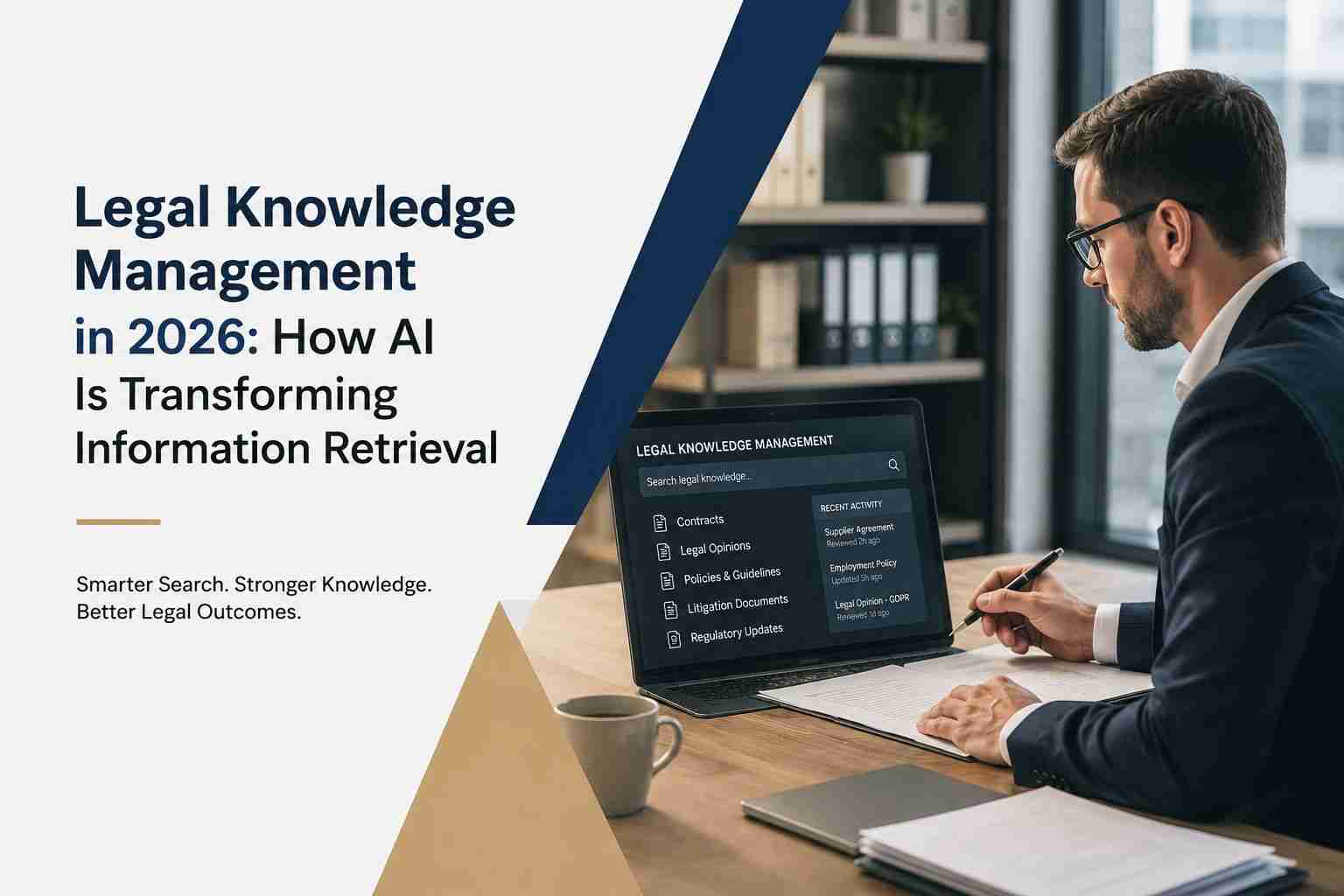
Legal Knowledge Management in 2026: How AI Is Transforming Information Retrieval
Introduction
Legal departments have never had access to more information than they do today. Contracts, legal opinions, litigation files, compliance records, corporate policies, regulatory updates, board resolutions and internal guidance continue to grow at an unprecedented pace. While this wealth of information should enable faster and more informed decision-making, many organisations face the opposite reality.
Legal professionals often spend significant time searching for documents, verifying the latest version of an agreement or locating previous legal advice. Information is frequently scattered across shared drives, document management systems, email inboxes and departmental folders, making it difficult to retrieve the right knowledge when it is needed most.
As legal departments take on broader responsibilities in governance, compliance and enterprise risk management, efficient knowledge retrieval has become a business necessity rather than an operational convenience. Modern legal teams need technology that helps them access trusted information quickly while maintaining security, accuracy and consistency.
Artificial intelligence (AI) is changing how legal knowledge is managed and retrieved. Instead of relying solely on keyword searches, AI can understand context, identify relationships between documents and surface relevant information within seconds. This evolution reflects a broader shift towards AI-powered LegalTech for in-house counsel, where intelligent automation is helping legal teams improve productivity, reduce manual effort and make faster business decisions.
What Is Legal Knowledge Management?
Legal knowledge management is the structured process of capturing, organising, maintaining and sharing legal information across an organisation. Its purpose is to preserve institutional knowledge and ensure legal professionals can quickly access reliable information whenever they need it.
A comprehensive legal knowledge management system typically includes:
- Contracts and commercial agreements
- Legal opinions and advisory notes
- Litigation files
- Regulatory guidance
- Corporate policies
- Internal precedents
- Legal templates
- Compliance documentation
- Governance records
Rather than recreating work or relying on individual experience, legal teams can build a central knowledge repository that supports consistent legal advice, faster decision-making and improved collaboration across the business.
Why Traditional Knowledge Management Is No Longer Enough
Although many organisations have invested in document management systems, simply storing documents is no longer sufficient. The real challenge lies in retrieving meaningful information quickly and confidently.
Information Is Fragmented
Legal information is often distributed across multiple systems. Contracts may reside in one repository, regulatory guidance in another and email discussions somewhere else entirely. This fragmentation creates inefficiencies and increases the likelihood of overlooking important information.
Searching Takes Too Long
Traditional keyword searches often produce hundreds of results without identifying the most relevant documents. Lawyers may spend valuable time opening multiple files before finding the information they actually need.
Valuable Knowledge Is Lost
Experienced legal professionals develop significant institutional knowledge over many years. Without a structured knowledge management strategy, much of this expertise disappears when employees leave the organisation.
Version Control Creates Risk
Multiple copies of contracts and legal documents frequently exist across different folders and departments. Without effective version control, organisations risk relying on outdated clauses or obsolete legal advice.
Governance Becomes More Difficult
As legal knowledge expands, maintaining oversight becomes increasingly challenging. AI should accelerate knowledge discovery while maintaining human oversight, auditability and enterprise governance. Effective governance ensures legal information remains accurate, secure and aligned with organisational policies while preserving accountability for legal decisions.
How AI Is Transforming Legal Information Retrieval
Artificial intelligence is fundamentally changing how legal professionals interact with organisational knowledge. Rather than searching for exact keywords, AI understands context, relationships and user intent.
Natural Language Search
Modern legal professionals no longer need to remember exact document names or file locations. AI allows users to search using everyday language.
For example, a lawyer might ask:
- Which supplier contracts expire within the next six months?
- Show employment agreements containing non-compete clauses.
- Find previous legal advice relating to data privacy compliance.
Instead of matching isolated keywords, AI interprets the intent behind the request and delivers more relevant results.
Semantic Search
Semantic search analyses the meaning behind legal content rather than simply matching identical words.
For example, a search for "termination rights" may also retrieve documents discussing contract cancellation, early exit provisions or breach clauses, even if those exact terms were never used.
This enables legal teams to discover relevant precedents and supporting information far more efficiently.
Intelligent Document Classification
AI can automatically classify contracts, litigation files, legal opinions and compliance documents based on their content. Instead of manually tagging every document, legal teams benefit from consistent categorisation while significantly reducing administrative effort.
Automated Metadata Extraction
Modern AI can automatically identify important information, including:
- Parties
- Jurisdictions
- Effective dates
- Renewal periods
- Contract values
- Governing law
- Legal obligations
This makes documents easier to organise and retrieve.
AI-Generated Summaries
Reviewing lengthy legal documents often consumes valuable time. AI-generated summaries allow lawyers to understand key clauses, risks and obligations before conducting a detailed review, helping prioritise work more effectively.
Contextual Knowledge Discovery
One of AI's greatest strengths is identifying relationships between documents. These capabilities become even more powerful when combined with advanced legal search and analytics, allowing legal professionals to locate specific clauses, compare contracts and extract valuable insights from large legal repositories in seconds.
Instead of presenting a single contract, AI may also recommend:
- Similar agreements
- Previous legal advice
- Related litigation
- Comparable regulatory guidance
- Relevant corporate policies
This provides legal professionals with richer context for decision-making.
A Practical Example of AI in Action
Imagine a legal team receives a request to identify every supplier agreement containing a change-of-control clause that was signed during the last three years.
Using traditional methods, lawyers might need to search multiple repositories, open dozens of contracts individually and manually review each agreement before compiling the results. Depending on the size of the organisation, this exercise could take several hours or even days.
An AI-powered legal knowledge management platform approaches the task very differently. By understanding the legal context of the request, it can identify the relevant supplier agreements, recognise the required clause, extract the appropriate documents and present a consolidated list within minutes.
Rather than replacing legal expertise, AI removes much of the manual effort involved in locating information, allowing legal professionals to focus on analysing the results and providing strategic advice.
Traditional Knowledge Management vs AI-Powered Knowledge Management
| Traditional Knowledge Management | AI-Powered Knowledge Management |
|---|---|
| Keyword-based search | Semantic, context-aware search |
| Manual document tagging | AI document classification |
| Folder-based navigation | Natural language search |
| Static document repository | AI knowledge recommendations |
| Manual document summaries | AI-generated summaries |
| Separate information silos | Unified knowledge base |
| Slow document retrieval | Rapid information discovery |
The comparison highlights how AI shifts legal knowledge management from passive document storage to intelligent information retrieval, enabling legal departments to respond more quickly to business needs.
Essential Features of an AI-Powered Legal Knowledge Management System
Selecting the right platform requires looking beyond basic document storage. Modern legal departments should evaluate solutions that improve accessibility, governance and long-term scalability.
Centralised Knowledge Repository
A single source of truth ensures legal information remains organised, searchable and consistently available to authorised users.
Enterprise Search
Powerful search capabilities enable users to locate information using natural language, metadata, clauses, jurisdictions, dates and legal concepts rather than relying solely on file names.
Intelligent Document Management
AI enhances document organisation by classifying files automatically, extracting metadata and maintaining structured knowledge across the legal repository.
Version Control
Maintaining a complete history of document revisions ensures legal professionals always work with the latest approved version while preserving historical records.
Role-Based Access Control
Legal departments manage highly confidential information. Access permissions should ensure users only view information relevant to their responsibilities.
Audit Trails
Comprehensive audit logs improve accountability by recording document access, edits, approvals and user activity, supporting both governance and regulatory compliance.
Analytics and Reporting
Modern platforms provide valuable insights into document usage, search behaviour, knowledge gaps and repository performance, enabling continuous improvement.
Benefits of AI-Powered Legal Knowledge Management
Artificial intelligence delivers value far beyond faster document searches.
Legal professionals spend less time locating information and more time advising the business on strategic legal matters. When combined with legal workflow automation, AI-powered knowledge management streamlines approvals, document reviews and routine legal processes, enabling teams to operate more efficiently.
For compliance teams, structured knowledge management improves audit readiness by ensuring supporting documentation, approvals and regulatory records remain easily accessible whenever required.
Best Practices for Successful Implementation
Technology alone does not guarantee success. Organisations should begin by reviewing and organising their existing legal knowledge, removing duplicate documents and archiving obsolete information. Developing a consistent taxonomy helps classify legal content in a structured manner, while clearly defined governance policies ensure ongoing quality and accountability.
AI should always operate alongside legal expertise. Human oversight remains essential for validating legal advice, reviewing AI-generated outputs and maintaining professional judgement. Training users is equally important. Even the most advanced platform delivers limited value if employees continue relying on disconnected folders or personal document collections.
Many organisations are now approaching legal AI as part of a broader digital transformation strategy. Beveron Technologies advocates responsible AI adoption that combines intelligent automation with strong governance, security and practical legal expertise, enabling organisations to modernise legal operations while maintaining trust and compliance.
The Future of Legal Knowledge Management Beyond 2026
Artificial intelligence is evolving rapidly, and legal knowledge management is expected to become significantly more intelligent over the next few years. Rather than simply helping users locate documents, future platforms will proactively deliver relevant knowledge, identify emerging legal risks and support more informed decision-making across the organisation.
While human expertise will always remain central to legal practice, AI will increasingly act as an intelligent assistant that helps legal professionals navigate growing volumes of information with greater speed and accuracy.
Enterprise Legal Copilots
One of the most significant developments is the emergence of enterprise legal copilots. Unlike public AI tools, enterprise legal copilots are designed to work securely within an organisation's legal environment. These AI assistants will be able to answer questions using approved organisational knowledge, draft summaries, retrieve relevant precedents and assist lawyers with everyday legal tasks without exposing confidential information to external systems.
Rather than replacing lawyers, legal copilots will reduce administrative effort and enable legal professionals to focus on higher-value work such as legal strategy, negotiation and risk management.
Retrieval-Augmented Generation (RAG)
Retrieval-Augmented Generation (RAG) is becoming an important capability for enterprise AI. Instead of generating responses solely from a large language model, RAG retrieves information from an organisation's trusted legal repository before generating an answer.
For legal departments, this means AI responses can be grounded in current contracts, internal policies, legal opinions and compliance documentation rather than relying only on publicly available information.
The result is greater accuracy, improved transparency and more reliable legal insights while maintaining confidence in the underlying source material.
Knowledge Graphs
Traditional document repositories store information as separate files. Knowledge graphs take a different approach by connecting people, contracts, legal entities, obligations, regulations and matters into an intelligent network of relationships. This enables legal professionals to discover insights that would otherwise remain hidden.
For example, a lawyer reviewing a supplier dispute could immediately identify related contracts, previous legal advice, connected entities, regulatory obligations and historical negotiations, all from a single search. As enterprise legal operations become more complex, knowledge graphs will play an increasingly important role in improving information discovery and legal intelligence.
Multimodal Search
Legal knowledge is no longer limited to text documents. Modern organisations also manage scanned agreements, handwritten notes, emails, presentations, images, meeting recordings and video discussions. Future AI platforms will increasingly support multimodal search, allowing legal professionals to retrieve information regardless of its format.
Instead of searching only documents, lawyers may ask AI to locate a board presentation discussing a specific acquisition, identify clauses within scanned agreements or retrieve meeting transcripts referencing a regulatory issue. This broader search capability will significantly improve knowledge accessibility across enterprise legal departments.
Private AI for Enterprise Legal Teams
As AI adoption continues to grow, many organisations are prioritising private AI deployments that allow sensitive legal information to remain within their own secure environments. Private AI gives organisations greater control over data privacy, governance and regulatory compliance while allowing legal professionals to benefit from advanced AI capabilities.
For highly regulated industries and organisations managing confidential legal information, private AI is likely to become an increasingly important part of enterprise legal technology strategies.
Why Legal Knowledge Management Is Becoming a Strategic Business Capability
Legal knowledge management is no longer simply about organising documents. It is becoming a strategic capability that enables legal departments to support faster business decisions, improve governance and reduce organisational risk. When legal professionals can quickly retrieve reliable information, they spend less time searching for documents and more time advising stakeholders, negotiating contracts and supporting business growth.
The combination of AI-powered search, intelligent document management and strong governance creates a legal function that is more responsive, collaborative and data-driven.
Forward-thinking organisations are increasingly recognising that knowledge management is not merely an operational improvement but an investment in organisational resilience and long-term competitiveness.
Conclusion
Legal knowledge has become one of the most valuable assets within modern organisations. However, its true value depends on how effectively that knowledge can be accessed, understood and applied.
Traditional document repositories are no longer sufficient for today's enterprise legal departments. As legal information continues to grow in both volume and complexity, organisations need intelligent systems that move beyond basic storage to deliver meaningful insights.
Artificial intelligence is transforming legal information retrieval through semantic search, intelligent document classification, automated summaries and contextual knowledge discovery. Combined with strong governance, human oversight and secure enterprise architecture, these capabilities enable legal professionals to work more efficiently while improving consistency, reducing operational risk and strengthening compliance.
The future of legal knowledge management will not be defined by replacing lawyers with AI. Instead, it will be shaped by technology that enhances legal expertise, accelerates knowledge discovery and enables enterprise legal departments to become more strategic business partners. Organisations that invest in modern knowledge management today will be better positioned to navigate evolving regulations, manage growing legal complexity and deliver greater value across the business in the years ahead.
Future-Proof Your Legal Knowledge Management with Beveron Technologies
The volume of legal information will only continue to grow. The question is whether your legal department can find, manage and use that knowledge efficiently when it matters most.
With AI-powered legal technology from Beveron Technologies, enterprise legal teams can centralise legal knowledge, retrieve critical information faster, automate routine processes and strengthen governance—all from a secure, intelligent platform. Learn how Beveron supports legal organisations with purpose-built solutions designed to improve efficiency, strengthen governance and accelerate digital transformation.
Whether you're modernising legacy systems or building a future-ready legal function, Beveron Technologies helps you transform legal knowledge into a strategic business asset.
Ready to empower your legal team with faster information retrieval and smarter legal operations? Explore how Beveron Technologies can help you build a more intelligent, efficient and resilient legal department.
Frequently Asked Questions
1. What is legal knowledge management?
Legal knowledge management is the process of capturing, organising, storing and sharing legal information such as contracts, legal opinions, compliance records, litigation documents and corporate policies. It enables legal professionals to access trusted information quickly while preserving institutional knowledge across the organisation.
2. How does AI improve legal information retrieval?
AI improves legal information retrieval by understanding context rather than relying solely on keywords. It can perform semantic searches, classify documents automatically, generate summaries, extract metadata and recommend related legal information, helping legal teams find relevant knowledge more efficiently.
3. What are the benefits of AI-powered legal knowledge management?
AI-powered legal knowledge management helps organisations improve productivity, accelerate legal research, strengthen compliance, reduce operational risk, improve collaboration and provide faster access to trusted legal information across the enterprise.
4. Is AI-powered legal knowledge management secure?
Modern enterprise legal platforms include robust security measures such as role-based access controls, encryption, audit trails, and secure document repositories. Many organisations also choose private AI deployments to maintain complete control over sensitive legal information while benefiting from AI capabilities.
5. How can organisations successfully implement AI-powered legal knowledge management?
Successful implementation begins with organising existing legal content, establishing a consistent taxonomy, defining governance policies, and ensuring high-quality data. Organisations should also provide user training, maintain human oversight, and regularly review adoption to maximise long-term value.
Best legal knowledge management software in the UAE
Best corporate legal knowledge management in the UAE
Best AI for legal departments in the UAE
If you need a free demo of the best legal knowledge management software in the UAE, please fill out the form below.