AI-Powered Legal Intake: Why General Counsel Are Replacing Email-Based Request Management
Introduction
For many corporate legal departments, email remains the default channel for legal requests. Contract reviews, regulatory questions, employment matters, procurement approvals, and compliance concerns often arrive through overflowing inboxes, creating a growing challenge for legal teams already operating under pressure.
The problem is not that email is ineffective for communication. The problem is that it was never designed to function as a legal intake management system.
As organisations grow, legal teams are expected to support more business units, manage increasing regulatory complexity, and respond faster to stakeholders. Yet many legal departments still rely on email threads to capture, prioritise, and assign work. The result is often delayed responses, inconsistent workflows, limited visibility, and valuable legal expertise being consumed by administrative tasks.
This is one reason why general counsel and legal operations leaders are increasingly exploring AI-powered legal intake solutions. By replacing fragmented email-based request management with structured workflows and intelligent automation, legal teams can improve efficiency, strengthen governance, and deliver a better experience for the business.
Why Email-Based Legal Request Management No Longer Works
The Volume Problem
Legal demand continues to grow across most organisations. Business teams require faster contract reviews, procurement teams need legal approvals, HR departments seek employment guidance, and compliance teams depend on legal input for regulatory matters.
As request volumes increase, inboxes often become informal work queues. High-priority requests can easily become buried beneath routine correspondence, making it difficult for legal teams to maintain consistent response times.
Unlike a dedicated legal intake management system, email provides no structured method for prioritisation, workload balancing, or service-level tracking. As a result, legal teams frequently spend valuable time searching for information rather than addressing legal issues.
Triage Bottlenecks and Human Error
Every incoming request typically requires someone to review the message, understand the context, determine its urgency, and assign it to the appropriate lawyer or team. While this process may appear manageable at lower volumes, it becomes increasingly difficult as demand grows.
Manual triage often leads to the following:
- Misrouted requests
- Duplicate submissions
- Inconsistent prioritisation
- Delays caused by missing information
- Excessive follow-up communication
Many legal departments discover that a significant portion of their intake effort is spent sorting and clarifying requests rather than delivering substantive legal advice.
Poor Data and Weak Audit Trails
Email threads rarely capture information in a consistent format. Critical details such as business impact, contract value, risk level, jurisdiction, or required completion date may be missing or scattered across multiple messages. This makes reporting difficult and limits a legal department's ability to analyse trends or demonstrate performance. The lack of structured data can also create challenges when organisations need to reconstruct decisions, support investigations, respond to audits, or review compliance activities.
Uneven User Experience
Internal stakeholders increasingly expect legal services to be delivered with the same efficiency they experience from other corporate functions. When legal requests disappear into inboxes without acknowledgement, status updates, or clear expectations, frustration often follows. An inconsistent intake process can unintentionally damage lawyers' reputations as strategic business partners, even when lawyers are delivering high-quality work.
What an AI-Powered Legal Intake System Looks Like
Core Components
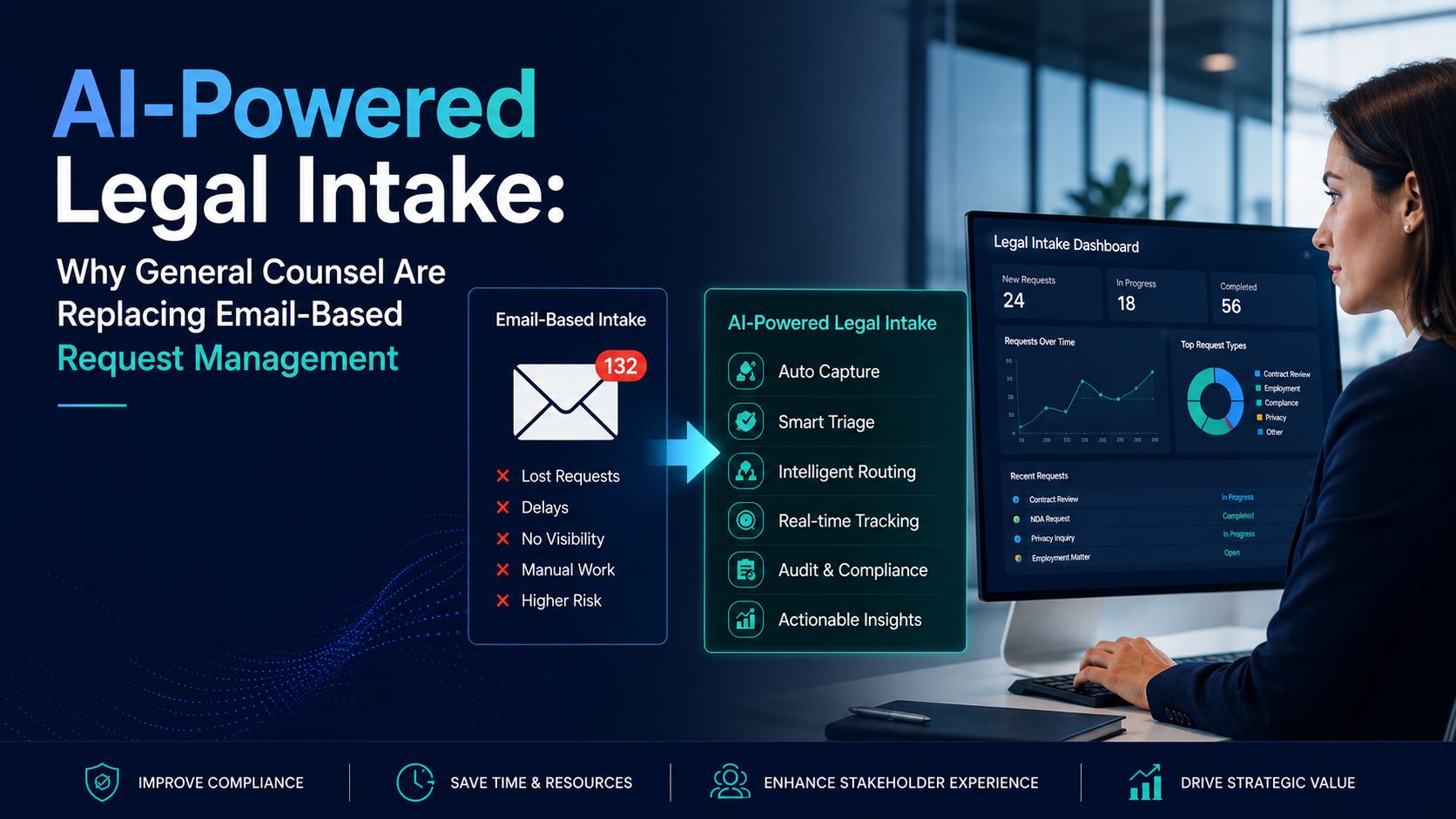
Modern AI legal intake software combines structured request capture with intelligent automation. Rather than sending emails, employees submit requests through guided forms that collect the information needed from the outset. This ensures requests arrive with the appropriate context, supporting documentation, and business details.
Artificial intelligence then analyses the request using natural language processing to identify:
- Matter type
- Urgency level
- Risk indicators
- Business impact
- Relevant legal workflows
Based on predefined rules and capacity considerations, the system automatically routes the request to the appropriate lawyer, legal team, or legal workflow automation. The result is a more organised and predictable intake process that reduces administrative effort while improving responsiveness.
Human-in-the-Loop Design
Successful legal intake automation does not replace legal judgement.
Instead, it removes repetitive administrative tasks that consume valuable time. AI can assist with classification, prioritisation, and workflow routing, while lawyers remain responsible for substantive legal decisions. Requests that involve higher complexity, elevated risk, or lower AI confidence scores can automatically be escalated for manual review. This balanced approach enables legal teams to benefit from automation while maintaining appropriate oversight and professional accountability.
Performance and Accuracy
When implemented effectively, AI-powered legal intake systems can deliver meaningful operational improvements.
Many organisations report:
- Faster request routing
- Reduced manual triage effort
- Improved assignment accuracy
- Shorter response times
- Better visibility into workloads
These improvements are part of a broader transformation taking place across corporate legal departments. As AI capabilities continue to evolve, legal teams are increasingly using intelligent software to automate routine work, improve decision-making, and enhance operational efficiency. Our article on 7 Ways AI Legal Software Revolutionizes In-House Teams in 2026 explores how AI is reshaping modern legal operations and enabling legal professionals to focus on higher-value strategic work.
Why General Counsel Are Adopting AI-Powered Legal Intake
Risk Reduction and Compliance
Structured legal intake helps ensure critical information is captured at the beginning of every request. This improves documentation quality, supports regulatory obligations, and reduces the likelihood of important matters being overlooked. Clear audit trails also make it easier to demonstrate compliance, investigate issues, and support governance requirements.
Cost and Capacity Optimisation
One of the most compelling benefits of legal workflow automation is the ability to redirect lawyer time toward higher-value work. When routine intake tasks are automated, legal professionals can focus more on strategic advisory services, negotiations, risk management, and business support. This often translates into improved productivity without increasing headcount.
Service Quality and Speed
Business stakeholders value responsiveness and predictability. AI-powered legal intake systems help legal teams establish and monitor service levels, ensuring that requests are consistently acknowledged, assigned, and progressed. This creates a more transparent experience for requesters while reducing unnecessary follow-up communication.
Strategic Visibility
Perhaps the most significant long-term benefit is the insight generated from structured intake data.
Instead of relying on anecdotal observations, legal leaders gain access to measurable information about:
- Request volumes
- Matter categories
- Workload distribution
- Common legal risks
- Recurring contract issues
- Business demand trends
These insights support better decision-making, resource planning, budgeting, and risk management. Legal intake automation is also part of a wider LegalTech movement that is transforming how legal departments operate. From matter management and compliance monitoring to AI-powered workflow automation, modern legal technology platforms are helping organisations create more connected and data-driven legal functions. Learn more in The Rise of Legal Tech in 2026: Tools Every Modern Law Firm Should Know About
Real-World Implementation Insights
Common Rollout Pathways
Most successful legal intake projects begin with a focused pilot. Rather than attempting a department-wide transformation immediately, organisations often start with a specific request category such as contract reviews, procurement approvals, or compliance enquiries. This allows legal teams to refine workflows, validate assumptions, and demonstrate value before expanding further.
Typical Pitfalls
Several common mistakes can limit the success of legal intake automation initiatives:
- Automating complex processes before standardising them
- Relying on poor-quality historical data for AI training
- Neglecting change management and user adoption
- Failing to define clear success metrics
- Over-automating without sufficient human oversight
Technology alone cannot solve process challenges. Strong governance and stakeholder engagement remain essential.
Success Patterns
The most successful implementations typically share several characteristics:
- Strong sponsorship from the General Counsel
- Clearly defined objectives and KPIs
- Ongoing feedback loops
- Incremental deployment strategies
- Continuous improvement processes
Organisations that treat AI implementation as an operational transformation initiative rather than a technology project tend to achieve better outcomes.
Designing an Effective AI Intake Process
Begin with Problems, Not Features
Before evaluating technology, legal teams should first understand their current challenges. Map existing workflows, identify bottlenecks, and analyse where delays or inefficiencies occur. This provides a clearer foundation for selecting the right legal intake management solution.
Build a Minimum Viable Intake Process
The most effective intake systems are often the simplest. Start with a limited number of required fields, clear routing rules, and a defined escalation process. Additional complexity can be introduced gradually as teams gain confidence and experience.
Curate Training Data and Feedback Loops
AI models are only as effective as the data used to train them. Historical requests should be reviewed and cleaned before training begins. Equally important is creating mechanisms that allow legal professionals to correct classifications and continuously improve model performance.
Monitor and Measure
Measurement is critical to long-term success.
Key performance indicators may include:
- Time-to-first-response
- Assignment accuracy
- SLA compliance
- Request completion times
- Stakeholder satisfaction
- Reduction in manual effort
These metrics help demonstrate value while identifying opportunities for further optimisation.
Organisations evaluating legal intake automation often look for platforms that combine legal request management, workflow automation, and corporate legal matter management capabilities within a single environment. Solutions such as Beveron's Smart Legal Counsel support structured intake processes while providing the visibility and governance that modern legal departments increasingly require.
Privacy, Security and Governance
Data Controls and Access
Legal data demands a high level of protection.
Any AI-powered legal intake solution should include:
- Role-based access controls
- Encryption at rest and in transit
- Detailed activity logging
- Secure document management
- Granular permission settings
Strong security controls help protect confidential information while supporting compliance obligations.
Model Governance and Explainability
As AI becomes more integrated into legal operations, governance becomes increasingly important.
Legal departments should establish policies covering the following:
- Model version control
- Performance monitoring
- Bias assessments
- Human review requirements
- Decision explainability
Maintaining transparency helps build trust and ensures accountability.
Regulatory Considerations
Organisations should carefully assess data residency requirements, retention policies, and cross-border data transfer obligations. Highly sensitive or privileged matters should always be subject to additional safeguards and restricted workflows.
Measuring ROI and Building the Business Case
Quantifying Time Savings
One of the simplest ways to evaluate return on investment is to calculate the reduction in administrative effort. By measuring time saved through automated routing, classification, and request management, legal teams can build a practical business case for wider adoption.
Looking Beyond Financial Benefits
While efficiency gains are important, they represent only part of the value.
Legal departments should also consider:
- Improved stakeholder experience
- Better compliance outcomes
- Stronger governance
- Increased transparency
- Enhanced strategic decision-making
These benefits often create long-term organisational value that extends well beyond cost reduction.
Roadmap from Pilot to Enterprise
Define Success Early
Establish clear objectives before launching a pilot. Success metrics should be realistic, measurable, and aligned with broader legal operations goals.
Build Governance for Scale
As AI-powered legal intake expands across additional request types and business functions, governance becomes increasingly important.
Successful organisations typically establish ownership structures covering:
- Intake management
- Data stewardship
- Workflow governance
- AI model oversight
- Continuous improvement
Regular reviews ensure that processes remain aligned with evolving business requirements.
Frequently Asked Questions
What is AI-powered legal intake?
AI-powered legal intake is a structured process that uses artificial intelligence to classify, prioritise, and route legal requests automatically, helping legal teams manage workloads more efficiently.
Why is email inefficient for legal request management?
Email lacks structured data capture, automated routing, workflow visibility, and performance reporting. As request volumes grow, these limitations often lead to delays and inefficiencies.
How does AI improve legal intake workflows?
AI helps automate request classification, identify urgency, route matters to the appropriate teams, and reduce manual administrative work, enabling faster and more consistent service delivery.
What should legal teams look for in legal intake software?
Legal teams should prioritise workflow automation, matter management integration, reporting capabilities, security controls, governance features, and AI-assisted routing capabilities.
Conclusion
The shift from email-based request management to AI-powered legal intake is not simply a technology upgrade. It represents a broader transformation in how legal services are delivered within modern organisations.
By introducing structured processes, intelligent automation, and data-driven visibility, legal departments can reduce administrative burdens, improve stakeholder experiences, and strengthen governance without sacrificing professional judgement.
For general counsel and legal operations leaders, the opportunity is clear: start with a focused use case, measure outcomes carefully, and scale gradually. Organisations that take this approach are often better positioned to build a legal function that operates not as a reactive inbox but as a proactive strategic partner to the business.
As legal teams move toward digital transformation, platforms like Beveron's Smart Legal Counsel can help centralise legal intake, streamline workflows, and create a more connected legal operations environment.
Ready to Transform Legal Intake?
Move beyond email-based request management with AI-powered legal intake that improves efficiency, visibility, and compliance across your legal operations.
Best legal request management software in the UAE
Best AI legal operations software in the UAE
Best legal workflow management software in the UAE
If you need a free demo of the best legal request management software in the UAE, please fill out the form below.