10 Questions Lawyers Are Asking About AI in 2026
Introduction
Artificial intelligence has become one of the most talked-about topics in the legal profession, but the conversation has changed significantly over the past few years. Lawyers are no longer asking whether AI will transform legal work—they're asking how to use it responsibly, where it genuinely adds value, and where caution is still needed.
That shift reflects a more practical approach. Law firms and corporate legal departments are under constant pressure to manage growing caseloads, control costs, and deliver faster responses without compromising accuracy. AI is helping many legal professionals work more efficiently, but it also raises important questions about confidentiality, reliability, ethics, and professional responsibility.
The challenge is that there is no shortage of opinions about AI. Some suggest it will replace lawyers, while others dismiss it as an overhyped trend. The reality sits somewhere in between. Like any technology, AI is only as effective as the people using it and the processes supporting it.
Whether you're a partner at a law firm, an in-house counsel, or a legal operations professional exploring AI for the first time, understanding its strengths and limitations is essential. The right knowledge helps you make informed decisions, avoid common pitfalls, and identify opportunities where AI can genuinely improve legal work.
This article answers ten of the most common questions lawyers are asking in 2026, offering practical insights based on how legal teams are using AI today rather than focusing on speculation about the future.
Why Are Lawyers Paying More Attention to AI in 2026?
Several factors have pushed AI to the forefront of legal conversations. Legal matters have become more complex, clients expect faster turnaround times, and firms are looking for ways to improve productivity without increasing headcount. At the same time, AI technology has matured considerably, making it more accessible and useful for everyday legal work.
Modern AI tools can review large volumes of documents, summarise lengthy case files, identify unusual contract clauses, and assist with legal research in minutes. These capabilities don't replace legal expertise, but they can significantly reduce the time spent on repetitive administrative tasks.
Another reason AI has gained attention is the growing focus on legal operations. Organisations are investing in technology that improves collaboration, standardises workflows, and provides better visibility into legal matters. AI has become part of that broader digital transformation rather than a standalone innovation.
Regulators and professional bodies are also issuing guidance on the responsible use of AI. As governance frameworks continue to evolve, lawyers are becoming more interested in understanding both the opportunities and the obligations that come with adopting AI in legal practice.
Ultimately, the question has shifted from "Should we use AI?" to "How can we use AI safely and effectively?"
1. Can AI Really Replace Lawyers?
The short answer is no.
Despite rapid advances in artificial intelligence, AI is not replacing lawyers. Instead, it's changing how legal professionals approach routine work, allowing them to spend more time on tasks that require critical thinking, negotiation, strategic advice, and human judgement.
Legal work isn't simply about finding information or generating documents. Every case involves unique facts, commercial considerations, client relationships, and legal nuances that AI cannot fully understand. A lawyer's ability to interpret context, weigh risks, exercise professional judgement, and provide tailored advice remains irreplaceable.
Think of AI as a highly capable assistant rather than a substitute for legal expertise. It can quickly organise information, highlight potential issues, summarise lengthy documents, and suggest draft language. However, deciding whether a contract adequately protects a client's interests or determining the best litigation strategy still depends on experienced legal professionals.
For example, during contract review, AI might identify clauses that differ from a company's standard template or flag unusual indemnity provisions. A lawyer then evaluates whether those differences are acceptable based on the commercial relationship, applicable law, and the client's objectives.
The firms seeing the greatest benefits aren't replacing lawyers with AI—they're enabling lawyers to focus on higher-value work while allowing technology to handle repetitive, time-consuming tasks.
2. Which Legal Tasks Can AI Handle Well Today?
AI performs best when supporting structured, repetitive, and information-heavy tasks. Rather than replacing legal professionals, it helps reduce the manual effort involved in everyday legal operations.
Some of the areas where AI is already delivering measurable value include:
- Reviewing contracts to identify key clauses and potential risks.
- Summarising lengthy agreements and litigation files.
- Assisting with legal research by finding relevant authorities more quickly.
- Organising case documents and extracting important information.
- Drafting first versions of routine emails, reports, and legal correspondence.
- Categorising incoming legal requests and routing them to the appropriate teams.
- Identifying patterns across large volumes of legal data that might otherwise go unnoticed.
These capabilities can save hours of administrative work each week, allowing lawyers to concentrate on analysis, negotiation, and client engagement.
However, successful AI adoption depends on having the right legal technology foundation. AI is most effective when integrated into well-designed legal workflows rather than used as a standalone tool. Firms with organised document management, matter management, and structured legal processes typically achieve better outcomes because AI has access to cleaner, more consistent information.
To understand the broader technology ecosystem that supports AI adoption, read The Types of Legal Software Every Modern Law Firm Needs – Complete Guide 2026.
It's equally important to recognise AI's limitations. It may produce incomplete answers, overlook jurisdiction-specific requirements, or misunderstand complex legal contexts. That's why a qualified legal professional should review every AI-generated output before being relied upon in practice.
When used thoughtfully, AI doesn't diminish the role of lawyers. Instead, it removes much of the repetitive work that has traditionally consumed valuable time, allowing legal professionals to deliver faster, more strategic, and more client-focused services.
3. Can AI Be Trusted with Confidential Legal Information?
For most lawyers, this is one of the first questions that comes to mind—and rightly so. Confidentiality sits at the heart of the legal profession. Clients trust their lawyers with sensitive commercial information, personal data, intellectual property, and privileged communications. Any technology used in legal practice must protect that trust.
The answer isn't simply "yes" or "no". It depends on the AI platform being used and the safeguards surrounding it.
Public AI tools often process information in ways that may not align with a firm's confidentiality obligations. Uploading client documents without understanding how the platform stores or uses that data could expose organisations to unnecessary risks.
Before introducing AI into legal workflows, firms should ask questions such as:
- Where is the data stored?
- Who has access to it?
- Is the information encrypted?
- Can client data be used to train future AI models?
- Does the platform comply with local privacy regulations?
Many organisations are responding by adopting private AI environments that keep sensitive legal data within their own infrastructure. This approach gives firms greater control over security, access permissions, audit trails, and regulatory compliance while still benefiting from AI-powered capabilities.
As AI adoption grows, security is becoming a competitive advantage rather than just an IT concern. Clients increasingly expect their legal advisers to demonstrate how confidential information is protected throughout its lifecycle.
If you're exploring secure AI deployment strategies, Secure On-Premise AI for Legal Teams explains how private AI environments can help organisations balance innovation with confidentiality.
4. How Accurate Is AI for Legal Work?
AI has become remarkably capable, but it is not infallible.
Large language models can generate convincing legal summaries, draft documents, and answer complex questions. The challenge is that they sometimes produce information that is inaccurate, incomplete, or entirely fabricated while presenting it with confidence.
This phenomenon, often called an "AI hallucination", is one of the biggest reasons legal professionals should never treat AI as a final authority.
Accuracy depends on several factors, including:
- The quality of the information provided to the AI.
- Whether the AI has access to reliable legal sources.
- The complexity of the legal issue.
- The jurisdiction involved.
- The clarity of the user's instructions.
For instance, AI may draft a well-structured contract clause but fail to reflect recent legislative changes in a specific jurisdiction. Similarly, it may summarise a court judgement accurately while overlooking an important exception that significantly changes its interpretation.
That's why experienced lawyers use AI as a starting point rather than the final answer.
A sensible review process usually involves:
- Checking citations and legal authorities.
- Verifying statutory references.
- Confirming jurisdiction-specific requirements.
- Reviewing the document for legal and commercial context.
- Applying professional judgement before sharing advice with clients.
Think of AI as an assistant that helps you work faster—not as a replacement for legal expertise. To understand the ethical and practical risks in greater depth, read AI Hallucinations, Bias and Privilege: The Ethical Minefield of Legal Tech.
5. Will AI Reduce Billable Hours?
This question often sparks debate because it touches on how legal services are delivered and valued.
At first glance, it may seem logical that if AI helps lawyers complete work faster, fewer billable hours will be recorded. In reality, the picture is far more nuanced.
Clients are increasingly focused on outcomes rather than the number of hours spent achieving them. Many organisations now expect their legal advisers to embrace technology that improves efficiency instead of charging for repetitive manual work.
Rather than reducing revenue, AI can create opportunities for firms to deliver greater value.
For example, if document review that once required eight hours can now be completed in three, lawyers gain additional time to focus on strategic advisory work, client relationships, complex negotiations, and business development. Those higher-value activities often strengthen long-term client partnerships and create new revenue opportunities.
AI also supports alternative pricing models such as:
- Fixed-fee legal services.
- Subscription-based legal support.
- Value-based pricing.
- Managed legal services.
These models reward efficiency instead of time spent, making AI an important competitive advantage.
Ultimately, clients are unlikely to pay more simply because work took longer. They're more interested in receiving accurate advice quickly, transparently, and cost-effectively. The firms that embrace AI thoughtfully are often finding that technology allows them to deliver better service while enabling lawyers to focus on work that truly requires legal expertise.
6. What Is the Difference Between Legal Automation and Agentic AI?
Although the terms are often used interchangeably, legal automation and Agentic AI solve different problems. Traditional legal automation follows predefined rules. It performs repetitive tasks exactly as instructed without making independent decisions.
Examples include:
- Sending contract approval reminders.
- Routing matters to the correct legal team.
- Generating standard legal documents from templates.
- Creating task lists when new matters are opened.
These workflows are predictable, consistent, and highly effective for routine administrative work.
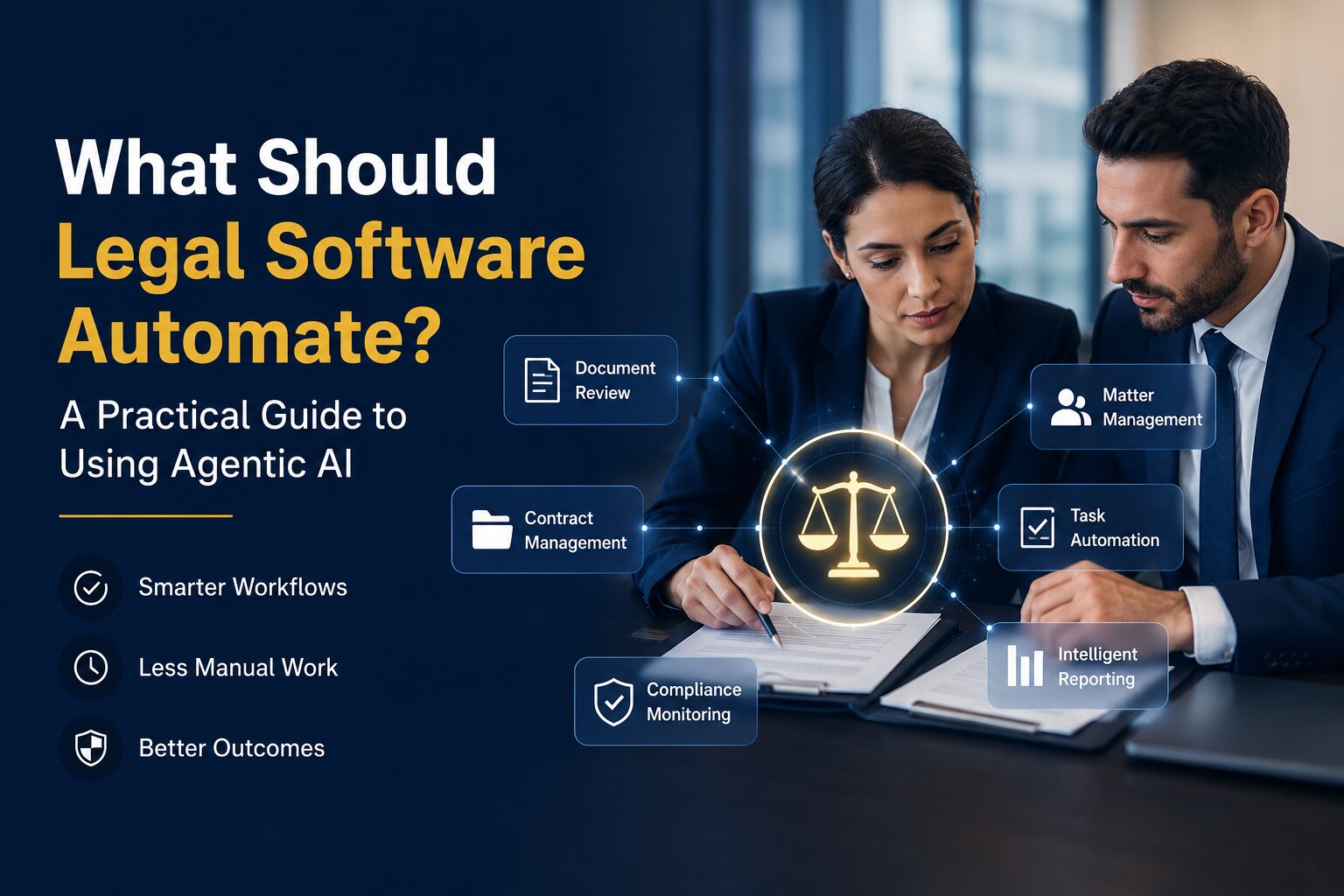
Agentic AI takes things a step further.
Instead of simply following fixed rules, it can analyse information, determine the next appropriate action, gather additional context, and complete multi-step tasks with limited human intervention.
For example, an Agentic AI assistant could:
- Review an incoming legal request.
- Identify the legal issue involved.
- Retrieve relevant internal policies.
- Prepare an initial summary.
- Suggest the appropriate legal team.
- Draft a response for lawyer review.
The lawyer remains responsible for approving the final advice, but much of the groundwork has already been completed.
Traditional Legal Automation | Agentic AI |
|---|---|
Rule-based workflows | Goal-oriented reasoning |
Follows predefined instructions | Adapts based on context |
Performs repetitive tasks | Handles multi-step processes |
Requires explicit workflow design | Can determine appropriate next actions |
Best for routine administration | Best for complex knowledge work with human oversight |
Despite these advances, Agentic AI should still operate within clear governance frameworks. Human oversight remains essential whenever legal judgement, ethics, or client advice is involved.
If you'd like a deeper comparison with practical examples, Agentic AI vs Traditional Legal Automation: What's the Difference? provides a detailed explanation.
7. How Can Lawyers Avoid AI Giving Incorrect Legal Advice?
AI can produce impressive results, but it's important to remember that it doesn't understand the law in the same way a qualified lawyer does. It identifies patterns in data and generates responses based on those patterns. That means it can occasionally miss important legal nuances, misunderstand context, or provide outdated information. The best way to reduce these risks is to treat AI as a drafting and research assistant—not as the final decision-maker.
Legal teams can build safer AI workflows by following a few practical principles:
- Verify every legal citation before relying on it.
- Cross-check AI-generated content against current legislation and case law.
- Ensure documents are reviewed by an experienced lawyer before they are shared externally.
- Limit AI use for high-risk matters unless appropriate safeguards are in place.
- Create internal policies that define when AI can and cannot be used.
Training is equally important. Lawyers should understand not only what AI can do but also where it is most likely to make mistakes. A team that knows how to write effective prompts, verify outputs, and recognise potential issues will gain far more value from AI than one that relies on it without question.
Building a Safe AI Review Process
An effective review process doesn't need to be complicated. Many firms are adopting a simple workflow:
- Use AI to prepare the first draft or research summary.
- Check all facts, authorities, and references.
- Review the advice in the context of the client's objectives.
- Make any necessary legal and commercial amendments.
- Approve the final document before it is shared.
This approach allows lawyers to benefit from AI's speed while maintaining the professional standards clients expect. For a closer look at the risks and safeguards involved, read When AI Gets Legal Advice Wrong: What Every Legal Team Needs to Know.
8. How Are Corporate Legal Departments Using AI?
While law firms have been early adopters, corporate legal departments are increasingly integrating AI into their daily operations. Their focus is often less about drafting legal advice and more about improving efficiency across the legal function.
AI is helping in-house teams manage growing workloads without significantly increasing resources. Instead of spending hours searching through contracts or manually tracking legal requests, legal professionals can access information more quickly and make better-informed decisions.
Common use cases include:
- Prioritising incoming legal requests.
- Reviewing contracts before negotiation.
- Monitoring compliance obligations.
- Organising legal knowledge repositories.
- Summarising large volumes of documentation.
- Supporting matter management and reporting.
- Identifying trends across legal data to improve decision-making.
For example, if a company receives hundreds of commercial agreements each month, AI can quickly identify contracts with unusual liability clauses or upcoming renewal dates. Lawyers can then focus their attention on agreements that genuinely require legal review instead of reading every document from start to finish.
Another emerging trend is the use of AI to generate operational insights. By analysing historical legal matters, organisations can identify recurring risks, measure workload distribution, and allocate resources more effectively.
To explore how AI is reshaping legal operations, read The Rise of Agentic AI in Legal Operations: What Corporate Legal Teams Need to Know.
9. What AI Trends Should Lawyers Watch in 2026?
AI is evolving rapidly, but not every new development will have a lasting impact on legal practice. The trends worth paying attention to are those that improve accuracy, security, and productivity while keeping lawyers in control of the decision-making process.
Some of the most significant developments include:
Agentic AI assistants: Rather than performing a single task, these systems can complete multiple connected activities, helping legal teams move work forward more efficiently.
Enterprise AI platforms: More organisations are choosing AI solutions designed specifically for business environments, with stronger governance, access controls, and compliance features than consumer AI tools.
Predictive legal analytics: AI is increasingly being used to identify patterns across historical legal data, helping organisations anticipate risks and make more informed strategic decisions.
AI-powered knowledge management: Instead of searching through folders and emails, lawyers can retrieve relevant precedents, policies, and internal guidance within seconds.
Responsible AI governance: Legal teams are placing greater emphasis on transparency, explainability, and accountability to ensure AI supports professional obligations rather than undermining them.
The common theme across these developments is clear: AI is becoming more practical, more secure, and more closely aligned with the realities of legal work. To learn more about the technologies shaping the legal profession, read 7 AI Trends Transforming Corporate Legal Departments in 2026
10. Where Should Smaller Law Firms and Startups Begin?
One of the biggest misconceptions about AI is that it requires a large budget or a dedicated technology team. In reality, many smaller firms achieve meaningful results by starting with one clearly defined problem.
Instead of trying to automate every legal process, focus on areas where repetitive work consumes the most time.
A practical starting point might be:
- Contract review.
- Client intake.
- Document organisation.
- Legal research assistance.
- Matter tracking.
- Internal knowledge management.
Once the team becomes comfortable using AI in one area, it becomes much easier to expand its use across other workflows.
It's also worth investing time in developing simple internal guidelines. Even a straightforward AI policy covering confidentiality, document review, and approval processes can reduce risks while encouraging consistent use across the firm. The goal isn't to adopt AI as quickly as possible. The goal is to adopt it responsibly, ensuring that technology supports legal professionals rather than creating additional complexity.
Smaller firms that take a gradual, well-planned approach often see stronger long-term results than organisations that attempt large-scale implementation from the outset. If you're looking for practical guidance on adopting legal technology with limited resources, How Startups Can Streamline Legal Work with the Right Software in 2026 offers useful insights.
Choosing AI That Fits Your Legal Practice
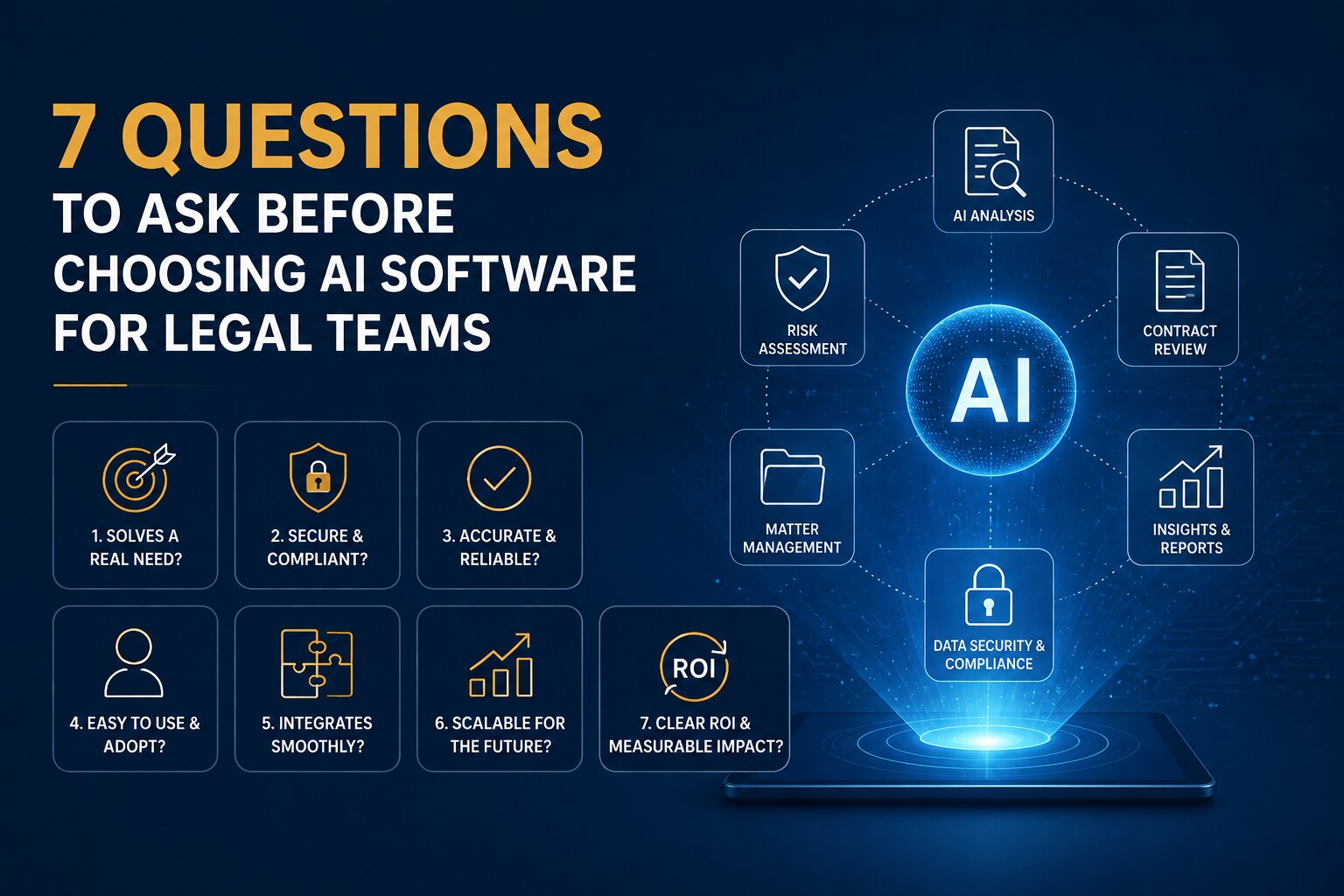
With so many AI solutions entering the legal market, selecting the right one can feel overwhelming. Rather than focusing on the number of features, start by evaluating whether a solution genuinely supports the way your legal team works.
Some important questions to consider include:
- Does it protect confidential client information?
- Can it integrate with your existing legal systems?
- Is it easy for lawyers to use without extensive training?
- Does it provide clear audit trails and access controls?
- Can it scale as your organisation grows?
- Does the vendor understand the specific needs of legal professionals?
The right technology should reduce administrative effort, improve collaboration, and support better decision-making without adding unnecessary complexity. If you're comparing legal technology solutions, Legal Tech Comparison can help you evaluate different options based on your firm's requirements. https://www.beveron.com/legal-tech-comparison/
Conclusion
The questions lawyers are asking about AI in 2026 reflect a profession that's moving beyond curiosity and towards practical adoption. The focus is no longer on whether AI belongs in legal practice but on how it can be used responsibly to deliver better outcomes for both lawyers and clients.
AI has already proven its value in areas such as document review, legal research, contract analysis, and workflow management. At the same time, it has highlighted the continued importance of human judgement. Technology can accelerate legal work, but it cannot replace the experience, ethical responsibility, and strategic thinking that define the legal profession.
Firms that succeed with AI are unlikely to be those that automate everything. Instead, they will be the ones that combine modern technology with strong governance, clear processes, and skilled legal professionals who know when to rely on AI—and when to rely on their own expertise.
As AI continues to evolve, the opportunity isn't simply to work faster. It's to build a legal practice that is more responsive, more informed, and better equipped to meet the changing expectations of clients.
If you're evaluating how AI fits into your legal strategy, explore How We Help the Legal Sector to learn how Beveron supports law firms and corporate legal teams with secure, practical technology designed for modern legal operations.
Ready to bring AI into your legal practice with confidence?
Whether you're looking to streamline legal workflows, strengthen data security, improve matter management, or explore secure AI solutions tailored to your organisation, Beveron Technologies can help.
Book a personalised demo today and discover how purpose-built legal technology can help your team work smarter, reduce administrative burden, and deliver better outcomes for your clients.
Frequently Asked Questions
Can AI provide legal advice without a lawyer?
No. AI can assist with research, drafting, and document analysis, but legal advice should always be reviewed and provided by a qualified legal professional.
Is AI suitable for small law firms?
Yes. Many smaller firms begin by using AI for tasks such as document review, legal research, and administrative workflows before expanding to other areas.
How can lawyers protect confidential information when using AI?
Choose AI solutions with strong security controls, understand how data is processed, and avoid uploading sensitive client information to public AI platforms without appropriate safeguards.
What is the biggest risk of using AI in legal practice?
The biggest risk is relying on AI-generated information without verification. Lawyers should always review outputs for accuracy, legal context, and jurisdiction-specific requirements.
Will AI replace lawyers in the future?
AI is expected to change how lawyers work rather than replace them. Human judgement, ethics, advocacy, and client relationships remain essential aspects of legal practice.
Best AI-Powered software for law firms in the UAE
Best AI legal software for lawyers in the UAE
Best AI tools for lawyers in the UAE
If you need a free demo of the best AI-powered software for law firms in the UAE, please fill out the form below.