AI-Powered Regulatory Change Tracking: A New Approach to Compliance Management
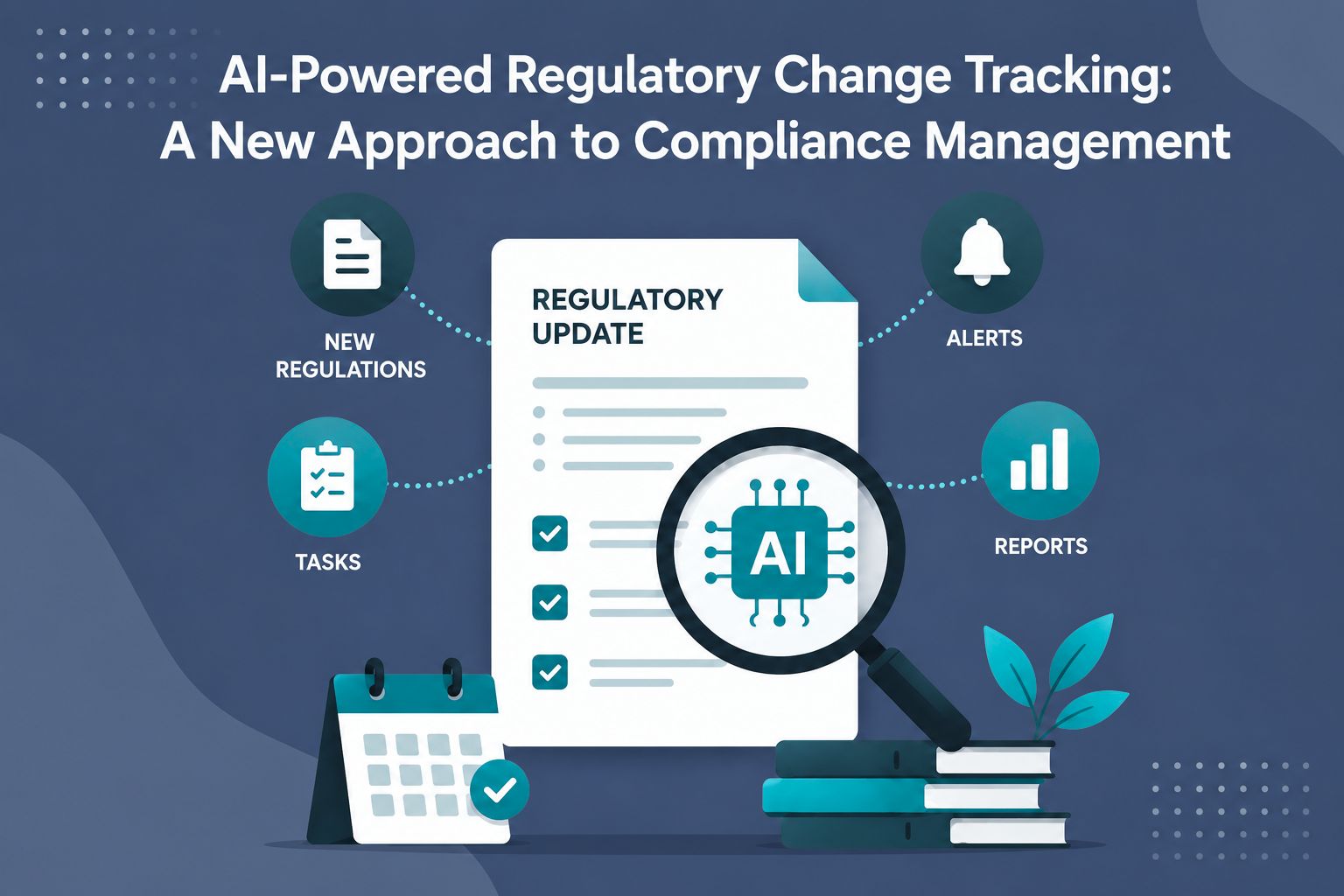
Regulatory change has become one of the most persistent operational pressures facing legal and compliance teams. New rules, amendments, guidance notes, enforcement trends, and reporting expectations continue to emerge across jurisdictions and industries, often at a pace that manual processes cannot keep up with. For many organisations, the real challenge is no longer finding regulatory information. It is knowing which updates matter, who needs to act, how quickly action is required, and whether the response can be clearly evidenced later.
Yet despite the scale of that challenge, regulatory change tracking is still managed in many businesses through a combination of email alerts, spreadsheets, shared folders, and manual reminders. These methods may appear manageable at first, but they become increasingly fragile as obligations grow. Important updates can be overlooked. Responsibilities can become unclear. Progress can be difficult to track. And when audit or regulatory scrutiny arrives, evidence is often spread across multiple systems and inboxes.
This is why AI-powered regulatory change tracking is becoming a more important part of modern compliance management. Rather than relying on teams to manually monitor sources, interpret updates, circulate information, and follow up on actions, AI can support a more structured and proactive approach. It can help organisations identify relevant developments faster, prioritise them more intelligently, and manage the response through clearer workflows and records.
For enterprise legal departments, this shift matters. Compliance is no longer just about staying informed. It is about building a repeatable and accountable process for turning regulatory change into business action. In this article, we explore why regulatory change tracking has become harder to manage, how AI is reshaping compliance operations, what businesses should look for in regulatory compliance software, and how a platform such as Beveron can help teams move from reactive monitoring to continuous regulatory readiness.
Why regulatory change tracking has become harder to manage
Regulatory change management has always required careful oversight, but the operating environment has changed significantly. Organisations are now dealing with a far wider range of obligations than they were even a few years ago. Data protection rules evolve, sector-specific regulations expand, employment obligations shift, ESG-related expectations grow, and regulators issue more detailed guidance around governance, reporting, and accountability.
The complexity is not only in the number of updates. It is also in how those updates affect different parts of the business. A regulatory change may apply to one geography, one business unit, one product line, or several functions at once. Legal and compliance teams, therefore, need to do more than simply capture the update. They need to assess relevance, understand impact, coordinate internal stakeholders, and monitor whether the required action has actually been completed.
This is where traditional tracking methods begin to struggle. A spreadsheet can list regulatory changes, but it does not easily show who owns the review, which documents need to be updated, what deadlines apply, or whether implementation is complete. Email alerts may surface useful information, but they do not provide a reliable framework for assigning accountability or maintaining an audit trail. As regulatory pressure grows, these disconnected tools create operational blind spots that can leave businesses exposed.
What AI-powered regulatory change tracking actually means
AI-powered regulatory change tracking is not simply about automating alerts. Its value lies in helping legal and compliance teams manage regulatory updates as part of a broader compliance workflow rather than as a series of isolated monitoring tasks.
At a practical level, AI can support the continuous monitoring of relevant regulatory sources and bring updates into one central environment. More importantly, it can help teams sort through high volumes of information by categorising updates based on topic, jurisdiction, business relevance, or urgency. That means teams spend less time manually triaging information and more time focusing on the changes that genuinely require legal analysis, operational review, or policy updates.
This is a meaningful shift for compliance management. Most legal and compliance functions are not short of information. They are short of time, capacity, and visibility. AI can reduce some of the repetitive work involved in tracking and sorting updates, making it easier for teams to focus on interpretation, risk assessment, and implementation planning. It does not replace legal judgement. It strengthens the process around that judgement by making regulatory monitoring more structured and manageable. This wider move towards smarter legal operations is closely linked to how in-house teams are adopting AI more broadly. If you want to explore that bigger shift, you can also read how AI is transforming in-house legal operations.
Where traditional regulatory change management starts to break down
The weakness of manual regulatory change tracking is not always obvious at first. In smaller environments, a spreadsheet and inbox may seem enough. The problem appears when the volume of change increases, the business expands across markets, or compliance responsibilities become more distributed across departments.
Manual review is one of the biggest pressure points. Legal and compliance professionals can spend a disproportionate amount of time scanning updates, checking regulator websites, forwarding information, logging issues into spreadsheets, and following up with internal stakeholders. These are essential tasks, but they are highly repetitive and difficult to scale. As the workload grows, so does the risk of delay, duplication, and human error.
Ownership is another common issue. A regulatory update may be identified by one team, but without a clear workflow for assigning responsibility, setting deadlines, and recording completion, it becomes difficult to know whether the business has actually responded. In practice, this often means compliance activity is happening in fragments. One team updates a policy, another changes a process, and another stores evidence in a separate folder, with no reliable central record connecting the work. Strong compliance execution depends heavily on task automation and deadline tracking for legal departments, particularly when multiple stakeholders need to act on the same regulatory change.
Impact analysis is also harder when information is disconnected. Regulatory changes rarely affect only one document or department. They may have implications for internal controls, customer communications, staff training, reporting procedures, contracts, or board reporting. If compliance information is spread across systems, understanding that impact becomes slower and less consistent, particularly when teams are already under pressure.
How AI improves regulatory change tracking in practice
The real value of AI in compliance management lies in operational consistency. It helps organisations move from ad hoc monitoring to a more systematic way of capturing, assessing, and responding to regulatory change.
One of the most immediate benefits is automated monitoring. Instead of relying on individuals to check multiple sources manually, AI-enabled systems can continuously monitor relevant regulatory channels and consolidate updates into a single workspace. This reduces the dependence on manual searching and lowers the risk of missing important developments simply because no one saw them in time.
AI also helps reduce noise. Not every regulatory update carries the same level of risk or urgency. Some may require immediate action, while others may simply need to be logged and monitored. By helping to classify and prioritise updates, AI allows legal and compliance teams to focus their time where it matters most. This is particularly valuable in enterprise environments, where large volumes of regulatory information can quickly overwhelm already stretched teams.
Another major benefit is workflow automation. Once a relevant update has been identified, the next challenge is execution. Someone needs to review it, determine its impact, assign tasks, set deadlines, gather evidence, and record decisions. AI-powered compliance workflows can help by routing tasks to the right stakeholders, tracking progress, and maintaining a clearer record of what has been done. This reduces the need for manual chasing and creates better visibility across the compliance process. For teams already looking at broader legal workflow automation for in-house teams, regulatory change tracking is a natural area where those workflow gains can deliver immediate value.
Stronger reporting is another important outcome. Legal and compliance leaders increasingly need to show not just that they monitor regulatory change, but also how the organisation responds. A structured system makes it easier to produce updates for leadership, internal audit, or regulators because the information is already captured in one place rather than being assembled retrospectively from multiple emails and documents.
The business value of AI-powered regulatory change tracking
AI-powered regulatory change tracking is often discussed in terms of efficiency, but its value goes beyond time savings. It supports a stronger compliance operating model by improving responsiveness, visibility, and control.
First, it helps businesses respond faster to regulatory developments. When updates are captured, filtered, and routed more quickly, teams can move sooner to assess impact, update policies, revise internal controls, and implement necessary changes. That speed matters because the longer a relevant change remains unaddressed, the greater the compliance risk becomes.
Second, it reduces the likelihood of fragmented follow-up. Centralised tracking gives legal and compliance teams a clearer view of what has been identified, what action is required, who owns the next step, and what remains outstanding. This makes it easier to prevent important actions from slipping through the gaps.
Third, it supports better collaboration between legal, compliance, and operational teams. Regulatory change rarely belongs to one department alone. A single update may require input from legal, risk, HR, finance, operations, or senior leadership. A connected system helps ensure those stakeholders are working from the same information and within a clearer process.
Finally, it gives enterprise legal departments a more scalable way to manage compliance. As businesses grow, expand into new jurisdictions, or face more complex regulatory obligations, manual tracking becomes harder to sustain. AI-supported regulatory change management provides a way to handle that growth without allowing administrative work to overwhelm the legal function.
What to look for in regulatory change tracking software
Not every compliance tool is designed to support regulatory change management practically. For legal and compliance teams evaluating solutions, a few capabilities are especially important.
A centralised dashboard should be a priority. Teams need one place to see incoming regulatory updates, open actions, ownership, deadlines, and completion status. Without that visibility, the organisation still faces the same coordination problem, just in a different tool.
Configurable workflows are equally important. Compliance processes differ from one organisation to another, and software should reflect that reality. The right platform should allow teams to assign tasks, define approval paths, escalate issues, and track actions in a way that aligns with internal governance processes.
Document linkage and audit trails also matter. Regulatory updates should be connected to the policies, records, evidence, and approvals they affect. This creates a clearer record of how the business responded and makes audit preparation far less disruptive.
Just as importantly, regulatory change tracking should not operate in isolation from the wider legal and compliance function. It works best when it sits within a connected system that supports collaboration, task management, document control, and reporting across the legal department.
How Beveron supports smarter compliance management
For organisations trying to move away from fragmented compliance processes, the value of a platform such as Beveron lies in bringing structure to the work that happens after a regulatory update is identified.
Regulatory change management is not only about knowing that something has changed. It is about making sure the change is reviewed, assigned, actioned, documented, and visible to the right stakeholders. That becomes much harder when updates, tasks, supporting documents, and follow-up records are spread across separate systems.
A connected platform helps legal and compliance teams manage those moving parts in one environment. Instead of relying on spreadsheets to track obligations and email chains to manage follow-up, teams can centralise compliance activities, improve visibility over progress, and maintain clearer records of decisions and actions. This supports stronger accountability across the compliance process and reduces the operational friction that often slows teams down.
For enterprise legal departments, that structure is increasingly important. Compliance obligations are closely tied to governance, workflows, internal approvals, and cross-functional collaboration. Beveron supports a more cohesive way to manage that work, helping legal and compliance teams move from fragmented tracking towards a more proactive and controlled compliance management model.
From reactive monitoring to continuous regulatory readiness
AI-powered regulatory change tracking is not just a technology trend. It reflects a broader shift in what enterprise legal departments need from their compliance operations. The old model of manually collecting updates, forwarding emails, and managing follow-up through spreadsheets is becoming too fragile for the pace and complexity of modern regulation.
What businesses need instead is a more disciplined and scalable approach. That means monitoring regulatory developments continuously, identifying what is relevant more quickly, assigning responsibility clearly, and maintaining a reliable record of how the organisation responded. AI can play an important role in that shift, but its real value comes from being embedded into a broader compliance management framework with the right workflows, controls, and visibility.
For legal and compliance leaders, the strategic implication is clear. Regulatory change management should not sit at the margins of legal operations as a manual administrative task. It should be treated as an ongoing business capability that supports risk management, accountability, and organisational resilience. Businesses that modernise this process now will be better placed to respond to regulatory change with confidence, reduce compliance exposure, and give leadership a clearer view of compliance performance.
Frequently Asked Questions
What is AI-powered regulatory change tracking?
AI-powered regulatory change tracking uses artificial intelligence and automation to monitor regulatory developments, identify relevant updates, prioritise them, and support compliance teams in managing follow-up actions more efficiently.
How does AI help with compliance management?
AI helps compliance management by reducing manual monitoring, filtering large volumes of regulatory information, supporting impact assessment, automating task assignment, and improving visibility into compliance activities and reporting.
Why is manual regulatory tracking risky?
Manual regulatory tracking often relies on spreadsheets, inboxes, and fragmented follow-up processes. This increases the risk of missed updates, delayed responses, inconsistent ownership, and poor audit documentation, particularly in larger or multi-jurisdiction organisations.
What features should regulatory change management software include?
The most useful features include centralised dashboards, configurable workflows, task management, document linkage, audit trails, reporting tools, and visibility across legal and compliance operations.
Can AI replace legal or compliance professionals?
No. AI should be viewed as a support tool rather than a replacement for legal or compliance expertise. It can reduce repetitive administrative work and improve speed, but interpretation, risk analysis, and decision-making still require human judgement.
Is your legal or compliance team still relying on spreadsheets, inboxes, and manual follow-ups to manage regulatory changes?
Beveron helps organisations centralise compliance activities, improve visibility across regulatory workflows, and maintain better control over how change is tracked and actioned.
Explore how Beveron can support a more proactive approach to compliance management.
Best compliance management software in the UAE
Best AI in compliance management in the UAE
Best compliance workflow automation in the UAE
If you need a free demo of the best compliance management software in the UAE, please fill out the form below.