How Legal Teams Can Prepare for AI Governance and Regulatory Scrutiny
Artificial intelligence is quickly becoming part of everyday legal work. Legal teams are using AI to review documents, summarise information, support research, manage contracts and automate repetitive tasks. Used properly, these tools can save time and help lawyers focus on higher-value work.
But there is another side to this shift. AI in legal departments also raises questions about confidentiality, accuracy, data protection, accountability and human oversight.
For legal teams, the challenge is no longer simply deciding whether to use AI. It is deciding how to use it responsibly and consistently.
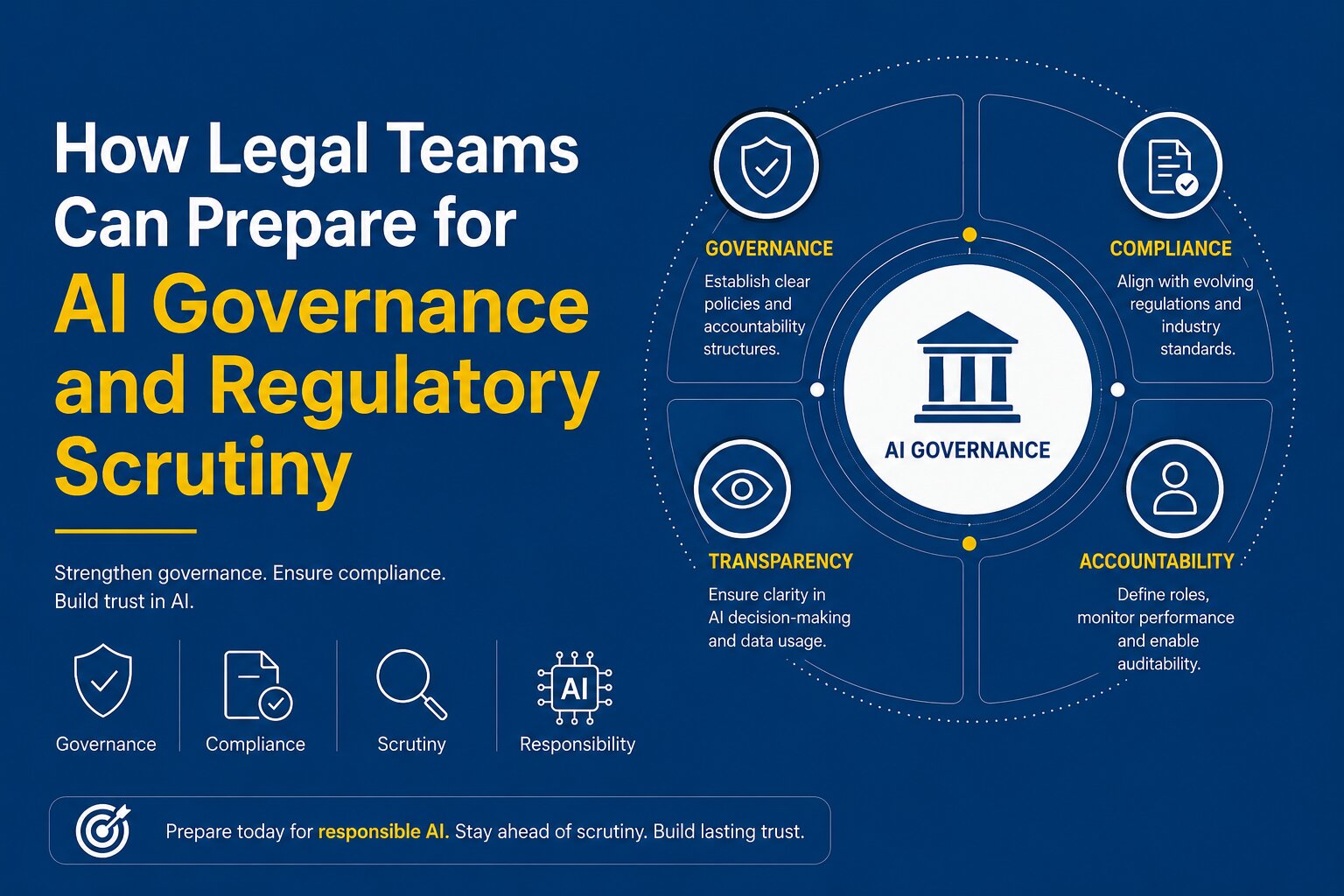
This is where AI governance for legal teams becomes important. A clear governance approach gives legal departments practical rules for using AI while helping the wider organisation manage legal, operational and compliance risks.
Why AI Governance Matters for Legal Teams
AI can support many areas of legal work, including:
- Contract review and analysis
- Legal research
- Document summarisation
- Matter management
- Compliance monitoring
- Drafting assistance
- Legal reporting
- Internal knowledge management
However, AI-generated information can be incomplete or incorrect. There are also risks when employees enter confidential business information or personal data into AI tools without understanding how that information is handled.
The UAE is actively developing its approach to responsible AI use. Its Charter for the Development and Use of Artificial Intelligence highlights privacy and data security, transparency, accountability and human oversight, while also stressing compliance with applicable laws.
This makes AI risk management for legal teams more than an IT issue. Legal, compliance, security and business teams all have a role to play.
What Is AI Governance for Legal Departments?
In simple terms, AI governance for legal departments means establishing clear rules around how AI is selected, used, monitored and reviewed.
A practical governance framework should answer questions such as:
- Which AI tools can employees use?
- What information can be entered into them?
- Which AI applications are considered high risk?
- When is human review required?
- Who is responsible for approving an AI use case?
- How should AI-related incidents be reported?
- What records should the organisation maintain?
The goal is not to prevent people from using AI. Instead, an effective AI compliance framework should make responsible AI adoption easier.
How Legal Teams Can Build an AI Governance Framework
1. Start by identifying how AI is already being used
Before creating new rules, legal teams need to understand what is already happening.
Employees may be using AI tools for tasks that have never been formally approved. Create an inventory covering:
- AI tools currently in use
- Departments using them
- Purpose of each tool
- Type of information processed
- Whether confidential or personal information is involved
- Person or department responsible for the use case
This gives the legal team a realistic starting point for legal technology governance.
2. Assess the risk of each AI use case
Not every use of AI creates the same level of risk. For example, using AI to organise a public document may present very different concerns from using AI to analyse confidential contracts or support a decision affecting an employee or customer.
Legal teams can assess use cases based on:
- Sensitivity of information
- Potential impact of errors
- Level of automation
- Human involvement
- Legal or regulatory consequences
- Dependence on third-party AI providers
This helps organisations focus their attention where it matters most.
3. Create a practical AI policy for legal teams
An AI policy for legal teams should be clear enough for employees to follow in their everyday work.
It can cover:
- Approved AI tools
- Prohibited uses
- Confidential information
- Personal and sensitive data
- Human review requirements
- Accuracy checks
- Intellectual property
- Record keeping
- Incident reporting
The policy should not simply be a document that sits in a shared folder. Employees need to understand what it means in practice.
4. Establish human oversight
AI should support professional judgement, not remove it. Legal teams should decide which activities require mandatory human review. For example, AI may help summarise a legal document, but a lawyer should still review the output before relying on it for an important legal decision.
A strong AI oversight framework should define:
- When human review is required
- Who reviews AI-generated work
- Who can approve an AI-assisted decision
- When a matter must be escalated
- How review and approval are recorded
Human oversight is also consistent with the UAE's AI governance principles, which emphasise the importance of human judgement in AI use.
5. Make accountability clear
AI governance can quickly become confusing if nobody knows who is responsible for a particular system or use case.
An AI accountability framework should identify:
- AI system owners
- Legal reviewers
- Compliance teams
- IT and security teams
- Business users
- Senior decision-makers
Clear ownership makes it easier to investigate problems, update policies and respond when something goes wrong.
How Legal Teams Can Prepare for Regulatory Scrutiny
AI governance should not be treated as a one-time compliance exercise. Organisations need to be able to show how they manage AI risks over time.
For example, legal teams can maintain records of:
- AI tools and use cases
- Risk assessments
- Approval decisions
- Policies
- Employee training
- Vendor assessments
- Human reviews
- AI-related incidents
- Periodic governance reviews
This documentation can help demonstrate that AI use is being actively managed rather than happening without oversight. Legal teams should therefore think beyond simply creating an AI policy and make sure they can produce evidence of approvals, risk assessments, human oversight and ongoing monitoring when required. For a more detailed checklist, see our guide to AI audit readiness and the documents legal teams should maintain.
For businesses operating in the UAE, this reinforces the need to consider AI governance alongside wider legal, privacy, cybersecurity and compliance responsibilities.
What Should an AI Compliance Framework Include?
A useful AI compliance framework can include:
- AI usage policy
- AI tool and use-case inventory
- Risk assessment process
- Data privacy and security controls
- Human oversight requirements
- Accountability structure
- Third-party AI vendor assessment
- Documentation and record keeping
- Employee training
- Incident reporting
- Regular audits and reviews
- Monitoring of regulatory developments
The framework should be proportionate to the organisation. A company using AI for simple administrative tasks may not need the same controls as one using AI in high-impact decision-making.
How Beveron Smart Legal Counsel Can Support AI-Ready Legal Operations
Governance policies are important, but legal teams also need the right operational structure to put those policies into practice.
Beveron Smart Legal Counsel is designed to help in-house legal departments manage legal matters, contracts, compliance activities, documents, tasks and workflows from a central platform. Beveron describes the platform as supporting centralised legal management, workflow automation, reporting and collaboration for corporate legal teams.
Centralise legal information
When legal matters, documents, tasks and communications are scattered across email and separate files, it becomes harder to maintain visibility and accountability.
A centralised system can help teams organise:
- Legal matters
- Documents
- Tasks
- Deadlines
- Compliance activities
- Case information
- Legal risks
- Matter history
This creates a stronger operational foundation for AI legal operations.
Create consistent workflows
A legal department AI strategy should not focus only on introducing AI tools. It should also look at how legal work is structured. Smart Legal Counsel supports structured workflows for activities such as matter management, approvals, compliance and legal operations.
This can help legal teams establish consistent processes before adding AI-assisted activities to them.
Improve visibility and accountability
Legal leaders need to know what is happening across the department.
Centralised workflows and reporting can help teams understand:
- Who is responsible for a matter
- Which tasks are complete
- What remains outstanding
- Which deadlines are approaching
- Where matters are in the workflow
- What activity has taken place
That visibility supports the wider principles behind an AI accountability framework, particularly when AI-assisted workflows are introduced.
Support responsible AI adoption
Legal technology can make AI adoption more manageable, but software alone does not create compliance.
Legal departments still need appropriate policies, risk assessments, human oversight and clearly defined responsibilities. The technology should support those processes rather than replace them.
Common AI Governance Mistakes to Avoid
Legal teams should watch out for a few common problems.
- Allowing unrestricted AI use: Employees may adopt tools without understanding data or confidentiality risks.
- Treating governance as an IT-only issue: Legal, compliance, security and business teams need to work together.
- Focusing only on regulations: Governance should also address accuracy, confidentiality, privacy, security and business risk.
- Forgetting human review: AI-generated content should be checked before it is relied upon for important legal or business decisions.
- Creating a policy without monitoring it: AI tools and use cases change quickly. Policies and risk assessments should be reviewed regularly.
A Practical AI Governance Checklist for Legal Teams
Before expanding AI use, legal teams can ask:
- Have we identified the AI tools currently being used?
- Do we know what information is being entered into them?
- Have we assessed the risks of each use case?
- Do we have an AI policy for legal teams?
- Are approved and prohibited uses clearly defined?
- Is human review required for high-impact work?
- Is responsibility clearly assigned?
- Are AI-related decisions and reviews documented?
- Have employees received appropriate training?
- Are third-party AI providers being assessed?
- Do we monitor regulatory and policy developments?
- Do we regularly review our governance framework?
Final Takeaway
AI governance is not about slowing down innovation. It is about giving legal teams a safer and more organised way to adopt it.
A practical approach starts with understanding how AI is being used, assessing risks, creating clear policies, defining human oversight and assigning accountability. Legal teams should also maintain reliable records so they can explain how AI is being managed when questions arise.
For organisations in the UAE, this is particularly relevant as the country's AI framework continues to emphasise responsible use, privacy, transparency, accountability, safety and human oversight.
With the right combination of AI governance for legal teams, clear policies and structured AI legal operations, legal departments can adopt AI with greater confidence while remaining prepared for increasing internal and regulatory scrutiny. For a practical guide to getting started, see our guide on building an AI-ready legal department.
Beveron Smart Legal Counsel can formsing internal and regulatory scrutiny. part of that operational foundation by helping legal teams centralise matters, organise workflows, track activities and improve visibility across legal operations. The goal is simple: use AI to make legal work better, without losing control over how it is used.
Frequently Asked Questions
What is AI governance for legal teams?
AI governance for legal teams is the process of creating rules, responsibilities and controls for how AI is selected and used within legal work. It covers areas such as risk assessment, data handling, human review, accountability and documentation.
Why do legal departments need an AI governance framework?
Legal departments need governance to manage risks linked to AI, including inaccurate outputs, confidential information, privacy, accountability and regulatory requirements. A clear framework also helps employees understand which AI uses are acceptable.
What should an AI policy for legal teams include?
An AI policy can cover approved tools, prohibited uses, confidential information, data handling, human review, accuracy checks, intellectual property, record keeping and procedures for reporting AI-related incidents.
How can legal teams manage AI risks?
They can start by identifying AI use cases, assessing their risks, setting clear policies, assigning responsibility, requiring human oversight where appropriate and regularly reviewing AI tools and processes.
Can legal software help with AI governance?
Legal software can support governance by organising matters, workflows, documents, tasks, deadlines and activity records. However, software should complement a broader governance framework rather than replace legal judgement, policies or compliance processes.
Best AI governance for legal departments in the UAE
Best AI for legal departments in the UAE
Best AI governance for in-house legal teams in the UAE
If you need a free demo of the best AI governance for legal departments in the UAE, please fill out the form below.