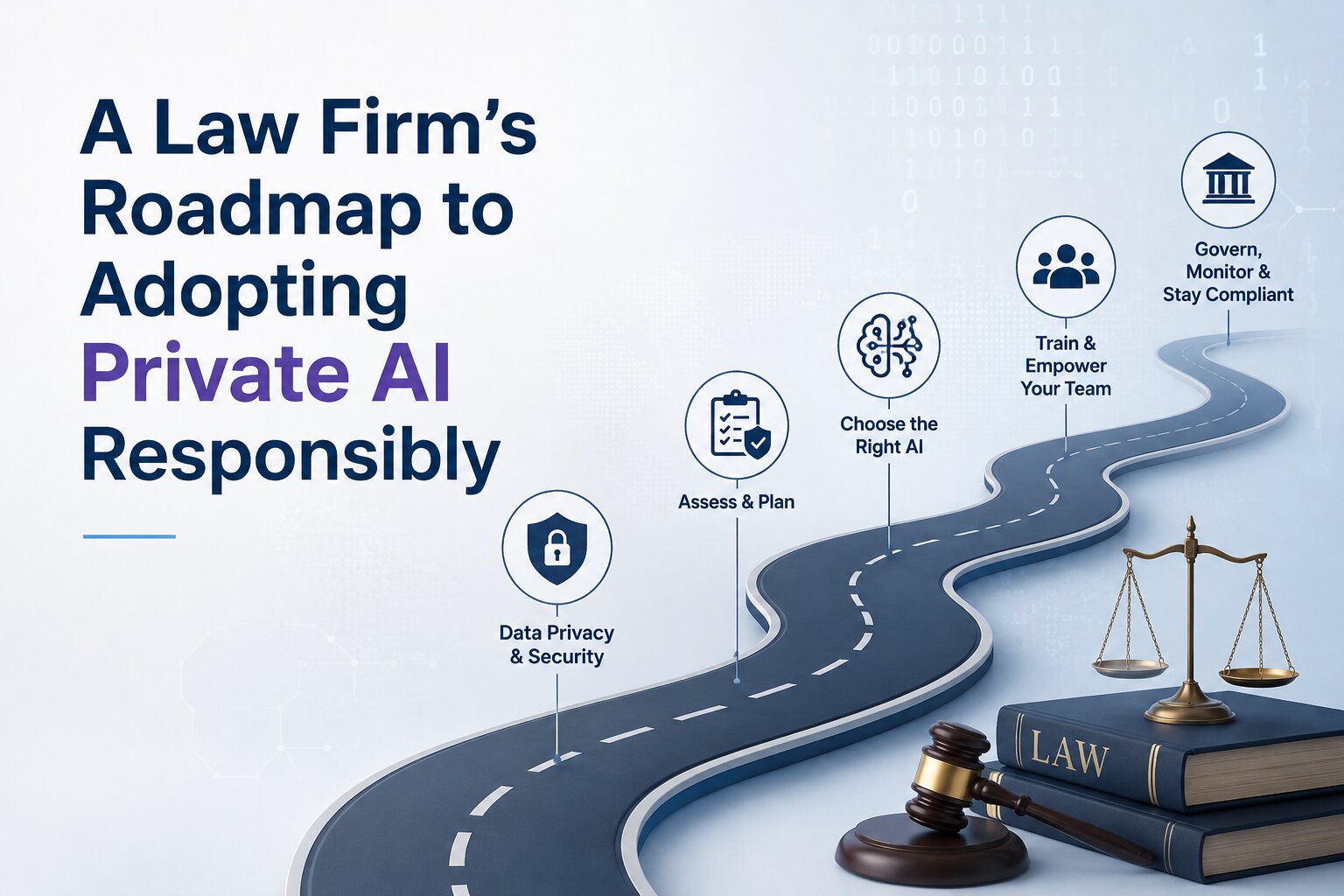
A Law Firm’s Roadmap to Adopting Private AI Responsibly
Artificial intelligence is quickly becoming part of everyday legal work. Lawyers are using AI to summarise documents, support legal research, review contracts, draft content, organise information, and speed up routine tasks. For many firms, the question is no longer whether AI has a place in legal practice. It is how to use it without putting client trust, confidentiality, or professional responsibilities at risk.
That is where private AI comes into the conversation.
Private AI can give law firms a more controlled environment for using AI with sensitive business and legal information. But adopting private AI is not simply a matter of buying software and switching it on. Firms need to understand where AI is already being used, establish clear rules, evaluate technology carefully, test it in real workflows, and continue monitoring how it is used.
A responsible approach allows law firms to benefit from AI while keeping appropriate human oversight and governance in place.
Why Responsible AI Adoption Is Now a Leadership Issue for Law Firms
AI adoption often starts informally. A lawyer tries an AI tool to summarise a long document. Another uses it to organise research notes. Someone else finds it useful for drafting an email or creating a first draft. These small experiments can quickly become part of everyday work.
The problem is that informal adoption can happen before a firm has decided what information can safely be shared with an AI system, which tools are approved, who is responsible for reviewing outputs, and how AI use should be documented.
For law firms, these questions matter because legal work depends heavily on trust and confidentiality.
Moving from AI experimentation to proper governance
There is a significant difference between experimenting with AI and adopting it as part of a firm's working practices. Experimentation may involve individual lawyers trying different tools. Governance means the firm has clear expectations around how those tools should be used.
A responsible AI approach should answer practical questions such as:
- Which AI tools are approved?
- What types of client information can be entered?
- What information must never be shared with an AI system?
- Who reviews AI-generated work?
- How should lawyers verify AI-generated legal information?
- What happens when an AI tool produces an incorrect or questionable answer?
- Who is responsible for monitoring AI use?
These rules do not need to make AI difficult to use. In fact, good governance should make it easier for lawyers to understand what they can do safely.
Why law firms can’t afford to wait
There are several reasons why AI governance is becoming a leadership issue.
Client expectations are changing. Clients increasingly want to know how their legal service providers protect confidential information and use emerging technologies.
Professional risks remain. A lawyer is still responsible for the work delivered to a client, even when AI has been involved in producing it. An AI-generated answer cannot replace professional judgment.
Competitive pressure is growing. Firms that use AI effectively may be able to complete certain tasks faster and handle information more efficiently. Waiting indefinitely may therefore create its own competitive disadvantage.
The goal should not be to adopt AI as quickly as possible. It should be to adopt it in a way that the firm can defend, explain, and manage.
What Can Go Wrong When AI Adoption Happens Without Proper Controls?
AI can create real value for legal teams, but uncontrolled use can also introduce new risks. The biggest problems usually do not come from AI existing inside the firm. They come from using AI without understanding how the technology handles information and how its outputs should be reviewed.
Confidentiality and privilege risks
Confidentiality is one of the most important concerns for any law firm considering AI.
Law firms handle client names, contracts, litigation documents, legal opinions, case strategies, and other sensitive information every day. When this information is entered into an AI system, firms need to understand how it is processed, stored, and protected. For a deeper look at why client information needs stronger protection when using AI, read Private AI for Law Firms: Why Client Data Needs a Secure AI Environment
Public or consumer AI services may have different policies regarding how information is processed, stored, retained, or used. The exact arrangements depend on the provider and the specific service, which is why firms should never assume that an AI tool is suitable for confidential legal information simply because it is popular or convenient.
Imagine a lawyer copying confidential client information into an unapproved AI tool to obtain a quick summary. Even if the intention is harmless, the firm may have created a data-handling risk.
Private AI approaches aim to give firms greater control over where sensitive information is processed and who can access it. However, “private” should not automatically be treated as synonymous with “secure.” Firms still need to examine the provider's security controls, data practices, access management, retention policies, and contractual commitments.
AI-generated mistakes and unreliable answers
Another major concern is accuracy. AI systems can produce convincing answers that contain factual errors, missing information, or fabricated references. These errors are often called hallucinations. The important point is simple: an AI-generated answer can sound confident without being correct.
This matters even more in legal work. A lawyer may use AI to create a research summary, draft a clause, review a document, or prepare a client communication. The output can be useful as a starting point, but it still needs appropriate human review.
AI should support legal professionals rather than replace their responsibility for accuracy and judgment.
The rise of “shadow AI” inside law firms
There is another challenge that firms may not immediately see: shadow AI. This happens when employees use AI tools that have not been officially approved by the organisation. If lawyers cannot access approved AI tools, or if the firm's policy is unclear, they may turn to whatever tools are easiest to access. That makes it difficult for IT and leadership teams to know where firm information is going or how AI is being used.
A clear AI policy, combined with practical approved tools, can help reduce this problem.
What Does Private AI Actually Mean for a Law Firm?
Private AI is therefore not simply a different version of ChatGPT or another AI tool. It is better understood as a controlled approach to using AI within an organisation's security and governance requirements. For a closer look at how security can be maintained throughout the AI process, from uploading a legal document to reviewing and storing the final output, read Building a Secure AI Workflow for Law Firms: From Document Upload to Final Output
Private AI vs. public AI: What’s the difference?
With a public or consumer AI service, the firm may have less control over the environment in which information is processed and stored.
With a private AI setup, the organisation can potentially apply tighter controls around:
- Who can access the system
- What data can be processed
- Where information is stored
- How long information is retained
- Whether data is used for model training
- How activity is logged and monitored
The difference between public and private AI becomes especially important when legal teams are working with confidential client information, privileged communications, contracts, and sensitive case documents. For a deeper comparison of the two approaches, see 5 Reasons Legal Teams Should Choose Private AI Over Public AI. The guide explains how private AI can provide greater control over data, security, governance, audit trails, and legal workflows.
The exact level of control depends on how the solution is designed and configured. Private AI is therefore not simply a different version of ChatGPT or another AI tool. It is better understood as a controlled approach to using AI within an organisation's security and governance requirements.
Where can private AI live?
A private AI environment can be deployed in different ways.
On-premises: The firm's systems and infrastructure host the AI environment directly. This can provide significant control but may require greater internal resources and technical expertise.
Private cloud: The AI environment operates within a controlled cloud setup. This can provide a balance between flexibility and control.
Secure vendor-hosted environment: A technology provider manages the infrastructure while providing controls designed around the firm's security and data requirements.
There is no single setup that is right for every law firm. The choice should depend on the firm's security requirements, technical capabilities, budget, regulatory obligations, and existing infrastructure.
The technical terms decision-makers actually need to understand
Law firm leaders do not need to become AI engineers. But they should understand a few basic concepts.
- Data isolation refers to keeping one organisation's information separated from other customers' information.
- Access controls determine who can access specific systems and information.
- Data retention refers to how long information is kept by the system or provider.
- Model training refers to whether information submitted to a system can be used to improve or train an AI model.
- Audit logs record activities within a system and can help organisations understand who accessed information and what actions were taken.
Understanding these basics makes vendor conversations much more productive.
Phase 1 — Assess: Find Out Where AI Is Already Being Used
Before purchasing a private AI solution, a law firm should understand its current AI landscape. This step is easy to overlook. Firms may assume they are starting from zero when lawyers and support teams are already using AI in different ways.
Audit AI usage across the firm
Start by asking simple questions. Which teams are using AI? Which tools are they using? What tasks are they completing with those tools?
The answers may reveal AI use across legal research, document drafting, contract review, summarisation, client communications, administrative work, and knowledge management. The purpose is not to punish people for experimenting with AI. The purpose is to understand what is actually happening.
An honest assessment gives leadership a much better starting point for creating sensible policies.
Identify the workflows that carry the most risk
Not every AI use case has the same level of risk. Creating a generic internal brainstorming list is different from processing confidential client documents. Firms should therefore classify workflows based on the sensitivity of the information involved and the potential consequences of an incorrect output.
High-risk areas may include:
- Legal research
- Client communications
- Contract analysis
- Sensitive document review
- Matter-related analysis
- Work involving confidential or privileged information
This assessment can help the firm decide where stronger controls are needed first.
Phase 2 — Define: Set the Rules Before Choosing the Technology
Once the firm understands how AI is being used, the next step is to establish clear principles. Technology should support the firm's governance approach, not define it.
Decide what data can and cannot be used with AI
Create clear categories for information. For example, the firm might distinguish between general public information, internal business information, confidential client information, privileged material, and highly sensitive personal or commercial data.
The policy should explain what can be entered into approved AI systems and what requires additional approval or is prohibited. The simpler the rules are, the more likely lawyers are to follow them.
Decide who is responsible for AI governance
AI governance should not sit entirely with one department. IT may be responsible for security and technical controls. Risk and compliance teams may assess legal and regulatory considerations. Legal operations may help integrate AI into workflows. Practice leaders can provide input on how AI affects day-to-day legal work.
Senior leadership should ultimately ensure that these responsibilities are coordinated.
Create an AI policy lawyers can actually follow
A 30-page policy that nobody reads will not solve the problem.
A useful AI policy should provide practical guidance. It should clearly explain:
- Approved AI tools
- Restricted or prohibited uses
- Data-handling requirements
- Human review expectations
- Verification requirements
- Reporting and escalation procedures
- Responsibilities of individual users
The policy should also be updated as the firm's technology and AI practices change.
Phase 3 — Evaluate: Know What to Look for in a Private AI Solution
Once the firm knows what it needs from a governance perspective, it can begin evaluating private AI solutions. A good solution should fit the firm's requirements rather than forcing the firm to change its risk standards simply to accommodate the technology.
Strong data isolation and access controls
Ask how the system separates one firm's information from other customers' information. Also examine user permissions.
Can partners, associates, paralegals, administrators, and other employees have different levels of access? Can access be limited according to matters, teams, or roles?
These details can make a significant difference when AI is being used with sensitive legal information.
Clear audit trails and traceable outputs
A firm should be able to understand how its AI environment is being used. Audit logs can help answer questions such as who accessed the system, when it was used, and what actions took place.
For some workflows, firms may also want ways to understand the information or documents that contributed to an AI-generated response. The level of traceability required will depend on the use case and the firm's governance needs.
Integration with existing legal workflows
AI should not become another isolated tool that lawyers have to manage. Consider how the solution works with existing document management, matter management, knowledge systems, and other legal workflows.
The easier it is to use AI within familiar processes, the more likely lawyers are to adopt it consistently.
Transparency around training and data retention
This is an important part of vendor evaluation. Firms should ask clear questions about how their data is processed, whether customer information is used to train models, how long data is retained, where it is stored, and who can access it.
Do not rely on broad claims such as “enterprise-grade security.” Ask for specific explanations and contractual commitments where appropriate.
Phase 4 — Pilot: Start Small Before Going Firm-Wide
A successful AI strategy does not require a firm-wide launch on day one. A controlled pilot can reveal practical issues that may not appear during a product demonstration.
Choose a practical, lower-risk use case
Start with a workflow where the benefits are measurable and the risks can be managed. For example, a firm might test AI for internal knowledge tasks, document summarisation, or another carefully selected workflow before expanding into more sensitive client-facing use cases.
The right pilot depends on the firm's practice areas and risk profile.
Measure what actually matters
Do not judge an AI pilot only by whether lawyers say they like the tool.
Track practical measures such as:
- Time saved
- Accuracy of outputs
- Quality of work
- Lawyer adoption
- Number of corrections required
- Security and policy compliance
- User feedback
These measures can help the firm determine whether the technology is genuinely improving the workflow.
Use lawyer feedback to improve the approach
AI adoption is not just an IT project. Lawyers understand the realities of legal work, including where a tool helps and where it creates additional effort. Regular feedback between lawyers, IT, legal operations, risk teams, and leadership can help identify problems early and improve the rollout.
Phase 5 — Scale and Sustain: Make Responsible AI Part of the Firm
A pilot is only the beginning. Once AI becomes part of everyday legal work, governance needs to become part of everyday operations too.
Keep lawyers trained and accountable
AI tools change quickly. Training should therefore not be a one-time event. Lawyers should understand both what an AI tool can do and where its limitations lie. They should also know when human review is mandatory and who to contact when something goes wrong. Most importantly, responsibility should remain clear. Using AI does not transfer professional responsibility from the lawyer to the software provider.
Keep governance policies up to date
AI technology, client expectations, security practices, and legal requirements will continue to evolve. A policy that made sense when a firm first introduced AI may become outdated within a relatively short period. Regular reviews can help ensure that the firm's AI governance framework continues to reflect how the technology is actually being used.
Common Mistakes Law Firms Make When Adopting AI
Law firms can make mistakes by moving too quickly, but they can also create problems by moving too slowly. One common mistake is adopting AI before establishing basic governance. This can leave lawyers unsure about which tools are safe to use. Another is taking the opposite approach and banning AI completely. A blanket ban may simply encourage employees to use AI privately, making the firm's AI activity harder to monitor.
Firms can also put too much trust in vendor claims. A provider describing its platform as secure is not a substitute for proper due diligence. Training is another area that is often overlooked. Giving lawyers access to AI without explaining its limitations can create unrealistic expectations and increase the chance of mistakes.
Finally, some firms try to introduce AI across every department at once. A smaller, well-managed pilot is often a more practical way to learn what works before expanding.
Frequently Asked Questions
Is private AI the same as an in-house AI model?
Not necessarily. An in-house AI model generally suggests that an organisation has built or operates its own model or AI system internally. Private AI is a broader concept focused on providing a controlled environment for using AI and protecting organisational data. A firm can therefore use a private AI environment without developing its own AI model from scratch.
How can law firms balance AI innovation with risk management?
The best approach is not to choose between innovation and caution. Instead, firms can introduce AI gradually. Start by identifying suitable use cases, establish clear data and usage rules, select technology that meets those requirements, and test it before expanding.
This allows the firm to learn while keeping risks under control.
Who should be responsible for AI governance in a law firm?
AI governance is usually a shared responsibility. IT can manage technical controls, while risk, compliance, legal operations, and practice leaders can contribute their own expertise. Senior leadership should ensure that these responsibilities are coordinated and aligned with the firm's overall strategy. The exact structure will depend on the size and organisation of the firm.
What is the first practical step a law firm should take toward private AI?
Start with an internal assessment. Find out which AI tools lawyers are already using, what they are using them for, and what types of information are being processed. That gives the firm a realistic picture of its current situation and helps identify where governance needs to come first.
How Law Firms Can Adopt AI Responsibly
For law firms, adopting private AI is not simply about adding an AI tool to the technology stack. It is about bringing AI into the daily practice of law without losing control over matters, documents, client information, and professional workflows.
This is where Smart Lawyer Office can support law firms looking to introduce AI within a structured legal practice management environment. By bringing matter management, case information, documents, workflows, and AI-assisted capabilities together, firms can explore AI while keeping legal work organised within the systems their teams already use.
For corporate legal departments, Smart Legal Counsel takes a similar approach from an in-house legal perspective. Legal teams can use AI-assisted capabilities alongside matter management, contracts, documents, compliance activities, and collaboration, helping them introduce AI into existing legal operations rather than relying on disconnected public AI tools.
Both approaches focus on an important principle: AI should work within a firm's governance and legal workflows, not outside them.
For law firms considering private AI, the starting point should therefore be the work itself. Which matters could benefit from AI? What information needs stronger protection? Where should human review remain mandatory? And how can AI be introduced without disrupting established legal processes?
Smart Lawyer Office and Smart Legal Counsel provide options for exploring these questions in the context of legal practice and in-house legal operations. The right approach will ultimately depend on the firm's workflows, data requirements, security expectations, and AI governance strategy.
Responsible AI adoption is not about handing legal work over to AI. It is about giving lawyers controlled, practical ways to use AI while keeping people, processes, and client confidentiality at the centre of legal work.
Ready to adopt private AI without losing control of your legal workflows?
Discover how Smart Lawyer Office and Smart Legal Counsel can help bring AI-powered capabilities into structured legal environments—so your firm can improve efficiency while keeping matters, documents, and client information under control.
Explore Beveron’s legal technology solutions and take the next step toward responsible AI adoption.
Best private AI for law firms in the UAE
Best private AI for legal teams in the UAE
Best AI security for law firms in the UAE
If you need a free demo of the best private AI for law firms in the UAE, please fill out the form.