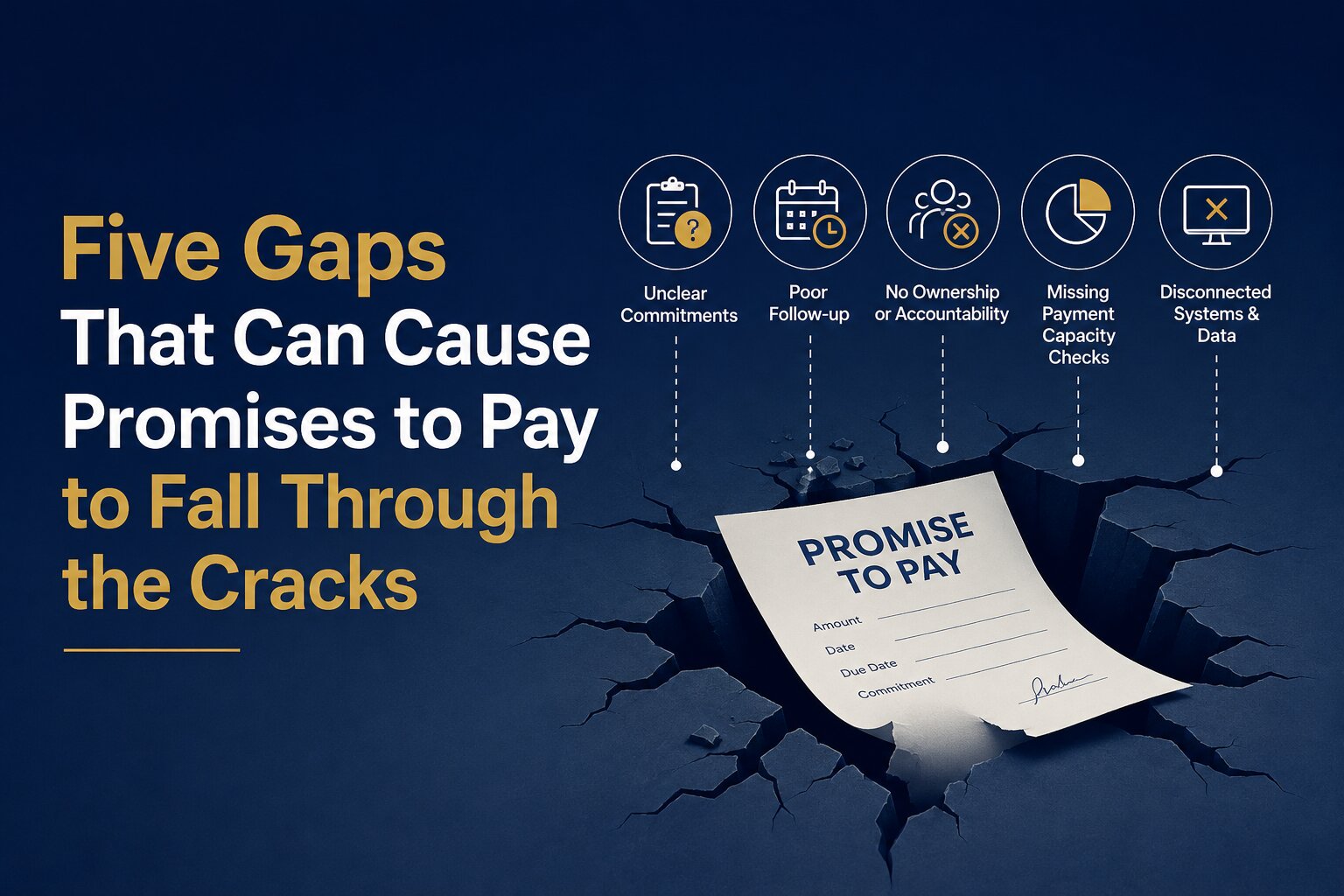
Five Gaps That Can Cause Promises to Pay to Fall Through the Cracks
A promise to pay can feel like a positive step in the collection process. A customer agrees to pay a certain amount by a particular date, and the collection agent records the commitment. But the work does not end there. The real challenge is making sure that the commitment remains visible until the payment is received. If the promise is recorded inconsistently, the follow-up is delayed, or the information is separated from the rest of the account history, a seemingly straightforward commitment can easily be missed.
This becomes more difficult when collection teams manage large numbers of overdue accounts and multiple promises to pay at the same time. For UAE banks, lenders, collection agencies and finance teams, having a clear process for tracking these commitments can therefore be an important part of debt recovery management.
Here are five common gaps that can cause promises to pay to fall through the cracks and what collection teams can do about them.
Why a Promise to Pay Can Still End Without a Payment
A promise to pay is a commitment from a customer to make a payment, but it is not the payment itself. Between the commitment and the actual payment, several things still need to happen. The commitment needs to be recorded correctly. Someone needs to know when the payment is expected. The account needs to be followed up at the appropriate time. If the payment does not arrive, the team needs to know what happens next.
Consider a collection agent who speaks with a customer and agrees on a payment of AED 5,000 by the end of the week. If that information remains in an individual note or spreadsheet and there is no clear follow-up process, another team member may not know about the commitment. By the time someone notices that the payment has not arrived, several days may have passed.
This is why effective promises to pay debt collection is not simply about recording commitments. It is about keeping those commitments connected to the collection process until they are resolved.
Gap 1 — Payment Commitments Are Not Recorded Consistently
The first problem can occur at the moment the promise is made. Different agents may record PTP information in different ways. One may enter the promised amount and date into a system, while another may add details to a spreadsheet or write them in free-form notes. Some records may contain detailed customer information, while others may simply say that the customer "will pay soon".
These differences may seem minor when dealing with individual accounts. Across hundreds or thousands of accounts, however, they can make promise-to-pay tracking much harder. A collection manager needs to know what was actually agreed. The agent needs enough information to follow up confidently. The next person handling the account should also be able to understand the commitment without having to search through separate records.
A more structured approach can help collection teams maintain consistent records while keeping payment information and customer interactions connected. For a broader look at using technology to improve debt recovery processes, see Improve Debt Recovery with Compliant Smart Software.
What should be captured when a PTP is made?
At a minimum, the process should make it easy to record information such as:
- The customer or account
- The amount promised
- The agreed payment date
- The current status of the commitment
- The relevant follow-up date
- Notes from the customer interaction
The exact information will depend on the organisation's collection policy, but consistency matters. A standard approach gives the team a clearer record of what has been promised and what still needs attention.
Gap 2 — Upcoming PTPs Are Easy to Miss
Even when a promise is recorded correctly, the next problem is knowing when to act on it. Collection agents may be responsible for a large number of accounts, each with different payment dates and follow-up requirements. If PTPs depend mainly on personal reminders, spreadsheets or manually maintained lists, an upcoming commitment can easily get lost among other collection activities.
This is particularly relevant when an agent has several customers promising payment on the same day. Without a clear way to prioritise those accounts, the team may spend time on other tasks while a time-sensitive follow-up waits.
Effective PTP tracking in debt collection should therefore do more than store a payment date. It should help the team see which commitments are upcoming, due or overdue and which accounts require attention. For a closer look at the process, see our guide on Handling Promise to Pay in Debt Collection, which covers practical approaches to recording, monitoring and following up on PTP agreements.
Turning PTP dates into collection actions
A useful process connects the promised date with an actual collection activity. For example, an upcoming PTP could appear in an agent's work queue before the due date. Once the date arrives, the account can be checked against the payment status. If the payment is received, the commitment can be updated. If it is not, the account can move into the organisation's defined follow-up process.
This creates a connection between the commitment and the action required from the collection team.
Gap 3 — Missed Promises Do Not Trigger a Clear Next Step
A customer may fail to make the promised payment for many reasons. The important point for a collection team is what happens next. If there is no defined process, a missed PTP can simply become another overdue account. The agent may need to remember to contact the customer again, determine the reason for the missed payment and decide what action to take. If that responsibility is unclear, follow-up can be delayed.
The situation can become more complicated when a customer makes a partial payment, asks for a new date or repeatedly makes commitments that are not fulfilled.
Define what happens after a missed PTP
A collection team should establish what happens when a commitment is not met. The next step could involve contacting the customer, updating the payment arrangement, reassessing the account or escalating it according to the organisation's internal policy. The appropriate action will vary by organisation and account circumstances. The important part is that the process should not depend entirely on an individual agent remembering what to do.
Good overdue payment management connects the missed commitment with a clear next action while preserving the account history. That makes it easier for the team to maintain continuity rather than treating every follow-up as a new interaction.
Gap 4 — Agents Cannot See the Full Commitment History
A customer's current promise does not always tell the whole story. Suppose a customer has agreed to pay on three previous occasions but missed each date. If an agent only sees the latest promise, they may approach the account without the context needed to understand the customer's previous payment behaviour. A connected history can show previous promises, missed commitments, partial payments, conversations and changes to agreed payment dates or amounts.
This does not mean that every previous commitment should automatically determine the next collection action. Rather, it gives the agent information that can be considered alongside the current account status and the organisation's collection policy.
Why account history matters during follow-up
When collection information is spread across different systems or individual records, agents may spend unnecessary time reconstructing what happened previously. A central account history can make that information easier to access. Before contacting the customer, the agent can review relevant previous activity and understand where the account currently stands.
For teams managing high volumes of overdue accounts, this can support a more consistent approach to debt recovery management.
Gap 5 — PTP Management Is Disconnected From the Wider Collection Workflow
The fifth gap is broader than PTP tracking itself. A promise to pay does not exist separately from the rest of a collection account. It is connected to the outstanding balance, previous communications, payment activity, account status and any actions already taken. When those pieces of information are kept in separate places, the team may have to move information manually between spreadsheets, emails, payment records and collection systems. That creates more opportunities for information to be missed or become outdated.
As collection teams move towards more connected digital workflows, PTP management can become part of a wider process that brings account information, communication, follow-ups and payment activity together. For a broader look at this shift, see Digital Transformation in Debt Collection: Key Legal Tech Trends for 2026
Connect PTPs with the wider collection process
A more connected debt collection workflow allows the commitment to sit alongside the information that collection teams already need. For example, an agent should be able to understand the customer's account, review relevant communication history, see the current PTP status and determine the appropriate follow-up without having to search across multiple disconnected records. This is also where debt collection workflow automation can become useful. Instead of relying on every step being manually remembered, organisations can use defined workflows to support reminders, task assignment, status updates and escalation according to their internal processes.
The goal is not to remove human judgement from collection activity. It is to reduce the number of routine steps that depend on memory or manual coordination.
What Should Collection Managers Look for in a PTP Management Process?
Once these gaps are identified, the next question is what a controlled PTP process should actually achieve.
Collection managers can assess their current process by asking:
- Can every agent record PTP information consistently?
- Can the team see which commitments are coming due?
- Can missed commitments be identified promptly?
- Is ownership of follow-up clear?
- Can agents see relevant previous commitment and communication history?
- Can managers monitor PTP activity and outcomes?
- Is PTP information connected to the wider collection workflow?
The answers can reveal whether the problem is simply a matter of agent discipline or whether the underlying process makes consistent follow-up difficult. This distinction matters. If a team repeatedly misses PTPs because information is scattered across spreadsheets and individual reminders, asking agents to "follow up more carefully" may not address the underlying issue.
When Does PTP Tracking Need More Than Manual Processes?
Manual tracking can work for smaller operations or limited account volumes. The challenge usually becomes more visible as the number of accounts, agents and payment commitments increases.
Some signs that the existing process may need additional support include:
- Collection teams rely heavily on spreadsheets to track PTPs.
- Agents use personal reminders to remember follow-ups.
- Managers cannot quickly identify today's or tomorrow's commitments.
- Missed PTPs are discovered only after significant delays.
- Several agents may work on the same accounts.
- Management reporting requires information to be collected manually.
- PTP information is separated from payment and communication records.
These signs do not automatically mean that an organisation needs new software. They indicate that the current process should be reviewed and that the team may benefit from a more structured way of managing commitments.
Supporting PTP Management With Debt Collection Software
For larger collection operations, debt collection software can provide a central place to manage accounts, commitments, follow-ups and recovery activity. The useful question is not simply whether a platform has a PTP feature. The more important question is whether PTP tracking fits naturally into the wider collection workflow.
Relevant capabilities may include centralised account information, payment status tracking, follow-up activities, communication records, collection queues and reporting. When these functions work together, collection teams have fewer disconnected records to maintain.
For UAE organisations, data handling should also be considered when reviewing a collection platform. The UAE's Federal Decree-Law No. 45 of 2021 on the Protection of Personal Data establishes requirements around lawful and transparent processing, data security and keeping personal data accurate and appropriately protected.
Where Debt Collection Software Can Support the Process
Beveron's Smart Debt Collection is designed for collection agencies, banks, lenders and corporate finance teams in the UAE. The platform provides centralised debt and customer information, collection workflow automation, payment tracking, communication management and reporting. Its feature set also includes a dedicated PTP dashboard and support for recording promises to pay.
For a team dealing with the gaps discussed above, the relevance is in bringing these activities into a connected collection environment. PTP information can be managed alongside account data, follow-up activities, communications and recovery actions rather than being maintained separately. The platform also supports communication through channels including SMS, email, WhatsApp and calls.
The right approach, however, is to assess the platform against the organisation's actual collection process. A system should support the way the team works rather than simply add another place to record information.
A Quick Check: Are Promises to Pay Falling Through the Cracks?
A collection manager can use the following questions as a simple starting point:
Are PTPs recorded consistently?
If different agents capture different information, the team may struggle to maintain a reliable record.
Can agents easily see commitments that are due?
If they have to search through spreadsheets or personal reminders, important follow-ups may be missed.
Are missed PTPs identified promptly?
The longer a missed commitment remains unnoticed, the harder it may be to maintain a consistent recovery process.
Is there a defined next action?
Agents should understand what the organisation expects after a payment commitment is missed.
Can agents see previous commitment history?
Relevant history gives the team context when deciding how to handle the next interaction.
Can managers monitor PTP activity?
Management visibility can help identify recurring process issues and areas that need attention.
Is PTP information connected to the wider collection workflow?
The promise should not exist as an isolated record. It should remain connected to the account and its subsequent recovery activity.
Closing the Gaps Between a Promise and a Payment
A promise to pay is an important point in a collection conversation, but it should not be treated as the end of the process. The commitment still needs to be recorded accurately, monitored at the right time and followed through until the payment is received or the account moves to the next appropriate action. For collection teams, the most useful place to start is by identifying where visibility is being lost. Is the problem inconsistent recording? Missed follow-ups? Limited account history? Or disconnected systems?
Once those gaps are clear, the organisation can decide whether changes to the process, clearer ownership or debt collection software are appropriate.
For UAE collection teams looking to bring PTP tracking, follow-ups and wider recovery activities into a more connected workflow, Beveron Smart Debt Collection provides a platform designed for banks, lenders, collection agencies and corporate finance teams.
Explore how Beveron Smart Debt Collection can fit your existing collection process and request a demo focused on your team's requirements.
Best promises-to-pay tracking software for corporate finance teams in the UAE
Best debt collection management software for collection agencies in the UAE
Best debt recovery management for banks in the UAE
If you need a free demo of the best promises-to-pay tracking software for corporate finance teams in the UAE, please fill out the form.