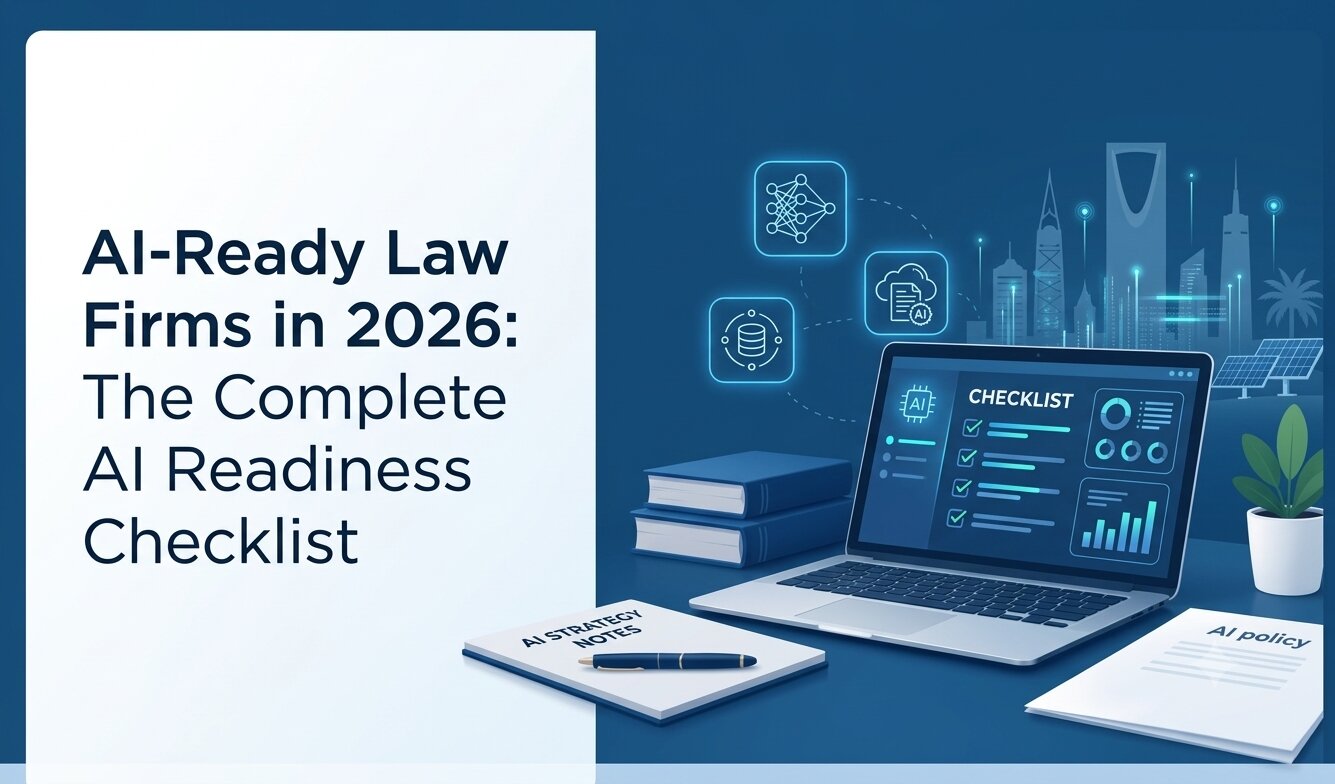
AI-Ready Law Firms in 2026: The Complete AI Readiness Checklist
Artificial intelligence is becoming part of everyday legal work. Law firms are using AI to assist with document analysis, research, contract review, workflow automation and other repetitive tasks. But there is an important difference between using AI and being genuinely AI-ready. A firm can have access to several AI tools and still struggle with disconnected data, inconsistent processes, poor document management or unclear security policies. In that situation, adding more AI may create more complexity rather than solving the underlying problem.
An AI-ready law firm has the right foundations in place. Its information is organised, its workflows are reasonably standardised, its people understand how to use AI responsibly, and its technology can support new digital capabilities. This checklist helps law firm leaders, legal operations teams and IT decision-makers assess where they currently stand and identify the areas that may need attention before expanding AI adoption.
Why AI Readiness Matters for Law Firms in 2026
AI adoption is changing how legal teams think about efficiency and technology. Clients increasingly expect legal services to be delivered efficiently, with clear communication and better visibility into matters. At the same time, firms are handling growing volumes of documents, contracts, emails and case information.
This makes the underlying legal technology environment increasingly important.
For example, an AI tool may be able to analyse a document quickly. But if relevant documents are spread across email accounts, personal folders and disconnected systems, the firm may still spend significant time finding and organising the information before the AI can be useful.
There are also important considerations around confidentiality, access controls, data handling and human oversight. Legal professionals work with sensitive client information, so AI adoption needs to be approached with appropriate governance rather than treated simply as another productivity experiment.
For firms operating in the UAE, Saudi Arabia and the wider GCC, digital transformation is also becoming an increasingly relevant part of modern legal operations. The specific requirements will vary by jurisdiction, organisation and type of legal work, but the underlying lesson is consistent: technology adoption needs a strong operational foundation.
The AI Readiness Checklist for Law Firms
There is no single definition of an AI-ready law firm. Readiness depends on the firm's size, practice areas, technology environment, data maturity and intended use cases.
The following eight areas provide a practical starting point.
1. Data and Document Infrastructure
AI works with information. That makes the quality, structure and accessibility of a firm's data an important part of AI readiness. Consider where your case files, contracts, correspondence, legal documents and other records currently live. If information is scattered across shared drives, email inboxes, spreadsheets and individual folders, introducing AI may not immediately solve the problem. A more organised environment makes it easier to locate information, control access and build consistent workflows.
Quick self-check: Can your team reliably find the right matter information and documents when they need them?
Common gap: Important information is stored in multiple locations with inconsistent naming, filing and access practices.
2. Contract Lifecycle Visibility
Contracts are often one of the first areas where legal teams look for automation. But contract automation involves more than reviewing documents with AI. A firm needs visibility across the contract lifecycle, including creation, review, approval, execution, storage, renewal and expiry. Teams should also be able to identify important dates, obligations and outstanding actions. When contracts are managed through disconnected spreadsheets and email conversations, it becomes harder to maintain a complete view of the portfolio.
Quick self-check: Can your team track a contract from creation through renewal or expiry without relying on multiple disconnected systems?
Common gap: Contracts are stored in different locations and key dates or obligations depend on manual tracking.
3. Standardised Legal Processes
Not every legal matter follows exactly the same path. However, many recurring activities can be standardised. Matter intake, document review, approval requests, task assignment, follow-ups and reporting are examples of processes that may benefit from consistent workflows. Standardisation also makes automation easier. If every person handles a recurring task differently, it becomes difficult to determine which steps should be automated and which require legal judgement.
Quick self-check: Would different members of your team follow roughly the same process when handling a similar type of legal matter?
Common gap: Workflows depend heavily on individual habits rather than clearly defined processes.
4. Team AI Literacy
AI readiness is not only a technology issue. People need to understand how the technology should be used. Legal professionals and support teams should have a basic understanding of what AI can do, where it can make mistakes and when human review is necessary. They should also know how organisational policies apply when using AI tools with legal information.
For example, an AI-generated summary may save time, but it should not automatically be treated as a final legal conclusion. Appropriate review remains important, particularly when the output could affect a client, matter or legal decision.
Quick self-check: Can your team identify appropriate AI use cases and recognise situations where human review is essential?
Common gap: Staff use different AI tools and approaches without consistent guidance or training.
5. Security, Confidentiality and Compliance Readiness
Law firms handle information that requires careful protection. Before adopting AI, firms should understand how data is accessed, stored and processed. Access permissions, authentication, confidentiality controls, auditability and vendor assessment are all relevant considerations. Firms should also understand the applicable data protection and professional obligations for their jurisdiction and client relationships. This does not mean every firm needs to eliminate all technology risk before using AI. It means that security and governance should be considered as part of technology selection rather than added later.
Quick self-check: Do you know who can access your firm's legal data and how that access is controlled?
Common gap: AI tools are introduced without a clear process for assessing data handling, permissions and confidentiality risks.
6. Technology Stack Compatibility
A modern law firm may already use several systems for case management, document storage, contracts, accounting, communication and other activities. The question is whether these systems can work together. A new AI capability may provide limited value if it creates another isolated information silo. Before selecting a platform, firms should consider integrations, APIs, data flows and compatibility with their existing technology environment.
The goal is not necessarily to replace every existing system. In many cases, it is about creating a more connected workflow.
Quick self-check: Can the technology you plan to introduce work with the systems your legal team already uses?
Common gap: Multiple applications operate independently, forcing employees to move information manually between systems.
7. Change Management and Leadership Readiness
Even useful technology can fail to deliver results if people do not adopt it. Leadership needs to communicate why a new technology is being introduced, which problems it is expected to solve and how success will be measured. Teams may also need training and time to adapt their existing workflows. This is particularly important with AI because adoption can change how people approach everyday tasks.
Quick self-check: Is someone clearly responsible for overseeing AI adoption, implementation and ongoing improvement?
Common gap: The firm purchases technology without a clear adoption plan, ownership structure or training process.
8. Clearly Defined AI Use Cases
AI adoption works better when it starts with a specific problem.
Instead of asking, "How can our firm use AI?", start with questions such as:
- Which repetitive legal tasks consume the most time?
- Where do documents or information get lost?
- Which workflows involve unnecessary manual steps?
- Where are delays occurring?
- Which processes would benefit from better visibility?
- What outcomes could be measured after automation?
Potential use cases may include contract review, document management, matter management, compliance workflows, reporting, legal research support and administrative automation. The appropriate use cases will differ from one firm to another.
Before deploying AI agents, legal teams should first assess whether a process is repetitive, clearly defined, data-supported and suitable for human oversight. For a practical framework on evaluating these factors, see our guide on Agentic AI for Legal Teams: How to Identify the Right Processes Before Deploying AI Agents
Quick self-check: Can your firm identify two or three specific workflows where AI or automation could provide measurable value?
Common gap: The firm has broad ambitions around AI but has not identified practical starting points.
AI Readiness Self-Assessment: How Ready Is Your Law Firm?
Use this quick checklist to identify areas that may need further attention.
| Readiness area | Yes | Partially | No |
|---|---|---|---|
| Legal data is organised and accessible | ☐ | ☐ | ☐ |
| Documents are centrally managed | ☐ | ☐ | ☐ |
| Contract lifecycle is visible | ☐ | ☐ | ☐ |
| Legal workflows are standardised | ☐ | ☐ | ☐ |
| Employees understand AI fundamentals | ☐ | ☐ | ☐ |
| Security and access controls are established | ☐ | ☐ | ☐ |
| Existing technology can integrate with new systems | ☐ | ☐ | ☐ |
| Leadership has an AI adoption plan | ☐ | ☐ | ☐ |
| Specific AI use cases have been identified | ☐ | ☐ | ☐ |
The purpose of this checklist is not to produce a perfect score. It is to show where the firm's foundations are strong and where additional work may be needed.
Early Readiness
If several areas are still marked "No", focus first on the fundamentals. Organise data, centralise important documents, map recurring processes and establish appropriate governance.
Developing Readiness
If many areas are partially in place, the firm may be ready to test specific AI use cases. Start with clearly defined workflows and establish appropriate measurement and oversight.
Operational Readiness
If most of the foundations are already established, the firm can consider expanding AI-enabled workflows and connecting more legal processes through automation and analytics.
AI-Powered Legal Technology for Closing Readiness Gaps
Once a firm understands its readiness gaps, the next question is how technology can address them. AI-powered legal technology can support firms by bringing information, workflows and legal processes into more structured environments. The right platform depends on the firm's specific requirements, existing technology stack and intended use cases.
For firms looking to strengthen their legal operations, Beveron Technologies provides legal technology solutions covering law firm case management, corporate legal matter management and contract lifecycle management.
Beveron Smart Lawyer Office
Beveron Smart Lawyer Office is designed for law firms that need a structured environment for managing cases, matters, documents, tasks and legal workflows.
Beveron Smart Legal Counsel
Beveron Smart Legal Counsel is designed for corporate legal teams to manage legal matters, requests, tasks and related workflows from a centralised platform.
Beveron Smart Legal Contract
Beveron Smart Legal Contract supports contract lifecycle management, helping teams manage contracts, reviews, approvals, tracking and important contract information through a more connected workflow.
The important point is that technology should support a firm's readiness journey rather than replace the need for good processes, governance and human judgement.
How to Choose the Right AI-Powered Legal Technology
Once a firm is ready to evaluate technology, the selection process should begin with the workflow rather than the AI feature list.
Start With the Problem
Identify the process that needs improvement. Is the problem document retrieval, contract tracking, matter management, reporting or repetitive administrative work?
A clearly defined problem makes it easier to evaluate whether a platform is actually useful.
Assess Data and Integration Requirements
Understand where your information currently sits and how a new platform would connect with existing systems. Consider whether data can be accessed efficiently and whether integrations are available for the tools your team already relies on.
Evaluate Security and Governance
Ask how user permissions, access controls, audit trails and data handling are managed. For legal teams, confidentiality and responsible data management should be part of the evaluation from the beginning.
Look for Measurable Outcomes
Define what improvement would look like.
Depending on the use case, this might involve:
- Less manual administrative work
- Faster matter processing
- Better contract visibility
- Fewer missed deadlines
- More consistent workflows
- Improved reporting
- Easier access to legal information
Think About Long-Term Scalability
A technology platform should not only address today's problem. Consider whether it can support additional workflows as the firm's digital maturity develops. A firm might begin with document and matter management and later expand into workflow automation, contract management or analytics.
What to Do Next Based on Your AI Readiness Level
AI readiness does not require a firm to transform everything at once.
If your firm is at an early stage, focus on organising information, improving document management, standardising processes and establishing clear governance.
If your firm is developing its readiness, identify a few practical use cases and test them within controlled workflows. Training and employee adoption should be considered alongside the technology itself.
If your firm has strong foundations, it can explore broader automation, connected workflows, analytics and additional AI-enabled capabilities.
The most useful approach is usually incremental. Solve a real operational problem, measure the outcome, learn from the implementation and then decide where the next opportunity lies.
Conclusion: AI Readiness Is an Ongoing Capability
Being an AI-ready law firm in 2026 is not simply about having access to an AI tool.
It means having organised information, repeatable processes, capable people, appropriate governance and technology that can support the way legal work is actually performed.
The firms beginning this journey do not need to automate everything immediately. A better starting point is to understand where the biggest operational gaps exist and identify specific use cases where technology can make a meaningful difference.
As those foundations improve, firms can gradually introduce more sophisticated AI-powered workflows while maintaining appropriate human oversight.
For law firms evaluating their next stage of digital transformation, legal technology platforms such as Beveron Smart Lawyer Office, Smart Legal Counsel and Smart Legal Contract can form part of that broader journey towards more connected and technology-enabled legal operations.
Ready to Build an AI-Ready Law Firm?
AI adoption starts with the right foundation. If your firm is looking to streamline case management, legal matters and contract workflows, explore how Beveron Technologies can support your move towards more connected, AI-powered legal operations.
Explore Beveron’s legal technology solutions today and take the next step towards a more efficient, technology-ready law firm.
Frequently Asked Questions
1. What is an AI-ready law firm?
An AI-ready law firm has the data, processes, people, governance and technology infrastructure needed to use AI effectively. It does not simply use AI tools; it has the operational foundations to integrate AI into appropriate legal workflows.
2. How can a law firm prepare for AI adoption?
A law firm can start by organising its data and documents, standardising repeatable workflows, improving team AI literacy, reviewing security and access controls, assessing technology integrations and identifying specific legal use cases where AI can provide measurable value.
3. What are the key signs that a law firm is ready for AI?
Key signs include structured and accessible legal data, standardised workflows, centralised document management, appropriate security controls, employees who understand responsible AI use and clearly defined use cases for automation or AI assistance.
4. What legal processes can law firms improve with AI?
Law firms can use AI and legal technology to support processes such as case and matter management, contract review and lifecycle management, document workflows, task automation, reporting and compliance tracking. The right use cases depend on the firm's specific workflows, data and technology readiness.
Best AI for law firms in the UAE
Best AI adoption in law firms in the UAE
Best AI-powered legal technology in the UAE
If you need a free demo on the best AI for law firms in the UAE, please fill out the form.