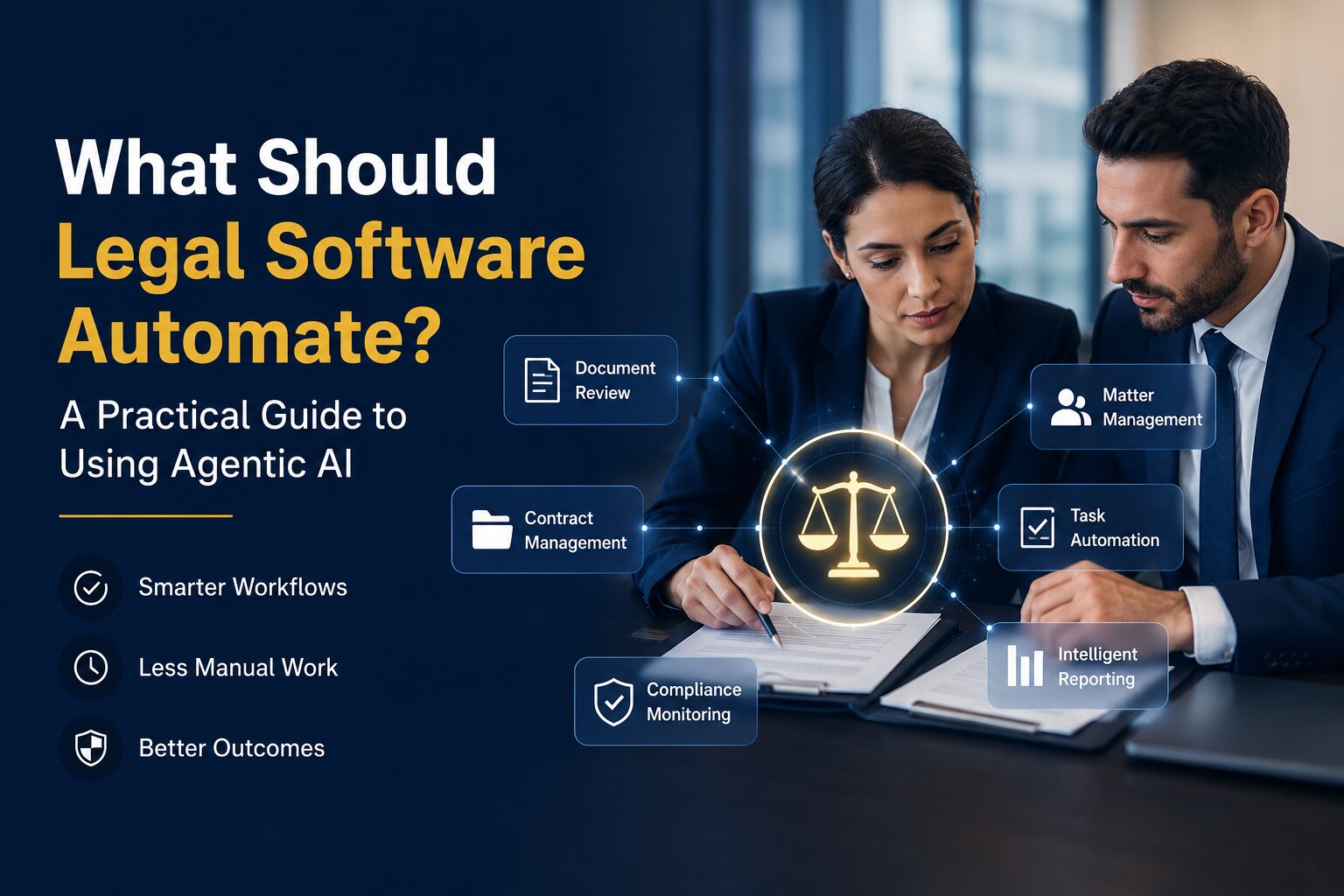
What Should Legal Software Automate? A Practical Guide to Using Agentic AI
Legal teams have always looked for ways to reduce repetitive work. Filing documents, tracking deadlines, reviewing standard clauses, updating matter records and preparing routine reports can take hours, even when the underlying work follows a familiar pattern.
Traditional legal software has helped automate many of these processes. But agentic AI introduces a different possibility. Instead of simply following a fixed rule, an AI agent can work through a series of steps, assess information, choose what to do next and adapt its actions based on what it finds. That does not mean every legal task should be handed over to AI.
In legal work, the ability to automate something is not the same as having a good reason to automate it. A task may be technically possible to automate but still require close human oversight because the consequences of getting it wrong are too serious.
The better question is therefore not, "Can this task be automated?" It is, "Should it be automated, and to what extent?"
The Real Question Isn't "Can It Automate" — It's "Should It"
The move from traditional automation to agentic AI changes how legal teams think about automation. Rule-based automation typically works from predefined instructions. For example, if a contract reaches a particular stage, the system might send a reminder or move it to the next step. These rules are useful when the process is predictable and the conditions are clear.
Agentic AI can go further. An AI agent may review information, determine which action is appropriate, carry out several related steps and respond differently depending on the situation.
For example, instead of simply reminding a lawyer that a contract is due for review, an agent could identify the agreement, examine key dates and obligations, summarise relevant changes and route the matter to the appropriate person. That sounds useful, but there is an important limitation: more capable automation also creates more room for mistakes.
Legal workflows often involve incomplete information, exceptions, confidential data and decisions where context matters. An automated system that makes the wrong assumption can create more work rather than less. This is why blanket automation rarely works well. The aim should not be to automate as much as possible. It should be to automate the right parts of a workflow while keeping people responsible for decisions that require legal judgement.
A useful way to make that decision is to look at four factors: frequency, judgment risk, data structure and downstream dependency.
A Framework for Deciding What to Automate
Not every repetitive legal task is a good candidate for agentic AI. Before automating a workflow, legal teams should look at what the task involves and what happens if something goes wrong.
Task frequency and volume
Start with how often the task occurs. A process that happens hundreds of times a month is usually a stronger automation candidate than a task performed once or twice a year. Repetitive activities also tend to create more opportunities for small manual errors.
Contract intake is a good example. A legal department may receive large numbers of agreements through different channels. Collecting basic information, identifying the document type and routing it to the right team member can consume significant time when handled manually.
By contrast, a highly unusual legal matter may not justify extensive automation because there is no consistent process to automate. Frequency alone is not enough, but it is a useful starting point.
Judgment risk
Next, consider how much legal judgement the task requires. Low-risk procedural activities are generally easier to automate. These might include sorting documents, checking whether required information is present, sending reminders or updating workflow statuses. Tasks involving interpretation, strategy or significant legal consequences need more caution.
An AI system might be able to identify a potentially unusual clause, for example, but that does not necessarily mean it should decide whether the clause is acceptable. That decision may depend on the commercial relationship, the applicable law, the organisation's risk appetite and other facts that are not obvious from the document itself.
The higher the judgment risk, the stronger the case for keeping a human involved.
Data structure
The nature of the information also matters. Structured information is easier for software to process consistently. Dates, names, matter numbers, contract types and predefined categories are examples. Legal documents, however, contain large amounts of natural language. The same concept can be expressed in many different ways, and important meaning can depend on context.
Agentic AI can help work with less structured information, but legal teams should still consider how reliable the system is for the specific type of document and language involved. A workflow based on standard templates may be easier to automate than one involving highly customised agreements.
Downstream dependency
Finally, look at what happens after the automated task is completed. If an incorrect output affects only an internal status field, the consequences may be relatively limited. If that output influences a contract decision, compliance action, payment, filing deadline or client communication, the risk is much greater.
The more people and processes depend on an automated output, the more important validation becomes. This is where human checkpoints can make a significant difference. Automation does not have to mean removing people from the process. In many cases, it means moving human attention to the points where it matters most.
Legal Workflows Well-Suited to Agentic Automation
When applied carefully, agentic AI can be useful for legal workflows that involve repeated steps, large volumes of information and clearly defined outcomes.
Contract intake and clause extraction
Contract intake often involves several small tasks before a lawyer can begin substantive review. An AI agent can help identify the type of agreement, extract key information, recognise relevant clauses and route the contract according to predefined criteria.
For example, it may identify renewal dates, termination provisions, governing law or specific commercial terms and place that information into the appropriate record.
The lawyer still needs to assess whether the information is accurate and what it means in context. The value of automation is that the initial information-gathering work can happen faster.
First-pass drafting and redlining
AI can also support the early stages of contract drafting and review. A system may work from an approved template, identify sections that need updating, suggest changes or compare a draft against predefined requirements. It can also highlight differences between versions for a lawyer to review.
This is particularly useful when the task involves familiar language and established organisational standards. The important distinction is between suggesting a change and approving it. The first can often be automated more safely than the second.
Deadline and obligation tracking
Legal teams deal with a constant stream of dates and obligations. Contracts may contain renewal periods, notice requirements, reporting obligations and other deadlines. Litigation matters may have filing dates, hearings and procedural milestones.
Agentic AI can help identify these obligations, record them, monitor changes and alert the relevant person when action is needed. This can reduce the risk of important dates being buried in documents, emails or spreadsheets. However, critical deadlines should not rely on a single automated mechanism. High-consequence dates may require confirmation and established escalation procedures.
Document classification and routing
Legal departments handle many types of documents, from contracts and correspondence to court documents, compliance records and internal requests. An AI system can classify incoming documents and determine where they should go based on the information it finds.
For example, a document relating to a particular matter could be linked to that matter and routed to the appropriate team. This reduces manual sorting and helps lawyers spend more time on substantive work.
Status updates and internal reporting
Routine reporting can also be a strong automation candidate. An agent can gather information from relevant records, identify outstanding actions and prepare a status summary for review. Instead of asking lawyers to manually compile updates from different systems, the technology can prepare the first version. Again, human review remains useful where the report will inform important management or legal decisions.
Legal Work That Should Stay Human-Led
There are areas where automation should support legal professionals rather than replace their judgement.
Novel legal interpretation and strategy
Some legal questions do not have a straightforward answer. A new regulatory issue, unusual dispute or complex interpretation may require a lawyer to consider legislation, case law, facts, commercial objectives and potential consequences together.
AI can assist with research and information organisation, but the responsibility for interpreting the situation and deciding on a legal strategy should remain with qualified professionals.
Client-facing negotiation and judgment calls
Negotiation is not simply about identifying the most favourable wording. A lawyer may need to understand the client's priorities, relationship with the other party, commercial pressures and willingness to accept risk. The same contract provision may be acceptable in one relationship and unacceptable in another.
AI can prepare information and suggest possible positions, but important negotiation decisions benefit from human judgement and communication.
Final review and sign-off on high-risk agreements
AI can be valuable during contract review without becoming the final decision-maker. For high-value, unusual or high-risk agreements, a lawyer should remain responsible for the final assessment and approval. This creates a practical division of work: technology handles much of the preparation, while the legal professional focuses on the decision.
Ethical and regulatory accountability points
Some responsibilities cannot simply be delegated to software. Legal teams remain accountable for how legal work is performed, how confidential information is handled and whether applicable professional and regulatory obligations are met. An automated workflow should therefore have clear ownership. Someone should know what the system is doing, what information it is using, where human approval is required and what happens when the system is uncertain.
How Agentic AI Differs From Traditional Legal Automation
Traditional automation and agentic AI can both reduce manual work, but they approach workflows differently. For a deeper comparison, see Agentic AI vs Traditional Legal Software: What’s Changing for Legal Teams.
Traditional automation usually depends on predefined rules. When a particular condition is met, the system performs a specific action. Agentic AI can work through a broader sequence of tasks. It may assess information, determine the next step and adapt the workflow based on what it encounters.
For a broader explanation of how this technology works in legal environments, see Beveron’s complete guide to Agentic AI in legal technology.
Consider a contract review process.
A traditional workflow might automatically send a contract to a designated reviewer whenever a new document is uploaded. An agentic workflow could potentially identify the contract type, extract relevant information, check it against defined criteria, identify issues that need attention, prepare a summary and route the matter according to the results.
The second approach can handle more variation, but that flexibility also requires stronger controls.
Human-in-the-loop checkpoints are therefore important. A human-in-the-loop simply means that a person reviews or approves an AI-generated result before an important action is completed. The right checkpoint depends on the risk of the task. A low-risk classification may need occasional quality checks. A high-risk contract decision may require human approval every time.
A Practical Checklist Before Automating Any Legal Task
Before introducing agentic AI into a legal workflow, ask:
- Does the task happen frequently enough to justify automation?
- How serious would the consequences be if the system made a mistake?
- Does the task involve legal judgement or mainly procedural work?
- Is the information reasonably consistent and accessible?
- Can the output be checked before it triggers an important action?
- Who remains responsible for the final decision?
- Is there a clear way to stop, correct or escalate the workflow when something looks wrong?
If a task scores well across these areas, it may be a good candidate for automation. If the task involves significant legal judgement and a mistake could have serious consequences, the safer approach may be to use AI as an assistant rather than an autonomous decision-maker.
Getting Started — A Phased Approach
Legal teams do not need to automate an entire department at once. A phased approach is usually more practical.
Start with low-risk, high-volume activities where the expected benefit is easy to measure. Document classification, information extraction, routine reminders and status preparation can be useful starting points.
Next, measure the results. Look at time saved, error rates, review effort and how often people need to correct the system.
The results should determine what happens next. If the system performs consistently, the team can gradually expand its role. If problems appear, the workflow can be adjusted before it becomes more deeply embedded.
It is also important to involve the people who actually use the workflow. Lawyers and legal operations teams often know where a process breaks down in practice. Their input can help identify unnecessary automation, missing approval steps and situations where the system needs more context. The goal is not to create a workflow where AI makes every decision. It is to create a workflow where people spend less time on routine administration and more time on work that genuinely requires their expertise.
Frequently Asked Questions
1. What tasks should never be fully automated in a law firm?
Tasks involving significant legal judgement, complex interpretation, sensitive client decisions, negotiation and final approval of high-risk matters should generally remain human-led. AI can support these activities, but qualified legal professionals should retain responsibility for important decisions.
2. Is agentic AI the same as traditional legal automation software?
No. Traditional automation generally follows predefined rules and workflows. Agentic AI can handle a sequence of tasks, assess information and adapt its next action within the boundaries it has been given. The two can also work together in the same legal technology environment.
3. How do legal teams evaluate whether an AI agent is ready for a given task?
Teams should consider the task's frequency, risk, level of judgement, data quality, expected accuracy and downstream impact. They should also test the system on realistic examples, establish human review points and define who is accountable for the result.
4. What's the risk of over-automating legal workflows?
Over-automation can remove useful human checks, amplify errors and make it harder to spot unusual situations. It can also create false confidence when an AI-generated result appears convincing but is incomplete or incorrect. The solution is not to avoid automation altogether, but to match the level of automation to the level of risk.
5. Should legal teams aim for fully autonomous AI workflows?
Not necessarily. In many legal settings, the strongest approach is selective automation. AI can handle routine steps and prepare information while lawyers retain control over decisions that require context, professional judgement or accountability.
Beveron: AI Legal Software Built for Practical Legal Workflows
The right legal AI solution should not simply automate tasks for the sake of automation. It should help legal teams reduce repetitive work while keeping people in control of decisions that require professional judgement.
This is where Beveron’s legal technology approach fits into the discussion. Beveron Technologies provides legal software designed to help law firms, corporate legal departments and debt collection teams manage everyday legal work through connected workflows, automation and AI-enabled capabilities.
Rather than treating every legal process as something that should run without human involvement, the focus is on supporting the different stages of legal work and giving teams greater visibility and control.
Smart Lawyer Office for Law Firms
For law firms, Smart Lawyer Office (SLO) brings key activities into a central legal management environment. It can support processes such as enquiries, proposals, client and KYC information, document collection, hearings, trust accounting, billing and reporting. For workflows that involve large amounts of administrative coordination, centralising information can reduce the need to move between disconnected tools and manual records.
AI and automation can then be applied where they are most useful, while lawyers remain responsible for legal decisions and client matters.
Smart Legal Counsel for Corporate Legal Teams
Corporate legal departments often manage a broader mix of matters, including contracts, disputes, compliance, risk and external counsel.
Smart Legal Counsel is designed to bring these activities together in one environment. It supports matter management, litigation, contracts, compliance, risk, expenses and outside counsel management, giving in-house legal teams a clearer view of their work.
This type of centralised workflow can provide a foundation for applying AI to repetitive activities such as information organisation, reporting and workflow coordination without removing human oversight from important legal decisions.
Smart Legal Contract for Contract Workflows
Contract-heavy legal teams can use Smart Legal Contract to manage contract lifecycle activities from a central platform.
The system supports contract management, electronic signing, advanced search and metadata filtering, along with AI-assisted capabilities such as clause extraction and contract analytics. Teams can also track renewal and expiry dates to reduce the chance of important obligations being overlooked.
These capabilities align closely with the types of contract workflows discussed earlier in this article: information extraction, document review support, obligation tracking and routing.
Applying the Right Level of Automation
Across these solutions, the underlying principle remains the same: not every legal task needs the same level of automation.
Routine and high-volume activities are natural candidates for automation. Tasks that involve interpretation, negotiation, strategy or significant risk still need human involvement.
For legal teams considering agentic AI, the objective should therefore be to find the right balance between technology and professional judgement. Beveron’s legal software provides a foundation for applying automation and AI across different legal workflows while keeping those workflows structured and manageable.
Conclusion
The most useful question about agentic AI in legal technology is not how much work it can take over. It is where it can genuinely improve the way legal work gets done. Routine, repetitive and information-heavy tasks are often strong candidates. Complex interpretation, negotiation, strategy and high-risk decisions usually need a human at the centre.
That balance is what makes legal automation practical. When legal teams evaluate each workflow based on frequency, risk, data, dependencies and accountability, they can use agentic AI to reduce administrative work without losing the judgement that good legal work depends on.
Ready to Put Legal AI to Work?
Move beyond repetitive legal administration and give your team more time for work that requires real judgement.
Explore Beveron’s AI-enabled legal software to see how Smart Lawyer Office, Smart Legal Counsel, Smart Legal Contract can help streamline legal workflows, manage information and apply automation where it matters most.
Talk to Beveron today and discover which legal workflows you can automate with confidence.
Best agentic AI for legal teams in the UAE
Best AI legal automation software for legal teams in the UAE
Best AI-powered legal software for law firms in the UAE
If you need a free demo on the Best agentic AI for legal teams in the UAE, please fill out the form.