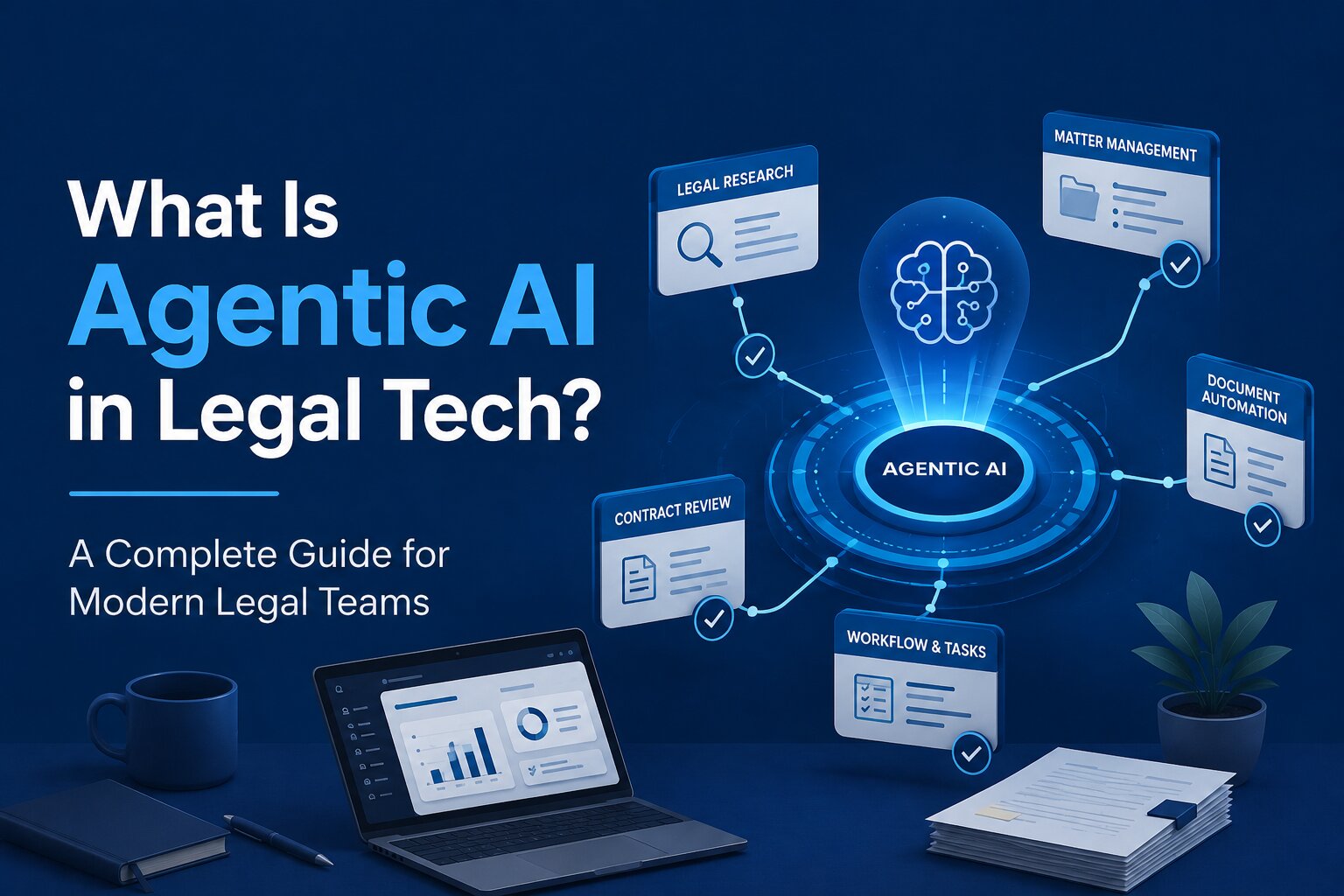
What Is Agentic AI in Legal Tech? A Complete Guide for Modern Legal Teams
Introduction
Legal technology has come a long way from simple digital tools that helped lawyers store documents, manage matters, or search for information. Artificial intelligence has taken that progress further by helping legal professionals draft documents, summarise information, review contracts, and answer questions.
But another shift is now taking place.
Instead of AI being used only to complete individual tasks, Agentic AI can support a series of connected activities to work towards a defined goal. In a legal environment, that could mean more than reviewing a contract. It could involve identifying an upcoming renewal, checking relevant terms, flagging potential issues, creating a task, notifying the right person, and monitoring what happens next. This shift is part of a broader transformation in legal technology, as explored in our guide to Why Agentic AI Is the Next Big Shift in Legal Technology.
That changes the role AI can play in legal operations. The important question is no longer simply, “What can AI do for lawyers?” It is “How can AI help legal teams move work forward?” This is where Agentic AI becomes particularly interesting. It represents a move from isolated AI-assisted tasks towards more connected legal workflows, while keeping human professionals involved where legal judgement, accountability, and decision-making are required.
How Agentic AI Is Changing the Way Legal Teams Work
Traditional legal software generally helps professionals perform specific activities. A lawyer may search for a document, create a task, review a contract, or update a matter. Generative AI can make some of these activities faster by producing content or finding and summarising relevant information.
Agentic AI takes a broader approach.
Rather than waiting for a person to initiate every individual step, an AI-enabled workflow can be designed to recognise what needs to happen next and carry out predefined actions within appropriate controls.
For example, consider a legal matter approaching a deadline. Instead of a lawyer manually checking the date, finding the relevant documents, creating a reminder, contacting the responsible team, and checking whether the action was completed, an agentic workflow could coordinate many of these operational steps.
This does not mean that AI independently takes over the legal matter. Instead, it helps reduce the administrative work surrounding it.
This shift can help legal teams:
- Move from answering questions to completing defined tasks
- Handle multiple connected activities within a workflow
- Reduce manual coordination of routine legal work
- Move information between processes and systems more efficiently
- Monitor deadlines, tasks, and follow-ups
- Escalate exceptions when human attention is required
- Spend more time on work that requires legal expertise and judgement
In other words, Agentic AI can help make legal operations more proactive. Rather than constantly reacting to the next request, deadline, or follow-up, teams can build workflows that keep work moving in a more structured way.
Agentic AI vs Generative AI: What’s the Difference?
Agentic AI and Generative AI are closely related, but they are not the same thing. Generative AI is designed primarily to create or transform content based on instructions. For a deeper look at how these two technologies differ in legal technology, see our guide to Agentic AI vs Generative AI in Legal Tech.
Generative AI can draft an email, summarise a lengthy contract, rewrite a clause, generate a report, or answer a question using the information available to it.
Agentic AI focuses more on achieving an objective through a sequence of actions.
For example, Generative AI might review a contract and identify its renewal date. An agentic workflow could take that information and use it as part of a larger process: identify the upcoming renewal, check relevant terms, flag exceptions, create a task, notify the responsible person, and monitor the workflow.
This does not mean Agentic AI replaces Generative AI. In many cases, generative capabilities can be one component of an agentic workflow.
The simplest way to think about the difference is this:
| Generative AI | Agentic AI |
|---|---|
| Responds to prompts | Works towards a defined goal |
| Creates or transforms content | Coordinates multiple steps |
| Usually produces an output | Can trigger predefined actions |
| Often focuses on an individual task | Can support connected workflows |
| Human usually initiates each request | Can initiate predefined actions within controls |
The distinction is therefore less about one technology being “better” than the other and more about how they are used. Generative AI helps produce the output. Agentic AI can help move the work forward.
Where Agentic AI Could Make the Biggest Difference in Legal Work
Not every legal activity needs an AI agent. The strongest opportunities are usually found in repetitive workflows, involve multiple steps, depend on deadlines, or require regular follow-up. Several areas of legal work fit this description.
Contract Management
Contract management is one of the clearest areas where Agentic AI can create value. Instead of simply reviewing or drafting contracts, AI can help coordinate activities across the contract lifecycle, from identifying the right template and checking clauses to routing approvals, tracking signatures, monitoring obligations, and flagging upcoming renewals.
For a deeper look at how Agentic AI can support these connected activities, see our guide to How Agentic AI Can Transform the Contract Lifecycle from Drafting to Execution.
An agentic workflow could help with activities such as:
- Reviewing contracts and extracting relevant information
- Identifying potential risks and obligations
- Comparing terms against predefined requirements
- Tracking renewal and expiry dates
- Monitoring required follow-ups
- Creating tasks for responsible team members
- Escalating exceptions for legal review
For example, if a contract is approaching its renewal window, the system could identify the relevant agreement, gather key information, flag unusual provisions, and notify the appropriate legal professional. The lawyer still makes the important decision. AI simply helps ensure the operational steps leading to that decision do not get lost.
Legal Research and Drafting
Legal research involves reviewing large amounts of case law, regulations, contracts, and other legal materials. Agentic AI could help gather relevant information, identify useful sources, organise findings, and support the preparation of research outputs. For a closer look at how AI is changing legal research across the GCC, see our guide on AI in Legal Research: What Law Firms in the GCC Need to Know.
The difference is that an agentic workflow could potentially connect research with subsequent actions. For example, after identifying relevant information, the system could organise findings, create follow-up tasks, update a matter, or route the work to a lawyer for review.
Agentic AI can support parts of this process by:
- Gathering relevant information from approved sources
- Organising research findings
- Comparing relevant legal materials
- Identifying information that may require closer review
- Supporting initial drafts
- Assisting with revisions
- Managing follow-up research tasks
Human review remains essential, particularly when the accuracy, relevance, or interpretation of legal information could affect a legal position or decision. The benefit is that lawyers can spend less time managing the mechanics of the research process and more time evaluating what the information actually means.
Compliance and Risk Management
Compliance workflows often involve recurring checks, deadlines, documentation, and remediation activities. An agentic system could help monitor relevant requirements, identify potential issues, track corrective actions, and escalate matters when attention is needed.
For example, when a compliance task remains incomplete beyond a defined deadline, a workflow could send a reminder, update the status, notify the responsible person, and escalate the matter according to predefined rules. This can give legal and compliance teams greater visibility without requiring someone to manually check every outstanding activity.
Matter and Client Management
Legal teams also spend considerable time managing incoming requests, assigning work, following up with colleagues, and keeping stakeholders informed.
Agentic AI can support this operational layer by helping:
- Capture incoming legal requests
- Categorise and prioritise matters
- Assign tasks
- Monitor matter progress
- Identify outstanding actions
- Send reminders and follow-ups
- Keep relevant stakeholders informed
For busy in-house legal teams, this can be particularly valuable. A significant amount of legal work happens outside the actual legal analysis. Managing that surrounding activity efficiently can have a meaningful impact on overall productivity.
What Does an Agentic AI Legal Workflow Actually Look Like?
It can be difficult to understand Agentic AI by looking only at definitions. A practical example makes the difference much clearer. Consider a contract renewal.
The Traditional Approach
A legal professional may need to manually check the contract repository for upcoming renewal dates. Once a renewal is identified, they may create a reminder, contact the relevant business team, retrieve the contract, review its terms, and follow up with stakeholders. If the business team does not respond, another reminder may be needed. The lawyer may then need to check the status again later.
None of these activities is necessarily difficult. The problem is that they consume time and require someone to keep the entire process moving.
An Agentic AI-Supported Approach
An agentic workflow could work differently. The system identifies an upcoming contract renewal and gathers the relevant contract information. It reviews key terms and obligations against predefined criteria and flags potential exceptions. A task is then created for the responsible lawyer. Relevant stakeholders are notified, and the workflow continues monitoring outstanding activities.
If everything progresses normally, the process moves forward according to its defined rules. If an issue falls outside those rules or requires professional judgement, the workflow can escalate it to a human. The lawyer remains responsible for the legal decision, but they do not necessarily have to manually coordinate every operational step surrounding it.
The Key Takeaway
The value is not simply that AI performs one task faster. The bigger opportunity is that AI can help coordinate the sequence of activities surrounding that task.
That is what makes workflow orchestration such an important part of the Agentic AI conversation.
What Should Legal Teams Consider Before Adopting Agentic AI?
Adopting Agentic AI requires more than choosing an AI platform and connecting it to existing systems. Legal teams need to understand which workflows are suitable for greater automation, where human approval is necessary, and what controls should be in place. A process-first approach can help organisations identify the right opportunities before deploying AI agents. For a practical framework, see our guide on Agentic AI for Legal Teams: How to Identify the Right Processes Before Deploying AI Agents.
Teams should consider several factors before implementation:
- Start with the right workflows: Not every legal process needs greater autonomy. Begin with repetitive, structured activities where AI can deliver measurable value.
- Define human approval points: Establish where lawyers or authorised professionals must review, approve, or intervene.
- Protect sensitive legal data: Legal workflows often involve confidential client, contract, and matter information, making data access and security essential.
- Maintain traceability: AI-driven actions should be visible and auditable so teams can understand what happened and why.
- Consider existing systems: Agentic AI should work with the legal systems and processes already used by the organisation rather than creating another disconnected workflow.
Tasks That Are Good Candidates for AI-Led Execution
Legal teams may consider using AI to support activities such as:
- Routine document checks
- Data gathering
- Information classification
- Status monitoring
- Reminders and follow-ups
- Initial risk identification
- Task creation
- Workflow coordination
- Routine reporting
These activities tend to have clearer rules, defined inputs, and measurable outcomes.
Responsibilities That Should Remain With Legal Professionals
Other responsibilities require professional judgement and should remain under appropriate human control. These include:
- Legal strategy
- Final legal interpretation
- Complex legal analysis
- High-risk decisions
- Client advice
- Negotiation
- Ethical decisions
- Final approvals and sign-off
The goal should not be to remove lawyers from the workflow. Instead, legal teams should look for opportunities to remove unnecessary operational effort while preserving human oversight where it matters most.
Core principle: The strongest use of Agentic AI is not replacing legal judgement. It is taking care of the operational work that surrounds that judgement.
The Real Value of Agentic AI Goes Beyond Automation
Automation is often the first benefit people associate with AI. And it certainly matters. Reducing repetitive manual work can save time and improve efficiency. But automation alone does not explain the larger opportunity presented by Agentic AI. Consider how much legal work involves coordination.
A request comes in. Someone reviews it. Information is gathered. A task is assigned. Another person needs to provide input. A deadline approaches. A reminder is sent. The matter is updated. Someone reviews the result. An issue is escalated.
The individual activities may be simple, but coordinating all of them can become time-consuming.
This is where Agentic AI can create additional value.
It can help legal teams:
- Spend less time coordinating routine activities
- Move requests from intake to action more quickly
- Improve visibility across matters and workflows
- Make routine processes more consistent
- Reduce missed follow-ups and deadlines
- Use legal team resources more effectively
- Create more time for strategic and judgement-intensive work
- Scale legal operations without simply adding administrative workload
The bigger opportunity is therefore workflow orchestration. Traditional automation might automate a particular action. Agentic AI can potentially connect multiple actions into a broader workflow.
That changes the question from:
“How much work can we automate?”
to:
“How much unnecessary coordination can we remove while keeping people in control?”
That is a much more useful question for legal leaders considering AI adoption.
What Should Legal Teams Consider Before Adopting Agentic AI?
Agentic AI should not be introduced simply because it is a new technology. Legal teams need to start with the workflow and the problem they are trying to solve.
Start With the Right Workflows
The best starting point is usually a process that is repetitive, relatively predictable, and clearly defined.
Look for workflows with:
- High volumes of similar activities
- Repetitive administrative steps
- Clear deadlines
- Frequent follow-ups
- Defined rules or decision criteria
It is generally better to begin with a controlled operational workflow than a highly complex legal decision.
Decide Where Human Approval Is Required
Not every AI action needs the same level of oversight. Legal teams should establish which actions can happen automatically and where a lawyer must review or approve the next step. Clear escalation rules are equally important. If a situation falls outside predefined conditions, the system should know when to stop and involve a human.
Protect Confidential Legal Information
Legal teams handle highly sensitive information, including confidential client data, contracts, business information, and privileged material.
Before implementing Agentic AI, organisations should consider:
- Data confidentiality
- Access controls
- User permissions
- Security requirements
- Data storage and processing
- Appropriate use of third-party AI services
AI adoption should strengthen legal operations without compromising the confidentiality and security obligations that come with them.
Make AI Activity Visible and Traceable
Legal teams need to understand what an AI-enabled workflow has done. Activity logs, audit trails, decision records, and workflow visibility can help organisations monitor AI-supported processes and investigate issues when necessary.
Traceability also helps build confidence. People are more likely to trust AI-supported workflows when they can see what happened and where human intervention occurred.
Consider the Systems You Already Use
Agentic AI rarely operates in isolation. Legal departments may already rely on matter management software, contract management systems, document repositories, CRM platforms, email, and other business applications. The more connected the workflow becomes, the more important integration is.
Before adopting an AI solution, legal teams should consider how it will interact with existing systems and whether information can move between them securely and reliably.
How Beveron Technologies Is Bringing AI Into Legal Operations
As legal teams move towards more connected and intelligent workflows, the technology they use becomes increasingly important. Beveron Technologies is a legal technology company focused on helping law firms, corporate legal departments, and legal professionals manage their day-to-day operations more efficiently through purpose-built digital solutions.
Rather than treating AI as a standalone feature, Beveron’s solutions are designed around the practical needs of legal teams, including matter management, legal operations, contract management, and workflow coordination.
Its legal technology portfolio includes solutions such as Smart Lawyer Office, Smart Legal Counsel, and Smart Legal Contract, each designed to address a different part of the legal workflow.
Smart Lawyer Office
Smart Lawyer Office is designed for law firms that need a centralised platform to manage their legal practice and everyday operations. It can help legal professionals organise matters, manage clients, track tasks and deadlines, handle documents, monitor activities, and improve visibility across ongoing work. By bringing key legal practice processes together, the platform can reduce reliance on disconnected tools and manual tracking.
For law firms looking to improve operational efficiency while maintaining better control over their matters and client work, Smart Lawyer Office provides a structured digital environment for managing day-to-day legal operations.
Smart Legal Counsel
Smart Legal Counsel is designed for corporate legal departments and in-house legal teams that need greater visibility and control over their legal work. It supports areas such as legal matter management, requests, tasks, documents, deadlines, compliance activities, and collaboration between legal teams and other business departments.
For growing legal departments, the ability to track what is happening across multiple matters and requests can be just as important as the legal work itself. Smart Legal Counsel helps create a more organised approach to managing these workflows and gives legal teams greater visibility into their workload and ongoing activities.
Smart Legal Contract
Smart Legal Contract focuses on the contract lifecycle, helping organisations manage contracts more systematically from creation and review through approval, execution, and ongoing monitoring. Contract management often involves much more than drafting an agreement. Teams need to identify important clauses, track obligations, monitor key dates, manage approvals, and ensure that required actions are completed.
Smart Legal Contract brings these activities into a more structured workflow, helping legal and business teams improve contract visibility and reduce the risk of important dates, obligations, or follow-ups being overlooked.
Building Smarter Legal Workflows
The broader value of platforms such as these is that legal teams do not have to view technology, automation, and AI as separate initiatives. When legal information, matters, contracts, tasks, deadlines, and workflows are connected, organisations have a stronger foundation for introducing more intelligent and AI-assisted processes.
This is particularly relevant as Agentic AI develops. The effectiveness of an AI-driven workflow depends not only on the AI model itself, but also on the quality of the underlying data, processes, permissions, and systems that support it.
For legal teams, the future is therefore likely to involve a combination of legal expertise, structured workflows, intelligent automation, and human oversight rather than AI operating independently from the systems lawyers already use.
The Next Stage of Legal Technology
Legal technology is gradually moving beyond isolated AI features. The next stage is likely to focus increasingly on how AI can connect different activities and help move work through a complete process.
Think about a typical legal request:
Request → Analysis → Action → Follow-up → Escalation
Today, people may be responsible for manually moving the work from one stage to the next. In the future, AI-enabled workflows may be able to coordinate more of these transitions automatically, subject to appropriate controls. That does not mean every legal process will become fully autonomous. Nor should it. The more important question is where autonomy genuinely creates value.
For a routine, well-defined process, allowing AI to perform several operational steps may make sense. For a complex legal decision, the right approach may be to use AI for information gathering and preparation while leaving the decision entirely with a legal professional. The competitive advantage will therefore not simply come from having AI.
It will come from knowing where AI can act, where it should assist, and where humans must remain firmly in control.
The Key Takeaway
Agentic AI should not be viewed as just another feature added to legal software. It represents a broader shift—from software that helps lawyers complete individual tasks to systems that can help coordinate and execute connected legal workflows.
For legal teams, that distinction could become increasingly important as AI becomes more deeply integrated into day-to-day operations.
Frequently Asked Questions
1. How is Agentic AI changing legal technology?
Agentic AI is helping move legal technology from individual task assistance towards connected workflows. Instead of simply generating an answer or completing one task, AI can potentially coordinate multiple predefined activities, such as gathering information, creating tasks, sending reminders, monitoring progress, and escalating exceptions.
2. What legal tasks can Agentic AI automate?
Agentic AI can support routine and clearly defined activities such as document checks, data gathering, information classification, deadline monitoring, reminders, follow-ups, task creation, workflow coordination, and routine reporting. The level of automation should depend on the risk and complexity of the task.
3. Can Agentic AI make legal decisions without lawyers?
Agentic AI can perform predefined actions and support decision-making, but complex legal judgement should remain under appropriate human oversight. Legal strategy, interpretation, negotiation, client advice, ethical decisions, and final approvals generally require qualified legal professionals.
4. Is Agentic AI suitable for in-house legal teams?
Yes. In-house legal teams can potentially benefit from Agentic AI in areas such as contract management, compliance monitoring, matter management, legal request intake, deadline tracking, and routine follow-ups. These teams often manage large volumes of recurring operational work, making workflow coordination particularly valuable.
5, How should legal teams prepare for Agentic AI?
Legal teams should start by identifying suitable workflows rather than trying to automate everything at once. They should define human approval points, protect sensitive legal data, establish auditability, and consider how AI will integrate with existing legal and business systems.
Conclusion
Agentic AI represents an important shift in the evolution of legal technology. The focus is moving from AI that simply helps with individual tasks towards AI that can support and coordinate connected workflows. For legal teams, this could mean less time spent chasing information, sending reminders, checking statuses, and coordinating routine activities.
But the goal is not to replace lawyers.
Legal judgement, strategy, accountability, negotiation, interpretation, and final approval remain essential. The most effective approach is likely to be one where AI handles appropriate operational work while legal professionals remain in control of decisions that require expertise and judgement.
For organisations exploring Agentic AI, the starting point should therefore be practical: identify the workflows that consume unnecessary time, determine where AI can safely create value, and establish clear boundaries for human involvement.
The future of legal technology is not simply about adding more AI. It is about using AI intelligently to help legal teams move work forward while keeping human judgement at the centre of legal practice.
Explore how Agentic AI is reshaping legal operations, from contract management and compliance to matter management and connected legal workflows.
Best agentic AI for legal teams in the UAE
Best agentic AI for law firms in the UAE
Best AI in legal operations in the UAE
If you need a free demo of the best agentic AI for legal teams in the UAE, please fill out the form.