Agentic AI vs Generative AI in Legal Tech: What's the Difference?
Legal technology has moved quickly from simple automation to systems that can understand documents, generate content, analyse information and, increasingly, take action. That progress has also created some confusion.
Terms such as generative AI, AI agents and agentic AI are now common in legal technology discussions. They are sometimes used as though they mean the same thing. In reality, there is an important difference between technology that primarily creates an output and technology that can work through a series of actions to achieve a goal.
For legal teams evaluating AI tools, this distinction matters. A tool that drafts a contract clause is solving a different problem from one that can coordinate the entire contract review process. So, when comparing agentic AI vs generative AI in legal tech, the most useful question is not which technology is better. It is what each technology can actually do, and where it fits into the way legal work gets done.
Why the Two Get Confused in Legal Tech Conversations
The confusion is understandable. Both technologies have become prominent during the same broader wave of AI adoption, and both can appear in the same legal technology platform.
Both terms entered legal vocabulary around the same time
Generative AI became particularly visible in legal work as large language models started being used for tasks such as document summarisation, drafting, research assistance and information extraction. Legal professionals quickly saw the potential. Instead of starting every document from scratch, they could ask an AI system to produce a first draft. Instead of reading a lengthy agreement line by line just to identify key provisions, they could use AI to surface relevant information. The conversation has now moved a step further.
Legal teams are increasingly interested in systems that do not simply answer a question or produce a document but can help manage what happens next. This is where agentic AI enters the discussion.
Vendors often use the terms loosely
Another reason for the confusion is marketing language. A platform may describe itself as "AI-powered", "generative AI-enabled", "autonomous" or "agentic" even when the actual capabilities behind those terms vary considerably.
For a legal team, the label alone is therefore not enough.
A useful starting point is to ask: Does the system mainly generate information for a person, or can it carry out a defined sequence of actions within a workflow? That question gets much closer to the real difference.
The Core Distinction: Output vs. Action
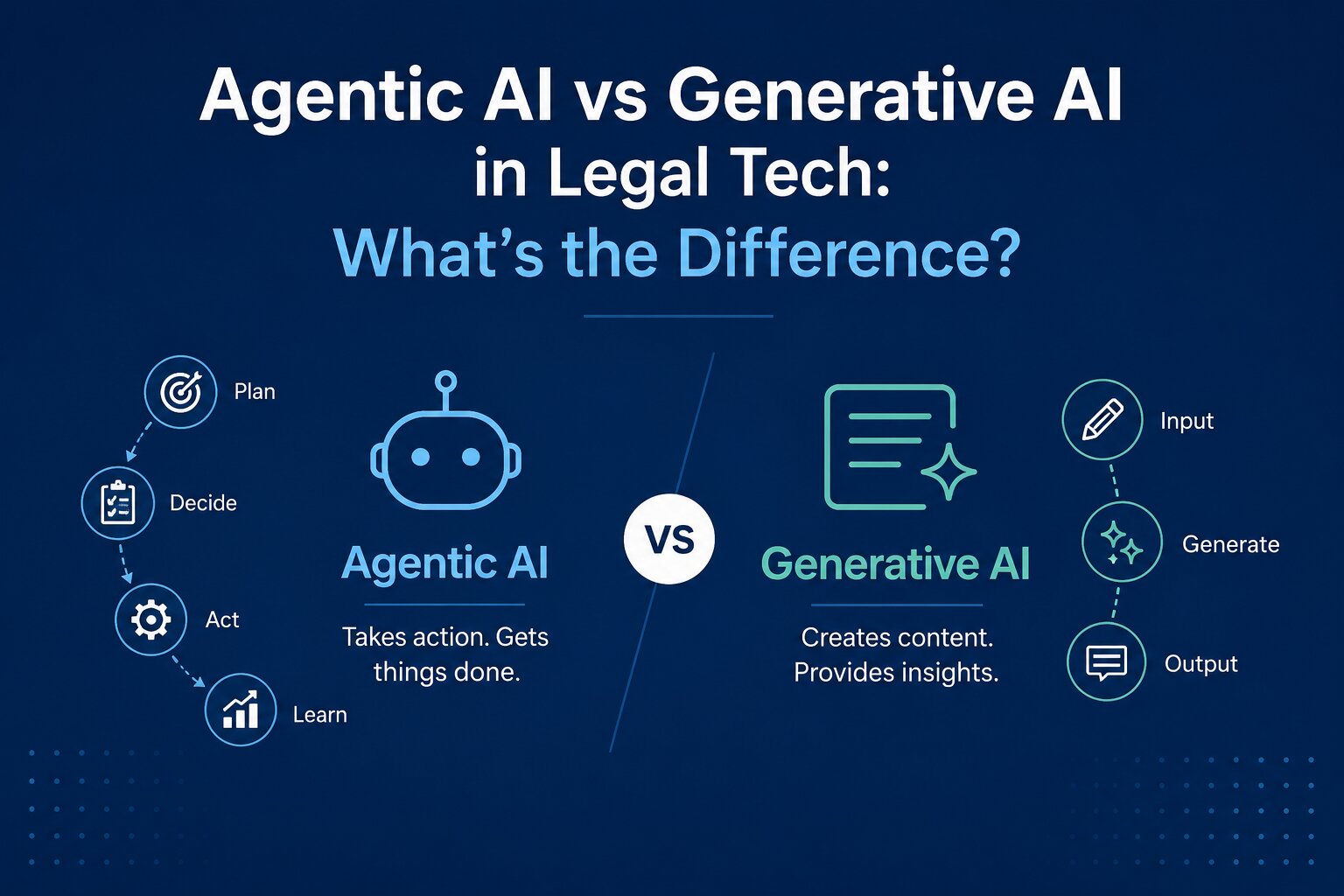
The simplest way to understand the difference between generative AI and agentic AI is to think about output versus action.
Generative AI produces content, drafts and suggestions
Generative AI is primarily designed to create or transform content based on an instruction or context.
In legal work, that might include:
- Drafting a contract clause
- Summarising a case file
- Creating a first version of a legal letter
- Comparing two documents
- Summarising a lengthy contract
- Extracting key information from a document
- Generating research summaries
- Suggesting alternative wording
The user typically provides the instruction, reviews the result and decides what happens next.
For example, a lawyer might ask:
"Summarise the termination provisions in this agreement and highlight any unusual requirements."
The AI analyses the document and produces a response. The lawyer then decides whether the information is accurate, what it means for the matter and what action should follow.
The basic pattern is:
Instruction → AI-generated output → Human review → Next action
Generative AI can therefore be extremely useful without being autonomous.
Agentic AI can execute multi-step tasks and workflows
Agentic AI takes the idea further. Rather than simply responding to individual instructions, an agentic system can be designed to work towards a defined goal by carrying out multiple steps. Depending on the system, it may use tools, retrieve information, make decisions within defined boundaries and trigger subsequent actions. Consider a contract review workflow.
Instead of simply asking AI to summarise a contract, a legal team could have a workflow that:
- Receives a new contract.
- Identifies the relevant contract type.
- Extracts important clauses.
- Checks those clauses against predefined requirements.
- Identifies potential risks.
- Categorises the findings.
- Creates follow-up tasks.
- Routes the contract to the appropriate reviewer.
- Tracks the review status.
- Escalates issues that require human attention.
The exact capabilities will depend on the technology and the controls around it. But the underlying idea is different. The system is not just producing an answer. It is participating in a process. That makes the distinction between generative AI and agentic AI particularly important in legal operations.
Agentic AI vs Generative AI: Side-by-Side Comparison
Area | Generative AI | Agentic AI |
|---|---|---|
Primary purpose | Generate or transform information | Work towards a defined goal through multiple steps |
Decision-making | Usually responds to user instructions | Can determine or recommend the next step within defined boundaries |
Autonomy | Generally lower | Generally higher, depending on design and permissions |
Human input | Often required for each interaction | Can require fewer interventions during workflow execution |
Typical output | Text, summaries, drafts and suggestions | Actions, workflow progress, decisions and outputs |
Workflow involvement | Usually supports individual tasks | Can coordinate multiple tasks |
System interaction | May operate mainly within the AI interface | Can interact with connected tools and systems |
Best suited for | Drafting, analysis, summarisation and ideation | Workflow orchestration, monitoring and process automation |
Human oversight | Important | Still essential, particularly for high-risk legal decisions |
Controls required | Accuracy, privacy and access controls | Those controls plus permissions, monitoring, escalation and auditability |
There is one important caveat. Agentic does not mean fully autonomous.
In a legal environment, giving an AI system unrestricted authority to make and execute decisions would introduce obvious risks. Sensitive legal work often requires human judgement, approval and accountability. A well-designed agentic workflow should therefore define what the system can do independently, what requires approval and when an issue should be escalated to a human.
How Each Shows Up in Legal Workflows
The difference becomes easier to see when we move away from definitions and look at everyday legal work.
Generative AI in legal work
Generative AI is particularly useful when the problem is primarily about working with information. A lawyer may spend significant time reading, writing, summarising and restructuring information. These are areas where generative AI can provide meaningful assistance.
Common examples include:
Clause drafting: A lawyer can use AI to create an initial version of a clause based on specified requirements.
Document summarisation: Long agreements, case materials or internal documents can be condensed into shorter summaries for review.
Legal research assistance: AI can help organise information, identify relevant themes and produce research summaries, although legal professionals still need to verify important sources and conclusions.
Correspondence drafting: Routine emails, letters and other communications can be prepared more quickly.
Document analysis: AI can help identify particular provisions, entities, dates, obligations or other information within large documents.
In each case, AI can reduce the amount of manual work involved. But the human usually remains responsible for deciding what to do with the result.
Agentic AI in legal work
Agentic AI becomes more relevant when a legal process contains multiple connected steps. Contract management is a good example. A contract rarely begins and ends with drafting. There may be intake, classification, review, negotiation, approval, execution, obligation tracking, renewal monitoring and eventual closure. An agentic workflow could potentially coordinate several of these activities based on predefined rules and permissions. Learn more about how agentic AI can improve contract management and reduce legal workloads across these connected stages.
Other examples could include:
Contract intake and routing: New agreements can be classified and directed to the appropriate workflow or legal team.
Deadline and milestone tracking:
The system can monitor important dates and trigger reminders or escalation when required.
Task orchestration: Different activities can be assigned to relevant people as a matter or contract moves through its lifecycle.
Follow-up management: Where a workflow requires a response or approval, the system can monitor progress and trigger the next step.
Exception handling: Issues outside predefined parameters can be flagged for human review rather than allowing the workflow to continue automatically.
Matter management: AI-supported workflows could help coordinate repetitive activities associated with legal matters while maintaining a central record of progress. This is where agentic AI can have a different operational impact.
The goal is not simply to help someone complete a task faster. It is to reduce the amount of manual coordination required to move work from one stage to the next.
Where the Two Overlap
It would be misleading to treat generative AI and agentic AI as completely separate technologies. In practice, they can work together.
Agentic systems often use generative models as a component
An agentic system may use a generative AI model to understand a document, interpret an instruction, classify information or produce a response. Other components can then manage the workflow around that capability. For example, a contract workflow might use a generative model to identify potentially risky language. The broader agentic system could then determine what workflow step should follow, create a review task, notify the appropriate person and record the outcome.
So the relationship can look something like this: Generative AI provides intelligence for specific tasks → Agentic architecture connects those capabilities to a broader workflow. The exact architecture varies between products, but this distinction helps explain why the two concepts frequently appear together.
Why "agentic" isn't simply generative AI with extra steps
It is tempting to think that an AI becomes agentic simply because someone gives it a longer prompt. That is not a useful way to distinguish the two. A genuinely agentic workflow generally involves more than generating a longer response. It may involve goal-orientated behaviour, tool use, workflow coordination, conditional logic, access to relevant systems and the ability to take permitted actions.
The important question is therefore not:
"Does this AI have multiple prompts?"
It is:
"Can this system work through a defined process and take appropriate actions within controlled boundaries?"
That is a much more meaningful question for legal technology buyers.
What This Means for Legal Teams Evaluating AI Tools
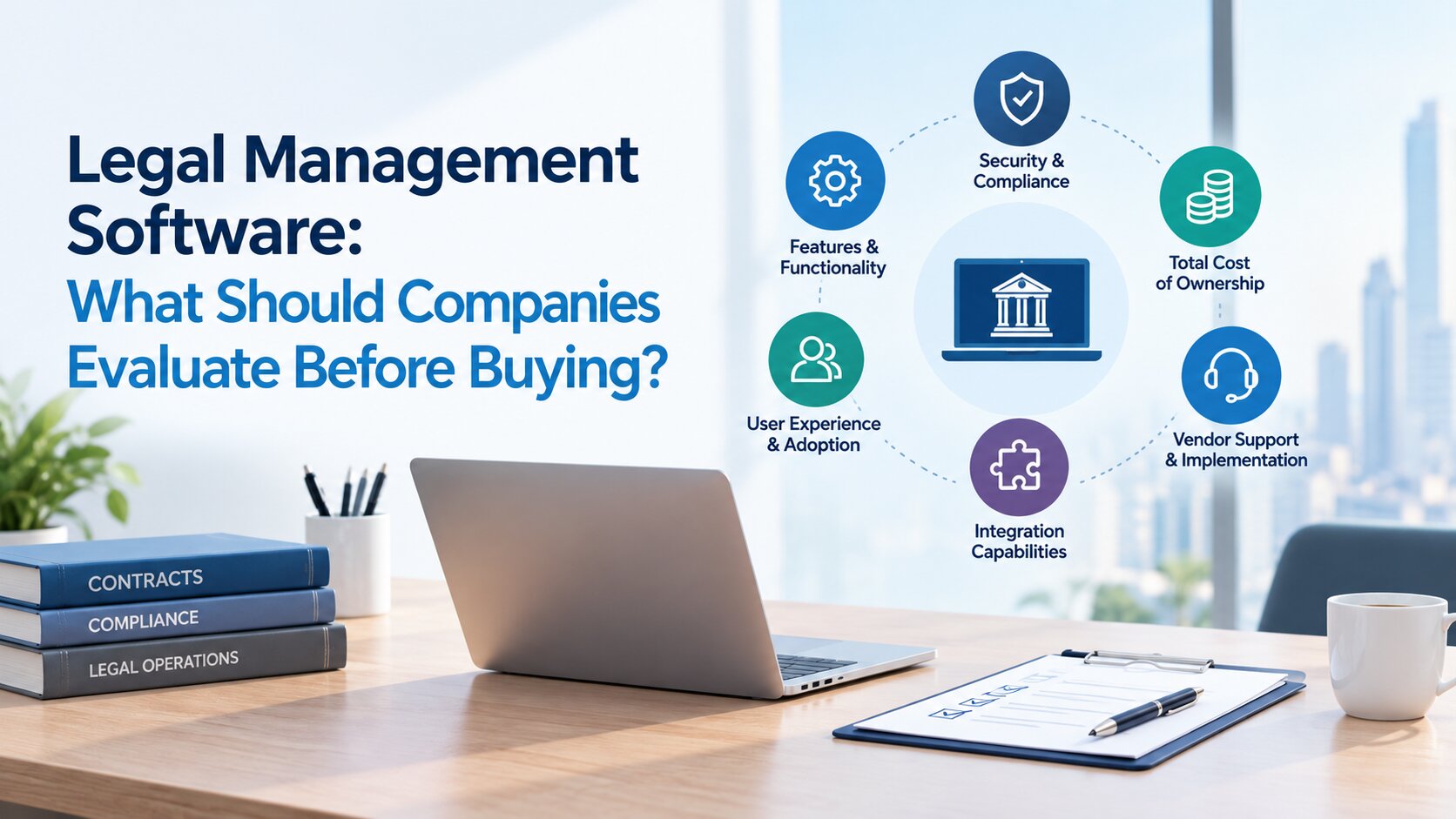
Legal teams should be cautious about choosing technology simply because it uses the latest AI terminology. The better approach is to start with the workflow and identify the right processes before deploying AI agents. This helps teams assess where agentic AI can create genuine value, where human oversight is still necessary, and which processes may not be suitable for automation.
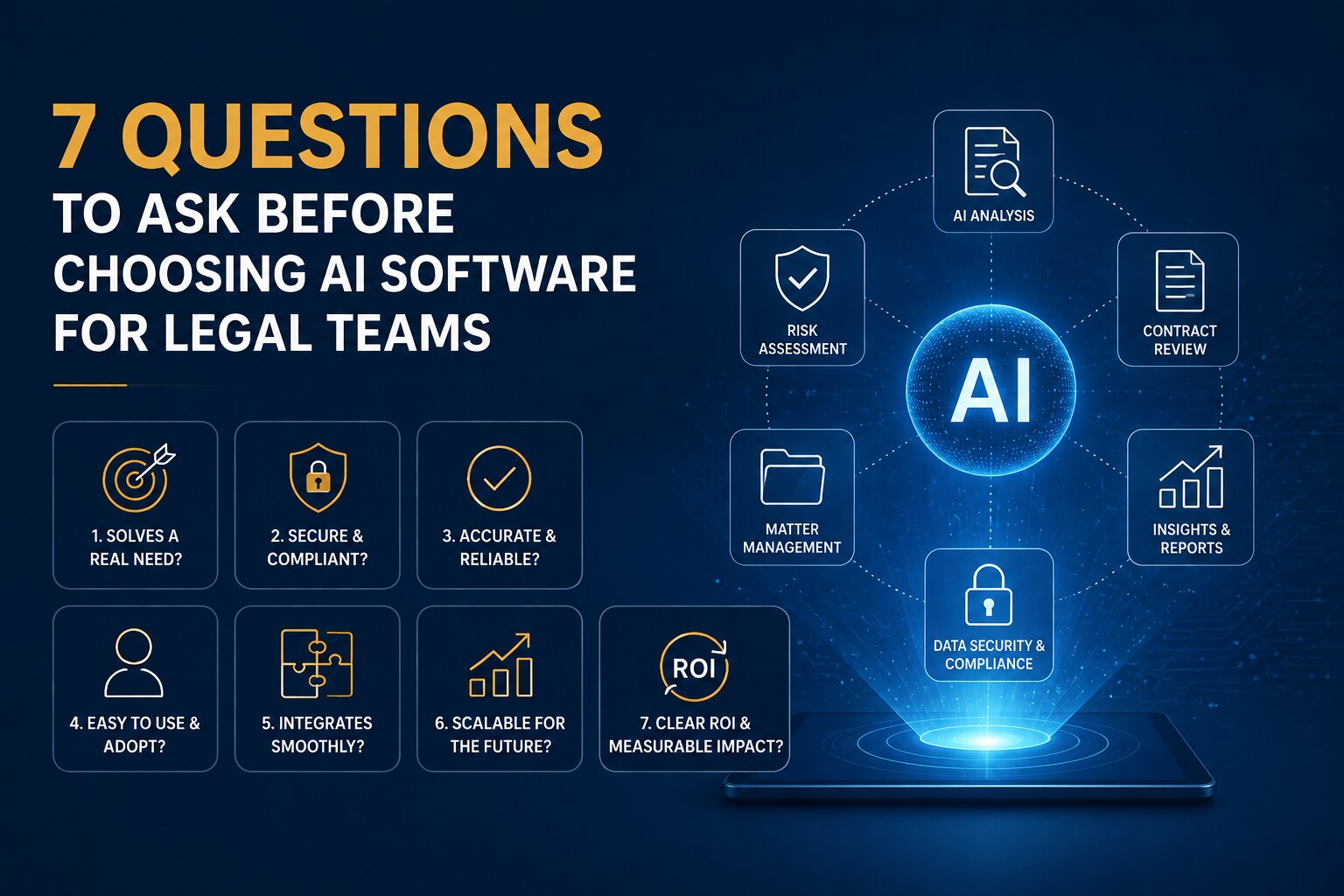
Questions to ask when a platform claims to be "agentic"
If a vendor describes a platform as agentic, ask what that actually means in practice.
Useful questions include:
- What can the AI do without another user prompt?
- Can it perform multiple steps towards a defined objective?
- Can it use connected tools or systems?
- What actions is it permitted to take?
- Which actions require human approval?
- How are permissions managed?
- Can every important action be audited?
- What happens when the system is uncertain?
- How are exceptions handled?
- Can workflows be configured around existing legal processes?
- Can users intervene or stop an automated process?
- How is sensitive legal information protected?
These questions help separate genuine workflow capabilities from AI terminology used primarily for marketing.
Match the technology to the actual workflow problem
Not every legal team needs agentic AI.
If the problem is that lawyers spend too much time summarising agreements, generative AI may be the right solution.
If the problem is that contracts repeatedly get stuck between legal review, business approval and execution, workflow automation or agentic capabilities may be more relevant.
Likewise, if lawyers spend hours drafting routine correspondence, generative AI could deliver an immediate productivity benefit without introducing more complex autonomous workflows.
The right question is therefore not:
"Which is more advanced: generative AI or agentic AI?"
Instead, ask:
"Where do we need intelligence, and where do we need action?"
That distinction can help legal teams avoid buying technology that solves a problem they do not actually have.
Leading Legal Tech Solutions and Where Beveron Technologies Fits
The shift towards AI-enabled legal operations is happening alongside a broader move towards digital legal workflow management. Beveron Technologies is one example of a legal technology provider building solutions around different areas of legal and recovery operations. Rather than treating legal technology as a single category, Beveron Technologies offers solutions aimed at specific operational needs.
Beveron Smart Legal Counsel
Smart Legal Counsel is designed for corporate legal teams managing legal matters and day-to-day legal operations. It can help organisations centralise matter information, organise legal workflows, manage tasks and improve visibility across ongoing legal work.
For in-house teams, this type of structured environment can provide an important foundation for introducing more automation and AI-supported processes.
Beveron Smart Lawyer Office
Smart Lawyer Office is designed for law firms and legal practitioners looking to manage their practice through a centralised digital platform. It supports areas such as matter and case management, documents, tasks and day-to-day operational coordination.
For law firms considering AI adoption, having structured information and consistent workflows is particularly important because AI capabilities are only as useful as the processes and data around them.
Beveron Smart Legal Contract
Smart Legal Contract focuses on contract management and lifecycle activities. Contract workflows are particularly relevant to the agentic AI discussion because contract work involves much more than generating a document. It can involve drafting, review, negotiation, approvals, execution, tracking and ongoing obligation management.
A structured contract lifecycle environment can therefore provide the operational foundation on which more advanced AI and automation capabilities can be applied.
Why this matters in the agentic AI discussion
The larger lesson is that agentic AI should not be viewed simply as a chatbot with more capabilities. Its potential value comes from connecting AI with real workflows, data, rules and actions. That means the legal technology platforms most relevant to this next stage of AI adoption are likely to be those that already understand how legal work is structured.
For buyers, this makes the underlying workflow platform just as important as the AI model itself.
Frequently Asked Questions
Is agentic AI more advanced than generative AI?
Not necessarily. The two technologies are designed around different capabilities. Generative AI focuses primarily on creating or transforming information, while agentic AI focuses on achieving a goal through multiple steps and actions. An agentic system may use generative AI as one of its components.
Can a legal tool be both generative and agentic?
Yes. In fact, the two can complement each other. A legal technology platform could use generative AI to analyse a document or produce a draft while an agentic workflow coordinates what happens before and after that task. The combination can be particularly useful for multi-stage legal processes.
Which one should a law firm prioritise first?
It depends on the firm's actual workflow problems. If the biggest challenge is drafting, summarisation, document analysis or research assistance, generative AI may be a practical starting point. If the bigger problem is repetitive coordination across multiple stages, an agentic or workflow-automation approach may provide more value. The technology should follow the problem, not the other way around.
Conclusion
The difference between agentic AI vs generative AI in legal tech becomes much easier to understand when you stop looking at the labels and look at the work itself. Generative AI is primarily about creating, transforming and understanding information. Agentic AI is about using intelligence to move towards a goal through a series of actions. The two are not competitors in every situation. An agentic legal technology system may rely on generative AI to perform some of its most important tasks.
For legal teams, the bigger decision is therefore not which AI term sounds more advanced. It is whether the technology can address a real operational problem while maintaining appropriate human oversight, security, governance and accountability.
As legal technology develops, the most useful AI will not necessarily be the technology with the most impressive terminology. It will be the technology that fits naturally into the work legal professionals already need to get done.
Ready to explore what AI-powered legal technology could look like for your organisation?
Discover how Beveron Technologies helps legal teams streamline matters, automate workflows and build more efficient legal operations with purpose-built technology.
Explore Beveron’s legal technology solutions and identify where smarter automation can make a measurable difference to your team.
Best agentic AI for law firms in the UAE
Best AI for legal technology in the UAE
Best AI-powered legal technology in the UAE
If you need a free demo of the best agentic AI for law firms in the UAE, please fill out the form.