7 Ways Agentic AI Can Improve Contract Management and Reduce Legal Workloads
Introduction
Contracts are at the centre of almost every business relationship in the UAE. They define what each party has agreed to, set expectations, protect business interests, and create a clear record of responsibilities. But managing those contracts can become a heavy workload for legal teams, especially for UAE businesses handling agreements with customers, suppliers, employees, and business partners.
A typical contract process may involve reviewing documents, checking clauses, suggesting changes, getting approvals, following up with stakeholders, recording important dates, and making sure obligations are met after signing. When these tasks are handled manually, even routine agreements can take up a significant amount of time.
This is where agentic AI for contract management in the UAE is beginning to make a difference. Traditional AI tools can help answer questions, summarise documents, or suggest information. Agentic AI goes a step further. It can work through a series of related tasks, use defined rules and instructions to determine what should happen next, and take certain actions with limited human involvement.
That does not mean AI replaces lawyers. Instead, it can take care of repetitive parts of contract management while legal professionals in the UAE remain responsible for important decisions, judgement, and oversight.
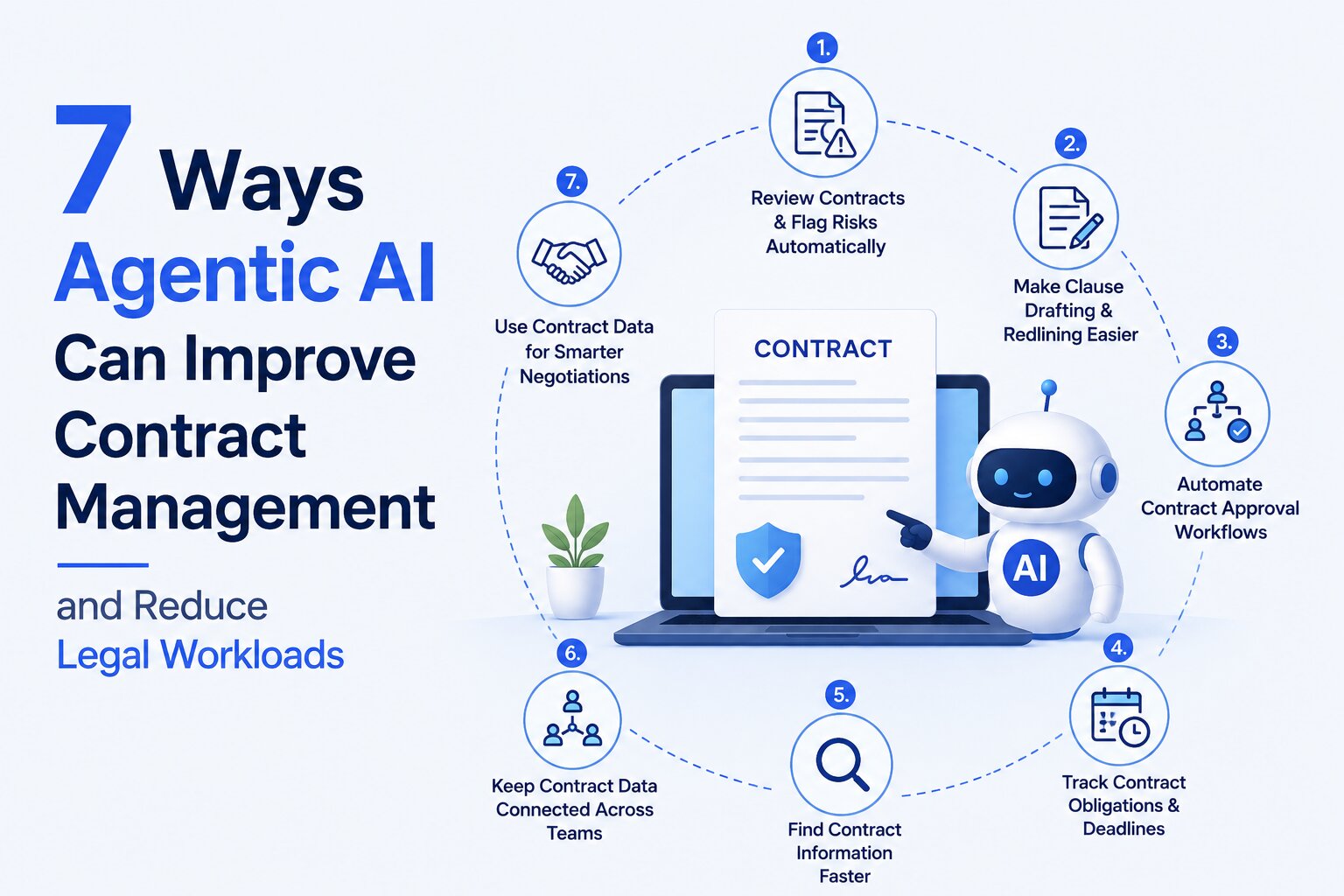
Here are seven practical ways agentic AI can help improve contract management and reduce legal workloads.
1. Review Contracts and Flag Risks Automatically
Contract review is one of the most time-consuming parts of the legal workflow. A lawyer may need to read dozens of pages, check specific clauses, compare them with company standards, and identify anything that could create unnecessary risk. Doing this manually becomes particularly difficult when the legal team is handling a large number of agreements at the same time.
Agentic AI can help with the initial review by analysing a contract and identifying areas that may require attention. For example, it can look for unusual wording, missing provisions, terms that differ from an organisation's approved standards, or clauses that fall outside predefined guidelines.For a deeper look at how AI can support contract reviews for UAE businesses, explore our guide on AI legal contract review in the UAE, including how AI can identify key clauses, assess potential risks, and make contract reviews more efficient.
Imagine a company that normally uses a standard limitation-of-liability clause. If a new supplier agreement contains significantly different wording, an AI system can flag the difference for review instead of expecting the lawyer to notice it during a lengthy manual review. The lawyer still makes the final decision. The difference is that they can start with the areas most likely to need attention. This can make first-level contract review faster while helping legal teams use their time where it matters most.
Agentic AI can help with:
- Identifying potentially risky or unusual clauses
- Comparing contract terms with approved standards
- Flagging missing or inconsistent provisions
- Highlighting clauses that need legal attention
- Reducing time spent on initial contract review
2. Make Clause Drafting and Redlining Easier
Contract drafting rarely ends with the first version. A clause may go through several rounds of changes before both sides agree. For legal teams, this can mean repeatedly rewriting similar provisions, checking whether proposed changes comply with internal policies, and preparing redlines for negotiation. Agentic AI can make this process more efficient by suggesting suitable clause language based on approved contract playbooks, existing templates, and organisational guidelines.
To understand how agentic AI can support the wider contract journey, from the initial draft through execution, explore our guide on how agentic AI can transform the contract lifecycle from drafting to execution.
For example, if a business regularly negotiates payment terms with suppliers, the system can use the organisation's preferred language as a starting point. If a proposed clause differs from the company's usual position, it can highlight the difference and suggest an alternative based on the relevant rules. This is especially useful for repetitive contracts where many clauses follow a similar pattern.
Rather than starting from a blank page each time, lawyers can review and refine AI-generated suggestions. That keeps legal expertise in the process while reducing some of the repetitive drafting work.
Agentic AI can help with:
- Suggesting appropriate clause language
- Supporting contract redlining
- Applying approved legal playbooks
- Reusing suitable language from existing templates
- Reducing repetitive drafting
- Helping shorten negotiation cycles
3. Automate Contract Approval Workflows
Even when a contract is ready for approval, it can sit untouched for days. The delay may have nothing to do with the legal work itself. Someone may have forgotten to review the document, an approval request may have been buried in an email inbox, or a stakeholder may not know that an action is waiting for them.
These small delays can add up quickly.
Agentic AI can help manage the approval process by identifying the required reviewers, routing the contract to the appropriate people, monitoring the status, and sending reminders when an action is overdue. For instance, a contract may require approval from legal, finance, and procurement. Instead of a legal team member manually checking each stage, the system can monitor the workflow and notify the relevant person when their action is required.
If an approval remains pending beyond a defined period, the system can also flag or escalate the delay according to the organisation's workflow rules. This allows legal teams to spend less time chasing approvals and more time handling contracts that genuinely need their attention.
Agentic AI can help with:
- Automatically routing contracts for approval
- Identifying the appropriate stakeholders
- Sending reminders for pending actions
- Tracking approval progress
- Highlighting or escalating delayed approvals
- Reducing manual follow-ups
4. Keep Track of Contract Obligations and Deadlines
Signing a contract is not the end of the contract lifecycle. Once an agreement is active, businesses still need to keep track of renewal dates, termination notice periods, payment obligations, service commitments, deliverables, reporting requirements, and other responsibilities. This is where contract management can become difficult. Important dates can be spread across different agreements, spreadsheets, calendars, and email conversations. When there is no central process for tracking them, something can easily be overlooked.
Agentic AI can help by identifying important dates and obligations in contracts and monitoring them over time.
For example, if a supplier contract requires 60 days' notice before renewal, the system can identify that requirement and provide a reminder ahead of the deadline. If a contract contains recurring obligations, those can also be tracked according to the configured workflow. The goal is not simply to send more notifications. It is to make sure the right people receive the right information at the right time. That can help businesses reduce missed deadlines, avoid unnecessary automatic renewals, and stay on top of their contractual commitments.
Agentic AI can help with:
- Tracking renewal and expiry dates
- Monitoring contractual obligations
- Identifying termination notice periods
- Sending proactive reminders
- Reducing the risk of missed deadlines
- Helping teams manage ongoing contractual commitments
5. Find the Right Contract Information Faster
Legal teams often spend more time searching for information than they would like. A lawyer might need to find a previous agreement, locate a particular clause, check how a customer contract was negotiated in the past, or identify agreements containing a specific type of obligation. If contracts are stored across folders, email attachments, shared drives, and different systems, finding the right information can become frustrating.
Agentic AI can make contract search more natural. Instead of relying only on exact keywords, users can ask questions in everyday language.
For example:
"Show me previous supplier agreements that contain similar termination terms."
Or:
"Which customer contracts are due for renewal in the next three months?"
The system can then identify relevant information from the available contract data. This can be particularly useful for legal teams that need to research previous agreements before drafting or negotiating a new one. The less time lawyers spend digging through documents, the more time they have for analysis and decision-making.
Agentic AI can help with:
- Searching contracts using natural language
- Finding similar clauses and agreements
- Retrieving relevant contract information quickly
- Identifying contracts based on specific terms
- Reducing time spent searching through documents
- Making existing contract knowledge easier to access
6. Keep Contract Data Connected Across Teams
Contract information rarely belongs to the legal team alone. Sales teams need to know what customers have agreed to. Procurement teams need visibility into supplier terms. Finance teams may need information about payment conditions. HR teams may need access to employment-related agreements. When each department maintains information separately, the same data may have to be entered several times. This creates unnecessary work and increases the chance of errors.
Agentic AI can help connect contract workflows with other business systems, such as customer relationship management, finance, procurement, and other internal platforms, where suitable integrations are available. For UAE businesses looking to strengthen the procurement side of contract management, procurement contract management software in the UAE can provide a more structured way to manage supplier agreements, approvals, renewals, and contractual obligations throughout the lifecycle.
For example, when a contract is approved, relevant information could be made available to the appropriate business workflow instead of requiring someone to manually copy the same details into another system. This creates a more connected process and can give teams better visibility into the agreements that affect their work. It also reduces the problem of different departments working from outdated or inconsistent information.
Agentic AI can help with:
- Connecting contract information across departments
- Reducing duplicate data entry
- Keeping relevant records updated
- Improving collaboration between legal and business teams
- Creating a more consistent source of contract information
- Reducing errors caused by repetitive manual updates
7. Use Contract Data to Make Smarter Negotiation Decisions
Every organisation negotiates contracts differently. Over time, those negotiations create a valuable collection of information. Previous agreements can show which clauses were accepted, which terms were frequently changed, where negotiations took longer, and which positions were difficult for counterparties to accept. Without the right tools, however, much of this knowledge remains buried inside old contracts.
Agentic AI can help legal teams analyse historical contract information and identify useful patterns. Before entering a negotiation, a lawyer could review similar agreements and understand how certain terms were handled previously. This could provide additional context when deciding whether to accept a proposed change, push back on a clause, or use an alternative position.
For example, if historical contracts show that a particular liability provision is frequently negotiated, the legal team can prepare for that discussion before the negotiation begins. AI does not decide what the lawyer should accept. Instead, it can bring relevant information together so the lawyer can make a more informed decision. This is one of the areas where contract management moves beyond administration and starts supporting strategic legal work.
Agentic AI can help with:
- Analysing historical contract data
- Identifying recurring negotiation patterns
- Comparing terms across previous agreements
- Supporting negotiation preparation
- Highlighting commonly negotiated provisions
- Giving lawyers more context for decision-making
How Agentic AI Can Change the Contract Management Workflow
The real value of agentic AI is not limited to one individual task. Consider a typical contract journey. A new agreement comes in, the system identifies the type of contract, checks it against relevant rules, highlights potential issues, and helps prepare suggested changes. Once the document is ready, it can move through the appropriate approval workflow.
After signing, important obligations and dates can be monitored. Later, when another agreement needs to be drafted or negotiated, information from previous contracts can help the legal team prepare. The result is a more connected contract management process rather than a collection of separate manual tasks.
However, human oversight remains important. Contract decisions can have financial, operational, regulatory, and legal consequences. AI-generated suggestions should therefore be reviewed according to the organisation's policies and risk level. The best approach is not to remove lawyers from the process. It is to remove unnecessary administrative work around them.
How Beveron Helps Bring Smarter Contract Management Into Practice
Agentic AI becomes more useful when it is connected to the day-to-day contract workflow rather than being treated as a standalone tool. Beveron Smart Legal Contract is designed to help organisations in the UAE manage contracts more efficiently throughout their lifecycle, from creation and review through approval, tracking, and ongoing management. The platform brings contract-related activities into a more organised workflow, helping UAE legal and business teams reduce repetitive administrative work, improve visibility into their agreements, and manage contracts more efficiently.
Beveron Smart Legal Contract
Beveron Smart Legal Contract can help organisations bring structure to contract management by supporting activities such as contract creation, review, approval, tracking, and ongoing management. Instead of managing contract information across disconnected files and manual processes, teams can use a centralised system to organise and monitor their agreements.
It can help teams:
- Streamline contract creation and review
- Organise contracts in one centralised system
- Track important contract dates and obligations
- Improve visibility into contract status
- Support collaboration between legal and business teams
- Reduce repetitive contract administration
- Manage contracts more consistently across their lifecycle
For organisations managing a high volume of agreements, having a structured contract workflow can make it easier to understand what needs attention and when.
Who Can Benefit from Smart Legal Contract?
Contract management affects many departments, not just legal. Beveron Smart Legal Contract can be useful for organisations where agreements are an important part of daily operations.
- Legal teams can use it to manage a high volume of agreements while keeping contract activities organised.
- Procurement teams can benefit from better visibility into supplier and vendor contracts, including important terms and dates.
- Sales teams can manage customer and commercial agreements more systematically and work more closely with legal during the contract process.
- Finance teams can access relevant contract information, including payment terms and other financial commitments.
- HR teams can organise employment-related agreements and keep track of relevant contract information.
- Businesses and enterprises can use a structured contract management approach to improve visibility, reduce manual work, and create more consistent processes.
Other Beveron Legal and Financial Solutions
Contract management is only one part of a broader legal and financial workflow. Beveron also provides solutions designed for other areas of legal and financial operations.
Smart Legal Counsel helps in-house legal teams manage legal matters, requests, documents, tasks, and workflows more effectively.
Smart Lawyer Office helps law firms manage cases, clients, documents, tasks, billing, and everyday legal operations from one system.
Smart Debt Collection helps businesses, financial institutions, and collection teams manage debt recovery workflows, customer accounts, follow-ups, and collection activities more efficiently.
Together, these solutions are designed to help organisations reduce manual administrative work and bring greater structure to their legal and financial processes.
What Legal Teams Should Consider Before Adopting Agentic AI
Agentic AI can offer significant benefits, but organisations should not adopt it simply because it is a new technology. The first step is to identify where the biggest manual bottlenecks exist. If lawyers spend most of their time chasing approvals, searching for documents, or tracking deadlines, those areas may be good candidates for automation.
It is also important to define what AI is allowed to do independently and where human approval is required. Low-risk administrative actions may be suitable for greater automation, while decisions involving significant legal or financial consequences should generally receive appropriate human review. Data quality matters too. If contract information is incomplete, outdated, or poorly organised, AI may not produce useful results. Clear internal policies, reliable contract data, access controls, and regular oversight are important parts of responsible implementation.
The goal should be practical: use AI where it genuinely saves time and improves the workflow, while keeping people in control of important decisions.
Conclusion
Agentic AI is changing how businesses in the UAE approach contract management. Instead of using AI only to search documents or generate summaries, UAE organisations can use it to support connected workflows across contract review, drafting, approvals, obligation tracking, information retrieval, collaboration, and negotiation preparation.
The real benefit is not simply processing more contracts. It is giving legal teams in the UAE more time to focus on work that requires human judgement, commercial understanding, negotiation, and strategic decision-making.
As businesses across the UAE continue to adopt digital and AI-driven solutions, contract management is likely to become less dependent on manual processes and more focused on managing risk, improving compliance, streamlining workflows, and gaining greater value from contract data.
For UAE organisations looking to make this transition, the goal should not be to replace legal professionals with AI. It should be to give legal and business teams smarter tools that help them manage contracts more efficiently while keeping human oversight at the centre of important decisions.
Ready to Make Contract Management Smarter?
Move beyond manual contract tracking and repetitive legal work with a more organised, AI-ready contract management approach. Beveron Smart Legal Contract helps legal and business teams manage contracts, approvals, important dates, obligations, and workflows from one centralised platform.
Want to simplify your contract lifecycle and give your legal team more time for strategic work? Explore Beveron Smart Legal Contract today.
Best agentic AI contract management in the UAE
Best contract management automation software in the UAE
Best AI legal contract management software in the UAE
If you need a free demo of the
Introduction
Contracts are at the centre of almost every business relationship in the UAE. They define what each party has agreed to, set expectations, protect business interests, and create a clear record of responsibilities. But managing those contracts can become a heavy workload for legal teams, especially for UAE businesses handling agreements with customers, suppliers, employees, and business partners.
A typical contract process may involve reviewing documents, checking clauses, suggesting changes, getting approvals, following up with stakeholders, recording important dates, and making sure obligations are met after signing. When these tasks are handled manually, even routine agreements can take up a significant amount of time.
This is where agentic AI for contract management in the UAE is beginning to make a difference. Traditional AI tools can help answer questions, summarise documents, or suggest information. Agentic AI goes a step further. It can work through a series of related tasks, use defined rules and instructions to determine what should happen next, and take certain actions with limited human involvement.
That does not mean AI replaces lawyers. Instead, it can take care of repetitive parts of contract management while legal professionals in the UAE remain responsible for important decisions, judgement, and oversight.
Here are seven practical ways agentic AI can help improve contract management and reduce legal workloads.
1. Review Contracts and Flag Risks Automatically
Contract review is one of the most time-consuming parts of the legal workflow. A lawyer may need to read dozens of pages, check specific clauses, compare them with company standards, and identify anything that could create unnecessary risk. Doing this manually becomes particularly difficult when the legal team is handling a large number of agreements at the same time.
Agentic AI can help with the initial review by analysing a contract and identifying areas that may require attention. For example, it can look for unusual wording, missing provisions, terms that differ from an organisation's approved standards, or clauses that fall outside predefined guidelines.For a deeper look at how AI can support contract reviews for UAE businesses, explore our guide on AI legal contract review in the UAE, including how AI can identify key clauses, assess potential risks, and make contract reviews more efficient.
Imagine a company that normally uses a standard limitation-of-liability clause. If a new supplier agreement contains significantly different wording, an AI system can flag the difference for review instead of expecting the lawyer to notice it during a lengthy manual review. The lawyer still makes the final decision. The difference is that they can start with the areas most likely to need attention. This can make first-level contract review faster while helping legal teams use their time where it matters most.
Agentic AI can help with:
- Identifying potentially risky or unusual clauses
- Comparing contract terms with approved standards
- Flagging missing or inconsistent provisions
- Highlighting clauses that need legal attention
- Reducing time spent on initial contract review
2. Make Clause Drafting and Redlining Easier
Contract drafting rarely ends with the first version. A clause may go through several rounds of changes before both sides agree. For legal teams, this can mean repeatedly rewriting similar provisions, checking whether proposed changes comply with internal policies, and preparing redlines for negotiation. Agentic AI can make this process more efficient by suggesting suitable clause language based on approved contract playbooks, existing templates, and organisational guidelines.
To understand how agentic AI can support the wider contract journey, from the initial draft through execution, explore our guide on how agentic AI can transform the contract lifecycle from drafting to execution.
For example, if a business regularly negotiates payment terms with suppliers, the system can use the organisation's preferred language as a starting point. If a proposed clause differs from the company's usual position, it can highlight the difference and suggest an alternative based on the relevant rules. This is especially useful for repetitive contracts where many clauses follow a similar pattern.
Rather than starting from a blank page each time, lawyers can review and refine AI-generated suggestions. That keeps legal expertise in the process while reducing some of the repetitive drafting work.
Agentic AI can help with:
- Suggesting appropriate clause language
- Supporting contract redlining
- Applying approved legal playbooks
- Reusing suitable language from existing templates
- Reducing repetitive drafting
- Helping shorten negotiation cycles
3. Automate Contract Approval Workflows
Even when a contract is ready for approval, it can sit untouched for days. The delay may have nothing to do with the legal work itself. Someone may have forgotten to review the document, an approval request may have been buried in an email inbox, or a stakeholder may not know that an action is waiting for them.
These small delays can add up quickly.
Agentic AI can help manage the approval process by identifying the required reviewers, routing the contract to the appropriate people, monitoring the status, and sending reminders when an action is overdue. For instance, a contract may require approval from legal, finance, and procurement. Instead of a legal team member manually checking each stage, the system can monitor the workflow and notify the relevant person when their action is required.
If an approval remains pending beyond a defined period, the system can also flag or escalate the delay according to the organisation's workflow rules. This allows legal teams to spend less time chasing approvals and more time handling contracts that genuinely need their attention.
Agentic AI can help with:
- Automatically routing contracts for approval
- Identifying the appropriate stakeholders
- Sending reminders for pending actions
- Tracking approval progress
- Highlighting or escalating delayed approvals
- Reducing manual follow-ups
4. Keep Track of Contract Obligations and Deadlines
Signing a contract is not the end of the contract lifecycle. Once an agreement is active, businesses still need to keep track of renewal dates, termination notice periods, payment obligations, service commitments, deliverables, reporting requirements, and other responsibilities. This is where contract management can become difficult. Important dates can be spread across different agreements, spreadsheets, calendars, and email conversations. When there is no central process for tracking them, something can easily be overlooked.
Agentic AI can help by identifying important dates and obligations in contracts and monitoring them over time.
For example, if a supplier contract requires 60 days' notice before renewal, the system can identify that requirement and provide a reminder ahead of the deadline. If a contract contains recurring obligations, those can also be tracked according to the configured workflow. The goal is not simply to send more notifications. It is to make sure the right people receive the right information at the right time. That can help businesses reduce missed deadlines, avoid unnecessary automatic renewals, and stay on top of their contractual commitments.
Agentic AI can help with:
- Tracking renewal and expiry dates
- Monitoring contractual obligations
- Identifying termination notice periods
- Sending proactive reminders
- Reducing the risk of missed deadlines
- Helping teams manage ongoing contractual commitments
5. Find the Right Contract Information Faster
Legal teams often spend more time searching for information than they would like. A lawyer might need to find a previous agreement, locate a particular clause, check how a customer contract was negotiated in the past, or identify agreements containing a specific type of obligation. If contracts are stored across folders, email attachments, shared drives, and different systems, finding the right information can become frustrating.
Agentic AI can make contract search more natural. Instead of relying only on exact keywords, users can ask questions in everyday language.
For example:
"Show me previous supplier agreements that contain similar termination terms."
Or:
"Which customer contracts are due for renewal in the next three months?"
The system can then identify relevant information from the available contract data. This can be particularly useful for legal teams that need to research previous agreements before drafting or negotiating a new one. The less time lawyers spend digging through documents, the more time they have for analysis and decision-making.
Agentic AI can help with:
- Searching contracts using natural language
- Finding similar clauses and agreements
- Retrieving relevant contract information quickly
- Identifying contracts based on specific terms
- Reducing time spent searching through documents
- Making existing contract knowledge easier to access
6. Keep Contract Data Connected Across Teams
Contract information rarely belongs to the legal team alone. Sales teams need to know what customers have agreed to. Procurement teams need visibility into supplier terms. Finance teams may need information about payment conditions. HR teams may need access to employment-related agreements. When each department maintains information separately, the same data may have to be entered several times. This creates unnecessary work and increases the chance of errors.
Agentic AI can help connect contract workflows with other business systems, such as customer relationship management, finance, procurement, and other internal platforms, where suitable integrations are available. For UAE businesses looking to strengthen the procurement side of contract management, procurement contract management software in the UAE can provide a more structured way to manage supplier agreements, approvals, renewals, and contractual obligations throughout the lifecycle.
For example, when a contract is approved, relevant information could be made available to the appropriate business workflow instead of requiring someone to manually copy the same details into another system. This creates a more connected process and can give teams better visibility into the agreements that affect their work. It also reduces the problem of different departments working from outdated or inconsistent information.
Agentic AI can help with:
- Connecting contract information across departments
- Reducing duplicate data entry
- Keeping relevant records updated
- Improving collaboration between legal and business teams
- Creating a more consistent source of contract information
- Reducing errors caused by repetitive manual updates
7. Use Contract Data to Make Smarter Negotiation Decisions
Every organisation negotiates contracts differently. Over time, those negotiations create a valuable collection of information. Previous agreements can show which clauses were accepted, which terms were frequently changed, where negotiations took longer, and which positions were difficult for counterparties to accept. Without the right tools, however, much of this knowledge remains buried inside old contracts.
Agentic AI can help legal teams analyse historical contract information and identify useful patterns. Before entering a negotiation, a lawyer could review similar agreements and understand how certain terms were handled previously. This could provide additional context when deciding whether to accept a proposed change, push back on a clause, or use an alternative position.
For example, if historical contracts show that a particular liability provision is frequently negotiated, the legal team can prepare for that discussion before the negotiation begins. AI does not decide what the lawyer should accept. Instead, it can bring relevant information together so the lawyer can make a more informed decision. This is one of the areas where contract management moves beyond administration and starts supporting strategic legal work.
Agentic AI can help with:
- Analysing historical contract data
- Identifying recurring negotiation patterns
- Comparing terms across previous agreements
- Supporting negotiation preparation
- Highlighting commonly negotiated provisions
- Giving lawyers more context for decision-making
How Agentic AI Can Change the Contract Management Workflow
The real value of agentic AI is not limited to one individual task. Consider a typical contract journey. A new agreement comes in, the system identifies the type of contract, checks it against relevant rules, highlights potential issues, and helps prepare suggested changes. Once the document is ready, it can move through the appropriate approval workflow.
After signing, important obligations and dates can be monitored. Later, when another agreement needs to be drafted or negotiated, information from previous contracts can help the legal team prepare. The result is a more connected contract management process rather than a collection of separate manual tasks.
However, human oversight remains important. Contract decisions can have financial, operational, regulatory, and legal consequences. AI-generated suggestions should therefore be reviewed according to the organisation's policies and risk level. The best approach is not to remove lawyers from the process. It is to remove unnecessary administrative work around them.
How Beveron Helps Bring Smarter Contract Management Into Practice
Agentic AI becomes more useful when it is connected to the day-to-day contract workflow rather than being treated as a standalone tool. Beveron Smart Legal Contract is designed to help organisations in the UAE manage contracts more efficiently throughout their lifecycle, from creation and review through approval, tracking, and ongoing management. The platform brings contract-related activities into a more organised workflow, helping UAE legal and business teams reduce repetitive administrative work, improve visibility into their agreements, and manage contracts more efficiently.
Beveron Smart Legal Contract
Beveron Smart Legal Contract can help organisations bring structure to contract management by supporting activities such as contract creation, review, approval, tracking, and ongoing management. Instead of managing contract information across disconnected files and manual processes, teams can use a centralised system to organise and monitor their agreements.
It can help teams:
- Streamline contract creation and review
- Organise contracts in one centralised system
- Track important contract dates and obligations
- Improve visibility into contract status
- Support collaboration between legal and business teams
- Reduce repetitive contract administration
- Manage contracts more consistently across their lifecycle
For organisations managing a high volume of agreements, having a structured contract workflow can make it easier to understand what needs attention and when.
Who Can Benefit from Smart Legal Contract?
Contract management affects many departments, not just legal. Beveron Smart Legal Contract can be useful for organisations where agreements are an important part of daily operations.
- Legal teams can use it to manage a high volume of agreements while keeping contract activities organised.
- Procurement teams can benefit from better visibility into supplier and vendor contracts, including important terms and dates.
- Sales teams can manage customer and commercial agreements more systematically and work more closely with legal during the contract process.
- Finance teams can access relevant contract information, including payment terms and other financial commitments.
- HR teams can organise employment-related agreements and keep track of relevant contract information.
- Businesses and enterprises can use a structured contract management approach to improve visibility, reduce manual work, and create more consistent processes.
Other Beveron Legal and Financial Solutions
Contract management is only one part of a broader legal and financial workflow. Beveron also provides solutions designed for other areas of legal and financial operations.
Smart Legal Counsel helps in-house legal teams manage legal matters, requests, documents, tasks, and workflows more effectively.
Smart Lawyer Office helps law firms manage cases, clients, documents, tasks, billing, and everyday legal operations from one system.
Smart Debt Collection helps businesses, financial institutions, and collection teams manage debt recovery workflows, customer accounts, follow-ups, and collection activities more efficiently.
Together, these solutions are designed to help organisations reduce manual administrative work and bring greater structure to their legal and financial processes.
What Legal Teams Should Consider Before Adopting Agentic AI
Agentic AI can offer significant benefits, but organisations should not adopt it simply because it is a new technology. The first step is to identify where the biggest manual bottlenecks exist. If lawyers spend most of their time chasing approvals, searching for documents, or tracking deadlines, those areas may be good candidates for automation.
It is also important to define what AI is allowed to do independently and where human approval is required. Low-risk administrative actions may be suitable for greater automation, while decisions involving significant legal or financial consequences should generally receive appropriate human review. Data quality matters too. If contract information is incomplete, outdated, or poorly organised, AI may not produce useful results. Clear internal policies, reliable contract data, access controls, and regular oversight are important parts of responsible implementation.
The goal should be practical: use AI where it genuinely saves time and improves the workflow, while keeping people in control of important decisions.
Conclusion
Agentic AI is changing how businesses in the UAE approach contract management. Instead of using AI only to search documents or generate summaries, UAE organisations can use it to support connected workflows across contract review, drafting, approvals, obligation tracking, information retrieval, collaboration, and negotiation preparation.
The real benefit is not simply processing more contracts. It is giving legal teams in the UAE more time to focus on work that requires human judgement, commercial understanding, negotiation, and strategic decision-making.
As businesses across the UAE continue to adopt digital and AI-driven solutions, contract management is likely to become less dependent on manual processes and more focused on managing risk, improving compliance, streamlining workflows, and gaining greater value from contract data.
For UAE organisations looking to make this transition, the goal should not be to replace legal professionals with AI. It should be to give legal and business teams smarter tools that help them manage contracts more efficiently while keeping human oversight at the centre of important decisions.
Ready to Make Contract Management Smarter?
Move beyond manual contract tracking and repetitive legal work with a more organised, AI-ready contract management approach. Beveron Smart Legal Contract helps legal and business teams manage contracts, approvals, important dates, obligations, and workflows from one centralised platform.
Want to simplify your contract lifecycle and give your legal team more time for strategic work? Explore Beveron Smart Legal Contract today.
Best agentic AI contract management in the UAE
Best contract management automation software in the UAE
Best AI legal contract management software in the UAE
If you need a free demo of the
Introduction
Contracts are at the centre of almost every business relationship in the UAE. They define what each party has agreed to, set expectations, protect business interests, and create a clear record of responsibilities. But managing those contracts can become a heavy workload for legal teams, especially for UAE businesses handling agreements with customers, suppliers, employees, and business partners.
A typical contract process may involve reviewing documents, checking clauses, suggesting changes, getting approvals, following up with stakeholders, recording important dates, and making sure obligations are met after signing. When these tasks are handled manually, even routine agreements can take up a significant amount of time.
This is where agentic AI for contract management in the UAE is beginning to make a difference. Traditional AI tools can help answer questions, summarise documents, or suggest information. Agentic AI goes a step further. It can work through a series of related tasks, use defined rules and instructions to determine what should happen next, and take certain actions with limited human involvement.
That does not mean AI replaces lawyers. Instead, it can take care of repetitive parts of contract management while legal professionals in the UAE remain responsible for important decisions, judgement, and oversight.
Here are seven practical ways agentic AI can help improve contract management and reduce legal workloads.
1. Review Contracts and Flag Risks Automatically
Contract review is one of the most time-consuming parts of the legal workflow. A lawyer may need to read dozens of pages, check specific clauses, compare them with company standards, and identify anything that could create unnecessary risk. Doing this manually becomes particularly difficult when the legal team is handling a large number of agreements at the same time.
Agentic AI can help with the initial review by analysing a contract and identifying areas that may require attention. For example, it can look for unusual wording, missing provisions, terms that differ from an organisation's approved standards, or clauses that fall outside predefined guidelines.For a deeper look at how AI can support contract reviews for UAE businesses, explore our guide on AI legal contract review in the UAE, including how AI can identify key clauses, assess potential risks, and make contract reviews more efficient.
Imagine a company that normally uses a standard limitation-of-liability clause. If a new supplier agreement contains significantly different wording, an AI system can flag the difference for review instead of expecting the lawyer to notice it during a lengthy manual review. The lawyer still makes the final decision. The difference is that they can start with the areas most likely to need attention. This can make first-level contract review faster while helping legal teams use their time where it matters most.
Agentic AI can help with:
- Identifying potentially risky or unusual clauses
- Comparing contract terms with approved standards
- Flagging missing or inconsistent provisions
- Highlighting clauses that need legal attention
- Reducing time spent on initial contract review
2. Make Clause Drafting and Redlining Easier
Contract drafting rarely ends with the first version. A clause may go through several rounds of changes before both sides agree. For legal teams, this can mean repeatedly rewriting similar provisions, checking whether proposed changes comply with internal policies, and preparing redlines for negotiation. Agentic AI can make this process more efficient by suggesting suitable clause language based on approved contract playbooks, existing templates, and organisational guidelines.
To understand how agentic AI can support the wider contract journey, from the initial draft through execution, explore our guide on how agentic AI can transform the contract lifecycle from drafting to execution.
For example, if a business regularly negotiates payment terms with suppliers, the system can use the organisation's preferred language as a starting point. If a proposed clause differs from the company's usual position, it can highlight the difference and suggest an alternative based on the relevant rules. This is especially useful for repetitive contracts where many clauses follow a similar pattern.
Rather than starting from a blank page each time, lawyers can review and refine AI-generated suggestions. That keeps legal expertise in the process while reducing some of the repetitive drafting work.
Agentic AI can help with:
- Suggesting appropriate clause language
- Supporting contract redlining
- Applying approved legal playbooks
- Reusing suitable language from existing templates
- Reducing repetitive drafting
- Helping shorten negotiation cycles
3. Automate Contract Approval Workflows
Even when a contract is ready for approval, it can sit untouched for days. The delay may have nothing to do with the legal work itself. Someone may have forgotten to review the document, an approval request may have been buried in an email inbox, or a stakeholder may not know that an action is waiting for them.
These small delays can add up quickly.
Agentic AI can help manage the approval process by identifying the required reviewers, routing the contract to the appropriate people, monitoring the status, and sending reminders when an action is overdue. For instance, a contract may require approval from legal, finance, and procurement. Instead of a legal team member manually checking each stage, the system can monitor the workflow and notify the relevant person when their action is required.
If an approval remains pending beyond a defined period, the system can also flag or escalate the delay according to the organisation's workflow rules. This allows legal teams to spend less time chasing approvals and more time handling contracts that genuinely need their attention.
Agentic AI can help with:
- Automatically routing contracts for approval
- Identifying the appropriate stakeholders
- Sending reminders for pending actions
- Tracking approval progress
- Highlighting or escalating delayed approvals
- Reducing manual follow-ups
4. Keep Track of Contract Obligations and Deadlines
Signing a contract is not the end of the contract lifecycle. Once an agreement is active, businesses still need to keep track of renewal dates, termination notice periods, payment obligations, service commitments, deliverables, reporting requirements, and other responsibilities. This is where contract management can become difficult. Important dates can be spread across different agreements, spreadsheets, calendars, and email conversations. When there is no central process for tracking them, something can easily be overlooked.
Agentic AI can help by identifying important dates and obligations in contracts and monitoring them over time.
For example, if a supplier contract requires 60 days' notice before renewal, the system can identify that requirement and provide a reminder ahead of the deadline. If a contract contains recurring obligations, those can also be tracked according to the configured workflow. The goal is not simply to send more notifications. It is to make sure the right people receive the right information at the right time. That can help businesses reduce missed deadlines, avoid unnecessary automatic renewals, and stay on top of their contractual commitments.
Agentic AI can help with:
- Tracking renewal and expiry dates
- Monitoring contractual obligations
- Identifying termination notice periods
- Sending proactive reminders
- Reducing the risk of missed deadlines
- Helping teams manage ongoing contractual commitments
5. Find the Right Contract Information Faster
Legal teams often spend more time searching for information than they would like. A lawyer might need to find a previous agreement, locate a particular clause, check how a customer contract was negotiated in the past, or identify agreements containing a specific type of obligation. If contracts are stored across folders, email attachments, shared drives, and different systems, finding the right information can become frustrating.
Agentic AI can make contract search more natural. Instead of relying only on exact keywords, users can ask questions in everyday language.
For example:
"Show me previous supplier agreements that contain similar termination terms."
Or:
"Which customer contracts are due for renewal in the next three months?"
The system can then identify relevant information from the available contract data. This can be particularly useful for legal teams that need to research previous agreements before drafting or negotiating a new one. The less time lawyers spend digging through documents, the more time they have for analysis and decision-making.
Agentic AI can help with:
- Searching contracts using natural language
- Finding similar clauses and agreements
- Retrieving relevant contract information quickly
- Identifying contracts based on specific terms
- Reducing time spent searching through documents
- Making existing contract knowledge easier to access
6. Keep Contract Data Connected Across Teams
Contract information rarely belongs to the legal team alone. Sales teams need to know what customers have agreed to. Procurement teams need visibility into supplier terms. Finance teams may need information about payment conditions. HR teams may need access to employment-related agreements. When each department maintains information separately, the same data may have to be entered several times. This creates unnecessary work and increases the chance of errors.
Agentic AI can help connect contract workflows with other business systems, such as customer relationship management, finance, procurement, and other internal platforms, where suitable integrations are available. For UAE businesses looking to strengthen the procurement side of contract management, procurement contract management software in the UAE can provide a more structured way to manage supplier agreements, approvals, renewals, and contractual obligations throughout the lifecycle.
For example, when a contract is approved, relevant information could be made available to the appropriate business workflow instead of requiring someone to manually copy the same details into another system. This creates a more connected process and can give teams better visibility into the agreements that affect their work. It also reduces the problem of different departments working from outdated or inconsistent information.
Agentic AI can help with:
- Connecting contract information across departments
- Reducing duplicate data entry
- Keeping relevant records updated
- Improving collaboration between legal and business teams
- Creating a more consistent source of contract information
- Reducing errors caused by repetitive manual updates
7. Use Contract Data to Make Smarter Negotiation Decisions
Every organisation negotiates contracts differently. Over time, those negotiations create a valuable collection of information. Previous agreements can show which clauses were accepted, which terms were frequently changed, where negotiations took longer, and which positions were difficult for counterparties to accept. Without the right tools, however, much of this knowledge remains buried inside old contracts.
Agentic AI can help legal teams analyse historical contract information and identify useful patterns. Before entering a negotiation, a lawyer could review similar agreements and understand how certain terms were handled previously. This could provide additional context when deciding whether to accept a proposed change, push back on a clause, or use an alternative position.
For example, if historical contracts show that a particular liability provision is frequently negotiated, the legal team can prepare for that discussion before the negotiation begins. AI does not decide what the lawyer should accept. Instead, it can bring relevant information together so the lawyer can make a more informed decision. This is one of the areas where contract management moves beyond administration and starts supporting strategic legal work.
Agentic AI can help with:
- Analysing historical contract data
- Identifying recurring negotiation patterns
- Comparing terms across previous agreements
- Supporting negotiation preparation
- Highlighting commonly negotiated provisions
- Giving lawyers more context for decision-making
How Agentic AI Can Change the Contract Management Workflow
The real value of agentic AI is not limited to one individual task. Consider a typical contract journey. A new agreement comes in, the system identifies the type of contract, checks it against relevant rules, highlights potential issues, and helps prepare suggested changes. Once the document is ready, it can move through the appropriate approval workflow.
After signing, important obligations and dates can be monitored. Later, when another agreement needs to be drafted or negotiated, information from previous contracts can help the legal team prepare. The result is a more connected contract management process rather than a collection of separate manual tasks.
However, human oversight remains important. Contract decisions can have financial, operational, regulatory, and legal consequences. AI-generated suggestions should therefore be reviewed according to the organisation's policies and risk level. The best approach is not to remove lawyers from the process. It is to remove unnecessary administrative work around them.
How Beveron Helps Bring Smarter Contract Management Into Practice
Agentic AI becomes more useful when it is connected to the day-to-day contract workflow rather than being treated as a standalone tool. Beveron Smart Legal Contract is designed to help organisations in the UAE manage contracts more efficiently throughout their lifecycle, from creation and review through approval, tracking, and ongoing management. The platform brings contract-related activities into a more organised workflow, helping UAE legal and business teams reduce repetitive administrative work, improve visibility into their agreements, and manage contracts more efficiently.
Beveron Smart Legal Contract
Beveron Smart Legal Contract can help organisations bring structure to contract management by supporting activities such as contract creation, review, approval, tracking, and ongoing management. Instead of managing contract information across disconnected files and manual processes, teams can use a centralised system to organise and monitor their agreements.
It can help teams:
- Streamline contract creation and review
- Organise contracts in one centralised system
- Track important contract dates and obligations
- Improve visibility into contract status
- Support collaboration between legal and business teams
- Reduce repetitive contract administration
- Manage contracts more consistently across their lifecycle
For organisations managing a high volume of agreements, having a structured contract workflow can make it easier to understand what needs attention and when.
Who Can Benefit from Smart Legal Contract?
Contract management affects many departments, not just legal. Beveron Smart Legal Contract can be useful for organisations where agreements are an important part of daily operations.
- Legal teams can use it to manage a high volume of agreements while keeping contract activities organised.
- Procurement teams can benefit from better visibility into supplier and vendor contracts, including important terms and dates.
- Sales teams can manage customer and commercial agreements more systematically and work more closely with legal during the contract process.
- Finance teams can access relevant contract information, including payment terms and other financial commitments.
- HR teams can organise employment-related agreements and keep track of relevant contract information.
- Businesses and enterprises can use a structured contract management approach to improve visibility, reduce manual work, and create more consistent processes.
Other Beveron Legal and Financial Solutions
Contract management is only one part of a broader legal and financial workflow. Beveron also provides solutions designed for other areas of legal and financial operations.
Smart Legal Counsel helps in-house legal teams manage legal matters, requests, documents, tasks, and workflows more effectively.
Smart Lawyer Office helps law firms manage cases, clients, documents, tasks, billing, and everyday legal operations from one system.
Smart Debt Collection helps businesses, financial institutions, and collection teams manage debt recovery workflows, customer accounts, follow-ups, and collection activities more efficiently.
Together, these solutions are designed to help organisations reduce manual administrative work and bring greater structure to their legal and financial processes.
What Legal Teams Should Consider Before Adopting Agentic AI
Agentic AI can offer significant benefits, but organisations should not adopt it simply because it is a new technology. The first step is to identify where the biggest manual bottlenecks exist. If lawyers spend most of their time chasing approvals, searching for documents, or tracking deadlines, those areas may be good candidates for automation.
It is also important to define what AI is allowed to do independently and where human approval is required. Low-risk administrative actions may be suitable for greater automation, while decisions involving significant legal or financial consequences should generally receive appropriate human review. Data quality matters too. If contract information is incomplete, outdated, or poorly organised, AI may not produce useful results. Clear internal policies, reliable contract data, access controls, and regular oversight are important parts of responsible implementation.
The goal should be practical: use AI where it genuinely saves time and improves the workflow, while keeping people in control of important decisions.
Conclusion
Agentic AI is changing how businesses in the UAE approach contract management. Instead of using AI only to search documents or generate summaries, UAE organisations can use it to support connected workflows across contract review, drafting, approvals, obligation tracking, information retrieval, collaboration, and negotiation preparation.
The real benefit is not simply processing more contracts. It is giving legal teams in the UAE more time to focus on work that requires human judgement, commercial understanding, negotiation, and strategic decision-making.
As businesses across the UAE continue to adopt digital and AI-driven solutions, contract management is likely to become less dependent on manual processes and more focused on managing risk, improving compliance, streamlining workflows, and gaining greater value from contract data.
For UAE organisations looking to make this transition, the goal should not be to replace legal professionals with AI. It should be to give legal and business teams smarter tools that help them manage contracts more efficiently while keeping human oversight at the centre of important decisions.
Ready to Make Contract Management Smarter?
Move beyond manual contract tracking and repetitive legal work with a more organised, AI-ready contract management approach. Beveron Smart Legal Contract helps legal and business teams manage contracts, approvals, important dates, obligations, and workflows from one centralised platform.
Want to simplify your contract lifecycle and give your legal team more time for strategic work? Explore Beveron Smart Legal Contract today.
Best agentic AI contract management in the UAE
Best contract management automation software in the UAE
Best AI legal contract management software in the UAE
If you need a free demo of the
Introduction
Contracts are at the centre of almost every business relationship in the UAE. They define what each party has agreed to, set expectations, protect business interests, and create a clear record of responsibilities. But managing those contracts can become a heavy workload for legal teams, especially for UAE businesses handling agreements with customers, suppliers, employees, and business partners.
A typical contract process may involve reviewing documents, checking clauses, suggesting changes, getting approvals, following up with stakeholders, recording important dates, and making sure obligations are met after signing. When these tasks are handled manually, even routine agreements can take up a significant amount of time.
This is where agentic AI for contract management in the UAE is beginning to make a difference. Traditional AI tools can help answer questions, summarise documents, or suggest information. Agentic AI goes a step further. It can work through a series of related tasks, use defined rules and instructions to determine what should happen next, and take certain actions with limited human involvement.
That does not mean AI replaces lawyers. Instead, it can take care of repetitive parts of contract management while legal professionals in the UAE remain responsible for important decisions, judgement, and oversight.
Here are seven practical ways agentic AI can help improve contract management and reduce legal workloads.
1. Review Contracts and Flag Risks Automatically
Contract review is one of the most time-consuming parts of the legal workflow. A lawyer may need to read dozens of pages, check specific clauses, compare them with company standards, and identify anything that could create unnecessary risk. Doing this manually becomes particularly difficult when the legal team is handling a large number of agreements at the same time.
Agentic AI can help with the initial review by analysing a contract and identifying areas that may require attention. For example, it can look for unusual wording, missing provisions, terms that differ from an organisation's approved standards, or clauses that fall outside predefined guidelines.For a deeper look at how AI can support contract reviews for UAE businesses, explore our guide on AI legal contract review in the UAE, including how AI can identify key clauses, assess potential risks, and make contract reviews more efficient.
Imagine a company that normally uses a standard limitation-of-liability clause. If a new supplier agreement contains significantly different wording, an AI system can flag the difference for review instead of expecting the lawyer to notice it during a lengthy manual review. The lawyer still makes the final decision. The difference is that they can start with the areas most likely to need attention. This can make first-level contract review faster while helping legal teams use their time where it matters most.
Agentic AI can help with:
- Identifying potentially risky or unusual clauses
- Comparing contract terms with approved standards
- Flagging missing or inconsistent provisions
- Highlighting clauses that need legal attention
- Reducing time spent on initial contract review
2. Make Clause Drafting and Redlining Easier
Contract drafting rarely ends with the first version. A clause may go through several rounds of changes before both sides agree. For legal teams, this can mean repeatedly rewriting similar provisions, checking whether proposed changes comply with internal policies, and preparing redlines for negotiation. Agentic AI can make this process more efficient by suggesting suitable clause language based on approved contract playbooks, existing templates, and organisational guidelines.
To understand how agentic AI can support the wider contract journey, from the initial draft through execution, explore our guide on how agentic AI can transform the contract lifecycle from drafting to execution.
For example, if a business regularly negotiates payment terms with suppliers, the system can use the organisation's preferred language as a starting point. If a proposed clause differs from the company's usual position, it can highlight the difference and suggest an alternative based on the relevant rules. This is especially useful for repetitive contracts where many clauses follow a similar pattern.
Rather than starting from a blank page each time, lawyers can review and refine AI-generated suggestions. That keeps legal expertise in the process while reducing some of the repetitive drafting work.
Agentic AI can help with:
- Suggesting appropriate clause language
- Supporting contract redlining
- Applying approved legal playbooks
- Reusing suitable language from existing templates
- Reducing repetitive drafting
- Helping shorten negotiation cycles
3. Automate Contract Approval Workflows
Even when a contract is ready for approval, it can sit untouched for days. The delay may have nothing to do with the legal work itself. Someone may have forgotten to review the document, an approval request may have been buried in an email inbox, or a stakeholder may not know that an action is waiting for them.
These small delays can add up quickly.
Agentic AI can help manage the approval process by identifying the required reviewers, routing the contract to the appropriate people, monitoring the status, and sending reminders when an action is overdue. For instance, a contract may require approval from legal, finance, and procurement. Instead of a legal team member manually checking each stage, the system can monitor the workflow and notify the relevant person when their action is required.
If an approval remains pending beyond a defined period, the system can also flag or escalate the delay according to the organisation's workflow rules. This allows legal teams to spend less time chasing approvals and more time handling contracts that genuinely need their attention.
Agentic AI can help with:
- Automatically routing contracts for approval
- Identifying the appropriate stakeholders
- Sending reminders for pending actions
- Tracking approval progress
- Highlighting or escalating delayed approvals
- Reducing manual follow-ups
4. Keep Track of Contract Obligations and Deadlines
Signing a contract is not the end of the contract lifecycle. Once an agreement is active, businesses still need to keep track of renewal dates, termination notice periods, payment obligations, service commitments, deliverables, reporting requirements, and other responsibilities. This is where contract management can become difficult. Important dates can be spread across different agreements, spreadsheets, calendars, and email conversations. When there is no central process for tracking them, something can easily be overlooked.
Agentic AI can help by identifying important dates and obligations in contracts and monitoring them over time.
For example, if a supplier contract requires 60 days' notice before renewal, the system can identify that requirement and provide a reminder ahead of the deadline. If a contract contains recurring obligations, those can also be tracked according to the configured workflow. The goal is not simply to send more notifications. It is to make sure the right people receive the right information at the right time. That can help businesses reduce missed deadlines, avoid unnecessary automatic renewals, and stay on top of their contractual commitments.
Agentic AI can help with:
- Tracking renewal and expiry dates
- Monitoring contractual obligations
- Identifying termination notice periods
- Sending proactive reminders
- Reducing the risk of missed deadlines
- Helping teams manage ongoing contractual commitments
5. Find the Right Contract Information Faster
Legal teams often spend more time searching for information than they would like. A lawyer might need to find a previous agreement, locate a particular clause, check how a customer contract was negotiated in the past, or identify agreements containing a specific type of obligation. If contracts are stored across folders, email attachments, shared drives, and different systems, finding the right information can become frustrating.
Agentic AI can make contract search more natural. Instead of relying only on exact keywords, users can ask questions in everyday language.
For example:
"Show me previous supplier agreements that contain similar termination terms."
Or:
"Which customer contracts are due for renewal in the next three months?"
The system can then identify relevant information from the available contract data. This can be particularly useful for legal teams that need to research previous agreements before drafting or negotiating a new one. The less time lawyers spend digging through documents, the more time they have for analysis and decision-making.
Agentic AI can help with:
- Searching contracts using natural language
- Finding similar clauses and agreements
- Retrieving relevant contract information quickly
- Identifying contracts based on specific terms
- Reducing time spent searching through documents
- Making existing contract knowledge easier to access
6. Keep Contract Data Connected Across Teams
Contract information rarely belongs to the legal team alone. Sales teams need to know what customers have agreed to. Procurement teams need visibility into supplier terms. Finance teams may need information about payment conditions. HR teams may need access to employment-related agreements. When each department maintains information separately, the same data may have to be entered several times. This creates unnecessary work and increases the chance of errors.
Agentic AI can help connect contract workflows with other business systems, such as customer relationship management, finance, procurement, and other internal platforms, where suitable integrations are available. For UAE businesses looking to strengthen the procurement side of contract management, procurement contract management software in the UAE can provide a more structured way to manage supplier agreements, approvals, renewals, and contractual obligations throughout the lifecycle.
For example, when a contract is approved, relevant information could be made available to the appropriate business workflow instead of requiring someone to manually copy the same details into another system. This creates a more connected process and can give teams better visibility into the agreements that affect their work. It also reduces the problem of different departments working from outdated or inconsistent information.
Agentic AI can help with:
- Connecting contract information across departments
- Reducing duplicate data entry
- Keeping relevant records updated
- Improving collaboration between legal and business teams
- Creating a more consistent source of contract information
- Reducing errors caused by repetitive manual updates
7. Use Contract Data to Make Smarter Negotiation Decisions
Every organisation negotiates contracts differently. Over time, those negotiations create a valuable collection of information. Previous agreements can show which clauses were accepted, which terms were frequently changed, where negotiations took longer, and which positions were difficult for counterparties to accept. Without the right tools, however, much of this knowledge remains buried inside old contracts.
Agentic AI can help legal teams analyse historical contract information and identify useful patterns. Before entering a negotiation, a lawyer could review similar agreements and understand how certain terms were handled previously. This could provide additional context when deciding whether to accept a proposed change, push back on a clause, or use an alternative position.
For example, if historical contracts show that a particular liability provision is frequently negotiated, the legal team can prepare for that discussion before the negotiation begins. AI does not decide what the lawyer should accept. Instead, it can bring relevant information together so the lawyer can make a more informed decision. This is one of the areas where contract management moves beyond administration and starts supporting strategic legal work.
Agentic AI can help with:
- Analysing historical contract data
- Identifying recurring negotiation patterns
- Comparing terms across previous agreements
- Supporting negotiation preparation
- Highlighting commonly negotiated provisions
- Giving lawyers more context for decision-making
How Agentic AI Can Change the Contract Management Workflow
The real value of agentic AI is not limited to one individual task. Consider a typical contract journey. A new agreement comes in, the system identifies the type of contract, checks it against relevant rules, highlights potential issues, and helps prepare suggested changes. Once the document is ready, it can move through the appropriate approval workflow.
After signing, important obligations and dates can be monitored. Later, when another agreement needs to be drafted or negotiated, information from previous contracts can help the legal team prepare. The result is a more connected contract management process rather than a collection of separate manual tasks.
However, human oversight remains important. Contract decisions can have financial, operational, regulatory, and legal consequences. AI-generated suggestions should therefore be reviewed according to the organisation's policies and risk level. The best approach is not to remove lawyers from the process. It is to remove unnecessary administrative work around them.
How Beveron Helps Bring Smarter Contract Management Into Practice
Agentic AI becomes more useful when it is connected to the day-to-day contract workflow rather than being treated as a standalone tool. Beveron Smart Legal Contract is designed to help organisations in the UAE manage contracts more efficiently throughout their lifecycle, from creation and review through approval, tracking, and ongoing management. The platform brings contract-related activities into a more organised workflow, helping UAE legal and business teams reduce repetitive administrative work, improve visibility into their agreements, and manage contracts more efficiently.
Beveron Smart Legal Contract
Beveron Smart Legal Contract can help organisations bring structure to contract management by supporting activities such as contract creation, review, approval, tracking, and ongoing management. Instead of managing contract information across disconnected files and manual processes, teams can use a centralised system to organise and monitor their agreements.
It can help teams:
- Streamline contract creation and review
- Organise contracts in one centralised system
- Track important contract dates and obligations
- Improve visibility into contract status
- Support collaboration between legal and business teams
- Reduce repetitive contract administration
- Manage contracts more consistently across their lifecycle
For organisations managing a high volume of agreements, having a structured contract workflow can make it easier to understand what needs attention and when.
Who Can Benefit from Smart Legal Contract?
Contract management affects many departments, not just legal. Beveron Smart Legal Contract can be useful for organisations where agreements are an important part of daily operations.
- Legal teams can use it to manage a high volume of agreements while keeping contract activities organised.
- Procurement teams can benefit from better visibility into supplier and vendor contracts, including important terms and dates.
- Sales teams can manage customer and commercial agreements more systematically and work more closely with legal during the contract process.
- Finance teams can access relevant contract information, including payment terms and other financial commitments.
- HR teams can organise employment-related agreements and keep track of relevant contract information.
- Businesses and enterprises can use a structured contract management approach to improve visibility, reduce manual work, and create more consistent processes.
Other Beveron Legal and Financial Solutions
Contract management is only one part of a broader legal and financial workflow. Beveron also provides solutions designed for other areas of legal and financial operations.
Smart Legal Counsel helps in-house legal teams manage legal matters, requests, documents, tasks, and workflows more effectively.
Smart Lawyer Office helps law firms manage cases, clients, documents, tasks, billing, and everyday legal operations from one system.
Smart Debt Collection helps businesses, financial institutions, and collection teams manage debt recovery workflows, customer accounts, follow-ups, and collection activities more efficiently.
Together, these solutions are designed to help organisations reduce manual administrative work and bring greater structure to their legal and financial processes.
What Legal Teams Should Consider Before Adopting Agentic AI
Agentic AI can offer significant benefits, but organisations should not adopt it simply because it is a new technology. The first step is to identify where the biggest manual bottlenecks exist. If lawyers spend most of their time chasing approvals, searching for documents, or tracking deadlines, those areas may be good candidates for automation.
It is also important to define what AI is allowed to do independently and where human approval is required. Low-risk administrative actions may be suitable for greater automation, while decisions involving significant legal or financial consequences should generally receive appropriate human review. Data quality matters too. If contract information is incomplete, outdated, or poorly organised, AI may not produce useful results. Clear internal policies, reliable contract data, access controls, and regular oversight are important parts of responsible implementation.
The goal should be practical: use AI where it genuinely saves time and improves the workflow, while keeping people in control of important decisions.
Conclusion
Agentic AI is changing how businesses in the UAE approach contract management. Instead of using AI only to search documents or generate summaries, UAE organisations can use it to support connected workflows across contract review, drafting, approvals, obligation tracking, information retrieval, collaboration, and negotiation preparation.
The real benefit is not simply processing more contracts. It is giving legal teams in the UAE more time to focus on work that requires human judgement, commercial understanding, negotiation, and strategic decision-making.
As businesses across the UAE continue to adopt digital and AI-driven solutions, contract management is likely to become less dependent on manual processes and more focused on managing risk, improving compliance, streamlining workflows, and gaining greater value from contract data.
For UAE organisations looking to make this transition, the goal should not be to replace legal professionals with AI. It should be to give legal and business teams smarter tools that help them manage contracts more efficiently while keeping human oversight at the centre of important decisions.
Ready to Make Contract Management Smarter?
Move beyond manual contract tracking and repetitive legal work with a more organised, AI-ready contract management approach. Beveron Smart Legal Contract helps legal and business teams manage contracts, approvals, important dates, obligations, and workflows from one centralised platform.
Want to simplify your contract lifecycle and give your legal team more time for strategic work? Explore Beveron Smart Legal Contract today.
Best agentic AI contract management in the UAE
Best contract management automation software in the UAE
Best AI legal contract management software in the UAE
If you need a free demo of the best agentic AI contract management in the UAE, please fill out the form below.