When Contracts Become Data: A New Approach to Contract Management
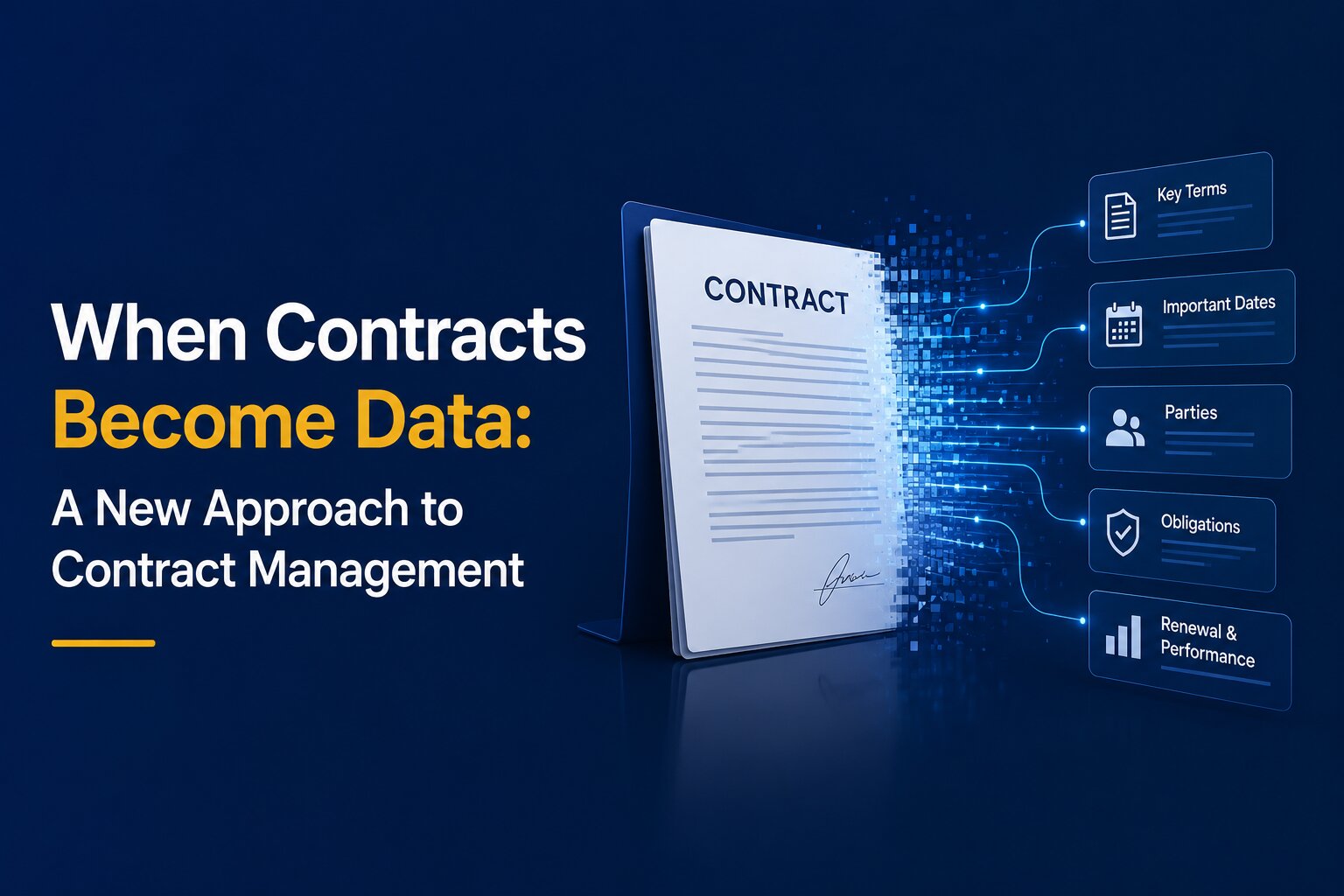
A contract does not stop being useful once it has been signed and filed away. The document may contain the agreed price, renewal date, notice period, obligations, parties involved and a long list of other details that the business may need months or even years later. Yet, in many organisations, that information remains buried inside the contract itself.
This creates a familiar situation for legal teams. Someone asks, “Which supplier agreements are coming up for renewal?” or “Which contracts include this requirement?” The answer may be there, but finding it means searching through folders, opening documents or checking spreadsheets that someone created to keep track of key dates.
This is where the idea of treating contracts as data becomes useful.
Instead of looking at a contract only as a document to store, organisations can also look at the information inside it as something that can be organised, searched, tracked and used throughout the contract lifecycle. For UAE legal teams managing a growing portfolio of agreements, that change in perspective can make contract management more practical and easier to manage.
The Information Inside a Contract Is Often More Valuable Than the Document Itself
A signed agreement is, of course, an important legal record. But the document also contains information that people across the organisation may need to work with. Think about a typical commercial contract. It might contain the names of the parties, contract value, start and end dates, renewal conditions, notice periods, obligations and specific clauses that have commercial or legal significance.
The information is already there. The problem is accessing it consistently when someone needs it.
Contracts contain more than legal language
Consider a supplier agreement. A legal team may need to know when it expires, how much it is worth, whether it renews automatically and how much notice is required to terminate it. None of this information is particularly difficult to understand. The difficulty comes when the organisation has hundreds or thousands of agreements, each containing similar information in slightly different formats. The same issue can arise with customer agreements, service contracts, leases, employment-related agreements and procurement documents.
The more contracts an organisation manages, the less practical it becomes to rely on someone's memory or a collection of manually maintained spreadsheets.
The challenge is making that information usable
There is a difference between information being present in a contract and information being readily available for use. A legal department may have every agreement properly stored and still struggle to answer straightforward questions.
Which contracts expire in the next three months?
Which agreements are above a particular value?
Which contracts contain a particular obligation? Which ones need to be reviewed before renewal?
If answering these questions means opening documents one at a time, the organisation has the information but not necessarily the visibility it needs.
Why Document-Centred Contract Management Becomes Difficult at Scale
A centralised contract repository can make it easier to locate agreements and reduce the confusion caused by scattered files, outdated versions and email-based storage.
Important information is scattered across agreements
Contract information can be spread across different files, folders and formats. Older agreements may follow one structure while newer ones use another. Teams may also maintain separate spreadsheets for renewal dates, contract values or other important details. These can be useful, but they introduce another layer that has to be kept up to date.
If the contract changes but the spreadsheet does not, the two records can quickly tell different stories.
Manual review takes time
Legal professionals need to read and interpret contracts. That part of the work cannot simply be removed. But there is a difference between reviewing a contract for a legal issue and spending time looking for basic information that should be easy to locate. Repeatedly checking documents for dates, parties or standard information can take time away from work that requires actual legal judgement.
This becomes more noticeable when a legal team is responsible for a large contract portfolio.
Portfolio-level questions are harder to answer
Managing contracts individually is different from understanding the portfolio as a whole. A General Counsel may want to know how many agreements are due for renewal this quarter. Procurement may want to understand supplier contracts by value. Finance may need information about particular commercial commitments. When contract information is locked inside individual documents, answering these questions often requires additional manual work.
That is where a contract management approach based on structured information starts to become more useful.
What Changes When Contracts Become Structured Data?
“Contracts as data” can sound more complicated than it really is. The basic idea is simple: take useful information from a contract and organise it in a consistent way so that people can find and work with it without having to read the entire document every time.
Turning contract content into structured information
A contract can still remain a PDF, Word file or other original document. What changes is that important information from the document can also be represented in structured fields.
For example:
| Contract information | Example |
|---|---|
| Contract type | Supplier agreement |
| Counterparty | ABC Trading LLC |
| Effective date | 1 January 2026 |
| Expiry date | 31 December 2027 |
| Contract value | AED 500,000 |
| Status | Active |
| Renewal | Automatic |
| Notice period | 90 days |
The purpose is not to reduce the contract to these fields. The original document remains essential. The structured information simply makes it easier to work with what the document contains.
Using metadata to give contracts context
This is where contract metadata becomes important. Metadata is simply information that describes a document. In contract management, it could include the contract type, parties, dates, value, status, business unit or renewal information. Consistent metadata can make a large contract repository much easier to navigate. Instead of asking someone to remember where a particular agreement is stored, a legal team can search based on information associated with the agreement.
Making existing contract information searchable
This approach is particularly useful for existing contract portfolios. Contract data extraction can help identify relevant information from agreements and make it available for searching or filtering. That does not mean every extracted piece of information should automatically be treated as legally definitive. Important terms may still need human review.
The value is in reducing the amount of manual searching required to get to the information that needs attention.
From Individual Documents to a Contract Portfolio
Once contract information is structured and accessible, legal teams can move beyond managing individual agreements and start using that information for strategic contract management.
See the portfolio as a whole
Suppose a company wants to understand its supplier contracts. Rather than opening each agreement individually, the team could look at contracts by supplier, business unit, contract type, value or expiry period. That makes it easier to identify where contracts are concentrated and which areas may require closer review.
Identify patterns that are difficult to spot manually
Contract analytics can help teams look beyond individual agreements. For example, a legal department might want to see how many contracts are approaching expiry, which types of agreements make up most of its portfolio or which business units manage the largest number of active contracts.
These views do not tell the legal team what decision to make. They give the team information that can help it make that decision.
Give the business a clearer view of contracts
Legal teams rarely manage contracts in isolation. Procurement, finance, compliance and business teams may all need information about the organisation's agreements. When contract information is easier to access, legal teams can spend less time searching for basic details and more time explaining what those details mean for the business.
That is an important distinction. Better contract visibility is not simply about finding a file faster. It is about making the information inside the file more useful.
Where Contract Data Becomes Useful Across the Contract Lifecycle
The usefulness of structured contract information does not end with search. It can support different stages of the contract lifecycle, including work that happens long after the agreement has been signed.
During review and approval
Information about a contract can be captured and organised while the agreement is being reviewed. This can make it easier to maintain consistent records across different agreements and reduce the need to reconstruct basic contract information later. It also gives the organisation a clearer starting point for managing the agreement once it is executed.
After the contract is signed
Signing is not the end of the contract lifecycle. An agreement may remain relevant for several years. There may be obligations to monitor, services to review, payments to manage or decisions to make before the next renewal. A digital contract management process can keep the information surrounding the agreement accessible throughout this period rather than treating the signed document as something that simply moves into an archive.
Around renewals and expiry
Renewals are a good example of where structured contract information can make a practical difference. A legal team may need to know which contracts are approaching expiry, how much notice is required and whether the business wants to continue the relationship. When this information is available in one place, teams have a better opportunity to start the review before the deadline becomes urgent.
During reporting and review
Legal departments are increasingly expected to provide information about their work and the risks they manage. Contract information can support regular reviews of active agreements, upcoming renewals, contract values and other areas that matter to the organisation. The less time spent manually compiling this information, the more time the team has to interpret it.
What a Modern Contract Management Approach Needs to Connect
Treating contracts as data does not mean buying a database and putting contract information into it. The useful part is the connection between the document, the information around it and the work that follows.
The document and its information
The original agreement should remain connected to the structured information associated with it. If a team sees an expiry date in a contract management system, it should also be able to access the underlying agreement when it needs to check the actual clause.
This connection matters because structured information supports navigation, while the original contract provides the legal context.
Information and action
A date sitting in a database is not particularly useful on its own. It becomes more useful when it connects to something the team needs to do. An upcoming expiry might require a renewal review. A particular obligation might need follow-up. A contract approaching a decision point might need input from the business owner.
This is where contract workflow automation can support legal operations without attempting to automate legal judgement itself.
Data and reporting
Contract information should also be useful beyond individual matters. A legal team may need to understand the status of its entire contract portfolio or provide information to management.
A system that connects individual contracts with structured data can make those views easier to produce and maintain.
Access and accountability
Contracts can contain commercially sensitive information and personal data, so accessibility needs to be balanced with appropriate controls. Legal teams should consider who can access contract information, what different users are allowed to do and whether relevant activity can be tracked.
For UAE organisations, these questions should form part of the wider approach to data governance and information management.
What UAE Legal Teams Should Consider When Managing Contract Data
The move towards structured contract information also needs to fit the organisation's operating environment. UAE businesses may manage agreements involving local and international counterparties, multiple business entities and contracts prepared in both Arabic and English. That can make consistent classification, search and access particularly useful.
Data protection is another consideration. Legal teams should understand how a contract management system handles sensitive information, what access controls are available and how information is governed. The right approach will depend on the organisation's contracts, internal policies and regulatory obligations. There is no single structure that will work for every UAE business.
The important point is to consider contract data management as part of the broader legal operations process, rather than treating it as a separate technology exercise.
Moving Towards a Data-Centred Contract Process
An organisation does not need to restructure every contract overnight. A more practical starting point is to identify the information that creates the most work today and determine whether it can be managed more consistently.
Start with information people actually need
Ask what questions the legal team receives repeatedly.
It could be:
- When does this contract expire?
- Who is the counterparty?
- What is the contract value?
- Which agreements are due for renewal?
- Which contracts contain a particular type of obligation?
These questions can help determine which information should be structured first.
Create consistent contract fields
If one contract records a renewal date as “Expiry” and another records it as “Renewal Date,” it becomes harder to compare them consistently. A defined set of contract fields can make information easier to search and report across the portfolio. The aim should be consistency without creating unnecessary administrative work.
Start with the contracts that matter most
A legal team does not necessarily need to begin with every agreement it has ever signed. It may make more sense to start with high-value contracts, agreements with frequent renewals, contracts carrying significant obligations or documents that are regularly requested by the business.
This allows the team to test the approach and expand it based on what works.
Connect information to the work that follows
The real value appears when contract information helps trigger or support the next action. An expiry date can lead to a renewal review. A contract status can inform a report. A particular clause can prompt a compliance check.
This turns structured information into something operational rather than simply another record to maintain.
Measure the practical difference
The success of the approach should not be measured only by how many contracts have been uploaded.
More useful questions include:
- Can the team find contract information faster?
- Has manual tracking decreased?
- Is it easier to prepare contract reports?
- Are renewal reviews starting earlier?
- Can the legal team answer business queries with less searching?
These are the kinds of changes that show whether a contract management process is actually becoming more useful.
Applying the Approach with Smart Legal Contract Management
This is where contract management software can provide the underlying structure for the approach. Beveron's Smart Legal Contract Management brings together contract storage, search, metadata filtering, contract information extraction, analytics and renewal or expiry tracking. For a UAE legal team, the relevance is not simply having another place to upload agreements.
The more important question is whether the system helps connect the contract itself with the information and activities surrounding it.
For example, searchable and structured information can make it easier to locate agreements based on relevant criteria. Contract data extraction can reduce some of the manual effort involved in identifying key information. Analytics can provide a broader view of the contract portfolio, while tracking and alerts can help teams stay aware of important dates.
The underlying principle is straightforward: the contract remains the source document, but the information within it becomes easier to work with.
The Next Step Is Making Contract Information Actionable
Treating contracts as data is not about turning legal documents into spreadsheets. It is about changing what an organisation can do with the information already contained in its contracts.
A traditional approach may focus on one question:
“Where is the contract?”
A more structured approach allows the organisation to ask broader questions:
“Which contracts are affected?”
“What information do they contain?”
“What needs attention?”
That shift can matter when a legal team is dealing with a large and constantly changing contract portfolio. The objective is not to remove lawyers from the process. It is to reduce the time they spend searching for information and give them a clearer picture of the agreements they are responsible for managing.
Conclusion: From Contract Storage to Contract Understanding
Contracts will always be legal documents first. But for the organisations that manage them, they are also sources of commercial, operational and compliance information. When that information is structured and accessible, contract management can move beyond simply storing agreements. Teams can search more effectively, understand their contract portfolio, keep track of important dates and connect contract information with the work that needs to happen next.
For UAE organisations managing a growing volume of agreements, this is the more useful way to think about digital contract management: not simply as a place to store documents, but as a way to make the information inside those documents easier to use.
Beveron Smart Legal Contract Management can help organisations bring contract documents, structured information and lifecycle tracking into one environment.
Explore how Smart Legal Contract Management can support a more connected approach to managing your contracts.
Frequently Asked Questions
What does it mean to treat contracts as data?
It means organising important information contained within contracts into consistent, searchable fields while keeping the original agreements accessible. This can include parties, dates, values, status, renewal terms and other relevant information.
What is contract data management?
Contract data management is the process of organising and maintaining information associated with contracts so that legal and business teams can find, track, review and use it throughout the contract lifecycle.
How does structured contract data differ from a traditional contract repository?
A traditional repository mainly provides a central place to store and retrieve documents. Structured contract data adds organised information about those documents, making it easier to search, filter, track and analyse a contract portfolio.
Can contract management software extract information from existing contracts?
Some contract management platforms provide contract data extraction capabilities to identify relevant information from existing agreements. The usefulness of extraction depends on the contract format, the information being identified and the technology used. Important legal information may still require human review.
Why is contract metadata important?
Contract metadata provides consistent information about an agreement, such as its type, parties, dates, value and status. This can make a large contract portfolio easier to organise and search.
What should UAE businesses consider when managing contract data?
UAE businesses should consider data governance, access controls, information security, the handling of Arabic and English agreements, internal compliance requirements and how the chosen technology manages sensitive contract information.
Best contract management software in the UAE
Best contract lifecycle management in the UAE
Best digital contract management software in the UAE
If you need a free demo of the best contract management software in the UAE, please fill the form.