Signs Your UAE Business Has Outgrown Shared Folders for Contract Management
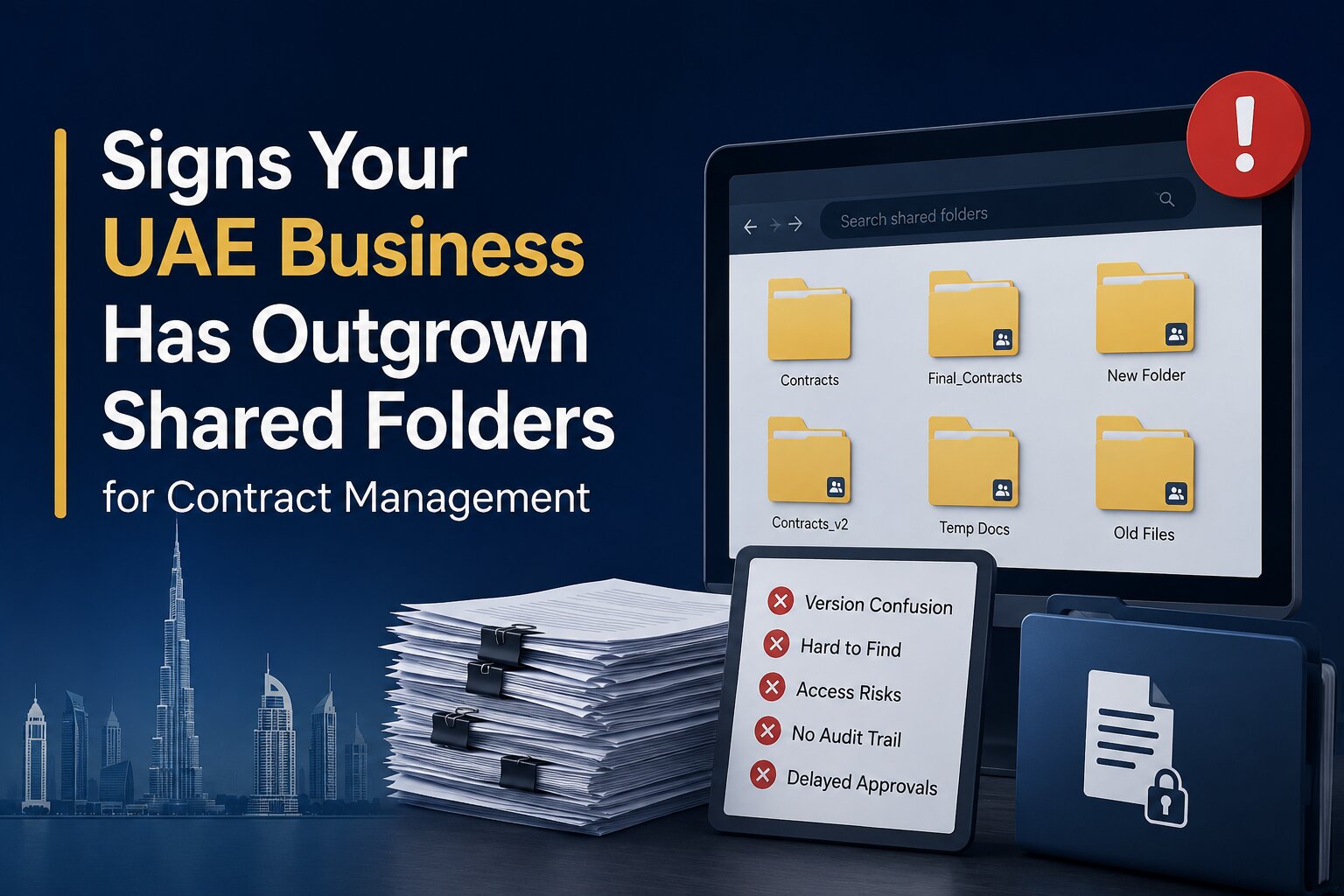
Shared folders are often a sensible starting point for managing business contracts. When a company has a relatively small number of agreements, storing documents in Google Drive, SharePoint or a shared network folder can be enough. Employees know where to look, files are easy to share, and there is no need to introduce another system. The situation changes as the business grows.
New suppliers, customer agreements, employment contracts, non-disclosure agreements and service arrangements all add to the number of documents that need attention. Different departments may have their own storage locations, approval processes and ways of tracking deadlines. Before long, finding the right contract or checking its current status can take longer than expected.
For businesses in the UAE, where teams may work across departments, offices and business locations, these small inefficiencies can become difficult to manage. A contract might be saved in one folder, its latest version attached to an email, and its renewal date recorded in a spreadsheet that only one employee maintains.
The question is not whether shared folders are useful. They are. The question is whether they still support the way your business handles contracts today.
Here are seven signs that your business may have outgrown its existing approach and could benefit from dedicated contract management software.
Why Shared Folders Become Difficult to Manage as Businesses Grow
Shared folders are designed primarily to store and organise files. They do not necessarily provide a complete picture of what happens to a contract throughout its lifecycle, from preparation and approval to signing, renewal and expiry. At first, employees can manage these activities through emails, spreadsheets and calendar reminders. However, each additional contract creates more information to maintain and more opportunities for something to be overlooked.
Consider a supplier agreement that needs approval from procurement, finance and legal before it can be signed. The document may be stored in a shared folder, while comments are exchanged over email and approval status is tracked separately. If someone asks for an update, an employee may need to check several places before answering. This does not mean shared folders are inherently unreliable. It means the surrounding process can become difficult to coordinate when too many activities depend on manual updates.
The following signs can help you decide whether your current setup is still working.
7 Signs Your UAE Business Has Outgrown Shared Folders for Contract Management
1. Employees Struggle to Find the Latest Contract Version
One of the first warning signs is uncertainty about which contract version is correct. An employee downloads a supplier agreement, makes changes and sends it to another department. Someone else edits a separate copy and returns it by email. Meanwhile, the original document remains in the shared folder. A few rounds of revisions later, the team has several files with similar names, and nobody is entirely sure which one contains the latest approved changes.
This creates unnecessary work. Employees spend time comparing documents, checking email attachments and asking colleagues to confirm which version should be used. The problem becomes more serious when outdated terms are used in negotiations or an agreement is shared without the latest changes.
A dedicated contract management system can help teams maintain a more organised contract repository, with consistent naming, searchable records and clearer control over document versions. The aim is to make it easier to identify the relevant contract without relying on someone's memory.
2. Contract Approvals Depend on Repeated Email Follow-Ups
Email is useful for discussing contract terms, but it can become difficult to manage when the entire approval process depends on it.
For example, a customer agreement might require approval from the legal, finance and sales teams. One department responds quickly, another requests changes, and a third has not yet reviewed the document. The person coordinating the agreement must keep track of every response and remind the right people to act. If the responsible employee is on leave or leaves the organisation, the process can slow down further.
When approval status is scattered across inboxes, it is difficult to answer basic questions:
Who needs to review the agreement?
What is holding it up?
Has the latest version been approved?
Contract management software can provide a more structured way to manage contract information and approval-related activities. Depending on the system and its workflow capabilities, it can also help teams assign responsibilities and monitor outstanding actions. If your employees regularly spend time chasing approvals instead of progressing the work, your current process may need more than better email organisation.
3. Renewal Dates and Expiry Deadlines Are Easy to Miss
Contracts often contain dates that require action well before the agreement expires. These might include renewal windows, notice periods, payment milestones or other contractual obligations. When these dates are recorded manually in spreadsheets or individual calendars, keeping them up to date becomes an ongoing responsibility.
Imagine that a service agreement renews automatically unless either party provides notice within a specified period. The contract is saved in a shared folder, but the renewal date has not been added to the team's tracking spreadsheet. By the time someone reviews the agreement, the notice period may have passed.
The consequences depend on the contract. The business might continue with a service it intended to replace, miss an opportunity to renegotiate terms or incur avoidable costs. A centralised contract repository with expiry and renewal alerts can help teams identify upcoming dates earlier. Relevant employees can then review the agreement and decide what action is needed.
For businesses managing contracts across several departments, this can be particularly useful because renewal information does not have to depend entirely on one person's calendar.
4. Nobody Has a Complete View of the Contract Portfolio
A contract portfolio is the collection of agreements a business manages across its operations. When contracts are stored in different folders, departments may have visibility only into the agreements they handle. Procurement may maintain supplier contracts, finance may keep payment-related records, and legal may store signed agreements separately. Each department might have a reasonable system of its own, yet the business may still lack a complete view of its contractual commitments.
Questions such as these can become surprisingly difficult to answer:
- How many active contracts do we currently have?
- Which agreements are due for renewal in the next three months?
- Who is responsible for each contract?
- Which agreements are waiting for approval?
- Where can we find the latest signed copy?
If answering these questions requires collecting information from several employees and spreadsheets, the business may have outgrown its current arrangement. Contract management software can help bring relevant contract records into one searchable location. With suitable metadata, such as contract type, owner, status and expiry date, teams can find information more easily and review the portfolio in a more consistent way.
5. Controlling Access to Sensitive Contracts Is Becoming Difficult
Not every employee needs access to every business agreement. Employment records, commercial terms, supplier pricing and confidential customer arrangements may contain information that should only be available to authorised people. Shared folders can support access restrictions, but those restrictions need to be configured and reviewed as employees change roles, projects end and teams expand. Inconsistent folder permissions can make it harder to maintain appropriate access.
There is also the question of visibility.
Can the business identify who is responsible for a document?
Are access permissions reviewed regularly?
Do employees know which location contains the official signed agreement?
These questions matter when contracts contain commercially sensitive information or personal data. A contract management system with appropriate user permissions and access controls can help establish a more consistent approach to managing contract records. However, the system still needs to be configured correctly, supported by suitable internal policies and reviewed periodically.
For UAE businesses, the choice of system should also take account of applicable data protection obligations, contractual confidentiality requirements and any relevant data storage or transfer restrictions.
6. Contract Reporting Requires Too Much Manual Work
Suppose the finance director asks for a list of contracts due to expire this quarter, while the legal team wants to review outstanding agreements and procurement needs an overview of active supplier contracts. If this information is spread across different spreadsheets and folders, someone must collect the records, check the details, remove duplicates and prepare the report.
This process can consume valuable time, particularly when the same information is requested regularly.
Manual reporting also introduces the possibility of inconsistent information. One spreadsheet might contain an updated expiry date, while another still reflects an earlier version. Even when employees work carefully, maintaining several copies of the same information is difficult. Contract management software can make reporting more straightforward when contract records contain consistent, searchable information. Depending on the system, teams may be able to filter agreements by status, type, date or other relevant details and use reporting tools to review the portfolio.
The real advantage is not simply producing reports faster. It is making contract information easier to use when planning renewals, reviewing obligations and making business decisions.
7. Contract Management Depends on Individual Employees
Every business has employees who know where particular documents are stored or understand how a specific approval process works. That knowledge is valuable, but it becomes a problem when the process depends entirely on one person's memory. An employee may know which spreadsheet contains renewal dates, which folder holds signed agreements and whom to contact for approval. If that person is unavailable, other team members may struggle to continue the work.
This creates unnecessary dependency and makes it harder to establish a consistent process across departments. A more structured contract management approach helps document ownership, standardise information and make important records accessible to authorised colleagues. Instead of relying on informal knowledge, teams can work from a shared source of contract information.
If routine contract tasks become difficult whenever a particular employee is unavailable, it may be time to reconsider how those tasks are organised.
What These Problems Mean for UAE Businesses
Individually, these issues may seem manageable. A missing document can be found, an approval can be chased, and a renewal date can be added to a calendar. The difficulty arises when several problems occur together. Employees spend more time searching for information. Approvals take longer because responsibilities are unclear. Contract renewals receive attention later than they should. Managers struggle to obtain a reliable overview of agreements across the business.
Over time, these issues can affect productivity, planning and the consistency of internal controls.
For UAE businesses, contract management should also be considered alongside applicable legal, regulatory and data protection requirements. The right process depends on the nature of the business, the contracts involved and the information being handled. Moving to dedicated software does not automatically make a business compliant or eliminate contractual risk. However, a well-designed system can support better record-keeping, clearer responsibilities and more consistent monitoring.
Shared Folders vs Contract Lifecycle Management Software
The main difference between shared folders and contract lifecycle management (CLM) software is the level of structure they provide. Shared folders are useful for storing documents and collaborating on files. CLM software is designed to help businesses manage contracts through different stages, including preparation, review, approval, storage, monitoring and renewal.
| Business requirement | Shared folders and spreadsheets | Contract lifecycle management software |
|---|---|---|
| Document storage | Files organised into folders | Centralised contract records with search and filtering |
| Version management | Often depends on file naming and manual checks | May provide more structured document and version management |
| Approval tracking | Commonly managed through email and spreadsheets | Can support defined workflows and approval tracking |
| Renewal monitoring | Depends on manual calendars and reminders | Can provide alerts for important dates |
| Contract reporting | Information often needs to be collected manually | Can support reports using structured contract data |
| Portfolio visibility | May require checking several locations | Can provide a consolidated view of recorded contracts |
The exact capabilities vary between products, so businesses should evaluate how each system handles their actual workflows rather than assuming every CLM platform offers the same features.
Shared folders may remain suitable for businesses with a small, straightforward contract portfolio. A dedicated system becomes more valuable when contract management requires consistent coordination, reliable tracking and visibility across multiple teams.
When Should a UAE Business Move to Contract Lifecycle Management Software?
There is no universal number of contracts at which a business must switch systems. A company managing a relatively small number of complex agreements may need more structure than one handling a larger number of straightforward documents. Instead of focusing only on contract volume, consider the work involved in managing each agreement.
A move to CLM software may be worth considering when:
- Renewal tracking has become difficult to maintain. If employees regularly check several calendars or spreadsheets to identify upcoming deadlines, centralised records and alerts may help.
- Multiple departments are involved in contract approvals. Where legal, finance, procurement and business teams must coordinate, a more structured process can make responsibilities and outstanding actions easier to track.
- The business needs regular contract reports. If management frequently requests information that takes hours to compile, searchable records and reporting tools may reduce manual work.
- Contract information is spread across too many locations. When employees cannot easily identify the relevant agreement or its current status, a central repository may be useful.
- The cost of mistakes is increasing. If missed dates, outdated documents or unclear ownership create significant operational or commercial risks, improving the process deserves attention.
Before investing in new software, review the current workflow. Identify where delays occur, which information is difficult to find and what employees repeatedly do by hand. These findings will help determine whether better folder organisation is enough or whether a dedicated contract management system is justified.
What to Look for in Contract Lifecycle Management Software
Once a business decides to move beyond shared folders, the next step is to identify the capabilities that address its specific problems.
Start with centralised storage and search. Employees should be able to locate contracts without remembering exactly where a document was saved. Search and filtering based on details such as contract type, party, status or expiry date can make a substantial difference.
Next, consider document handling and contract review. Version management, searchable contract records and access to key clauses can help teams understand what an agreement contains without repeatedly searching through multiple files. Some platforms also use artificial intelligence (AI) to extract relevant clauses and information, although the accuracy of these features should be assessed before relying on them.
Approval processes deserve equal attention. Look for a system that supports the way your business reviews and approves agreements, with clear responsibilities and visibility into pending actions.
Renewal tracking is another important requirement. Check whether the software can record important dates and send appropriate notifications early enough for employees to act.
Finally, review reporting, user permissions and integration with existing tools. Consider whether the platform can accommodate your team's working practices, whether employees can access the information they need, and whether the proposed setup meets your security and data handling requirements.
The goal is not to purchase the system with the longest feature list. It is to select one that addresses the problems your business actually faces.
How Beveron Smart Legal Contract Management Helps Teams Move Beyond Shared Folders
For businesses that have reached the limits of folder-based contract management, Beveron Smart Legal Contract Management offers a more structured way to manage contract information. Rather than relying solely on file names and manually maintained spreadsheets, teams can use a dedicated contract management platform to organise records and make important information easier to find.
Its capabilities include contract search, metadata filtering and AI-based clause extraction. These features can help employees locate relevant agreements, narrow down records using contract details and identify important clauses for further review. Expiry and renewal alerts can also help teams keep upcoming contract dates visible, making it easier to plan reviews and take action before a deadline approaches. Contract analytics can provide additional visibility into the information recorded across the contract portfolio.
These capabilities are particularly relevant to businesses that regularly handle supplier agreements, customer contracts and other commercial arrangements across departments. The value depends on how the system is configured and used. Businesses should map their existing processes, identify their reporting and access requirements, and confirm that the platform supports their specific needs before implementation.
For teams looking to move beyond scattered documents and manual tracking, Beveron Smart Legal Contract Management is worth exploring as part of that evaluation.
How to Prepare for the Transition From Shared Folders
Introducing contract management software does not need to mean moving every document at once. A planned transition can help the business prioritise the records and processes that need attention first.
Audit Existing Contracts and Storage Locations
Start by identifying where contracts are stored, which departments manage them and whether multiple copies exist. This creates a clearer picture of the current situation and helps identify gaps in the records.
Identify Contract Owners and Approval Requirements
Determine who is responsible for each contract type and which employees need to review or approve agreements. Clear ownership makes it easier to maintain records and respond to upcoming deadlines.
Prioritise Active Contracts and Upcoming Renewals
Begin with active agreements, important contractual obligations and contracts approaching renewal. Older or inactive records can be addressed according to their relevance and retention requirements.
Define Access Permissions and Data Migration Requirements
Decide which employees should have access to particular contract records. Before transferring documents, review data quality, duplicate files, confidentiality requirements and any applicable restrictions on storing or transferring information.
Establish a Consistent Process for New Contracts
Agree on how new contracts will be recorded, reviewed, approved, stored and monitored. Consistent processes help prevent the business from recreating the same problems in a new system. A successful transition depends as much on clear responsibilities and employee adoption as it does on the software itself.
Frequently Asked Questions
When should a business replace shared folders with contract management software?
A business should consider dedicated software when employees regularly struggle to find current contract versions, track approvals, monitor renewal dates or prepare reports. The decision should reflect the complexity and risk of its contract processes, not just the number of agreements it manages.
Can small businesses in the UAE benefit from contract lifecycle management software?
Yes. Small businesses may benefit when they manage complex agreements, recurring renewals or contracts involving several departments. However, businesses with a small number of straightforward agreements may find that well-organised shared folders remain sufficient.
What is the difference between shared folders and a contract management system?
Shared folders primarily organise and store files. A contract management system adds tools for organising contract information, tracking important dates and managing related activities. CLM software can extend this further by supporting multiple stages of the contract lifecycle.
Can contract management software track expiry dates and renewals?
Many contract management platforms provide expiry and renewal alerts. The usefulness of these features depends on whether contract dates are recorded correctly, notifications are configured appropriately and employees act on them in time.
What should UAE businesses consider before moving contracts to a cloud-based system?
Businesses should assess access controls, data protection, confidentiality, storage and transfer arrangements, integration requirements and contractual obligations. They should also confirm that the proposed system and its configuration meet the organisation's specific legal and operational requirements.
Conclusion: Make Contract Management Easier to Control as Your Business Grows
Shared folders can work well when a business has a straightforward contract process. The challenge begins when document storage is no longer enough to support approvals, renewal tracking, reporting and coordination across teams. If employees regularly search through emails for the latest agreement, manually compile contract reports or depend on individual reminders to track deadlines, these are signs that the existing process deserves a closer look.
The next step is not necessarily to replace every folder immediately. Start by identifying the biggest gaps, assessing the risks and deciding which workflows would benefit most from a more structured approach. For UAE businesses seeking better visibility into their contract records, more organised tracking and easier access to important contract information, Beveron Smart Legal Contract Management offers an option to consider.
Explore Beveron Smart Legal Contract Management to see whether its capabilities align with your business's contract management needs.
Best contract lifecycle management software in the UAE
Best contract renewal management in the UAE