What Should Saudi Legal Teams Consider Before Choosing Contract Management Software?
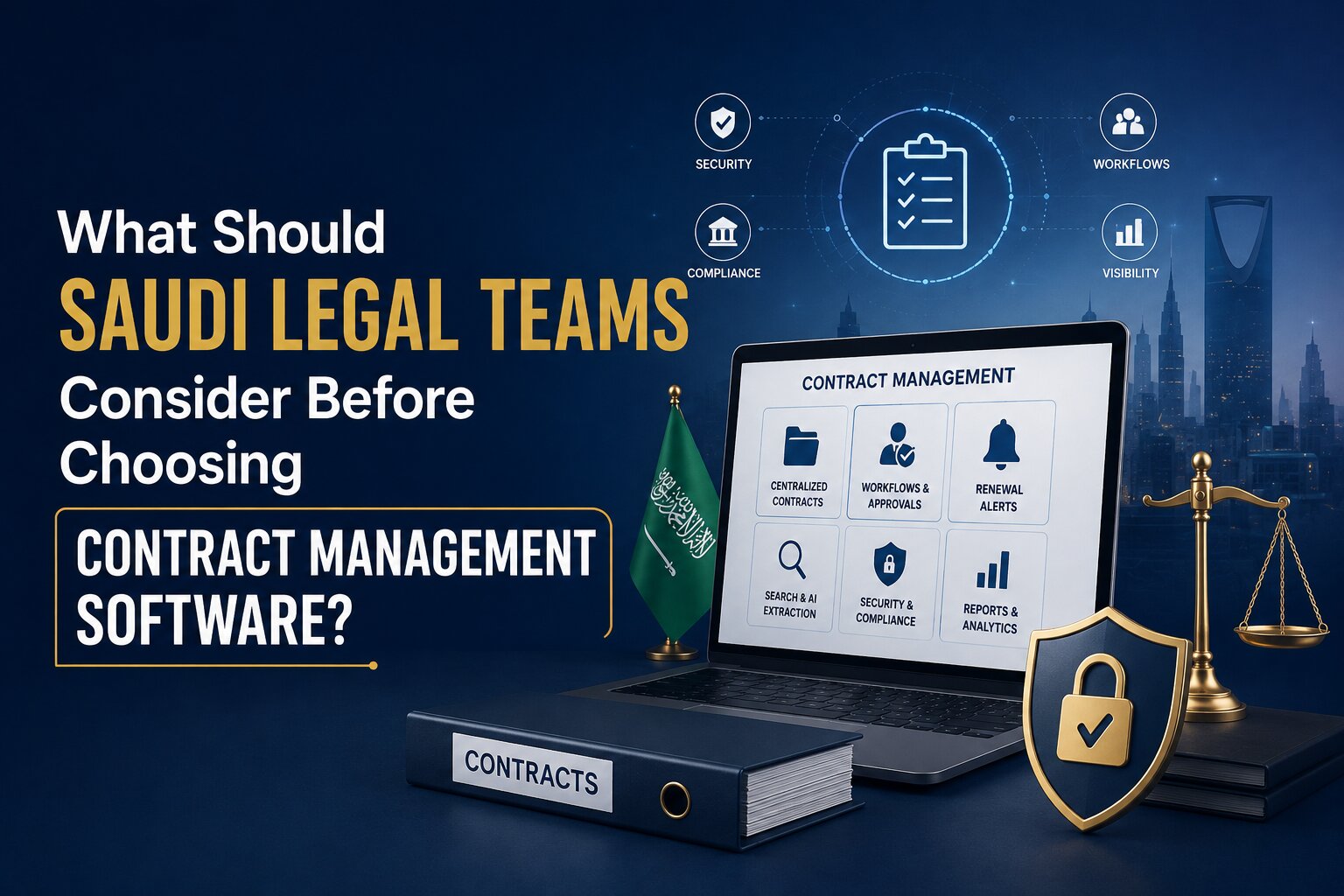
Managing contracts through spreadsheets, email threads and shared folders can become difficult as a business grows. Legal teams may spend hours searching for documents, chasing approvals and checking renewal dates. Important information can get lost across departments, making it harder to keep contracts organised and up to date.
Contract management software helps businesses bring these activities together in one place. However, choosing the right solution involves more than comparing features. Saudi legal teams need to consider data security, applicable regulations, Arabic and English language support, approval workflows, integrations and long-term costs. Understanding these factors can help businesses select a solution that fits their daily operations and future needs.
1. Identify Your Current Contract Management Challenges
Before comparing contract management software providers, take a close look at how your team currently handles agreements.
Are contracts stored across different folders?
Do employees rely on email to obtain approvals?
Is it difficult to identify the latest version of an agreement or find a signed contract when someone needs it?
These problems can slow down legal work and create unnecessary administrative effort. Manual tracking can also make it harder to monitor contract status and ensure that important deadlines receive attention.
Start by identifying the areas that need improvement. Your team may need a central place to store agreements, a clearer approval process or a reliable way to track renewals. Understanding these priorities helps you focus on the features that matter most rather than paying for capabilities that do not support your actual requirements.
2. Evaluate Data Security and Saudi Compliance Requirements
Contracts often contain confidential commercial terms, financial information, customer details and employee data. Legal teams must understand how a software provider protects this information and manages access to sensitive documents. Look for features such as role-based access controls, which allow businesses to decide who can view or edit particular contracts. Audit trails are also useful because they record important actions and changes, helping teams understand how documents have been handled.
Ask providers where contract data will be stored, how backups are managed and what recovery arrangements are available if information becomes inaccessible. You should also understand the provider's policies for data retention, deletion and transfers, particularly when information may be processed or stored outside Saudi Arabia.
Saudi businesses should assess their obligations under the Personal Data Protection Law (PDPL) and its implementing regulations, where applicable. The relevant requirements depend on the organisation, the information being processed and the circumstances of its use. Choosing contract management software does not automatically guarantee compliance. Businesses should verify the provider's security measures, understand how the system handles data and confirm that its controls support their legal and operational requirements.
3. Verify Arabic and English Language Capabilities
Language support is an important consideration for Saudi organisations managing local agreements, international contracts and documents prepared in both Arabic and English. A platform may claim to support Arabic, but legal teams should check what that means in practice.
Can users read and edit Arabic documents without formatting problems?
Does the system display right-to-left text correctly?
Can employees search for contract information in Arabic and English?
Are bilingual templates and documents supported where needed?
These details matter because poor formatting or limited search capabilities can make contract review more difficult. They may also lead employees to maintain separate records outside the main system. Ask vendors to demonstrate their language capabilities using actual business documents. Testing real contracts is more useful than relying on general product descriptions, especially when your team regularly works with bilingual agreements.
4. Assess Contract Lifecycle Management Workflows
Contract management involves more than storing signed agreements. Legal teams need to handle several stages, from receiving a contract request to preparing, reviewing, approving, signing and storing the final document. Contract management software should support the stages relevant to your business. Templates can help standardise common agreements, while collaboration tools allow legal, finance, procurement and other departments to review documents. Approval workflows can assign tasks to the right people and show which agreements are waiting for action.
Electronic signatures may also be important if your organisation wants to manage signing as part of a connected process. Before selecting a platform, check which signature options are available and whether they meet your business and legal requirements. A central contract repository makes it easier to retrieve signed agreements and related documents without searching through multiple folders. When these activities are connected, teams can spend less time coordinating tasks manually and gain a clearer view of contract progress.
Ask each shortlisted provider to demonstrate a complete workflow using a realistic example, such as a supplier agreement that requires review by legal, finance and management. This will help you understand whether the software fits the way your organisation works.
5. Check Contract Renewal Alerts and Obligation Tracking
Missing a renewal date or overlooking a notice period can result in avoidable costs and business risks. These issues become harder to manage when employees rely on spreadsheets or individual calendar reminders to track deadlines across many agreements. Contract management software can help by recording important dates and sending reminders before action is required. Legal teams should check whether a system can track contract start dates, expiry dates, renewal deadlines and other important obligations.
Dashboards that highlight upcoming renewals can help employees prioritise agreements that need attention. Assigning responsibility for reviewing each reminder is equally important because an alert alone does not ensure that someone takes action. The quality of contract information also matters. Teams should have a reliable process for recording dates accurately and checking them against the signed agreement. With accurate information, clear responsibilities and timely reminders, legal teams can manage deadlines more consistently.
6. Evaluate Search, Reporting and AI Capabilities
Finding the right information should not require opening dozens of documents. Search and reporting features can help legal teams retrieve agreements and understand the status of their contract portfolio. Check whether users can filter contracts by counterparty, contract type, status and expiry date. Reports showing pending approvals, upcoming renewals and contract volumes can also help managers understand where attention is needed.
Some contract management platforms offer artificial intelligence (AI) features that identify clauses or extract information from documents. These capabilities may reduce repetitive work by helping users locate relevant terms without reading every agreement from beginning to end. However, AI results should not be accepted without appropriate review.
Before adopting these features, legal teams should understand how AI fits into their existing processes. Our article on how to implement AI contract management software in corporate legal teams explains the key considerations for introducing AI into contract workflows.
During a product demonstration, ask the provider to show how extracted information can be checked against the original document, whether users can correct errors and how contract information is processed and protected. AI can support legal professionals by making certain tasks easier, but it should not replace legal judgement. Its usefulness depends on the quality of the results, the type of contract and the review process followed by the team.
7. Review Integrations, Implementation and Total Cost of Ownership
Contract management software should fit your existing business processes rather than create another disconnected system. Check whether the platform integrates with the email, document management and productivity tools your employees already use. Implementation also deserves attention. Moving existing contracts into a new system may require document organisation, data checking and the transfer of important contract details. Ask the vendor about migration support, implementation timelines, employee training and ongoing technical assistance.
Consider how the software will support your organisation as contract volumes increase or additional departments begin using it. A solution that meets current needs should also be practical to maintain as the business grows. Price is another important factor. Subscription fees may not reflect the full cost of adopting a platform. Additional expenses can include implementation, data migration, extra user licences, integrations, training and ongoing support.
Comparing these costs gives legal teams a more realistic basis for evaluating vendors. The right choice should balance useful capabilities, ease of adoption and long-term affordability.
8. How Beveron Smart Legal Contract Supports Contract Management in Saudi Arabia
Beveron Smart Legal Contract is designed to help businesses organise contract activities and manage agreements throughout their lifecycle. For Saudi legal teams evaluating contract management software, its capabilities can be assessed against the challenges discussed above. The platform supports contract requests, drafting, collaboration, approvals, electronic signatures and centralised storage. These capabilities can help teams organise contract-related activities and reduce reliance on disconnected email threads and folders.
Contract search and metadata filtering can help users locate agreements and retrieve relevant information. AI-assisted clause extraction can support the process of identifying important contract terms, while analytics can provide a clearer view of contract activity. Expiry and renewal alerts can also help teams identify upcoming deadlines and plan the actions required.
For organisations working across Arabic and English, language capabilities are another factor to evaluate when considering the platform. As with any software solution, businesses should verify that the specific language, security, data handling and integration capabilities meet their requirements.
Saudi legal teams can explore Beveron Smart Legal Contract for Saudi Arabia to learn more about the platform and assess whether it suits their contract management processes.
Conclusion
Choosing contract management software in Saudi Arabia starts with understanding what your legal team needs to manage contracts effectively. Security and applicable data protection requirements, Arabic and English support, connected workflows, renewal tracking, search capabilities, integrations and total cost should all influence the decision. Rather than choosing a platform based on its feature list alone, test how it handles your everyday contract processes. Ask vendors to demonstrate realistic scenarios, verify important capabilities and understand the costs involved before making a commitment.
The right solution should help your team find agreements more easily, manage approvals consistently and keep track of important deadlines. By evaluating these factors carefully, Saudi legal teams can choose contract management software that supports their current operations and future growth.
Explore Smarter Contract Management with Beveron
Looking for contract management software that fits your organisation’s needs in Saudi Arabia? Discover how Beveron Smart Legal Contract can help your team manage contract workflows, track renewals, streamline approvals and keep agreements organised in one place.
Explore Beveron Smart Legal Contract or request a demo to see how it can support your contract management process.
Frequently Asked Questions
1. What should Saudi businesses look for in contract management software?
Saudi businesses should evaluate data security, applicable data protection requirements, Arabic and English language support, approval workflows, document search, renewal alerts, integrations and total cost. The right solution should address the organisation's actual contract management needs.
2. Why is Arabic language support important in contract management software?
Arabic support helps legal teams work with Arabic contracts and bilingual agreements. Businesses should check text formatting, document display, search capabilities and template support using their own documents before choosing a platform.
3. How can contract management software help prevent missed renewals?
It can record expiry dates, track renewal deadlines and send reminders before action is required. Accurate contract information and clearly assigned responsibilities help ensure that teams review agreements and act on time.
4. Does contract management software ensure compliance with Saudi data protection laws?
No. Software can provide security and data management controls that support compliance, but organisations must assess their applicable legal obligations and ensure that the platform is configured and used appropriately.
5. What is the difference between contract management and contract lifecycle management software?
Contract management generally refers to organising and administering agreements. Contract lifecycle management (CLM) typically covers a connected process from contract requests and drafting through review, approvals, signing, storage and renewal.
6. How should businesses evaluate contract management software vendors in Saudi Arabia?
Businesses should test realistic contract workflows, verify security and language capabilities, review integrations and migration requirements, and compare the full cost of implementation and ongoing use. They should also confirm that the solution supports their operational and regulatory requirements.
Best contract management software in Saudi Arabia
Best legal contract management software in Saudi Arabia
Best Arabic contract management software in Saudi Arabia
If you need a free demo of the best contract management software in Saudi Arabia, please fill out the form.