What to Look for in Contract Lifecycle Management Software in 2026
Contracts rarely become difficult because a business has too many documents. The real problem is what happens around those documents. A contract may begin as an email request, move through several Word files, sit in someone's inbox waiting for approval, get signed through another platform, and eventually end up in a shared folder that few people revisit. Months later, a renewal date approaches and the legal team has to search through emails and spreadsheets to work out what was agreed.
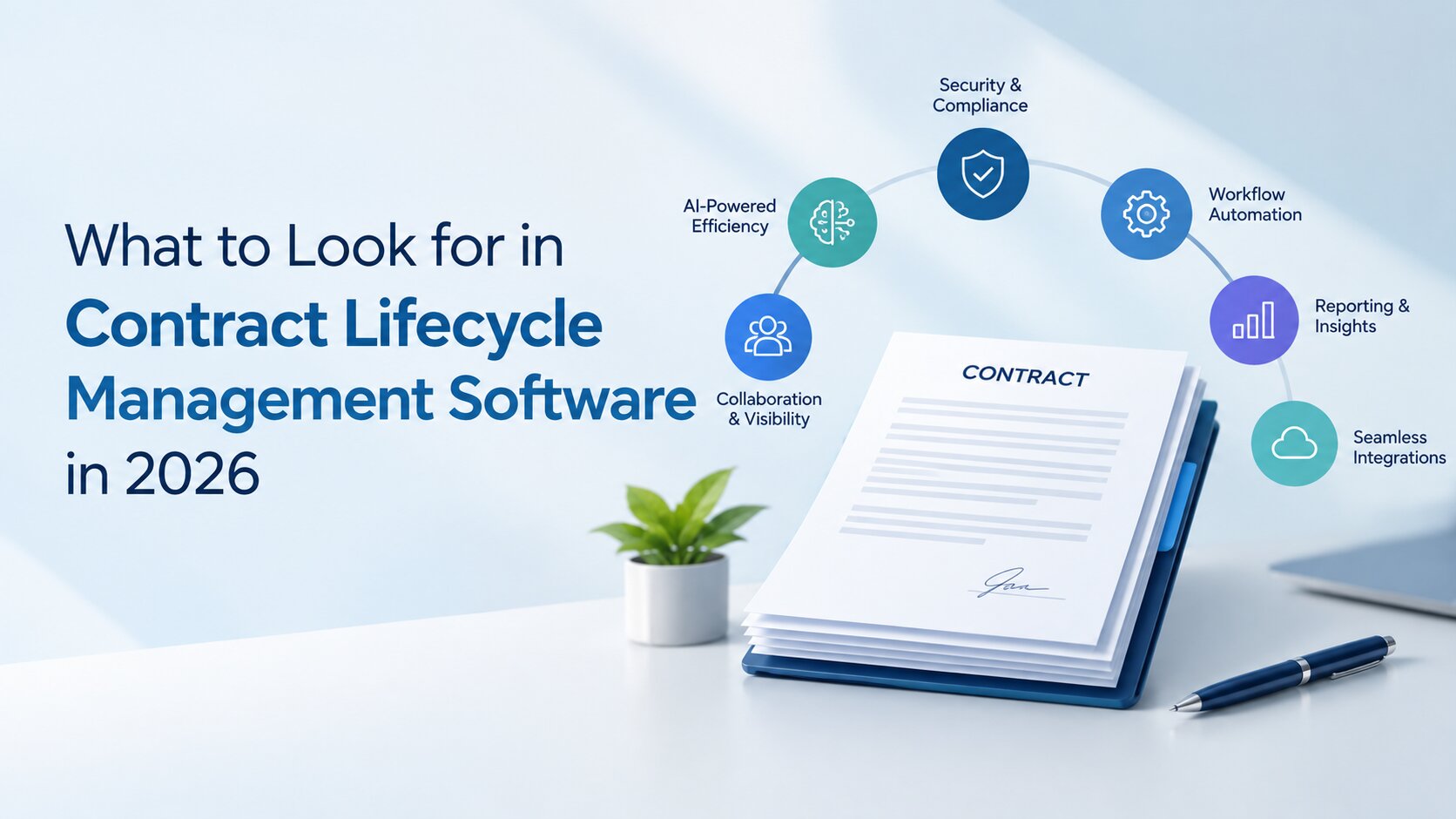
This is where contract lifecycle management software has become increasingly important. In 2026, organisations are looking beyond basic contract storage. Legal and business teams want systems that can support drafting and review, automate approvals, surface important obligations, connect with existing business tools and provide better visibility into contract risk. For businesses operating across the UAE and wider GCC, language, data governance and regional requirements also form an important part of the decision.
The right CLM platform should therefore do more than replace a shared folder. It should make the contract process easier to manage from the initial request through review, signature, ongoing obligations and renewal. This article looks at the capabilities legal and corporate teams should evaluate before choosing a CLM platform in 2026.
What Does Contract Lifecycle Management Software Do?
Contract lifecycle management software is designed to manage contracts throughout their working life. That can include the initial contract request, drafting, review, negotiation, approval, signature, storage, obligation tracking and renewal or expiry.
The distinction between CLM and ordinary document storage is important. A document management system may help a team store and retrieve files, but CLM is concerned with the processes surrounding those files. Who needs to review a contract? Which version is current? Has the agreement been approved? What obligations need attention? When does the contract expire? Who needs to act before the renewal date?
When these questions are answered through emails, spreadsheets and individual calendars, information can easily become fragmented. A CLM platform brings the relevant contract information and workflow into a more structured environment.
When Is It Time to Move Beyond Manual Contract Management?
Not every organisation needs sophisticated contract software from day one. For a small team with a limited number of straightforward agreements, a well-organised process may be enough. The difficulties usually become more obvious as contract volumes increase and more people become involved in the process.
One common warning sign is that renewal and expiry dates depend on individual calendars or reminders. If a person leaves the organisation or changes roles, important information can be overlooked. Another is the amount of time lawyers spend searching for the latest version of an agreement or checking email threads to understand where a contract currently stands.
Approval delays are another indication that the existing process may no longer be sufficient. A contract can sit in an inbox for days because nobody is sure who needs to approve it next. At the same time, legal leadership may have limited visibility into the number of contracts under review, outstanding obligations or agreements approaching renewal.
These are not simply document-storage problems. They are workflow and visibility problems, which is where contract lifecycle management software can make a practical difference.
10 Features to Prioritise When Evaluating CLM Software in 2026
AI-Assisted Contract Review and Drafting
AI has become one of the most discussed areas of contract technology, but the important question in 2026 is not whether a CLM platform has AI. It is how that AI is actually used within the contract process.
Useful capabilities can include identifying clauses, extracting key terms, highlighting unusual language, comparing provisions and suggesting changes based on predefined legal positions. Some systems can also support playbook-based reviews, allowing legal teams to establish preferred clauses, fallback positions and rules for identifying deviations. As AI evolves beyond individual review tasks, agentic AI can also support different stages of the contract lifecycle, from drafting and negotiation through to execution. For a closer look at this approach, see our article on how agentic AI can transform the contract lifecycle from drafting to execution.
For legal teams, control matters just as much as convenience. AI suggestions should support legal judgement rather than replace it. When evaluating a platform, ask whether the AI can work with your organisation's own templates, clauses and review standards, how results are presented to users, and what controls exist for human review and approval.
A Searchable Contract Repository
A central repository is one of the basic building blocks of a useful CLM system, but simply putting contracts into one folder is not enough. Users should be able to find the information they need without remembering exactly where a particular file was saved. Modern CLM platforms can organise agreements using metadata such as contract type, counterparty, effective date, expiry date, business unit and status. Search can go beyond the document title to include full contract text and, where supported, individual clauses.
Version history is equally important. When several people work on an agreement, the legal team needs confidence that it is reviewing the correct version and can see how the document has changed. A repository that combines search, structured information and version visibility can save considerable time compared with searching through shared drives and email attachments.
Configurable Workflows and Approvals
Contracts rarely follow exactly the same path. A standard supplier agreement may require a different review process from a high-value commercial agreement or a contract involving sensitive information. CLM software should therefore allow organisations to configure workflows around their own approval structure. A contract request might move from the business team to legal, then to finance or procurement, followed by an authorised signatory. The system should make the next action clear and maintain a record of what happened at each stage.
Role-based permissions are also important. Not every employee needs access to every contract. A good system should allow organisations to control who can view, edit, approve or manage specific information. When assessing a platform, look at how much of this configuration can be managed without extensive technical work. A system that technically supports workflows but is difficult to adapt may create another operational burden.
Obligation, Renewal and Deadline Tracking
Signing a contract is not the end of the lifecycle. In many cases, the most important work begins afterwards. Contracts contain obligations, notice periods, renewal dates, payment conditions, deliverables and other commitments that may need attention months or years after signature. If these details are buried in documents, they can easily be forgotten.
CLM software can provide a structured way to record important dates and responsibilities and trigger reminders before deadlines arrive. This gives legal and business teams more time to act rather than discovering an issue after a deadline has passed. When comparing systems, check whether alerts can be configured around different types of events and whether responsibility can be assigned to specific users or teams. It is also worth checking whether the platform continues to track obligations after the contract has been signed.
Templates and Clause Libraries
A legal team should not have to recreate the same contract language every time a familiar agreement is requested. Templates and clause libraries help organisations standardise commonly used language while still allowing appropriate changes for individual transactions. A useful library should make it easy to manage approved templates and clauses and ensure users are working from current versions. It can also give legal teams greater control over which provisions are available for different types of agreements.
For organisations operating across multiple jurisdictions or business units, this becomes even more important. Different agreements may require different templates, fallback clauses or approval rules. The platform should make those distinctions manageable without making the process unnecessarily complicated.
Arabic–English Contract Support
For organisations operating in the UAE, Saudi Arabia and the wider GCC, language support deserves more attention than it often receives during software evaluations. Arabic and English may both be part of the contract process, and simply translating a user interface does not necessarily mean that a platform provides meaningful bilingual contract support. Legal teams should consider whether Arabic documents can be stored, searched and managed effectively, whether right-to-left text is handled properly, and whether relevant metadata remains consistent across languages.
The evaluation should therefore go beyond asking whether the software “supports Arabic.” Ask to see how an actual Arabic or bilingual agreement moves through the platform. That practical demonstration can reveal limitations that may not be obvious from a product specification.
Regional Compliance and Data Governance
Data governance has become an increasingly important consideration when selecting legal technology. Contracts can contain commercially sensitive information, personal data and confidential business details, so organisations need to understand how that information is stored, accessed and protected. For UAE and Saudi businesses, the evaluation may include questions around applicable data-protection requirements, hosting arrangements, data residency, retention policies and internal access controls. The exact requirements will depend on the organisation, its industry and the nature of the information being processed.
A CLM platform should not be treated as a guarantee of regulatory compliance. Instead, legal and IT teams should examine whether the platform's security and data-management practices can support their own compliance obligations. Ask the vendor where data is hosted, how access is controlled, what audit information is available and what documentation can be provided to support an internal security review.
Security, Permissions and Auditability
Contract information often needs to be shared across legal, finance, procurement, sales and management teams, but broad access is rarely appropriate for every agreement. Security controls should allow organisations to determine who can access particular information and what actions they can perform. Encryption, permissions, authentication, audit logs and controlled access are all worth examining during the buying process.
Auditability is particularly useful when a team needs to understand what happened to a contract. Being able to see who accessed or changed information, when an approval took place and how a document progressed through the workflow can provide useful accountability. Deployment options should also be considered. Depending on the organisation's security policies and technical environment, cloud, private hosting or other deployment models may have different implications.
Integrations With Existing Business Tools
A CLM platform should not become another isolated system where employees have to enter the same information again. Contracts often originate in CRM systems, involve information from finance or procurement platforms and pass through email, document-editing tools and e-signature services. Integrating these systems can reduce duplicate data entry and make the overall process easier to manage.
For example, information about a customer or supplier may already exist in another business system. If users have to manually recreate that information every time they initiate a contract, the new technology may introduce more work rather than remove it. Ask vendors which integrations are available, how they work and whether they support your existing technology environment. It is more useful to evaluate integrations based on the workflows they improve than simply counting the number of systems a vendor says it can connect with.
Reporting and Contract Intelligence
Legal teams increasingly need to demonstrate what is happening across their contract portfolio, not just manage individual agreements. Reporting can help answer questions such as how long contracts take to move through review, where approvals are getting delayed, which agreements are approaching renewal and how much contract activity a particular business unit is handling.
The value of reporting depends on the quality of the underlying information. If users still need to maintain separate spreadsheets to produce reliable reports, the CLM system is not providing the level of visibility it should. Look for dashboards and reports that reflect the questions your legal and business leaders actually ask. The goal is not to have the largest collection of charts. It is to make useful contract information easier to understand and act on.
Questions to Ask Before Choosing a CLM Vendor
A product demonstration can make almost any platform look impressive. The more useful approach is to ask vendors to demonstrate how their system would handle your actual contract workflow. Start with implementation. Ask how long deployment typically takes for an organisation of your size, what is involved in migrating existing contracts and what support is provided during onboarding. Contract migration is particularly important because a new system is of limited value if important historical agreements are left behind in shared folders.
Regional and language support should also be discussed early. If your organisation works with Arabic and English agreements, ask the vendor to demonstrate the relevant workflow rather than relying on a simple statement that Arabic is supported. Data hosting and security deserve detailed questions as well. Find out where contract data will be stored, what security controls are in place, what audit information is available and what security documentation can be shared with your IT or compliance team.
Finally, understand the commercial model. Pricing may depend on users, modules, contract volumes or other factors. Ask how costs may change as the organisation grows and which capabilities are included in the standard package.
Common Mistakes When Selecting CLM Software
One of the easiest mistakes is choosing a platform because it has the longest feature list. More features do not necessarily mean a better fit. A system with fewer capabilities but a workflow that closely matches the organisation's needs may deliver more value. Another mistake is treating AI as the deciding factor. AI can make contract work faster, but legal teams still need to understand what the system is doing, where its information comes from and how human review fits into the process. A convincing AI demonstration should lead to more questions, not fewer.
Regional requirements can also be overlooked when teams focus on general CLM capabilities. Arabic language support, hosting arrangements and data governance should be considered before purchase rather than added to the requirements list after implementation has begun. User adoption is another practical consideration. If the platform is difficult for sales, procurement or business users to navigate, they may continue sending contracts through email and bypass the intended process. Legal, sales, finance, procurement and IT stakeholders should therefore have a voice in the evaluation.
CLM Evaluation Scorecard
A simple scorecard can make vendor comparisons more objective. Rather than judging platforms based on different demonstrations or individual impressions, score each one against the same requirements.
| Evaluation area | Weight (1–5) | Vendor score (1–5) | Notes |
|---|---|---|---|
| AI review and drafting | |||
| Contract repository and search | |||
| Workflow and approvals | |||
| Obligation and renewal tracking | |||
| Templates and clause library | |||
| Arabic–English support | |||
| Regional compliance and data governance | |||
| Security and access controls | |||
| Integrations | |||
| Reporting and analytics |
The weighting matters because not every requirement has the same importance. For one organisation, Arabic support and data hosting may be critical. For another, integration with an existing CRM or ERP system may carry greater weight. Scoring vendors against the same criteria helps prevent an attractive product demonstration or a long feature list from overshadowing the requirements that actually matter to the business.
How Smart Legal Contract Supports Modern Contract Management
Beveron's Smart Legal Contract is built to help legal and business teams manage contracts across key stages of the contract lifecycle. Instead of relying on email threads, shared folders and spreadsheets to track agreements, teams can bring contract information into a centralised environment. Features such as contract search, metadata filtering, AI-assisted clause extraction, analytics, and expiry and renewal alerts can help teams find important information faster and keep track of contracts after they are signed.
For organisations operating in the UAE and wider GCC, contract management also involves handling large volumes of information across different agreements, counterparties and business requirements. Smart Legal Contract supports structured contract management while giving teams better visibility into key contract information. Its capabilities can help legal teams identify relevant clauses, monitor important dates and review contract data without having to manually search through individual documents.
Consider a UAE legal team managing hundreds of agreements across shared drives and email. Finding a particular clause may require opening multiple documents, while renewal dates may be tracked separately in spreadsheets. With a centralised contract management system, the team can organise contract information, search across agreements, identify relevant clauses and receive alerts for upcoming expiries and renewals. This creates a more consistent process and reduces the need for manual tracking.
The best way to assess any CLM platform is to see how well it fits your existing contract workflows. A walkthrough of Smart Legal Contract can help your team understand how its contract search, clause extraction, analytics and renewal management capabilities could fit into your day-to-day operations.
Frequently Asked Questions
What is the difference between CLM software and a document management system?
A document management system primarily focuses on storing, organising and retrieving documents. CLM software goes further by managing the processes around contracts, including drafting, review, approvals, signatures, obligations, renewals and reporting.
How much does contract lifecycle management software cost?
CLM pricing varies considerably depending on the vendor, number of users, contract volume, features, integrations and deployment model. Instead of comparing licence prices alone, organisations should consider implementation, migration, support and future scaling costs as part of the total investment.
Can CLM software manage Arabic contracts?
Some CLM platforms support Arabic contracts, but the depth of support varies. Legal teams should check whether Arabic documents can be stored, searched and reviewed effectively, whether right-to-left text is handled properly and whether bilingual workflows are supported throughout the contract lifecycle.
How long does CLM implementation take?
Implementation time depends on the size of the organisation, the number of contracts being migrated, workflow complexity, integrations and configuration requirements. A straightforward deployment may be relatively quick, while a larger implementation involving multiple departments and systems will require more planning.
Is AI contract review reliable enough for legal teams?
AI can assist with tasks such as clause identification, comparison, extraction and risk flagging, but it should not remove appropriate legal oversight. Teams should evaluate the quality of the AI output, the information it uses, the controls available to users and how easily lawyers can review and approve its recommendations.
Conclusion
Choosing contract lifecycle management software in 2026 is less about finding the platform with the most features and more about finding one that fits the way your organisation actually manages contracts. AI-assisted review, workflow automation, obligation tracking, strong search, Arabic–English support, security, integrations and useful reporting should all be evaluated against real business requirements.
For legal teams in the UAE and wider GCC, regional considerations deserve equal attention alongside functionality. A practical demonstration using your own contract workflows can make the decision much clearer.
Ready to simplify contract management?
Explore how Smart Legal Contract can help your team manage agreements, identify key clauses, and stay ahead of renewals.
Book a personalised walkthrough with Beveron.
Best contract lifecycle management software in the UAE
Best AI contract management in the UAE
Best contract management software Saudi Arabia in the UAE
If you need a free demo of the best contract lifecycle management software in the UAE, please fill out the form.