The 5 Stages of Legal Operations Maturity: From Spreadsheets to Predictive Workflows
A legal team can be busy all day and still struggle to answer simple questions.
How many matters are currently open? Which contracts need attention this week? Where are approvals getting delayed? How much legal spend is expected next quarter? Which risks need leadership attention?
When the answers depend on someone checking a spreadsheet, searching through email threads, or asking a colleague who “usually handles that”, the problem is rarely a lack of effort. The business has probably grown faster than the way legal work is organised.
This is where legal operations maturity becomes important. It is not about replacing people with technology or buying the most advanced legal software available. It is about gradually building better ways to manage processes, information, people and technology as the legal function grows.
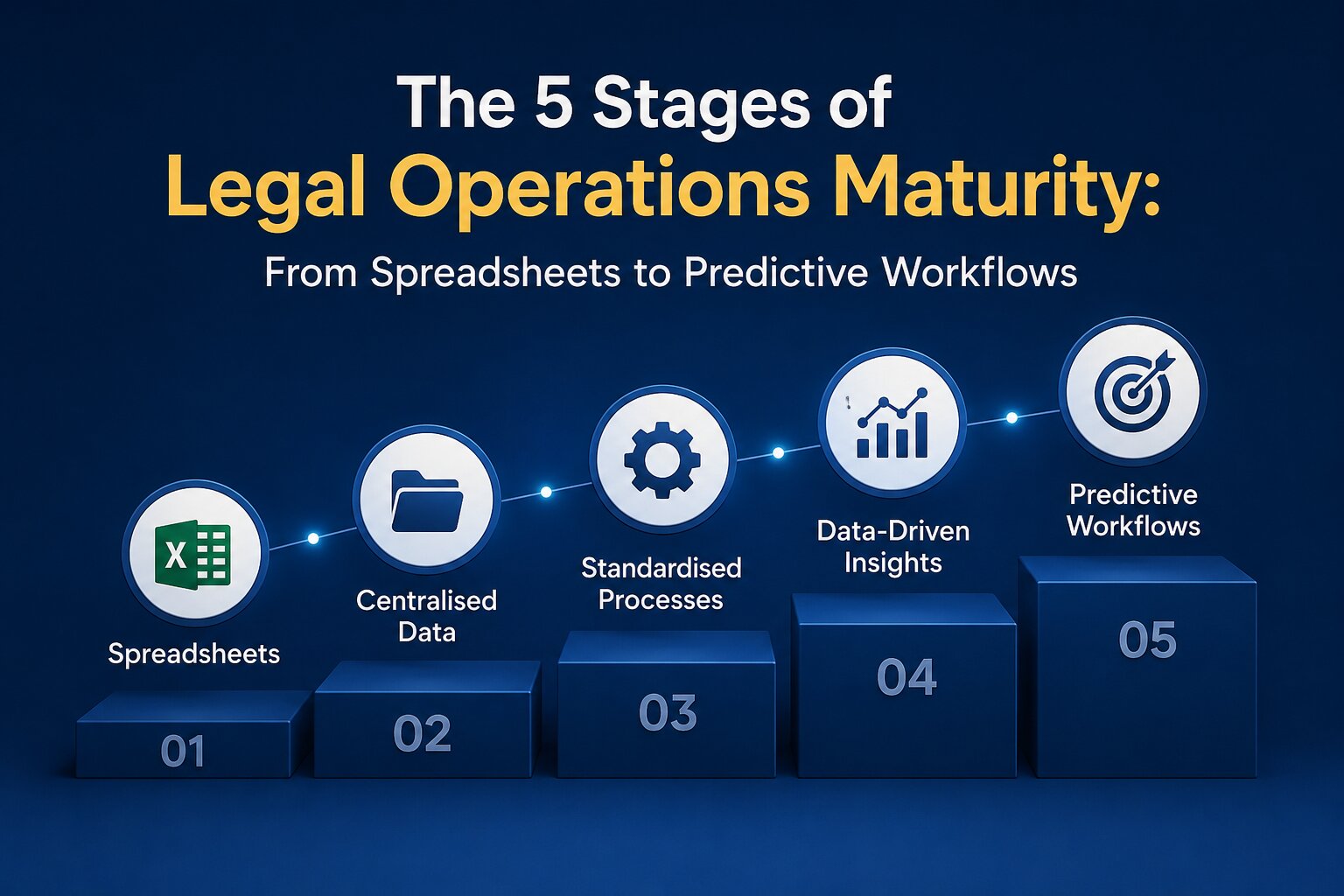
There are broadly five stages of this journey, from reactive manual work to predictive and intelligent workflows. Not every organisation will move through them at the same speed, and some may combine stages. What matters is understanding where your team is today and what needs to change next.
Why Legal Operations Maturity Matters Now
The role of the legal function has changed considerably. Legal teams are increasingly expected to support business growth while managing risk, costs, compliance requirements and growing volumes of work.
That makes the way legal work is organised just as important as the legal expertise within the team.
The shift from cost centre to strategic function
For years, legal departments were often viewed mainly as a support function: respond to requests, review contracts, manage disputes and advise the business when needed.
That model becomes harder to sustain as organisations expand.
Legal teams now deal with more contracts, regulatory obligations, disputes, internal requests and external counsel relationships. At the same time, business leaders expect clearer information about workload, costs, risks and turnaround times.
A mature legal operations function helps the legal team move from simply responding to requests to understanding patterns and planning ahead.
For example, instead of only reporting how many contracts were reviewed last month, a mature operation can look at where delays are happening, which contract types create the most work and where a process could be improved.
What "maturity" actually measures
Legal operations maturity is not simply a measure of how much software a legal department uses.
It considers several connected areas:
- Processes: Are legal workflows clear, consistent and repeatable?
- People: Do team members know who owns each task and decision?
- Data: Can the team access reliable information when it needs it?
- Technology: Does technology support the work rather than create another layer of administration?
- Decision-making: Can leaders use information to make better operational decisions?
A team with expensive software but unclear processes may still be operating at a relatively early stage. Conversely, a smaller team with well-defined workflows and reliable data may be further along.
Stage 1 — Reactive & Manual: The Spreadsheet Stage
This is where many legal teams begin.
The team is getting the work done, but much of the operation depends on individual effort. Information may sit across spreadsheets, inboxes, folders, messaging platforms and people's personal knowledge.
Common characteristics
A typical Stage 1 environment may include:
- Spreadsheets used to track matters, contracts or deadlines
- Email used for most requests and approvals
- Shared folders with inconsistent naming or filing practices
- Manual reminders for renewals and important dates
- Different people maintaining separate versions of the same information
- Knowledge that exists mainly in the heads of experienced team members
None of these tools is inherently bad. A spreadsheet can be perfectly useful for a small amount of work.
The problem appears when the spreadsheet becomes the system that the entire legal operation depends on.
Where this breaks down as volume grows
As workload increases, manual processes become harder to maintain. A missed update can make a report inaccurate. A deadline can be overlooked because a reminder was buried in an inbox. Someone may spend hours looking for information that another team member already has.
The legal team can also become dependent on particular individuals. If the person maintaining a critical tracker is unavailable, others may struggle to understand what is happening. The result is often a cycle of firefighting: the team spends more time finding information and coordinating work, leaving less time for higher-value legal activities.
Signs you're stuck here
You may be at Stage 1 if:
- Most work enters through individual emails or messages
- There is no consistent intake process
- Teams maintain multiple trackers
- Reporting requires significant manual effort
- Deadlines depend heavily on personal reminders
- It is difficult to get a reliable view of the overall workload
The goal at this stage is not to automate everything. It is to make the work visible and repeatable.
Stage 2 — Organised but Siloed
At Stage 2, the legal team has started bringing some order to its work. There may be shared folders, standard templates, dedicated trackers or basic systems for particular activities. Processes are becoming more structured, but they often remain separated from one another.
Introduction of basic tracking systems
Teams may introduce systems for matter tracking, contract storage, document management or reporting. This is an important step because information becomes easier to find and responsibilities become clearer.
However, having several organised systems does not necessarily mean the operation is connected. A contract may be stored in one location, approval information in another and financial information somewhere else.
Departmental processes exist but don't talk to each other
Consider a procurement team requesting a contract review. The legal team may receive the request by email, review the document in a shared folder, obtain approval through another channel and then send the completed contract back manually.
Each part of the process may be organised. The overall workflow, however, remains fragmented. This creates unnecessary handoffs and makes it difficult to see what is happening from beginning to end.
The visibility gap for leadership
Siloed processes also make reporting difficult. Leadership may know how many matters are open, but not necessarily how long they have been waiting for action. They may know total legal spend without having a clear picture of where that spend is going.
The organisation has information, but not necessarily connected information. The next step is to bring these processes together.
Stage 3 — Standardised & Centralised
Stage 3 is where legal operations starts becoming a coordinated function rather than a collection of separate activities.
The focus shifts towards consistent processes, centralised information and structured workflows.
Unified intake, matter management and workflow standardisation
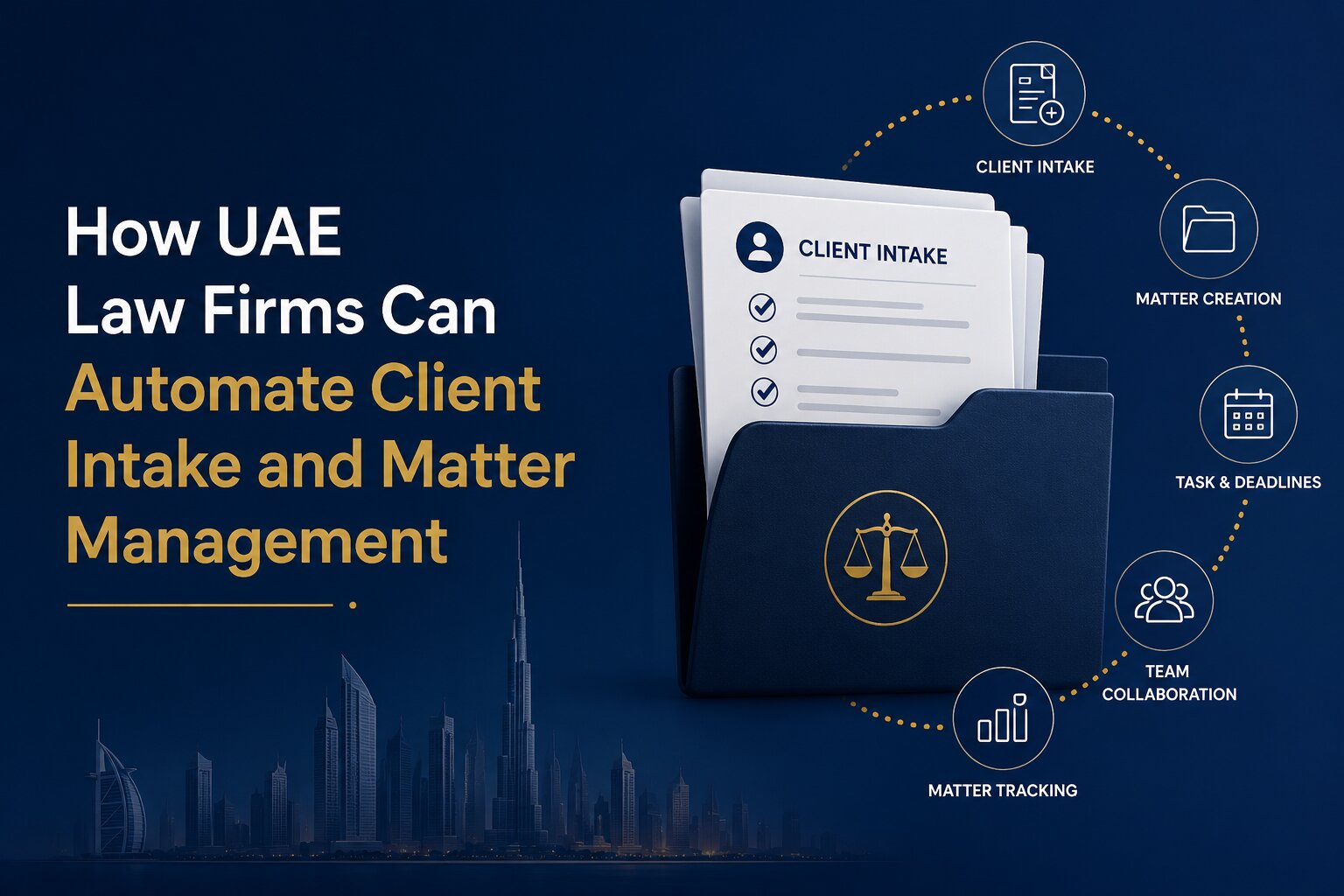
Instead of receiving requests through multiple channels, the legal team can establish a more consistent intake process.
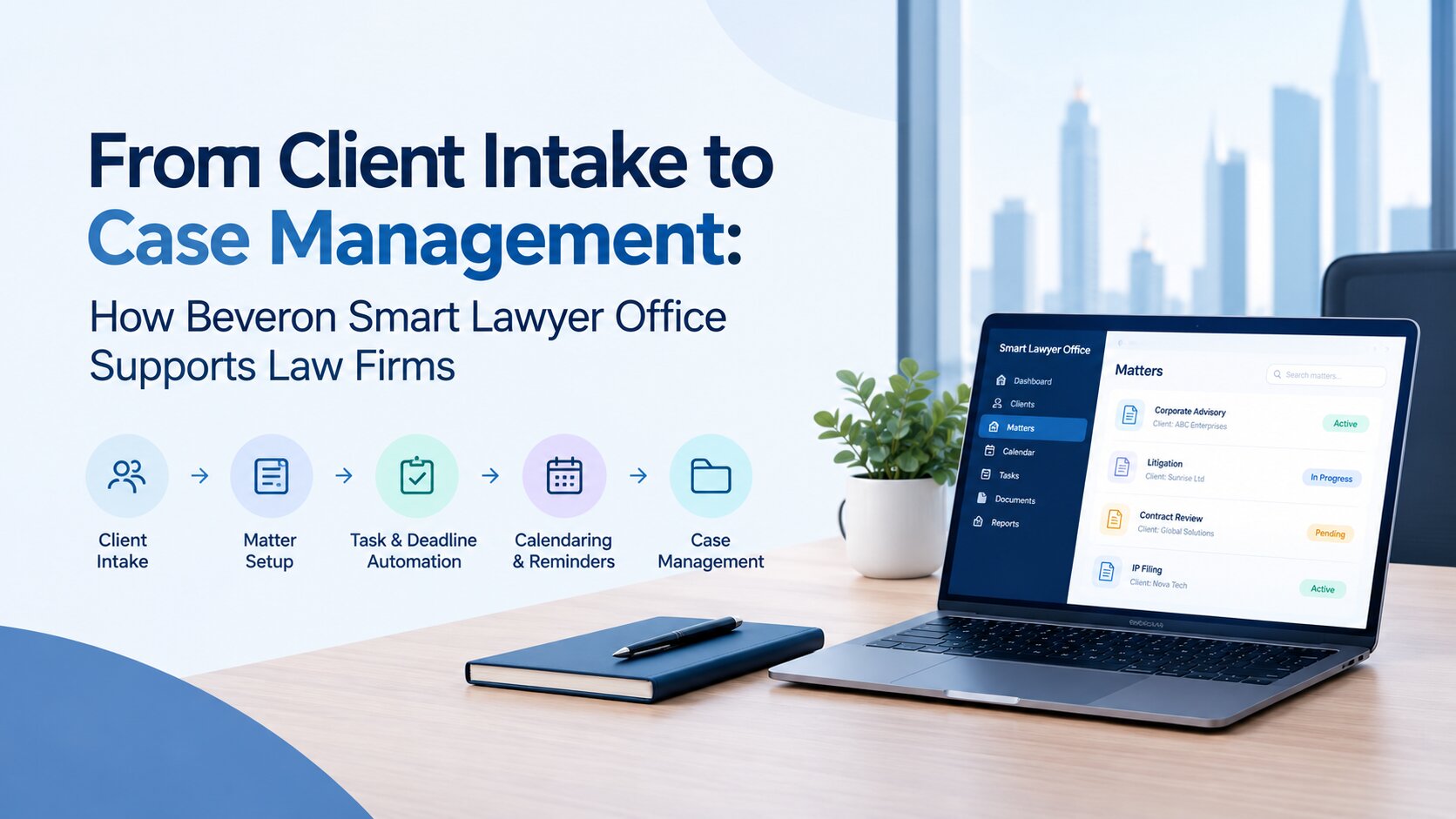
Requests can be categorised, assigned to the appropriate person and tracked through defined stages. Corporate legal case management tools can help bring matters, documents, deadlines and team activities into one structured environment, making it easier for legal teams to manage work and maintain visibility across ongoing matters.
The same principle applies to matter management and contracts. Information is captured in a consistent format, making it easier for team members to understand the status of work without relying on individual explanations. Standardisation does not mean every legal matter must follow exactly the same path. Different types of work can have different workflows while still following clear rules.
Data becomes usable for reporting
Once information is consistently captured, it becomes much easier to answer operational questions.
A legal leader can start looking at metrics such as:
- Matter volumes
- Contract turnaround times
- Workload by team member or department
- Outside counsel spend
- Open and overdue matters
- Approval timelines
- Contract renewal activity
The important change is that reporting no longer depends entirely on manually collecting information at the end of each month.
What pushes teams towards Stage 3?
Several factors can accelerate this transition. Rapid business growth is one. So are increasing legal costs, audit requirements, regulatory expectations and a growing number of internal stakeholders. Sometimes the trigger is simply scale. A process that worked well for 100 matters may become difficult to manage when the team is handling 1,000.
At this stage, centralisation creates the foundation for more advanced automation.
Stage 4 — Data-Driven & Automated
At Stage 4, the legal operation begins to use its structured information to improve how work gets done. The focus is no longer just on tracking work. It is on reducing unnecessary manual effort and using data to make better decisions.
Automating repetitive workflows
Many legal processes contain predictable steps. A request may need to be reviewed, assigned, approved, updated and closed. Certain deadlines may require reminders. Some documents may need to be routed to specific people based on their type or value. These are areas where automation can help.
For example, a workflow could automatically route a request to the appropriate team, notify an approver, send a reminder when action is overdue and update the status once a task is completed. Agentic AI for legal teams can take this a step further by helping coordinate multi-step workflows while keeping people involved in decisions that require legal judgement.
The purpose is not to remove human judgement. It is to reduce the amount of routine coordination people have to perform manually, giving legal professionals more time to focus on work that requires experience and context.
Metrics-based decision-making takes hold
At this stage, legal leaders can move beyond asking, “What happened?”
They can start asking, “Why is it happening?”
If contract turnaround times are increasing, data may reveal that most delays occur during a particular approval step. If outside counsel costs are rising, matter and spend information may help identify where resources are being used.
This creates a feedback loop: measure the process, identify the problem, improve the workflow and measure it again.
Connecting legal with other business functions
Legal work rarely exists in isolation. Contracts may involve procurement and finance. Compliance may involve risk and operations. Litigation can have financial implications. Vendor agreements may require input from several departments.
At Stage 4, legal workflows can connect more effectively with these functions.
That broader connection gives the legal team a more complete view of the work and its impact on the wider business.
Stage 5 — Predictive & Intelligent Workflows
The fifth stage represents a shift from managing today's workload to anticipating what may happen next. This is where AI and advanced data analysis can become useful, provided they are introduced with appropriate controls and human oversight.
AI-assisted forecasting
A mature legal operation may be able to use historical and current data to identify patterns.
For example, it could help teams spot:
- Matters that may require additional attention
- Potential changes in legal workload
- Patterns in contract turnaround times
- Areas associated with higher operational risk
- Expected legal spend based on previous activity
- Upcoming renewal or compliance pressures
These insights do not replace professional judgement. They give legal teams more information to work with before a problem becomes urgent.
From reactive to proactive legal operations
The biggest difference at Stage 5 is timing. A reactive operation tells you that a deadline was missed. An automated operation reminds you about the deadline.
A predictive operation may identify which upcoming matters are most likely to create delays and help the team act earlier.
That distinction matters because the value of legal operations is not only in doing existing work faster. It is also in helping the organisation prepare for what is coming.
What distinguishes predictive from merely automated?
Automation follows defined rules.
For example: If a contract is approaching its renewal date, then send a reminder.
Predictive systems go further by analysing patterns in available data to identify what may happen. For example, a system may identify that certain types of matters tend to experience longer turnaround times and flag them for earlier attention.
This distinction matters because automation helps work move, while predictive capabilities can help teams decide where attention may be needed next. AI for legal operations can take this further by connecting multiple steps within a workflow, helping with tasks such as routing, follow-ups, deadline monitoring and escalation while keeping human judgement involved.
How to Assess Your Team's Current Stage
You do not need a complicated maturity assessment to get started.
Look at four areas: process, data, technology and people.
| Area | Early-stage question | More mature question |
|---|---|---|
| Process | Do people know how work should move? | Are workflows standardised and continuously improved? |
| Data | Can we find the information we need? | Can we use reliable data to identify trends? |
| Technology | Are we using tools to store or track work? | Are systems connected to workflows and decision-making? |
| People | Does work depend on individual knowledge? | Are ownership, responsibilities and collaboration clearly defined? |
You can also ask your team a few practical questions:
- How does a new legal request enter the team?
- Can we see the status of every important matter?
- How much reporting is still done manually?
- Which recurring tasks consume the most time?
- Can leadership get reliable operational information without asking several people to prepare it?
- Are we using data to anticipate problems, or mainly to explain them afterwards?
The answers will usually reveal more than a technology checklist.
Common signs of stalling between stages
Teams can also get stuck between stages. A department may have implemented a matter management system but continue using spreadsheets for critical tracking. Another may have automated reminders but lack standardised processes. A third may collect large amounts of data but rarely use it to make decisions.
These are common signs that technology has moved ahead of the operating model. The answer is usually not another tool. It is understanding which part of the process is holding the team back.
Moving Up the Maturity Curve
Legal operations maturity is not a race to Stage 5. The right next step depends on the team's size, workload, risk profile, budget and business needs.
From Stage 1 to Stage 2
Start by making work visible.
Identify the main types of legal requests, define basic ownership and establish consistent ways to track important information.
Do not try to automate a process that nobody has properly defined yet.
From Stage 2 to Stage 3
Focus on standardisation and centralisation.
Map the most important workflows, remove unnecessary handoffs and establish a reliable source of information for matters, contracts and other core legal activities.
This is often where process improvement matters more than buying additional technology.
From Stage 3 to Stage 4
Look for repetitive, rule-based activities.
Prioritise tasks such as routing, notifications, approvals, status updates and recurring reminders.
At the same time, introduce meaningful metrics. Automation without measurement can make an inefficient process run faster without actually making it better.
From Stage 4 to Stage 5
Build on the data and workflows you already have.
Before introducing predictive or AI-based capabilities, make sure the underlying information is reliable and the processes are well understood.
AI can support forecasting, pattern recognition and decision-making, but legal teams still need appropriate oversight, accountability and human review.
The technology should strengthen the team's judgement, not replace it.
Frequently Asked Questions
What is legal operations maturity?
Legal operations maturity describes how effectively a legal team manages its processes, people, data and technology as its workload and business responsibilities grow. It ranges from reactive manual work to standardised, automated and eventually predictive workflows.
How long does it take to move between stages?
There is no fixed timeline. A small team with simple workflows may progress quickly, while a large organisation with complex systems and multiple stakeholders may take considerably longer. The quality of the underlying processes is often more important than speed.
Do you need software to reach Stage 5?
Software alone will not create a mature legal operation. Reliable data, well-defined processes, clear ownership and appropriate governance need to come first. Technology can then provide the infrastructure needed for advanced automation and predictive capabilities.
Can a small legal team skip stages?
Yes, to some extent. A small team does not necessarily need to experience every stage in sequence. It can adopt standardised workflows and appropriate technology earlier if the business case is clear. However, skipping the underlying process work can create problems later.
Is legal operations maturity only relevant to large organisations?
No. Smaller legal teams can benefit from the same principles. In fact, establishing clear workflows and reliable information early can make it easier to scale without adding unnecessary administrative work.
Conclusion: Maturity Is About Making Legal Work Easier to Manage
The journey from spreadsheets to predictive workflows is not really a technology journey. It is an operating journey. The most mature legal teams are not necessarily the ones with the largest technology stack. They are the ones that understand how work moves through the organisation, where information lives, who owns each decision and where technology can genuinely reduce friction.
For some teams, the right next step may simply be replacing disconnected spreadsheets with a consistent tracking process. For others, it may mean centralising matters and contracts, connecting workflows across departments or using AI to identify emerging patterns.
The important question is not, “How advanced is our technology?”
It is, “What is the next operational problem we need to solve?”
Once that is clear, the right technology becomes much easier to identify.
Legal teams looking to bring matters, contracts, compliance, workflows, and operational information into a more connected environment can use platforms like Beveron's Smart Legal Counsel (SLC) to centralise legal operations, reporting, and workflow management. The first step, however, is understanding your current stage and identifying where the biggest gap lies.
Best legal operations automation in the UAE
Best predictive workflows for legal teams in the UAE
Best AI for legal operations in the UAE
If you need a free demo on the best legal operations automation in the UAE, please fill out the form.