Where Does a Law Firm Lose Time Between a New Enquiry and an Active Matter?
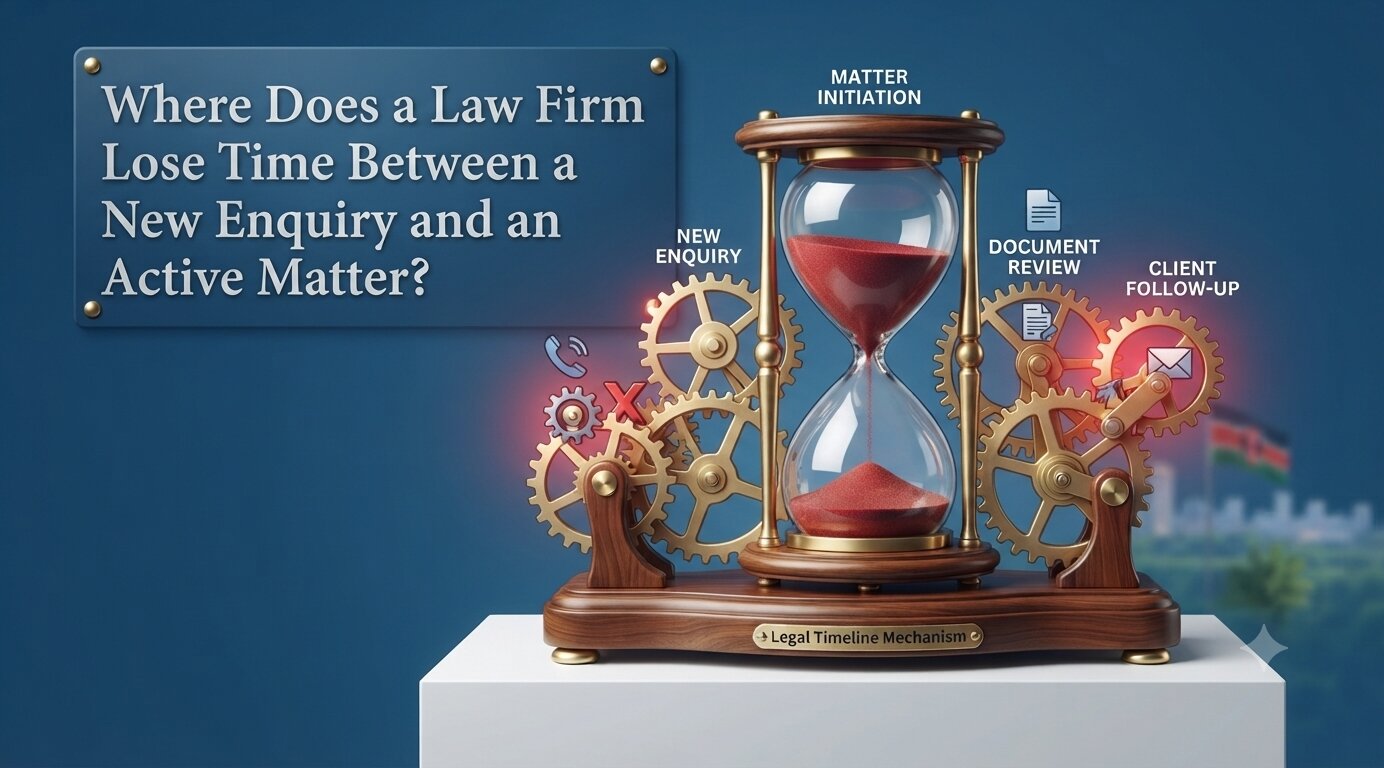
A new client enquiry can arrive in minutes. Turning that enquiry into an active matter can take considerably longer. The reason is not always the complexity of the legal work. Often, the time is lost before the lawyer even starts working on the matter: someone needs to respond to the enquiry, collect client details, request documents, check whether the firm can take the matter, complete internal checks, discuss fees or engagement terms, follow up with the prospective client and finally create the matter record.
Individually, these steps may seem small. Across a busy practice, however, they can create a long chain of waiting, handoffs and repeated administrative work. For law firms reviewing their law firm client intake process, the useful question is therefore not simply, "How quickly do we respond to enquiries?" It is:
Where does an enquiry wait, who owns the next step, and how long does it take before the firm can actually begin the matter?
What Happens Between a New Enquiry and an Active Matter?
The path from first contact to an active matter can vary between firms and practice areas. But most firms have several common stages.
1. An enquiry arrives
The first contact might come through a website form, email, phone call, referral or an existing client. At this point, the firm needs enough information to understand who the prospective client is, what they need help with and whether the enquiry should move forward. The first problem can appear here: the enquiry may enter through a channel that is not visible to everyone who needs to act on it.
An email may sit in an inbox. A phone enquiry may be written into a spreadsheet. A referral may be passed directly to a lawyer. Unless there is a clear process for capturing and assigning new enquiries, the starting point itself can become difficult to track.
2. The enquiry is qualified
The firm then needs to establish whether the enquiry is relevant to its practice. This might involve understanding the legal issue, identifying the appropriate practice area, assessing urgency and determining which lawyer or team should handle it. This is not simply a sales step. It is part of deciding whether and how the firm should proceed with the prospective client.
3. Client information and documents are collected
If the enquiry progresses, the firm may need additional information and supporting documents. Depending on the matter, this could include identification details, contact information, contracts, correspondence, notices, previous legal documents or other relevant records. This is one of the points where small delays can accumulate. A client may provide some documents but not others. A staff member may need to send another email. Someone else may need to check what is still missing.
The work itself may be straightforward, but the back-and-forth can take time.
4. Internal checks and engagement take place
Before work begins, the firm may need to complete internal checks, assess the matter, discuss fees and engagement terms, and obtain any necessary internal approval. Not all waiting at this stage is avoidable. A proper review or conflict check should not be rushed simply to improve a timing metric. The important distinction is between necessary professional review and avoidable administrative waiting.
5. The matter becomes active
Once the firm is ready to proceed, the client and matter need to be properly recorded. The relevant information, documents, communications and responsibilities should be connected to the new matter so that the legal team can work from a reliable record. This is the point where the initial legal enquiry to matter conversion becomes a working legal relationship.
Where Do the Waiting Points Usually Occur?
Looking at the stages individually makes one thing clear: the delay is not necessarily in one large task. It is often spread across several small points.
Unclear ownership after an enquiry arrives
An enquiry can be received quickly but still remain unattended if nobody is clearly responsible for the next action. For example, a prospective client may send an email on Monday. One person assumes the partner is handling it, while the partner assumes the office team is collecting the information. Nothing has necessarily gone wrong. There is simply no clear ownership.
A good law firm lead management process should make it possible to see who is responsible, what stage the enquiry has reached and what needs to happen next.
Missing or incomplete client information
Another common waiting point is incomplete information. A lawyer may be ready to assess a matter but still be waiting for a document. A client may have sent a photograph instead of the required document. Or the firm may realise later that information collected at the beginning was incomplete. This creates another round of communication.
The issue is not that clients need to provide information. They often do. The issue is whether the firm has a clear way to identify what is required, what has been received and what remains outstanding.
Repeated data entry and document handling
Information can also be entered several times as an enquiry moves through the firm. A name and contact number may first be recorded in an email or spreadsheet, then entered into a client record, and later entered again when a matter is created. The same can happen with documents.
When systems are disconnected, administrative work grows around the legal work. Staff spend time moving information rather than progressing the matter.
Internal checks and approval handoffs
Some steps naturally require review by a lawyer, partner or another authorised person. The problem occurs when the status of that review is unclear. If a matter is waiting for approval, can the responsible person see that immediately? Does the person managing the enquiry know whether they should follow up internally? Is there a record of what is still outstanding?
A structured process does not remove professional judgement. It makes the status of that judgement easier to manage.
Follow-ups that are difficult to track
Not every prospective client responds immediately. Some need time to gather documents. Others need to discuss fees internally. Some simply stop responding. Without a clear follow-up process, it becomes difficult to distinguish between an enquiry that is actively progressing and one that has effectively gone cold.
When communication and follow-ups are managed across separate emails, spreadsheets or personal reminders, it becomes difficult to see what has been completed and what still needs attention. A structured law firm CRM workflow can help organise client communication, reminders and routine workflow tasks in one place.
That matters for both client service and management visibility.
What Do These Delays Affect?
The immediate effect may be a few extra administrative tasks. The wider impact can be harder to see.
Lawyer and staff time
A lawyer may spend several minutes looking for information, checking an email chain or asking a colleague for an update. One occurrence is insignificant. Repeated across dozens of enquiries, those small tasks become part of the firm's administrative workload.
Once a matter is opened, having a structured system for organising documents, tasks, deadlines and matter information can also reduce ongoing administrative effort. For a broader look at this workflow, see our matter management software for UAE advocates.
Client communication
From the client's perspective, the firm may simply appear slow. The client does not necessarily see the internal handoffs taking place. They only see that they sent information on Tuesday and are still waiting for the next step on Thursday. A clear process can help the firm provide more consistent updates without requiring someone to manually reconstruct the enquiry history.
Visibility over prospective matters
Partners and managers may also have difficulty answering basic questions:
- How many new enquiries are currently being handled?
- Which ones are waiting for client information?
- Which have been qualified?
- Which are waiting for an internal decision?
- Which have not received a follow-up?
- How long are enquiries taking to become active matters?
If the information is spread across inboxes, spreadsheets and individual records, answering these questions can itself become an administrative task.
Speed of matter opening
The longer the firm takes to move from a qualified enquiry to an active matter, the longer it takes for the legal team to begin structured work. Again, not every day of elapsed time represents inefficiency. Some matters genuinely require more review or client input. The useful measure is the difference between necessary elapsed time and avoidable waiting time.
Management reporting
A structured intake process can also make it easier to understand what is happening at the front of the firm's workflow. Instead of only seeing active matters, management can examine what happens before a matter is opened. That can reveal whether the issue is response time, qualification, document collection, internal review or follow-up.
What Should a More Efficient Intake Process Look Like?
The objective should not be to make every step automatic. It is to make the process clear enough that people know what needs to happen, who owns it and what information is still missing.
Give every enquiry clear ownership
Every new enquiry should have an identifiable owner or next responsible person. That does not necessarily mean one person handles everything. It means responsibility should not disappear between teams.
The firm should be able to answer: Who is responsible for this enquiry right now?
Collect information systematically
A structured legal client onboarding process can make it easier to collect information consistently. Rather than asking clients for whatever seems necessary at each stage, the firm can define the information normally required for different types of enquiries. This also makes it easier to identify missing information before the matter reaches the lawyer.
Track outstanding actions
A useful intake process should make the next action visible.
For example:
- Awaiting client document
- Internal review pending
- Fee discussion required
- Follow-up due
- Engagement confirmed
- Matter ready to open
This is more useful than simply marking an enquiry as "open".
Keep client information connected to the matter
Once an enquiry becomes a client and matter, the information already collected should remain useful. The team should not have to reconstruct the history from old emails or copy the same details into another system. This is where law firm matter management becomes closely connected to intake. Matter management should not feel like the beginning of an entirely new process. It should be the next stage of the same client journey.
For firms comparing different approaches to legal technology, it is also useful to assess how each option fits the firm's existing workflows, integrations, security requirements and operational needs. A structured legal technology comparison can help teams evaluate those factors before choosing a platform.
Separate legal judgement from administrative waiting
This distinction is particularly important. A partner may need time to assess whether the firm should accept a complex matter. A conflict check may need proper review. A client may need time to consider an engagement proposal. Those are legitimate parts of the process.
What should be reduced are delays caused by not knowing who is responsible, losing track of documents, repeating data entry or forgetting to follow up. Reducing this type of administrative work can also help lawyers spend more of their time on billable legal work rather than repetitive tasks that do not require legal judgement.
Where Can Intake Automation Help—and Where Should People Stay in Control?
Law firm intake automation is most useful when it supports routine coordination rather than attempting to replace professional judgement.
Routine tasks can be structured
Technology can help with activities such as:
- capturing enquiry information;
- assigning enquiries;
- sending reminders;
- tracking outstanding information;
- recording follow-up activity;
- updating statuses;
- maintaining a history of client communication.
These are areas where consistency can matter more than complex decision-making.
Follow-ups and reminders can be easier to manage
Instead of relying entirely on individual memory or inbox searches, the firm can use structured reminders and task ownership. The purpose is simple: make it harder for an enquiry to disappear because everyone assumed someone else was handling it.
Legal decisions should remain with the appropriate people
Technology should not determine whether a firm should accept a matter, how a complex legal issue should be assessed or whether a client relationship should proceed. Those decisions belong with the appropriate lawyers and firm leadership. The role of automation is to support the process around those decisions.
Which Intake Metrics Should a UAE Law Firm Track?
A firm does not need dozens of measurements to understand its intake process. A small set of practical measures can reveal where time is being lost.
Initial response time
How long does it take for a new enquiry to receive an initial acknowledgement or response?
Qualification time
How long does it take to determine whether an enquiry is relevant and should move forward?
Time waiting for client information
How much elapsed time is attributable to missing documents or information?
This should be interpreted carefully. Some waiting is outside the firm's control.
Time from qualified enquiry to active matter
This is one of the most useful measures for the question addressed by this article. It shows how long the firm takes to move from a viable prospective matter to an active matter, while allowing management to investigate what happened during that period.
Enquiries without a next action
An enquiry with no clear next step is a visibility problem waiting to become a delay. Tracking these records can reveal where ownership needs attention.
Enquiry-to-matter conversion
The number of enquiries that become active matters can provide useful context, but it should not be treated as a simple performance score. Different practice areas attract different types of enquiries. Some matters may be unsuitable, outside the firm's scope or declined for legitimate reasons. The more useful question is often why enquiries do or do not progress.
What Should UAE Firms Consider When Improving Client Intake?
A law firm's intake process also needs to reflect the environment in which it operates.
Arabic and English communication
UAE firms may work with clients, organisations and documents across Arabic and English. Where bilingual communication is part of the firm's normal operations, the intake process should support that reality rather than treating language as an afterthought.
Client data and privacy
Client intake involves personal information and potentially sensitive legal documents.
The UAE's Federal Decree-Law No. 45 of 2021 on the Protection of Personal Data establishes a federal framework covering the processing and protection of personal data, including obligations around confidentiality, privacy and data management.
For a law firm, this makes the handling of client information an important consideration when reviewing any digital intake process. Firms should assess the specific data flows, access controls, storage arrangements and processing activities relevant to their operations rather than assuming that a particular tool is automatically compliant.
Local operational requirements
The intake workflow should also reflect how the firm actually works in the UAE. For example, the information required for a litigation matter may differ from that required for advisory work, corporate matters or document review. A useful system should support the firm's process rather than force every enquiry into the same path.
This broader approach to legal technology also means considering how different legal workflows connect across the firm, from client intake and matter management to ongoing case administration. Firms can explore how legal technology supports the legal sector when reviewing these wider operational needs.
Secure document and information handling
The UAE legal environment increasingly relies on digital services. The UAE government notes that electronic services are used across the judiciary, including electronic filing and case-management services. That makes it increasingly important for firms to think about how information is handled before a matter reaches the formal case stage as well.
How to Create a More Connected Intake-to-Matter Workflow
Once the firm has identified where its intake process is slowing down, technology can help connect the stages. Smart Lawyer Office is designed for law firm operations and includes workflows covering enquiries, proposals, KYC and document collection, matters, hearings, billing, reporting and client communication. The relevance here is not simply the number of features. It is the ability to connect related activities.
For example, instead of treating an enquiry as an email that eventually becomes a matter somewhere else, the firm can structure the progression from initial contact through information collection, follow-up and matter management.
That can give the team a clearer view of:
- where an enquiry currently stands;
- what information is still required;
- who needs to act next;
- which follow-ups are due;
- when the enquiry is ready to become an active matter.
The same principle applies after the matter is opened. Case and matter management platforms can centralise information such as client details, documents, communication and case activity rather than leaving the legal team to reconstruct the matter from separate sources. The technology does not remove the professional decisions that lawyers need to make. It can, however, provide more structure around the administrative work that surrounds those decisions.
A 10-Question Audit of Your Law Firm's Client Intake Process
Before changing software or introducing more automation, a firm can start by examining its current process.
Ask:
- Where does a new enquiry first enter the firm?
- Who becomes responsible for it?
- How quickly is the enquiry acknowledged?
- Where is its current status recorded?
- What information is required before the firm can assess it?
- How are missing documents or details tracked?
- How many times is the same client information entered?
- Who owns follow-up when the client does not respond?
- How does a qualified enquiry become a client and matter record?
- Can management see where enquiries are waiting and why?
The answers can reveal more than a software comparison alone. If the firm cannot easily answer several of these questions, the issue may be less about individual employee performance and more about how the process itself is structured.
Conclusion: Find the Waiting Points Before Trying to Fix Them
The time between a new enquiry and an active matter is made up of many small steps. Some are essential. Lawyers need to assess matters properly, complete appropriate checks and make informed decisions about engagement. Others are administrative: forwarding emails, requesting the same information again, looking for documents, checking who owns an enquiry or remembering to follow up. Those are the areas worth examining first.
For a UAE law firm, improving the law firm client intake process does not necessarily mean automating everything. It means understanding the journey, making ownership visible, reducing unnecessary handoffs and ensuring that information collected at intake can continue into matter management.
A connected platform such as Smart Lawyer Office can support that process by bringing enquiries, client information, document collection, follow-ups and matter management into a more structured workflow. The first practical step, however, is simpler: map where an enquiry waits today.
Ready to Find the Delays in Your Intake Workflow?
If new enquiries are getting stuck between the first response, client onboarding and matter creation, it may be time to look at the workflow behind them. Smart Lawyer Office helps law firms organise enquiries, client information, documents, follow-ups and matters in one connected system.
See how a more structured intake-to-matter workflow can help your firm reduce administrative delays and gain better visibility over every new enquiry. Request a personalised demo today.
FAQs
1. What is a law firm client intake process?
A law firm client intake process is the series of steps used to take a prospective client from an initial enquiry through qualification, information and document collection, internal checks, engagement and, where appropriate, creation of an active matter.
2. Where do law firms commonly lose time during client intake?
Common waiting points include unclear enquiry ownership, incomplete client information, repeated data entry, document collection, internal handoffs and follow-ups that are difficult to track.
3. How can law firm intake automation reduce administrative delays?
Automation can help structure routine activities such as enquiry assignment, reminders, information collection, status updates and follow-ups. Professional decisions such as matter assessment and acceptance should remain with the appropriate legal professionals.
4. How does client intake connect with law firm matter management?
Client intake gathers and validates information before a matter begins. Matter management then provides the structure for handling the active legal work. Connecting the two can reduce repeated data entry and help preserve relevant information as the client relationship progresses.
5. What should a law firm measure in its intake process?
Useful measures include initial response time, qualification time, time waiting for client information, time from qualified enquiry to active matter, enquiries without a next action and enquiry-to-matter conversion.
6. Can Smart Lawyer Office support the enquiry-to-matter workflow?
Smart Lawyer Office supports law firm workflows involving enquiries, proposals, KYC and document collection, client communication, follow-ups and matter management. The relevance depends on how the firm's existing intake and matter processes are configured.
Best matter management software for lawyers in the UAE
Best law firm intake automation software in the UAE
Best law firm lead management in the UAE
If you need a free demo of the best matter management software for lawyers in the UAE, please fill out the form.