How Kenyan Law Firms Can Improve Matter Tracking and Case Oversight
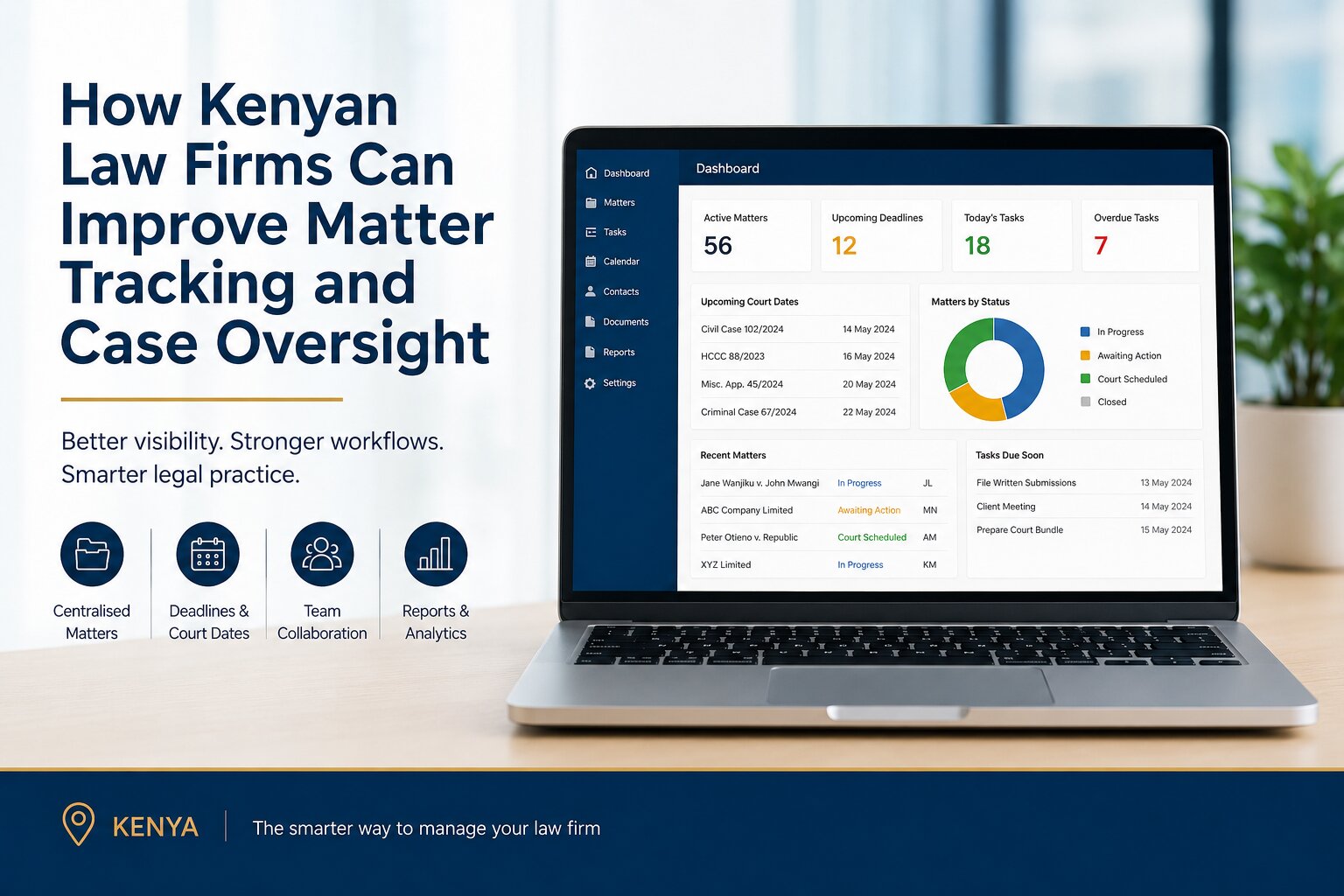
Managing legal matters is rarely about one task at a time. A lawyer may be preparing for a hearing, reviewing documents, following up with a client, monitoring a filing deadline, and checking several other matters on the same day.
As a firm's caseload grows, managing these activities through spreadsheets, emails, paper files, and individual calendars can become increasingly difficult. Information gets scattered across different places, deadlines can be overlooked, and partners may have limited visibility into the progress of active matters.
For Kenyan law firms, this challenge is becoming increasingly relevant as legal processes continue to move towards digital systems. The Judiciary's expansion of electronic filing and case-tracking infrastructure is contributing to a more digitally connected legal environment. This is where matter management software in Kenya can help. By bringing matter information, documents, tasks, deadlines, and activity into a structured environment, legal teams can improve case oversight without adding unnecessary administrative work.
Why Matter Tracking Matters for Kenyan Law Firms
A legal matter is more than a case number. It can involve client information, case history, documents, correspondence, court dates, filing deadlines, internal tasks, lawyer assignments, notes, and updates.
When these elements are managed separately, lawyers can spend unnecessary time searching for information or asking colleagues for updates. A partner may want to know which matters have upcoming hearings, while an associate may need to check whether a document has been filed or a client has provided the required information.
Effective matter tracking gives firms a more consistent way to:
- See which matters need attention
- Identify upcoming deadlines and court-related activities
- Monitor outstanding work
- Establish responsibility for important tasks
- Access matter-related information more easily
- Understand how work is distributed across the team
- Give partners a clearer view of active matters
The objective is not to create another administrative burden. It is to make the information lawyers already manage easier to access and act on.
Centralise Matter Information in One Place
A strong matter management software in Kenya solution can provide a structured record for each legal matter. Instead of keeping client information in one location, documents in another, deadlines in a calendar, and updates in email conversations, firms can organise these details around the matter they belong to.
If your firm is still evaluating whether matter management software is the right fit, our guide on What Every Kenyan Law Firm Should Know About Matter Management Software explains the fundamentals, common adoption questions, and key factors to consider before choosing a solution.
This creates a more consistent source of information for everyone authorised to work on the file.
Create a Complete Matter Record
Depending on the firm's workflow, a matter record can include:
- Client and contact details
- Matter type and status
- Assigned lawyers and staff
- Case documents
- Tasks and follow-ups
- Court dates
- Filing and internal deadlines
- Notes and updates
- Correspondence
- Previous activity
This becomes particularly useful when several people work on the same matter. A lawyer taking over a file can review its history and current information without relying entirely on another team member's memory or searching through disconnected email threads.
Improve Case Status and Progress Tracking
One of the simplest ways to improve case oversight is to make the status of every matter visible. Case status tracking gives lawyers and partners a consistent way to understand where matters currently stand.
A firm could use statuses such as:
- New matter
- Initial review
- In progress
- Awaiting client information
- Awaiting court action
- Hearing scheduled
- Decision pending
- Completed
The exact stages will depend on the firm's practice areas and internal processes. The important point is to use consistent statuses that help the team understand what needs attention.
Monitor Progress Without Constant Status Checks
Partners managing a large portfolio of matters should not have to ask individual lawyers for an update every time they need an overview.
A structured matter system can help them review information such as:
- Latest matter activity
- Outstanding actions
- Upcoming dates
- Assigned team members
- Recent documents
- Current status
This provides a practical way to monitor progress while allowing lawyers to focus on the legal work itself.
Manage Legal Deadlines and Court Dates
Legal work is highly time-sensitive. Filing deadlines, hearings, client commitments, and other matter-specific dates need to be handled carefully. Relying entirely on memory, paper notes, or scattered calendars can make this more difficult as the number of matters increases.
Set Legal Deadlines and Reminders
A digital matter-management system can help organise reminders around:
- Filing deadlines
- Court-related dates
- Internal review dates
- Client follow-ups
- Document submission dates
- Other matter-specific actions
These reminders provide an organisational layer around legal work. They do not replace professional judgement or the need for lawyers to verify dates and requirements through the appropriate sources.
Keep Court Dates Connected to the Matter
Court date tracking is particularly important for firms handling multiple litigation matters. Kenya's Judiciary has introduced digital systems to support case tracking and electronic filing. Its Case Tracking System is designed to track cases through their lifecycle, while the Causelist Portal provides information about cases scheduled for hearing.
A firm's internal matter-management system serves a different but complementary purpose. It can help the legal team organise its own responsibilities around those cases by connecting court-related activities with the relevant matter, assigning follow-up work, and keeping internal information accessible to authorised team members.
Standardise Litigation Workflows and Case Assignments
Litigation often involves a sequence of activities rather than one isolated task. Documents need to be collected, pleadings prepared, filings completed, hearings prepared for, and clients kept informed. A structured litigation workflow can help firms turn these activities into a more consistent process.
For example, a litigation workflow might move through:
Matter intake → Initial case assessment → Document collection → Pleading preparation → Filing → Hearing preparation → Client communication → Follow-up → Matter closure
Not every case will follow exactly the same path. A workflow should provide a consistent starting point while allowing lawyers to apply professional judgement when circumstances change.
Give Every Task a Clear Owner
Case assignments become easier to manage when each important task has a defined owner and, where appropriate, a due date.
Instead of simply recording that a filing needs to be completed, the firm can identify:
- What needs to be done
- Who is responsible
- Which matter it relates to
- When it is due
- Whether it has been completed
This makes accountability clearer and helps teams identify outstanding work before it becomes a larger issue.
Balance Lawyer Workloads More Effectively
As a law firm grows, workload can become difficult to judge through informal conversations alone. One lawyer may be handling several urgent matters while another has more capacity. Without sufficient visibility, partners may unintentionally continue assigning work to the same people.
For litigation-heavy practices, workload management becomes particularly important as hearings, filings, client updates, and case-related tasks compete for the same resources. Learn more about Managing Litigation Workloads More Efficiently in Kenyan Law Firms
Lawyer workload management provides a clearer picture of how matters and responsibilities are distributed.
By reviewing assigned matters and tasks, partners can identify:
- Overloaded team members
- Upcoming workload peaks
- Unassigned work
- Delayed tasks
- Matters requiring senior attention
This information can support better decisions about work allocation. The purpose is not to reduce legal work to numbers, but to give managers better information when deciding how resources should be used.
Keep Case Documents Connected to the Matter
Legal matters generate substantial documentation, including pleadings, evidence, correspondence, agreements, court documents, client records, and internal notes. Without organised case document management, lawyers can waste valuable time searching through folders, email attachments, and physical files.
Connecting documents directly to their relevant matters can make it easier to:
- Find documents when they are needed
- Keep related files together
- Reduce unnecessary duplication
- Maintain a clearer history of the matter
- Give authorised team members access to relevant information
The important distinction is that document management should support matter management rather than exist as a completely separate activity. A document is more useful when its relationship to the client, case, task, or stage of the matter is clear.
Use Matter Reporting to Improve Firm-Level Oversight
Managing individual matters is only part of effective case oversight. Partners and practice managers also need to understand what is happening across the wider firm. Matter reporting can provide a broader view of the firm's active workload and operational activity.
For example, management may want to identify:
- How many matters are currently active
- Which matters have upcoming deadlines
- Which tasks are overdue
- Which cases have remained inactive
- How work is distributed across lawyers
- Where workflow delays are occurring
For firms evaluating whether a legal management platform is delivering measurable value, it is also useful to look beyond matter activity and assess factors such as efficiency, security, user adoption, client service, and billing performance. See our guide to 5 KPIs for Evaluating the Best Law Management Automation Software for a practical framework.
Turn Matter Data into Management Decisions
Reports are most useful when they lead to practical action.
If several matters repeatedly become delayed at the same stage, the firm can review that part of the workflow. If one lawyer consistently carries a disproportionate workload, assignments can be reconsidered. If documents are frequently difficult to locate, the firm's document structure may need improvement.
The goal of reporting is therefore not simply to produce dashboards. It is to help partners identify issues and make better operational decisions.
How Beveron Smart Lawyer Office Supports Matter Tracking in Kenya
Beveron Smart Lawyer Office provides a structured environment for managing the different activities connected to a legal matter. Instead of treating case information, documents, tasks, deadlines, and updates as separate administrative activities, firms can organise them around the matter itself.
For example, when a new matter is created, the firm can associate the relevant client information and team members with it. Lawyers can then organise documents, assign tasks, record updates, monitor deadlines, and maintain activity information as the matter progresses.
This creates a connected workflow from matter intake to ongoing case management and closure.
Bringing Matter Management Activities Together
| Matter-management need | How a digital system can support it |
|---|---|
| New matter | Create a structured matter record |
| Team responsibility | Assign lawyers and staff |
| Case activity | Record updates and actions |
| Documents | Keep matter-related files organised |
| Deadlines | Set reminders and due dates |
| Litigation workflow | Track stages and outstanding actions |
| Case oversight | Review matter status and activity |
| Management | Use reports to identify workload and delays |
For Kenyan law firms handling a growing number of matters, this connected approach can reduce the need to search across multiple disconnected sources whenever someone needs an update. The objective is straightforward: help lawyers spend less time chasing information and more time working on the legal issues that matter to their clients.
Practical Steps for Better Matter Oversight
Technology alone will not solve every matter-management challenge. Firms also need clear internal processes and consistent ways of working.
For firms evaluating technology options, choosing the right platform should start with the firm's existing workflows, team structure, matter volume, and operational requirements.
To explore the key factors Kenyan law firms should consider when evaluating legal practice management software, read our guide on Choosing the Right Legal Practice Management Software for a Kenyan Law Firm.
A practical starting point is to:
- Standardise matter information so every file contains the key details the team needs.
- Define consistent matter statuses for different practice areas.
- Connect documents and correspondence to the relevant matter.
- Assign clear ownership for matters and individual tasks.
- Track deadlines and court-related activities systematically.
- Review workloads and stalled matters regularly.
- Use reporting to identify operational bottlenecks and improve workflows.
These steps can help firms build a more organised approach to case oversight without requiring lawyers to completely change how they work.
The Future of Matter Tracking for Kenyan Law Firms
Kenya's legal sector is already experiencing a broader shift towards digital processes. The Judiciary's electronic filing initiatives and Case Tracking System demonstrate how technology is becoming part of the wider legal environment.
For law firms, the next step is not simply replacing paper files with digital folders. It is creating connected workflows around each matter.
That means better visibility into cases, clearer responsibility for tasks, easier access to documents, more structured deadline management, and reporting that helps partners understand what is happening across the practice. As legal technology develops, firms may also use automation and AI to support more routine legal and administrative activities. However, these technologies are most useful when the underlying matter information is organised, accurate, and accessible.
Frequently Asked Questions
What is matter management software in Kenya?
Matter management software is a digital system that helps law firms organise and monitor legal matters. It can bring together case information, documents, tasks, deadlines, communications, and activity records in one structured environment.
How can Kenyan law firms improve case status tracking?
Firms can improve case status tracking by creating standard matter statuses, maintaining regular updates, assigning clear responsibility, and using a centralised system where lawyers can see the current state of each matter.
How does matter management software help with court date tracking?
It can help firms organise court dates and related tasks alongside the relevant matter. This gives the legal team a clearer internal view of upcoming activities and responsibilities. Lawyers should still verify court information through the appropriate official channels.
Can matter management software improve lawyer workload management?
Yes. By connecting lawyers to their assigned matters and tasks, firms can get a clearer picture of how work is distributed. Partners can use this information when assigning new work or identifying potential bottlenecks.
Why is centralised matter information important for law firms?
Centralised matter information reduces the need to search across disconnected systems. It gives authorised team members a clearer view of the client, case history, documents, tasks, deadlines, and recent activity associated with a matter.
Conclusion: Better Matter Tracking Starts with Better Visibility
Effective matter tracking starts with visibility. When lawyers can quickly understand where a matter stands, what needs to happen next, which documents are relevant, and who is responsible for the next action, managing the practice becomes easier. For Kenyan law firms, matter management software can bring these activities into a more structured environment, helping teams manage case information, deadlines, documents, workflows, and responsibilities more consistently.
The goal is not to add another layer of administration. It is to reduce the time lawyers spend searching for information, chasing updates, and coordinating routine activities.
For firms looking to strengthen their approach to matter oversight, Beveron Smart Lawyer Office provides a centralised environment for organising the information and workflows that support day-to-day legal practice.
Ready to bring your firm's matters, deadlines, documents, and workflows into one organised system?
Book a free demo of Beveron Smart Lawyer Office and see how smarter matter management can give your legal team greater control and visibility.
Best matter management software for law firms in Kenya
Best case management software for lawyers in Kenya
Best law firm case management software in Kenya
If you need a free demo of the best matter management software for law firms in Kenya, please fill out the form below.