From Client Intake to Case Management: How Beveron Smart Lawyer Office Supports Law Firms
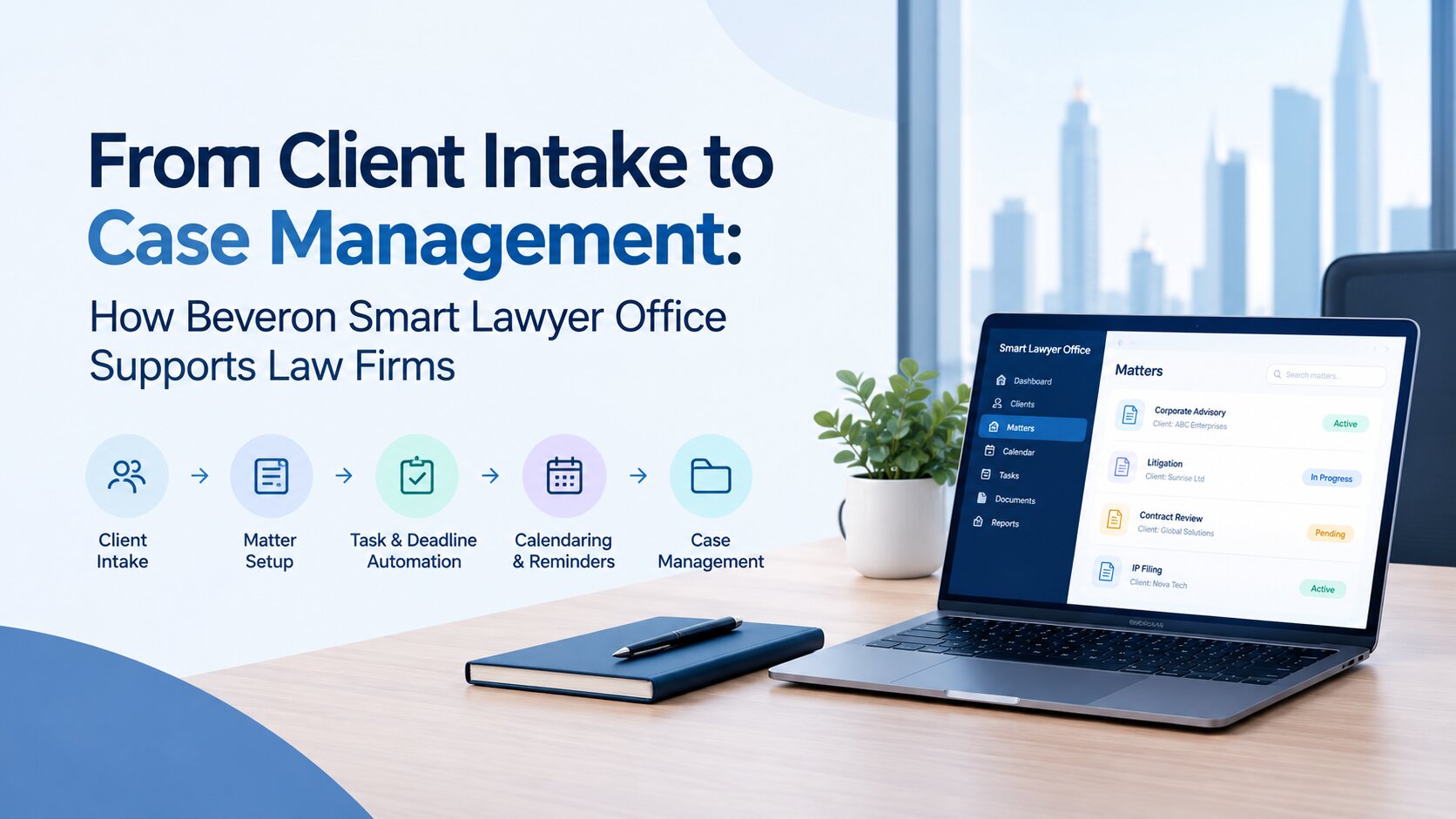
For law firms in the UAE, connecting these stages is an important part of managing client relationships and day-to-day legal work. Legal intake and case management software can help bring client information, onboarding activities and matter records into a more structured process, giving the team a clearer view of what has been completed and what still needs attention.
The aim is not simply to digitise paperwork. It is to ensure that information collected at the beginning of a client relationship remains useful throughout the legal matter. Understanding how this process works can help law firms identify gaps in their existing practices and decide which software capabilities are worth evaluating.
Where Does Client Intake End and Case Management Begin?
Client intake and case management are closely connected, but they serve different purposes. Client intake concerns the information and checks required when a prospective client approaches a firm. Case management begins to take shape as the firm establishes the engagement and organises the legal work that follows.
What happens during legal client intake?
The intake process often starts with a phone call, an email, a website enquiry or a referral. The firm needs to record who has made contact, understand the nature of the legal issue and identify the information required to assess the request.
Depending on the matter, this may involve collecting contact details, identifying the relevant parties, requesting documents, conducting conflict checks and determining whether the firm can take on the work. Client verification and other checks should follow the firm's applicable legal and professional obligations.
At this stage, timely communication matters. If a prospective client submits an enquiry but does not receive a response, or if the team cannot establish which documents are outstanding, the process can stall before the firm has even accepted the matter. Legal client intake software can help organise enquiry details and follow-up activities so that staff have a clearer record of each request and its status.
When does an enquiry become an active legal matter?
Once the firm has completed its required assessments and agreed to proceed, the information gathered during intake becomes the foundation for the engagement and matter record. The next steps may include preparing a fee proposal, issuing a service agreement, collecting remaining documents, assigning the responsible lawyer and recording important dates. The team then needs to manage correspondence, tasks, deadlines, documents and progress throughout the matter.
The transition should not require staff to reconstruct the client's history from multiple sources. Relevant information should carry forward into the matter record, with access and permissions appropriate to the work. A clear transition also helps distinguish between a prospective client who has not yet engaged the firm and a client with an active matter. This distinction is important for managing workloads and maintaining accurate records.
What Problems Arise When Client Intake and Case Management Are Disconnected?
Consider a law firm that receives a new enquiry from a business seeking legal assistance. The initial details arrive by email, supporting documents follow in separate messages, and a member of the team records the information in a spreadsheet. Once the firm agrees to proceed, another employee creates a matter record and manually enters much of the same information again.
Each step may seem manageable on its own. The difficulty arises when the firm handles many enquiries and active matters simultaneously.
Information may be duplicated, documents may be stored in different locations, and staff may have to contact colleagues to confirm the latest status. If the person responsible for an enquiry is unavailable, another team member may struggle to establish what has already been discussed or which documents are still outstanding.
These gaps can also affect the client experience. Clients may be asked to resend information, receive delayed responses or remain uncertain about the next steps. Internally, lawyers and support staff spend time locating records and checking progress instead of concentrating on the work that requires their attention.
The answer is not necessarily to add another tool for every stage. Law firms should first examine whether their existing processes provide a consistent way to record information, assign responsibility and carry relevant details from intake into matter management.
What Should Legal Intake and Case Management Software Help a Law Firm Do?
Legal intake and case management software should support the actual work a firm carries out, from recording a prospective client's details to organising an active matter. The objective is to create a reliable process in which information is available to the appropriate people when they need it.
Capture enquiries and maintain consistent client records
A structured intake process gives staff a consistent place to record client details, the nature of an enquiry, relevant parties and follow-up activity. It also helps the firm maintain a record of previous interactions rather than relying entirely on individual email inboxes.
For example, when a business contacts a firm about a commercial dispute, the team should be able to record the enquiry, identify the responsible person and track any information still required. If the client contacts the firm again, staff should be able to retrieve the existing record rather than start from scratch.
The process should also distinguish between prospective clients, existing clients and matters that are no longer active. This helps keep records organised and reduces confusion when the same client approaches the firm about different legal issues.
Client intake is also closely connected to client relationship management. A structured approach to tracking enquiries, following up with prospective clients and maintaining communication can help firms build lasting client relationships. Explore these law firm CRM strategies for transforming leads into long-term clients for practical ways to strengthen client engagement.
Support onboarding and engagement procedures
Once the firm has assessed an enquiry and decided to proceed, the next stage may involve collecting identification documents, obtaining relevant case information, preparing fee proposals and issuing service agreements. These activities require clear responsibility and visibility. Staff need to know which documents have been received, which approvals remain outstanding and whether the required steps have been completed before work begins.
Legal client onboarding software can help organise these activities through structured records, assigned tasks and status tracking. However, software should support the firm's established procedures rather than replace professional judgement or the checks required for a particular engagement.
Carry client information into matter management
One of the most important parts of the process is the transition from onboarding to active matter management. Information already collected should be available to the team managing the legal work, subject to appropriate access controls. This may include client details, relevant parties, engagement documents and supporting information. Without a clear transition, staff may have to recreate records or search through earlier correspondence to understand the matter. A connected process helps preserve context and gives the responsible lawyer a clearer starting point.
This does not mean that every enquiry should automatically become an active matter. The firm must retain control over client acceptance, required checks, approvals and matter creation.
Manage ongoing work and client communication
Once a matter is active, the focus shifts to managing the work itself. Lawyers may need to monitor deadlines, assign tasks, organise documents, record developments, coordinate with colleagues and keep clients informed. Law firm case management software can help bring these activities into a more organised working environment. Instead of depending on separate personal reminders or informal updates, the team can use matter records and workflow information to understand what needs attention.
The practical value depends on how well the software fits the firm's processes and whether staff maintain accurate records. A system can provide visibility, but it cannot compensate for unclear responsibilities or inconsistent working practices.
Where Can AI Assist with Legal Client Intake?
AI is becoming relevant to legal intake because some of the work involves reviewing information, identifying relevant details and organising documents. Used appropriately, it may help staff process information more efficiently. Its value depends on the task, the quality of the information and the safeguards surrounding its use.
Which intake tasks may benefit from AI assistance?
Depending on the capabilities of the software, AI may help extract information from uploaded documents, classify files, summarise lengthy enquiries or organise information for staff review. For example, a prospective corporate client might send several documents alongside an email describing a legal issue. An AI tool could help identify relevant information and prepare a summary for the intake team to check. This may reduce some initial reading and data-entry work.
However, extracting information is not the same as verifying it. AI-generated summaries may omit context, misinterpret a document or identify information incorrectly. Staff should verify important details against the original records before relying on them.
What requires human review and oversight?
Decisions about whether to accept a client, whether a conflict exists and what legal advice to provide require appropriate professional judgement and established review procedures. AI should not be treated as a substitute for these responsibilities. Law firms should also understand how an AI tool processes client information, whether data is retained, who can access it and whether information may be used to improve external AI models.
Before adopting AI intake tools, firms should establish which tasks they want to improve, what information the tools will handle and how staff will verify the output. They should also confirm the actual capabilities of any proposed software instead of assuming that a product offering AI features supports every intake activity.
What Should UAE Law Firms Evaluate Before Choosing Legal Software?
Selecting software involves more than comparing feature lists. A suitable system should support the firm's working practices, protect sensitive information and remain practical for lawyers and administrative staff to use.
Data protection, confidentiality and access controls
Law firms handle personal information, identification documents, commercial records and confidential client communications. Their software evaluation should therefore include access permissions, document security, audit records, data retention and the handling of information by external service providers.
The UAE's Federal Decree-Law No. 45 of 2021 on the Protection of Personal Data establishes a framework for processing and protecting personal data. Its application depends on the organisation and the information involved. Firms operating in the Dubai International Financial Centre (DIFC) or Abu Dhabi Global Market (ADGM) should also assess the separate data protection regimes applicable in those jurisdictions.
When assessing a software provider, firms should ask where their information is stored, who can access it, how access is controlled and what arrangements apply to data transfers and deletion. They should also review the provider's contractual terms and security documentation. The aim is to understand whether the proposed system and its operating arrangements are appropriate for the firm's obligations. Purchasing software alone does not establish compliance.
Arabic-English support and document handling
Law firms serving clients across the UAE may need to work with both Arabic and English records, correspondence and supporting documents. The requirements vary by practice area and client base.
During a demonstration, firms should test the actual tasks their staff perform.
Can users organise documents in both languages?
Can they search for records effectively?
Are the relevant screens, templates and reports available in the languages the firm requires?
It is also important to distinguish between a system that stores Arabic documents and one that can accurately extract, search or process Arabic content. These are different capabilities and should be assessed separately.
Workflow fit, integration and implementation
Even a capable system can create difficulties if it does not fit the way the firm works. Before selecting a solution, identify the processes that need to be supported, the people who will use it and the systems that must remain connected.
Ask vendors to demonstrate realistic scenarios, such as creating a client record, collecting documents, opening a matter, assigning work and tracking deadlines. Where integration with email, document storage or other tools is important, confirm the available integrations and any additional requirements.
Implementation also deserves attention. Existing client records may need to be cleaned and transferred, access permissions configured, workflows agreed and staff trained. A phased rollout may be more practical than attempting to change every process at once. The right choice is the system that meets the firm's actual requirements and can be adopted consistently, not necessarily the one with the longest feature list.
How Can Law Firms Measure Whether Their Intake Process Is Improving?
Before changing software or introducing a new workflow, firms should understand how their current process performs. Without a baseline, it is difficult to determine whether the changes have made a meaningful difference. Start by examining the time taken to move an enquiry through the firm's intake stages. Record how long it typically takes to collect the required information, complete the necessary checks and open a matter once the firm has agreed to proceed. Other useful measures include the frequency of repeated information requests, the number of incomplete client records, overdue follow-ups and the time staff spend locating documents or updating records manually.
These measures should reflect the firm's priorities. A practice that handles a high volume of routine enquiries may focus on response times and intake workload, while a firm handling complex commercial matters may place greater emphasis on document completeness, approvals and the accuracy of matter records.
Once the new process is in place, review the same measures at regular intervals. Staff feedback can also reveal problems that numbers alone may not show, such as confusing workflows, unnecessary steps or difficulties finding information. Improvements should be assessed against the firm's starting position. Software can support better organisation and visibility, but the results also depend on staff adoption, process design and the quality of the information entered.
How Beveron Smart Lawyer Office Supports Law Firm Workflows
For firms looking to connect client administration with ongoing legal work, the relevant question is whether their software can support the stages they need to manage without creating additional administrative complexity. Beveron Smart Lawyer Office is designed for law firms and legal consultancies, with capabilities covering client records, fee proposals, service agreements, KYC and document collection, expiry tracking, matter management, workflows, timesheets, billing and reporting.
These capabilities are relevant at different points in the client journey. Client records help organise information about the people and organisations the firm works with. Fee proposals and service agreements support engagement procedures, while document collection helps staff keep track of information required from clients.
Once a matter is active, matter records and workflow capabilities support the organisation of legal work. Depending on the firm's requirements and configuration, teams can also use timesheets, billing and reporting capabilities to monitor work and related administrative activities. The key consideration is how these capabilities fit together in the firm's actual process. During a product demonstration, the team should test the journey from a new client record through onboarding and matter management, paying particular attention to duplicate entry, task ownership, document access and the visibility of outstanding work.
Firms considering AI-assisted intake should separately confirm whether the specific AI functions they need are available within the proposed product or require another tool. They should also verify any integration requirements rather than assuming that all external intake systems connect automatically. You can explore Beveron's Smart Lawyer Office solution to understand how it supports law firm case management and day-to-day legal operations.
Building a More Consistent Journey from Enquiry to Active Matter
A well-managed intake process does more than collect client information. It establishes the records, responsibilities and checks needed to begin legal work with clarity. When those details carry forward into case management, the team has a better starting point for organising documents, tracking deadlines and managing client communication.
For UAE law firms, the first step is to review the current journey from initial enquiry to active matter. Identify where information is duplicated, where progress becomes difficult to track and which tasks consume unnecessary administrative time. Use those findings to define the requirements that matter most when evaluating software. Beveron Smart Lawyer Office is one option for firms assessing how to organise client records and legal matter workflows within a dedicated law firm system. A practical demonstration based on the firm's own processes can help determine whether the available capabilities match its needs.
Explore Beveron Smart Lawyer Office and request a demonstration to see how its case management capabilities could fit your firm's workflow.
Frequently Asked Questions
1. What is legal intake and case management software?
Legal intake and case management software helps law firms organise information from initial client enquiries through onboarding and ongoing matter management. Depending on the system, it may support client records, document collection, engagement procedures, task tracking, deadlines and reporting.
2. Can law firms manage client onboarding and legal matters in one system?
Yes, some legal practice management systems support both client onboarding and matter management. The available capabilities vary by provider, so firms should check how client information moves into active matter records and whether additional tools or integrations are required.
3. Can AI help law firms organise information collected during client intake?
AI may assist with tasks such as extracting information from documents, classifying files and summarising enquiries. Staff should verify the output, particularly when it relates to client identity, conflicts, legal decisions or confidential information. Firms should also assess data handling and security before using AI with client records.
4. What should UAE law firms consider when selecting legal case management software?
Firms should evaluate data protection, confidentiality, access controls, Arabic-English requirements, document management, workflow fit, integrations, reporting and implementation needs. They should also check which legal and regulatory requirements apply to their organisation and test the software using realistic scenarios.
5. How can a law firm measure the effectiveness of its client intake process?
Useful measures include the time taken to open matters, the frequency of repeated information requests, the completeness of client records, overdue follow-ups and the time spent on manual administration. Firms should establish a baseline and compare results after making changes to their processes.
Best AI-powered legal intake software for law firms in the UAE
Best Law firm case management software for advocates in the UAE
Best Legal practice management software for lawyers in the UAE
If you need a free demo of the best AI-powered legal intake software for law firms in the UAE, please fill out the form.