Choosing Arbitration Software in the UAE: 5 Key Factors to Consider

Arbitration has become an important method of resolving commercial disputes in the UAE, particularly for businesses operating across different industries and jurisdictions. From construction and real estate to financial services and international trade, disputes can involve multiple parties, extensive documentation, expert evidence and strict procedural timelines. Managing these activities requires legal teams to maintain accurate records, coordinate hearings, organise submissions and keep everyone involved informed throughout the proceedings.
The UAE has also taken steps to support modern arbitration practices. Federal Law No. 6 of 2018 on Arbitration, as amended in 2023, recognises the use of modern technological means in arbitration proceedings. The legal framework also addresses confidentiality and virtual hearings.
These developments make technology an important consideration for law firms, arbitration practitioners and corporate legal departments. However, choosing arbitration software is not simply about finding a platform with the largest number of features. Organisations need a solution that supports their workflows, handles confidential case information appropriately and fits their operational requirements.
Here are five important factors to consider when selecting arbitration software in the UAE.
1. Choose Software That Supports Your Arbitration Workflows
Arbitration proceedings involve several activities that need to be coordinated throughout the lifecycle of a dispute. Legal teams must maintain case information, monitor procedural developments, assign responsibilities, track hearing dates and ensure that important deadlines are not overlooked. When these activities are managed through separate spreadsheets, emails and calendars, maintaining a clear picture of each proceeding can become difficult.
When evaluating arbitration software, look for case management capabilities that allow your team to maintain individual matter records, track case progress and organise important activities in one place. The system should make it easier to assign tasks, monitor responsibilities and record important dates, including submission deadlines, procedural meetings and hearing schedules.
Consider the different arbitration workflows your organisation handles. For example, a law firm managing commercial disputes for several clients may need to monitor multiple proceedings simultaneously, each involving different parties, legal teams, documents and timelines. The software should make it possible to manage these matters separately while giving authorised team members an overall view of their progress.
It is also worth considering whether the platform can accommodate the procedural requirements associated with the arbitration rules your organisation follows. For instance, firms handling DIAC-administered proceedings may need to coordinate document submissions, procedural timetables, hearings and communications in line with the DIAC Arbitration Rules 2022.
2. Evaluate Document Management and Evidence Handling
Documents and evidence form a substantial part of arbitration proceedings. Legal teams may need to manage contracts, statements of claim, statements of defence, correspondence, witness statements, expert reports, financial records and supporting evidence. As proceedings develop, these materials may require several revisions, reviews and exchanges between the parties.
For UAE law firms handling domestic and international disputes, document organisation can become more challenging when different parties and professionals are working across jurisdictions. Language requirements may also need consideration, particularly where documents or communications involve both Arabic and English.
Arbitration software should provide a structured environment for storing, organising and retrieving case-related documents. Look for centralised document storage, search functionality, document categorisation and version tracking. These capabilities can help legal professionals locate relevant records without repeatedly searching through emails and separate folders.
Evidence management also deserves attention. Ask whether the platform supports document indexing, evidence organisation, review processes and the preparation of hearing materials. If your team regularly handles large volumes of supporting records, consider how easily the software can accommodate these documents and make them accessible to authorised users.
Another important consideration is document access. Different lawyers, support staff, clients and external participants may have different information requirements. The ability to manage permissions and maintain organised records can help prevent confusion and reduce the risk of unauthorised document sharing.
Rather than assuming that every legal case management system provides specialist evidence management, ask providers to demonstrate the exact capabilities available.
3. Assess Remote Hearing and Collaboration Capabilities
Arbitration proceedings in the UAE may involve parties, lawyers, arbitrators, witnesses and experts located in different countries. Coordinating these participants requires clear communication, accessible case information and careful scheduling. Remote and hybrid hearings have also made digital collaboration an important consideration when selecting arbitration software.
The UAE's arbitration framework recognises the use of modern technological means. Article 33 of the amended Federal Arbitration Law addresses hearings and proceedings, while Article 35 allows witness testimony through modern communication methods that do not require physical attendance.
For this reason, organisations should examine how software supports hearing coordination and communication between participants. Important capabilities may include hearing calendars, automated reminders, task assignments, document sharing and updates relating to upcoming proceedings.
For legal teams working with international clients, the ability to coordinate activities across different locations and time zones can also make a difference. A centralised system can help team members understand upcoming responsibilities and access relevant case information without depending entirely on lengthy email conversations.
However, scheduling and managing a hearing is different from hosting one. Some platforms provide hearing calendars and coordination tools but rely on external video conferencing applications for virtual proceedings. Confirm whether the software includes online hearing facilities or integrates with other platforms your organisation already uses.
The objective is to ensure that legal professionals can coordinate proceedings efficiently, regardless of where the participants are located.
4. Prioritise Data Security, Confidentiality and Responsible AI Use
Confidentiality is particularly important in arbitration because proceedings may involve sensitive commercial agreements, financial information, business strategies, personal information and private communications. Organisations selecting arbitration software should understand how their information is stored, accessed, shared and protected.
The UAE's Federal Arbitration Law, as amended by Federal Decree-Law No. 15 of 2023, strengthened the legal framework relating to confidentiality in arbitration. The DIAC Arbitration Rules 2022 also contain provisions addressing the confidentiality of arbitration materials and proceedings.
Software evaluation should therefore include a close examination of security controls. Look for role-based access permissions, secure document storage, encryption, backup arrangements and activity records that help organisations monitor access to information. It is also useful to understand how the provider manages data retention, deletion and security incidents.
Data protection requirements should be considered according to the organisation's location and the nature of the information being processed. The UAE's Federal Decree-Law No. 45 of 2021 on Personal Data Protection establishes requirements concerning personal data processing, confidentiality and cross-border data transfers. Organisations operating in the DIFC or ADGM should also examine the separate data protection frameworks applicable in those financial free zones.
Another consideration in 2026 is the increasing use of artificial intelligence (AI) in legal work. AI tools can assist with document summarisation, information extraction, document classification and legal research. These capabilities may help reduce repetitive administrative work, but they also introduce questions about confidentiality, accuracy and human oversight.
Before choosing a platform with AI features, understand how it processes uploaded documents, whether confidential information is used to train external AI models, and what controls are available to review its output. Legal professionals should remain responsible for checking AI-generated information, particularly when it relates to evidence, legal arguments or procedural decisions.
The right software should help organisations benefit from technology without compromising confidentiality, data protection or professional responsibility.
5. Consider Integration, Deployment and Long-Term Value
Arbitration software should fit into the existing technology environment of your organisation. Law firms and corporate legal departments may already use email applications, document storage platforms, calendars, accounting systems and other business tools. If the selected software cannot work alongside these applications, employees may end up repeating tasks or maintaining the same information in several places.
Before making a decision, identify the tools your team currently uses and check which integrations the software supports. Also consider whether it offers data import and export options, as these can be useful during implementation and future system changes.
Deployment is another important consideration for UAE organisations. Cloud-based solutions can provide convenient access for authorised users working from different locations. On-premise deployment may be preferable for organisations with specific infrastructure, internal IT or data governance requirements. Neither option is automatically suitable for every organisation, so the decision should reflect your security policies and operational needs.
Scalability also matters. A platform that works well for a small legal team should be capable of accommodating additional users, increasing caseloads and changing operational requirements. Consider whether the provider offers flexible licensing, customisable workflows and support for future expansion.
Finally, evaluate the total cost rather than focusing only on the initial subscription or licence fee. Implementation, staff training, customisation, integrations, maintenance and technical support can all influence the overall investment. Ask providers for a clear explanation of these costs before making a commitment.
A demonstration using your organisation's typical workflows can help establish whether the software offers practical long-term value.
Questions to Ask Before Choosing Arbitration Software in the UAE
Once you have identified your requirements, compare potential providers using practical questions. This will help you understand whether a platform can support your organisation's actual needs.
Does the software support our arbitration workflows? Check whether it can manage matters, hearing schedules, deadlines and task responsibilities.
Can it handle Arabic and English documents? Understand its language support, document search and information retrieval capabilities.
How does it manage confidential case information? Ask about access permissions, encryption, storage, backups and data protection arrangements.
Can it support remote and hybrid proceedings? Confirm whether it offers virtual hearing facilities or requires external integrations.
Does it offer useful AI capabilities? Understand how AI features work and what safeguards are available for confidential information.
Can it integrate with our existing applications? Check compatibility with the tools your legal team already uses.
What deployment options are available? Compare cloud and on-premise arrangements against your organisation's requirements.
What is the total implementation cost? Request details about licensing, setup, training, maintenance and ongoing support.
These questions can help your organisation move beyond product descriptions and evaluate software based on practical requirements.
Finding the Right Legal Case Management Solution for Your UAE Practice
Choosing arbitration software requires a clear understanding of your organisation's workflows, document requirements, security expectations and technology needs. While arbitration-specific platforms may offer specialised capabilities, some law firms may also benefit from broader legal case management systems that help organise matters, hearings, documents, deadlines and team responsibilities.
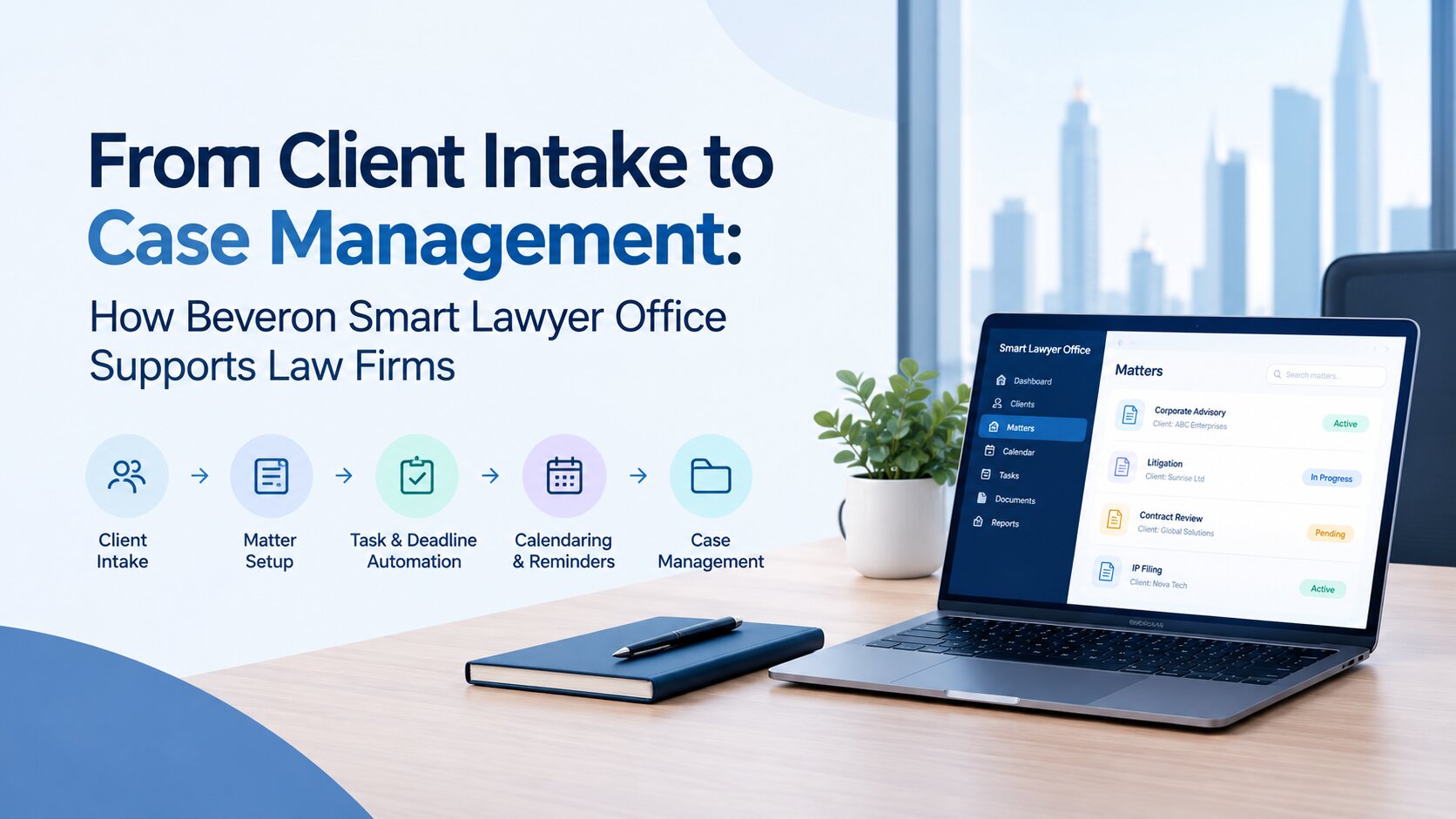
Beveron Smart Lawyer Office offers legal case management capabilities designed to support law firms and legal consultancies. Its features include matter management, hearing schedules, document management, task tracking, reminders, client management and reporting. The solution also offers English and Arabic support, with cloud and on-premise deployment options.
For UAE legal practices looking to organise their case-related activities and improve coordination between team members, exploring these capabilities can be a useful starting point.
Explore Beveron Smart Lawyer Office or request a personalised demonstration to understand how its capabilities align with your legal team's requirements.
Frequently Asked Questions
1. What should you look for in arbitration software in the UAE?
Look for case management, document organisation, hearing schedules, deadline tracking, task management, collaboration tools and appropriate security controls. UAE organisations should also consider Arabic-English support, deployment options and applicable data protection requirements. The right features depend on the type and complexity of arbitration matters being handled.
2. How does arbitration software help UAE law firms manage case documents?
Arbitration software can help law firms organise contracts, pleadings, correspondence, witness statements and supporting evidence within individual matters. Features such as centralised storage, search, document categorisation and version tracking can make it easier for authorised users to locate and review relevant information.
3. Can AI be used in arbitration case management?
AI can support administrative and document-related activities such as summarisation, information extraction and document classification. However, its use should be governed by appropriate confidentiality controls and human review. Legal professionals should verify AI-generated information before relying on it in arbitration-related work.
4. Is legal case management software the same as arbitration software?
Not necessarily. Arbitration software may include specialist capabilities for procedural management, evidence handling, tribunal coordination and arbitration-specific workflows. Legal case management software generally supports broader law firm activities, including matter tracking, hearing schedules, documents, deadlines and client management. Some organisations may use a combination of both, depending on their requirements.
Best arbitration case management software in the UAE