6 Essential Criteria for UAE Legal Teams Choosing Contract Management Software
For an legal team, choosing contract management software is not simply about finding a place to store agreements. Contracts move through several stages before and after they are signed, from drafting and review to approval, execution, renewal and ongoing monitoring. When these stages are handled across email, shared folders and spreadsheets, it can become difficult to know what needs attention and when.
The challenge can be greater for UAE organisations managing large contract portfolios across properties, projects, suppliers, business units or multiple companies. A real estate legal department may need to keep track of leases and property agreements, while a construction company may manage contracts connected to several projects. Hospitality and corporate organisations face their own mix of recurring commercial agreements.
This makes the choice of legal contract software an operational decision, not just a technology purchase. The right system should fit the way the legal team actually works and provide visibility throughout the contract lifecycle.
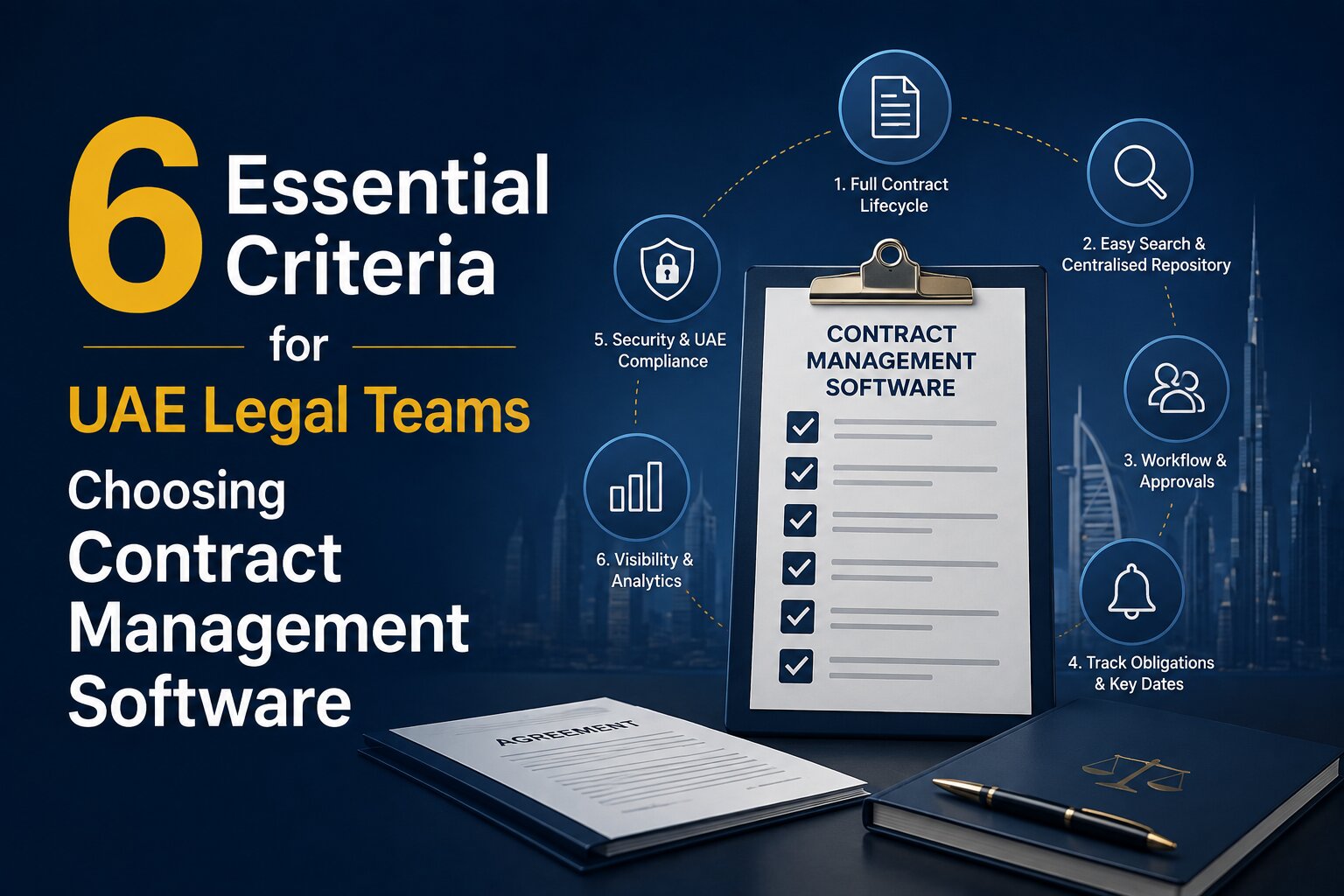
Here are six criteria UAE legal teams should consider when evaluating contract management software.
1. Does the Software Support the Full Contract Lifecycle?
A contract rarely begins and ends with a signed document. Legal teams may be involved in drafting, reviewing, negotiating, obtaining internal approvals, executing the agreement and monitoring it after signing. This is why it is worth checking whether a contract management system supports the full lifecycle rather than focusing on just one stage. For a broader look at the stages, capabilities and considerations involved in legal contract management, see our complete guide to legal contract management software.
Look for support across areas such as:
- Contract drafting and templates
- Review and negotiation
- Internal approval
- Execution
- Centralised storage
- Post-signature tracking
- Renewals and expiry management
For example, a construction company's legal team may review an agreement several times before it is approved and signed. Once the contract is active, the team may still need to monitor important dates and obligations. If each stage is handled in a different place, information can easily become fragmented.
A contract lifecycle management approach brings these activities into a more connected workflow. This can give legal teams better continuity from the first draft through to the end of the agreement.
2. Can the Legal Team Find and Manage Contracts Easily?
A contract is only useful when the people who need it can find the right information quickly. As contract volumes increase, legal teams can end up searching through shared folders, email attachments, spreadsheets and different departmental systems. This becomes particularly challenging for groups of companies where agreements may be managed across several entities or business units. A centralised contract repository can provide one place for storing and organising agreements. However, simply putting documents in one folder is not enough. The system should make the information easy to search and filter.
When evaluating contract repository software in the UAE, consider whether the system supports:
- Search across contract information
- Metadata and categorisation
- Filtering by relevant contract details
- Access controls
- Version visibility
- Centralised document storage
Consider a legal manager who receives a request for all active supplier contracts expiring within the next six months. If the information is scattered across different folders, compiling that list may require significant manual work. A structured repository with search and filtering capabilities can make this type of task more manageable.
For legal teams, this is one of the practical differences between simply digitising contracts and having legal contract software that supports day-to-day work.
3. Can It Simplify Review and Approval Workflows?
Contract review often involves more people than the legal team alone. Depending on the agreement, finance, procurement, business managers, senior leadership or other stakeholders may need to review or approve it. When these steps are managed through long email chains, it can be difficult to see where a contract is in the process. A document may be waiting for approval without the legal team having a clear view of who needs to act.
Contract automation software can help organise these workflows by defining stages for review and approval. For a closer look at how workflow automation can support the process from drafting through approval, see our guide to contract workflow automation.
A useful system should allow the organisation to establish appropriate workflows for different types of agreements. For example, a standard supplier agreement may require a different approval path from a high-value commercial contract. The goal is not to remove human judgement from the process. Legal review remains important. The value comes from making the process around that review clearer and reducing repetitive coordination work.
Version control is another important consideration. Legal teams should be able to understand which version is being reviewed and avoid confusion between earlier drafts and the current document.
For a corporate legal department, this can make collaboration with finance, procurement and business teams easier to manage without relying entirely on manual follow-ups.
4. Can It Track Obligations, Renewals and Key Contract Dates?
Signing a contract does not mean the legal team's work is finished. Many agreements contain dates, obligations, renewal conditions and other requirements that need attention after execution. If these details are tracked manually, important information can become dependent on spreadsheets, calendars or individual reminders. This is where contract tracking software can provide practical value.
When assessing a system, consider whether it can help the team monitor:
- Contract start and end dates
- Renewal and expiry dates
- Key milestones
- Contractual obligations
- Required follow-ups
- Upcoming actions
The requirements will vary by industry. A real estate legal team may need visibility into lease-related dates. A hospitality company may manage recurring supplier and service agreements. A construction company may need to monitor important contractual milestones throughout a project. The point is not that software removes contractual responsibility. Instead, it can give the legal team a clearer view of what is approaching and where action may be required.
Good contract lifecycle management software should therefore continue to be useful after the agreement has been signed, rather than becoming little more than an electronic filing cabinet.
5. Does It Meet the Requirements of a UAE Legal Environment?
Legal teams also need to consider whether the software is suitable for the environment in which their organisation operates. Contracts can contain sensitive commercial information, personal data, pricing information, business terms and confidential details. Access to this information may need to be controlled according to the organisation's internal policies and responsibilities.
For UAE organisations, data protection should form part of the evaluation. The UAE's Personal Data Protection Law establishes a framework covering areas such as the processing and protection of personal data, confidentiality and certain cross-border data transfers. Organisations should assess how a software provider's data handling and security practices align with their own legal and internal requirements.
Language can also matter. Organisations working across UAE operations may deal with contracts in both Arabic and English. Legal teams should therefore verify whether a system can support the languages and document workflows they actually use.
Other areas worth reviewing include:
- User permissions and access controls
- Audit trails
- Data security
- Data storage and handling
- Internal governance requirements
- Arabic and English workflows where relevant
A vendor's general statement about security or compliance should not replace the organisation's own assessment. Legal and IT teams should understand how the system works and whether its controls meet their specific requirements.
6. Will It Give Legal Teams Useful Visibility as the Contract Portfolio Grows?
A contract management system should not only help legal teams manage individual agreements. It should also help them understand the wider contract portfolio. As an organisation grows, the number of contracts, users and business units can increase. A legal team may eventually need answers to questions such as:
- How many active contracts do we have?
- Which contracts are approaching renewal?
- Which agreements are still under review?
- Where are approval delays occurring?
- Which business units have the highest contract volume?
- What requires legal attention?
Reporting and analytics can make these questions easier to answer without creating manual reports each time. This is particularly relevant for groups of companies, where legal teams may need visibility across different entities. It can also help larger corporate, construction, real estate and hospitality organisations understand their overall contract workload. When comparing contract management software UAE options, look beyond whether a platform has a dashboard. Consider whether the information presented is actually useful for legal decision-making.
The best reporting approach for a legal team is not necessarily the one with the most charts. It is the one that helps the team understand contract status, upcoming actions and areas that need attention.
How Should UAE Legal Teams Evaluate Contract Management Software?
Once the main criteria are clear, the next step is to apply them to the organisation's own workflow.
Map the Current Contract Workflow
Start by documenting what happens to a contract today.
Where does a new contract request come from?
Who drafts it?
Which teams review it?
Who approves it?
Where is the signed agreement stored?
How are renewals and obligations tracked?
The answers can reveal where the current process is working well and where manual effort is creating delays. It is also useful to identify the types of contracts the team handles most frequently. A real estate company, for example, may have very different requirements from a hospitality group or construction company.
Test the Software With Real Contract Scenarios
A product demonstration can look impressive when each feature is shown separately. A more useful test is to ask the vendor to demonstrate a complete workflow using a realistic contract scenario.
For example:
Draft → Review → Approval → Execution → Repository → Tracking → Renewal
Ask what happens at each stage and who can see or act on the contract. If possible, use a representative agreement from the organisation's actual workflow. This can reveal practical issues that may not be obvious during a standard demonstration.
Identify Must-Have Requirements Before Comparing Vendors
Legal teams should establish their essential requirements before comparing platforms. Separate requirements into three groups:
Essential: capabilities the organisation cannot operate effectively without.
Useful: capabilities that would improve the workflow but are not critical.
Nice to have: additional functionality that may be valuable but should not drive the decision.
This approach helps prevent a common mistake: choosing software because it has an impressive list of features while overlooking whether it solves the problems the legal team actually faces.
What Should Different UAE Legal Teams Look for in Practice?
The same evaluation criteria can have different importance depending on the organisation.
Real Estate Legal Departments
Real estate legal teams may manage leases, property agreements, supplier contracts and other documents connected to multiple properties or business relationships. For these teams, centralised contract information, date tracking, renewals and easy retrieval can be particularly important.
Groups of Companies
A group of companies may have contracts distributed across subsidiaries, business units and departments. In this environment, legal teams may need stronger control over access, categorisation and reporting. Being able to understand the contract portfolio across different entities can also become important as the organisation grows.
Construction Companies
Construction legal teams often deal with project-related agreements involving several parties and stages. Their evaluation may therefore focus on workflow control, approvals, contract milestones, obligations and the ability to retrieve the relevant agreement when project teams need it.
Corporate Companies
Corporate legal departments may manage a broad range of commercial agreements, including supplier, service, partnership and other business contracts. For these teams, the ability to standardise review and approval processes while maintaining visibility across the contract portfolio can be valuable.
Hospitality Companies
Hospitality organisations may manage contracts with suppliers, service providers, property partners and other commercial parties. Because many agreements may have recurring dates and obligations, reliable contract tracking and renewal visibility can become an important part of the legal workflow.
What Should Legal Teams Expect From Contract Management Software?
Once the evaluation criteria are defined, a platform such as Beveron's Smart Legal Contract can be assessed against those specific requirements rather than simply against a general feature list. Smart Legal Contract is designed to support contract management across the lifecycle, including contract storage, search, metadata management, review and tracking. Features such as contract search and filtering can help legal teams organise and retrieve agreements, while renewal and expiry monitoring can support post-signature contract management.
For teams handling a high volume of agreements, analytics and reporting can also provide a broader view of the contract portfolio.
The important question for any UAE legal team is whether these capabilities fit its own workflows. A real estate company may prioritise contract and renewal visibility, while a group of companies may place greater emphasis on centralised management across entities. A construction or hospitality organisation may have different workflow and tracking requirements.
That is why a practical evaluation based on real contracts and processes is more useful than choosing software solely from a feature list.
Conclusion: Choose Software Around Your Legal Team's Contract Workflow
Choosing contract management software is ultimately about how well the system fits the way the legal team works. The six criteria provide a useful starting point: lifecycle coverage, contract search and management, review and approval workflows, tracking of obligations and dates, UAE-specific requirements, and portfolio visibility. From there, legal teams should map their current processes, identify their essential requirements and test potential solutions using realistic contract scenarios.
For UAE organisations managing contracts across real estate, construction, hospitality, corporate operations or multiple companies, the right contract management approach can provide a more organised way to manage agreements throughout their lifecycle.
If your legal team is evaluating legal contract software, Smart Legal Contract can be explored against your current contract workflows and requirements.
Looking for Contract Management Software for Your UAE Legal Team?
See how Beveron can support contract management, tracking and visibility across your organisation. Request a personalised demo.
Frequently Asked Questions
What is legal contract software?
Legal contract software is a system that helps organisations manage contracts throughout their lifecycle. Depending on the platform, this can include drafting, review, approval, storage, search, tracking, renewals and reporting.
What should UAE legal teams consider when choosing contract management software?
They should consider whether the software supports the full contract lifecycle, provides reliable search and storage, manages review and approval workflows, tracks important dates and obligations, meets their security and privacy requirements, and provides useful visibility into the overall contract portfolio.
What is the difference between contract management software and a contract repository?
A contract repository primarily provides a central place to store and retrieve documents. Contract management software can go further by supporting activities such as review, approval, tracking, renewal management and reporting throughout the contract lifecycle.
Can contract management software support Arabic and English contracts?
This depends on the software. UAE legal teams that work with both languages should verify the platform's specific language and document-handling capabilities before selecting it.
How does contract management software help track renewals and obligations?
Depending on the system, contracts can be organised around important dates, milestones and obligations, with reminders or alerts for upcoming actions. This can give legal teams better visibility than relying solely on spreadsheets or individual calendars.
Which types of UAE businesses can use legal contract software?
Legal contract software can be relevant to many organisations, including real estate companies, groups of companies, construction businesses, corporate organisations and hospitality companies. The specific requirements will depend on the organisation's contract volume, workflows and operational structure.
Best legal contract management software for legal teams in the UAE
Best contract lifecycle management software for construction businesses in the UAE
Best contract tracking software for real estate organisations in the UAE
If you need a free demo of the best legal contract management software for legal teams in the UAE, please fill out the form.