Building an AI-Ready Legal Department: What General Counsel Should Do First
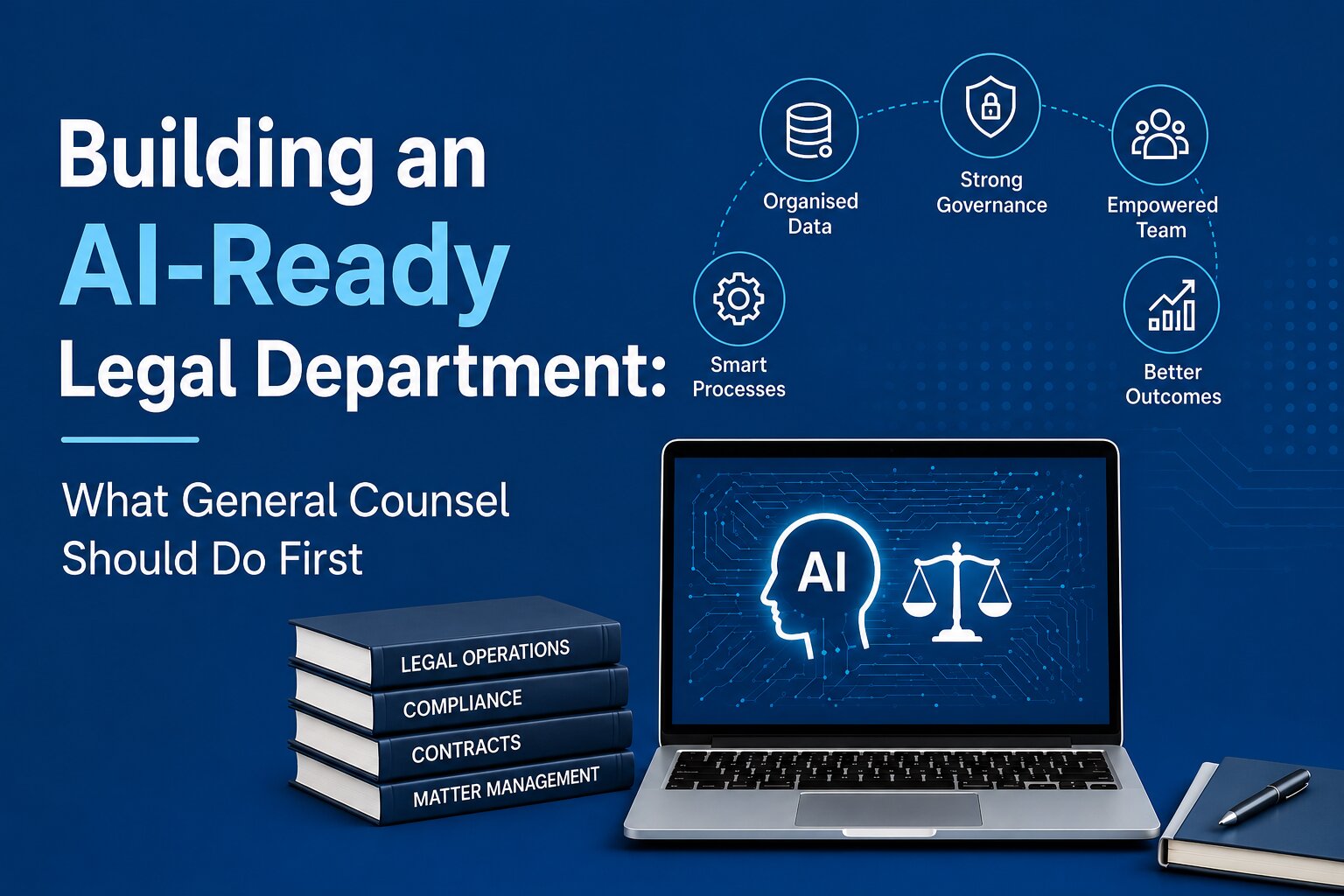
Artificial intelligence (AI) is no longer a future concept for corporate legal teams. It is becoming an essential part of how legal departments manage growing workloads, reduce manual tasks, and deliver faster support to the business. As organisations expand, legal teams are expected to review more contracts, manage more legal matters, ensure compliance with changing regulations, and provide strategic advice without significantly increasing headcount.
For many General Counsel, the biggest question is not whether AI should be adopted but where to begin. Investing in AI tools without preparing the legal department often leads to poor results. Successful AI adoption starts with organised processes, reliable data, and a clear strategy.
This guide explains the first steps General Counsel should take to build an AI-ready legal department and create a strong foundation for long-term success.
Why Every Legal Department Needs an AI Strategy
Legal departments have changed significantly over the past few years. Businesses expect faster contract reviews, quicker legal advice, better compliance reporting, and greater visibility into legal risks. At the same time, regulations continue to evolve, making legal work more complex.
Traditional ways of working, such as tracking matters in spreadsheets, searching through email chains, or storing contracts in multiple folders, can slow productivity and increase the risk of mistakes.
An AI strategy helps legal teams prepare for these challenges. Rather than treating AI as another software purchase, General Counsel should view it as part of a broader digital transformation. A well-planned strategy ensures that AI supports legal professionals by reducing repetitive work while allowing lawyers to focus on negotiation, risk assessment, and strategic decision-making.
Organisations that begin preparing today will be better positioned to take advantage of future AI capabilities without disrupting daily operations.
Step 1: Assess Your Current Legal Operations
The first step towards becoming AI-ready is understanding how your legal department currently works.
Before introducing any AI solution, review the existing workflows from start to finish. Look at how legal requests are received, how matters are assigned, how contracts move through approvals, and how documents are stored.
Many legal teams still rely on manual processes that consume valuable time. For example, lawyers may receive requests through emails, track deadlines in spreadsheets, or search multiple folders to locate the latest version of a contract. These tasks are repetitive and often create unnecessary delays.
One of the quickest ways to modernise legal operations is by replacing scattered email requests with a structured legal intake process. AI-powered legal intake automatically captures, categorises, and routes requests to the right people, giving legal teams better visibility and reducing administrative work. Learn more in our guide on AI-Powered Legal Intake: Why General Counsel Are Replacing Email-Based Request Management, which explains how AI is transforming the way in-house legal teams receive, prioritise, and manage legal requests.
Mapping your current processes helps identify bottlenecks and opportunities for improvement. It also reveals where automation and AI can provide the greatest value.
Questions General Counsel should ask include:
- Which legal tasks consume the most time?
- Where do delays regularly occur?
- Are legal documents stored in a central location?
- Can matter status be viewed easily?
- How much manual reporting is required each month?
A clear understanding of existing operations makes future AI implementation far more effective.
Step 2: Identify High-Impact AI Use Cases
Not every legal process needs AI immediately. The best approach is to start with areas that deliver measurable improvements while carrying relatively low implementation risk.
Matter management is often one of the easiest places to begin. AI can help categorise legal matters, assign tasks to the right team members, monitor deadlines, and prioritise urgent work.
Contract management is another high-value opportunity. AI-assisted tools can identify important clauses, highlight potential risks, compare contract versions, and speed up contract reviews without replacing legal judgement.
Legal research also benefits from AI. Instead of spending hours searching through previous advice, policies, or internal knowledge bases, lawyers can quickly retrieve relevant information and previous work.
Compliance management is another area where AI adds value. It can monitor regulatory changes, generate alerts, organise policy documentation, and help legal teams maintain audit readiness.
Reporting is equally important. AI can assist in creating dashboards that provide management with insights into workload, matter progress, contract status, and legal performance metrics.
Starting with a few practical use cases allows legal departments to build confidence before expanding AI across additional functions.
While contract review is often the first AI application organisations explore, it is only one part of a much larger opportunity. AI is also transforming legal intake, matter management, compliance monitoring, legal research, document management, reporting, and knowledge management. To discover how corporate legal teams are applying AI across their entire legal function, read our guide on Beyond Contract Review: AI Use Cases for Corporate Legal Teams.
Step 3: Build Clean and Organised Legal Data
AI performs best when it works with accurate, organised, and structured information. If contracts, legal matters, and documents are scattered across different systems, AI cannot deliver reliable results.
For this reason, data preparation should be a priority before introducing advanced AI capabilities.
Legal departments should centralise documents, remove duplicate records, standardise file naming conventions, and organise contracts according to consistent categories. Metadata, such as contract type, client name, renewal date, and legal owner, should also be captured wherever possible.
Version control is equally important. Working from outdated contract versions or incomplete legal files can create unnecessary legal and business risks.
Clean data not only improves AI performance but also makes everyday legal work faster and more efficient. Lawyers spend less time searching for information and more time providing valuable legal advice.
Building a reliable legal knowledge base today creates a stronger foundation for future AI applications.
Step 4: Strengthen AI Governance Before Deployment
AI adoption should always be supported by clear governance.
Legal departments manage confidential business information, sensitive contracts, intellectual property, and privileged communications. Protecting this information remains a top priority even when AI becomes part of daily operations. General Counsel should establish policies that define how AI can be used within the legal department. These policies should cover data privacy, user permissions, document security, and human review requirements.
AI should assist lawyers rather than replace their professional judgement. Important legal decisions, contract approvals, litigation strategies, and regulatory advice should always involve qualified legal professionals.
Vendor evaluation also plays an important role. Before implementing any AI-enabled legal solution, organisations should review security certifications, compliance standards, data storage practices, integration capabilities, and long-term vendor support. Evaluating legal technology goes beyond comparing features—it requires understanding how well a solution fits your legal workflows, compliance requirements, and future AI strategy. For a practical framework, read our guide on The General Counsel's Playbook for Evaluating Legal Tech Vendors, which outlines the key criteria every General Counsel should consider before selecting a legal technology partner.
Preparing documentation before regulators request it is just as important as selecting the right AI technology. Legal teams should maintain clear records of AI policies, approval workflows, risk assessments, audit trails, and governance decisions to demonstrate compliance when needed. If you want a practical checklist, read our guide on AI Audit Readiness: What Legal Teams Should Document Before Regulators Ask, which explains the key documents every legal department should have in place before a regulatory review.
Strong governance builds confidence across the organisation and supports responsible AI adoption.
Step 5: Prepare Your Legal Team for AI Adoption
Technology alone does not create successful transformation. People play an equally important role.
Some legal professionals may worry that AI will replace their jobs. In reality, AI is designed to reduce repetitive administrative work, allowing lawyers to spend more time on complex legal analysis, client relationships, negotiations, and strategic planning.
General Counsel should communicate this clearly from the beginning.
Training programmes help legal teams understand how AI works, what it can and cannot do, and where human expertise remains essential.
It is also helpful to identify internal AI champions who encourage adoption, answer questions, and share successful use cases with colleagues.
Small pilot projects often produce better results than organisation-wide deployments. As employees become familiar with AI tools and experience measurable productivity improvements, adoption naturally increases.
An AI-ready legal department is built through continuous learning rather than a single software implementation.
Common Challenges General Counsel Should Expect
Every digital transformation brings challenges, and AI adoption is no exception.
One common obstacle is resistance to change. Lawyers who have followed the same processes for years may hesitate to adopt new technologies. Clear communication and practical training can reduce these concerns.
Poor data quality is another challenge. If legal information is incomplete or inconsistent, AI recommendations become less reliable. Investing time in data preparation delivers long-term benefits.
Integration with existing business systems may also require careful planning. Legal software should connect smoothly with document management platforms, email systems, finance applications, and other business tools.
Budget limitations can also affect implementation. Instead of trying to automate everything at once, organisations should prioritise projects that deliver measurable operational improvements.
Finally, unrealistic expectations should be avoided. AI is a powerful assistant, but it is not a replacement for legal expertise. Success comes from combining intelligent technology with experienced legal professionals.
How to Measure AI Readiness
Before investing further in AI, General Counsel should evaluate whether their legal department has the right foundation in place.
An AI-ready legal department typically demonstrates several characteristics:
- Legal documents are stored in a central, secure repository.
- Matter management follows consistent workflows.
- Contract information is organised and searchable.
- Data quality is regularly maintained.
- AI governance policies have been established.
- Staff receive ongoing AI training.
- Leadership actively supports digital transformation.
- Performance metrics are tracked through dashboards and reports.
The stronger these foundations become, the easier it is to expand AI capabilities in the future.
How Beveron Smart Legal Counsel Helps Build an AI-Ready Legal Department
Preparing for AI begins with creating a modern, organised legal environment. Beveron Smart Legal Counsel is designed to help in-house legal departments achieve exactly that.
The platform centralises legal matters, contracts, documents, and workflows into one secure system, reducing reliance on spreadsheets, email chains, and disconnected storage locations.
Its matter management capabilities provide complete visibility into ongoing legal work, helping teams monitor deadlines, assign responsibilities, and track progress from initiation to completion.
For contract management, Smart Legal Counsel offers a central repository where legal teams can securely store agreements, organise documents, manage approvals, and quickly retrieve information whenever needed. Having structured contract data also creates a stronger foundation for future AI-powered contract analysis.
Workflow automation further improves efficiency by automatically routing approvals, assigning tasks, sending reminders, and reducing repetitive administrative work. This allows lawyers to spend more time on legal strategy instead of routine coordination.
The platform also supports compliance through audit trails, document history, policy management, and secure record keeping. These capabilities help organisations maintain governance while improving transparency across legal operations.
Executive dashboards provide valuable insights into legal workloads, matter status, contract performance, and key operational metrics. General Counsel can use this information to make better decisions and identify opportunities for continuous improvement.
By creating organised legal data, standardised processes, and better operational visibility, Beveron Smart Legal Counsel helps organisations establish the digital foundation required for successful AI adoption today and future AI innovations tomorrow.
The Future of AI-Driven Corporate Legal Departments
AI will continue transforming legal operations over the coming years. Future legal departments are likely to benefit from intelligent assistants that support contract drafting, legal research, document summarisation, compliance monitoring, and predictive analytics.
However, the role of lawyers will remain critical.
Legal expertise, ethical judgement, negotiation skills, and strategic business advice cannot be replaced by technology. Instead, AI will handle repetitive and time-consuming tasks while lawyers focus on higher-value work that requires experience and critical thinking.
General Counsel who begin preparing now will be better equipped to take advantage of these emerging capabilities while maintaining strong governance, security, and legal quality.
Conclusion
Building an AI-ready legal department is not about purchasing the latest technology. It starts with improving legal operations, organising data, strengthening governance, and preparing people for change.
By assessing current workflows, identifying practical AI use cases, improving data quality, establishing responsible AI policies, and investing in employee training, General Counsel can create a legal department that is ready for both today's challenges and tomorrow's opportunities.
Platforms like Beveron Smart Legal Counsel support this journey by centralising legal operations, automating routine workflows, improving visibility, and creating the structured digital environment that AI depends on. With the right foundation in place, legal departments can confidently embrace AI while continuing to deliver trusted legal expertise, stronger compliance, and greater value to the business.
Ready to Build an AI-Ready Legal Department?
The future of legal operations starts with a strong digital foundation. If you're looking to streamline matter management, centralise legal documents, automate workflows, and prepare your legal team for AI adoption, Beveron Smart Legal Counsel can help.
Book a free demo today to see how Beveron Smart Legal Counsel empowers General Counsel and in-house legal teams with smarter legal operations, greater visibility, and the confidence to embrace AI—securely and efficiently.
Start your AI transformation with Beveron Smart Legal Counsel today.
Best AI for legal department software in the UAE
Best AI for In-house legal department software in the UAE
Best AI legal operations software in the UAE
If you need a free demo of the best in-house legal department software in the UAE, please fill out the form below.