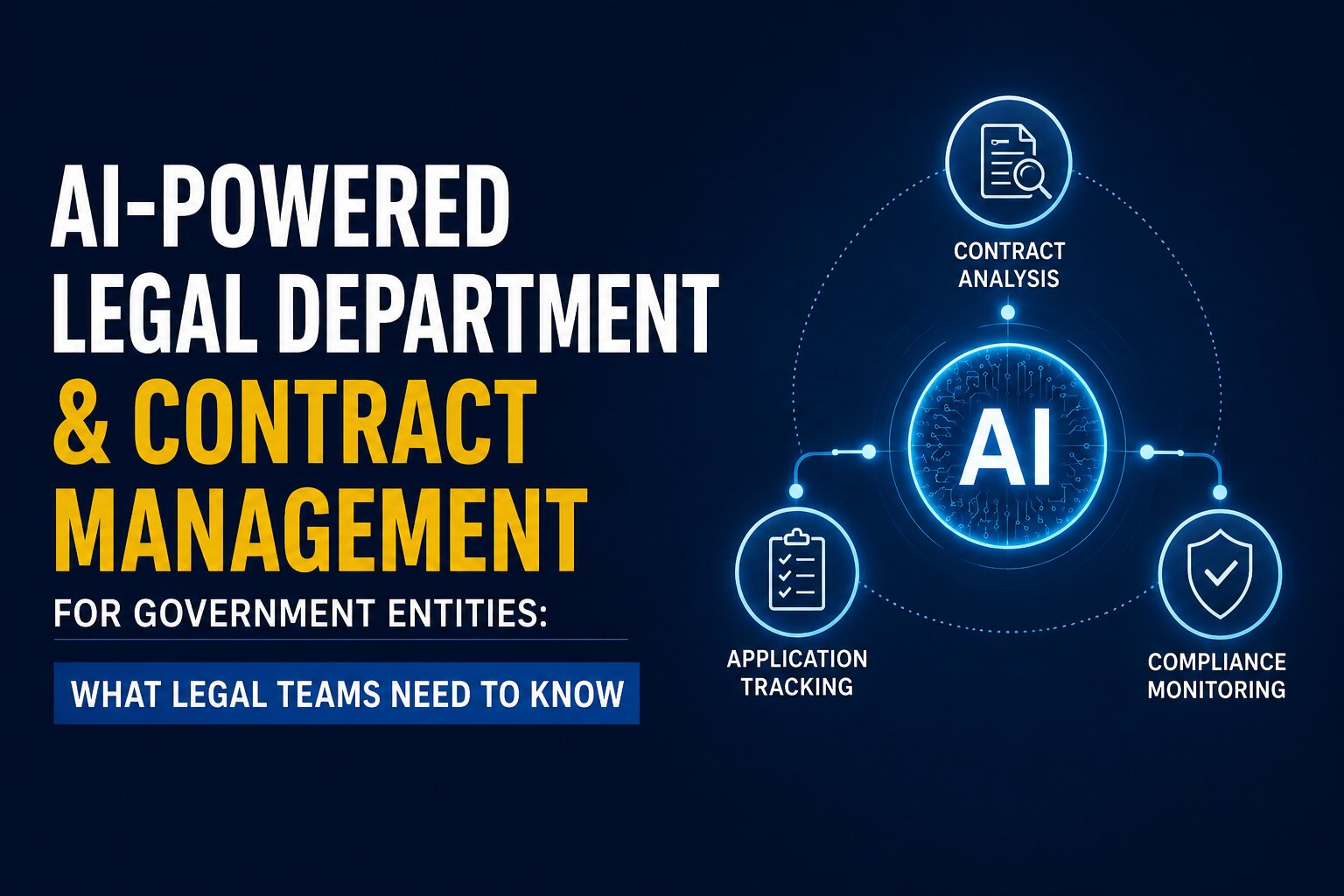
AI-Powered Legal Department & Contract Management for Government Entities: What Legal Teams Need to Know
Government legal departments deal with a level of complexity that is difficult to manage through disconnected tools and manual processes. Contracts move between departments, legal requests arrive from different teams, approvals involve multiple stakeholders, and important obligations can remain active for years. At the same time, legal teams are expected to respond faster, provide stronger oversight and manage growing volumes of information without compromising governance or accountability.
This is where AI-powered legal department and contract management is becoming relevant. The opportunity is not simply to add an AI chatbot to the legal function. It is to use AI within structured legal workflows so teams can find information faster, monitor obligations, automate repetitive activities and make better use of their time.
For government entities considering this shift, the important question is not whether AI is available. It is how AI can be introduced responsibly and where it can create practical value.
Why Government Legal Work Is Becoming Harder to Manage
The legal department of a government entity rarely works on one type of matter. A team may be managing procurement agreements, service contracts, employment-related matters, disputes, regulatory issues, memoranda, amendments, vendor agreements and internal legal requests at the same time. Each document or matter can also involve several actions. Someone may need to review a clause, obtain an approval, respond to a department, monitor an obligation or prepare for a renewal.
When these activities are managed through spreadsheets, email threads, shared folders and separate document repositories, the difficulty is not necessarily finding a particular document. The bigger challenge is understanding what needs to happen next. For example, knowing that a contract exists is useful. Knowing that it expires in 60 days, contains a notice requirement, has an outstanding obligation and requires approval from another department is much more valuable.
This distinction is important. Modern legal operations are moving from simply storing legal information towards making that information usable.
Why Government Legal Departments Need a Different Approach
Government legal teams have many of the same operational challenges as corporate legal departments, but the surrounding environment can be more complex. Contracts and legal matters may involve multiple departments, approval levels and external parties. Legal information can also be highly sensitive, while government organisations often need clear records of who reviewed, approved or acted on something. That makes visibility and traceability particularly important.
A legal technology platform used in this environment therefore needs to do more than provide document storage. It should support controlled access, structured workflows, auditability, reporting and clear ownership. The same applies to AI. An AI tool that produces a useful answer but cannot work within the organisation's permissions, workflows and governance model may have limited practical value.
For government legal teams, the more useful model is: AI + structured legal data + defined workflows + governance + human oversight.
The Challenges Look Different Depending on the Role
One reason legal technology projects sometimes fall short is that the legal department is treated as one user group. In reality, different roles need different outcomes.
General Counsel and Heads of Legal
For senior legal leaders, the challenge is often visibility. They may need to understand the department's workload, identify delayed matters, monitor important contracts and report on legal activity without spending hours collecting information from different systems. An AI-powered legal platform can help bring this information into a more structured view, allowing leaders to focus on exceptions, priorities and decisions rather than manual reporting.
Contract Managers
Contract managers face a different problem. Their work does not end when an agreement is signed. They may need to track renewal dates, obligations, amendments, approvals, responsible stakeholders and important contractual information throughout the agreement's lifecycle. AI can help identify and organise information within contracts, while automated workflows can help ensure important dates and actions are not dependent on someone's spreadsheet or personal calendar.
Legal Operations Teams
Legal operations teams often sit between legal professionals and the wider organisation. They may manage legal requests, allocate work, monitor deadlines, coordinate processes and prepare reports. For them, workflow automation can be particularly valuable. Instead of relying on emails to determine who owns a request or whether something has been completed, structured workflows can provide a clearer process from intake through to completion.
Compliance and Governance Teams
Compliance teams need evidence as well as information. They may need to know whether an obligation has been completed, who was responsible for an action and when it was performed. AI-assisted monitoring can help surface exceptions and overdue activities, while structured records and audit trails provide the underlying evidence needed for governance.
Internal Departments and Business Stakeholders
Government departments that submit legal requests also benefit from greater transparency. A structured legal request process can show whether a request has been received, who is handling it and what stage it has reached. This can reduce unnecessary follow-ups and make collaboration between legal and operational teams more predictable.
Where AI Can Actually Help Government Legal Teams
The value of AI becomes clearer when it is connected to specific legal workflows. The value of AI becomes clearer when it is connected to specific legal workflows. AI-powered legal operations and contract intelligence are increasingly being used to support activities such as legal intake, workload management, contract analysis, predictive insights and lifecycle management. Consider contract review. A lawyer may spend considerable time searching an agreement for renewal provisions, obligations, termination language or other relevant clauses. AI can help identify and surface this information for review.
The lawyer still decides what the clause means and what action should be taken. The technology simply reduces some of the manual searching involved. The same principle can apply across other activities.
Contract Management
AI can assist with:
- Identifying important clauses and contractual information
- Summarising lengthy agreements
- Extracting obligations and key dates
- Supporting contract search
- Highlighting potential exceptions for review
- Helping teams locate relevant information quickly
Legal Request Management
AI-enabled workflows can support:
- Request categorisation
- Routing
- Task creation
- Prioritisation
- Deadline tracking
- Notifications
- Status reporting
Compliance Monitoring
AI can help legal and compliance teams identify exceptions, monitor recurring obligations and bring overdue activities to the attention of the appropriate person. The important point is that AI should support defined processes rather than operate as an uncontrolled decision-maker.
For government legal work, human review remains essential where legal judgement, interpretation or formal approval is required.
What This Looks Like in Practice
The most useful way to understand AI-powered legal management is through everyday scenarios. A Beveron case study on next-generation CLM and automation illustrates how these principles can be applied to fragmented contract storage, approval workflows, obligation tracking and legal reporting.
1. Managing Contract Renewals
Imagine a government entity has hundreds or thousands of active agreements. Without a centralised system, renewal information may be spread across documents, spreadsheets and email reminders. A structured contract management system can bring renewal dates into one view. AI can assist in identifying relevant dates and contractual information, while workflows can notify the appropriate stakeholders as action becomes necessary.
The result is not "AI managing contracts on its own". It is a more reliable process for ensuring people know what requires attention.
2. Finding Information During Contract Review
A legal professional may need to answer a question about an agreement quickly. Instead of manually opening multiple documents and searching through long contracts, AI-assisted search can help locate relevant clauses or information.
The lawyer can then verify the result against the original agreement before deciding.
3. Routing Legal Requests
A procurement team may submit a new contract for legal review. Rather than letting the request disappear into an email inbox, a structured workflow can capture the request, collect relevant information, assign it to the right person, and track its progress. AI can support classification or routing where appropriate, while the legal team retains control over the actual review.
4. Managing Approvals
Government contracts may require several levels of review and approval. A workflow can define who needs to review the document, what happens after each approval and what remains outstanding. This creates a clearer audit trail and reduces reliance on manual follow-ups.
5. Monitoring Obligations
A contract may contain several obligations that continue after signing. AI can help identify those obligations, while workflow automation can associate actions with responsible users and monitor their status.
This turns contract management from a repository function into an ongoing operational process.
How Beveron Smart Legal Counsel Supports Government Legal Teams
For government legal teams looking to bring these activities into a more structured environment, Beveron Smart Legal Counsel provides a platform approach to legal and contract management. Rather than treating AI as a separate tool, the platform brings legal matters, contracts, workflows and operational information into a connected environment.
For contract management, this can support the lifecycle from creation and review through approval, storage, renewal and ongoing monitoring.
For legal operations, structured workflows can help teams manage requests, tasks, deadlines and approvals.
AI capabilities can assist with activities such as document analysis, information retrieval and workflow support, while legal professionals remain responsible for reviewing outputs and making decisions that require professional judgement. This distinction matters in government environments. The goal is not to remove human accountability from legal processes. It is to give legal teams better tools for managing the information and repetitive work surrounding those decisions.
How Government Legal Teams Should Approach Implementation
Introducing AI across an entire legal department at once may sound attractive, but it can make adoption harder. A more practical approach is to start with clearly defined processes.
Step 1: Map the Existing Workflow
Before selecting technology, understand how legal work currently moves through the organisation. Identify where requests originate, where contracts are stored, who reviews them, how approvals happen and where delays or duplicated work occur.
This creates a baseline for deciding what actually needs to change. It also helps legal leaders determine whether they need contract lifecycle management, workflow automation, AI-assisted document analysis, matter management or a combination of these capabilities. A structured legal technology strategy and implementation approach can help organisations assess their current processes, select appropriate technology and plan adoption across the legal function.
Step 2: Select High-Value Use Cases
Not every legal activity needs AI. Start with processes where the combination of automation and AI assistance can provide a clear operational benefit. Contract search, renewal tracking, obligation monitoring, legal request management and document review assistance are examples worth evaluating.
Step 3: Establish Governance
AI adoption should be accompanied by clear rules.
Government legal teams should define:
- Who can access AI-enabled features
- What information can be processed
- Which activities require human approval
- How AI-generated outputs are reviewed
- How actions are recorded
- How exceptions and errors are handled
Step 4: Connect With Existing Systems
Legal technology should not create another isolated information source. Where appropriate, organisations should consider integration with existing document management, ERP, CRM and productivity environments. The objective is to make legal information easier to work with, not create another layer of fragmentation.
Step 5: Measure Before and After
AI adoption should have measurable objectives. Useful indicators may include contract turnaround time, legal request response time, approval cycle time, time spent searching documents, overdue obligations and workload distribution.
These measurements make it easier to determine whether a technology investment is actually improving legal operations.
What Should Government Legal Teams Look for in an AI-Powered Platform?
Choosing a platform requires looking beyond the word "AI".
AI Capabilities
Ask what the AI can actually do.
Can it analyse documents?
Can it identify relevant information?
Can it support workflows?
Can users review and validate its outputs?
The answers matter more than the presence of an AI label.
Contract Lifecycle Management
The platform should support the full contract lifecycle rather than focusing only on storage. Look for capabilities such as contract creation, review, approval, version management, renewal tracking, obligation monitoring and audit trails.
Legal Operations
Evaluate whether the platform can support legal requests, matters, tasks, deadlines, work allocation and reporting.
Security and Governance
For government entities, this area deserves particular attention. Consider access controls, auditability, data protection, deployment options, AI governance and the ability to maintain human oversight.
Integration
A legal platform should fit into the organisation's broader technology environment. Integration can be particularly important where legal information is connected to procurement, finance, HR, document management or other operational systems.
Scalability
Finally, consider whether the platform can grow with the organisation. A system that works for one legal team should also be able to support additional departments, users, contract volumes and workflows as adoption expands.
Building the Business Case for AI-Powered Legal Management
The business case for AI should not rely on vague promises of "transforming legal". The more useful question is: what changes operationally?
A well-designed legal technology environment can reduce repetitive administrative work, make contract information easier to find and improve visibility into deadlines and obligations. It can also create greater accountability by showing who owns a task, where a matter stands and what actions remain outstanding.
For legal leadership, structured data can make reporting easier and provide a clearer view of workload and operational performance. Over time, these improvements can allow legal professionals to spend less time chasing information and managing routine administration and more time on activities that require legal expertise, judgement and strategic input. The value therefore comes from the combination of AI, automation, structured information and human expertise.
The Strategic Shift: From Legal Administration to Legal Operations
For government entities, AI-powered legal management should not be viewed as a race to automate every legal activity. The more meaningful opportunity is to build a legal operating environment where information is organised, workflows are visible, routine actions can be automated and AI can assist professionals with information-intensive tasks. That requires more than an AI tool.
It requires reliable legal data, defined processes, appropriate access controls, governance, integration and people who understand where human judgement must remain central. This is why the future of government legal technology is likely to be less about replacing legal professionals and more about improving the environment in which they work.
Beveron Smart Legal Counsel can support this shift by bringing legal department management, contract lifecycle processes, workflows, reporting and AI-assisted capabilities into a more connected environment.
For government legal teams, the real question is not simply whether AI can be added to legal work. It is whether AI can be introduced in a way that makes legal operations more visible, controlled, accountable and useful to the organisation as a whole.
Explore AI-Powered Legal Management with Beveron
Government legal teams need more than isolated AI tools. They need a connected environment where contracts, legal matters, workflows, approvals and compliance activities can be managed with greater visibility and control.
Beveron Smart Legal Counsel brings legal department management, contract lifecycle management, workflow automation and AI-assisted capabilities together in one platform—helping legal teams move from fragmented processes towards more structured and proactive legal operations.
Explore Beveron Smart Legal Counsel and see how AI-powered legal management can support your organisation.
Best AI-powered legal department & contract management for UAE government entities
Best AI-powered legal department & contract management for Dubai government entities
Best AI-powered legal department & contract management for Saudi Arabia government entities
Best AI-powered legal department & contract management for Qatar government entities
Best AI-powered legal department & contract management for Kuwait government entities
If you need a free demo on the best AI-powered legal department & contract management for UAE government entities, please fill out the form.