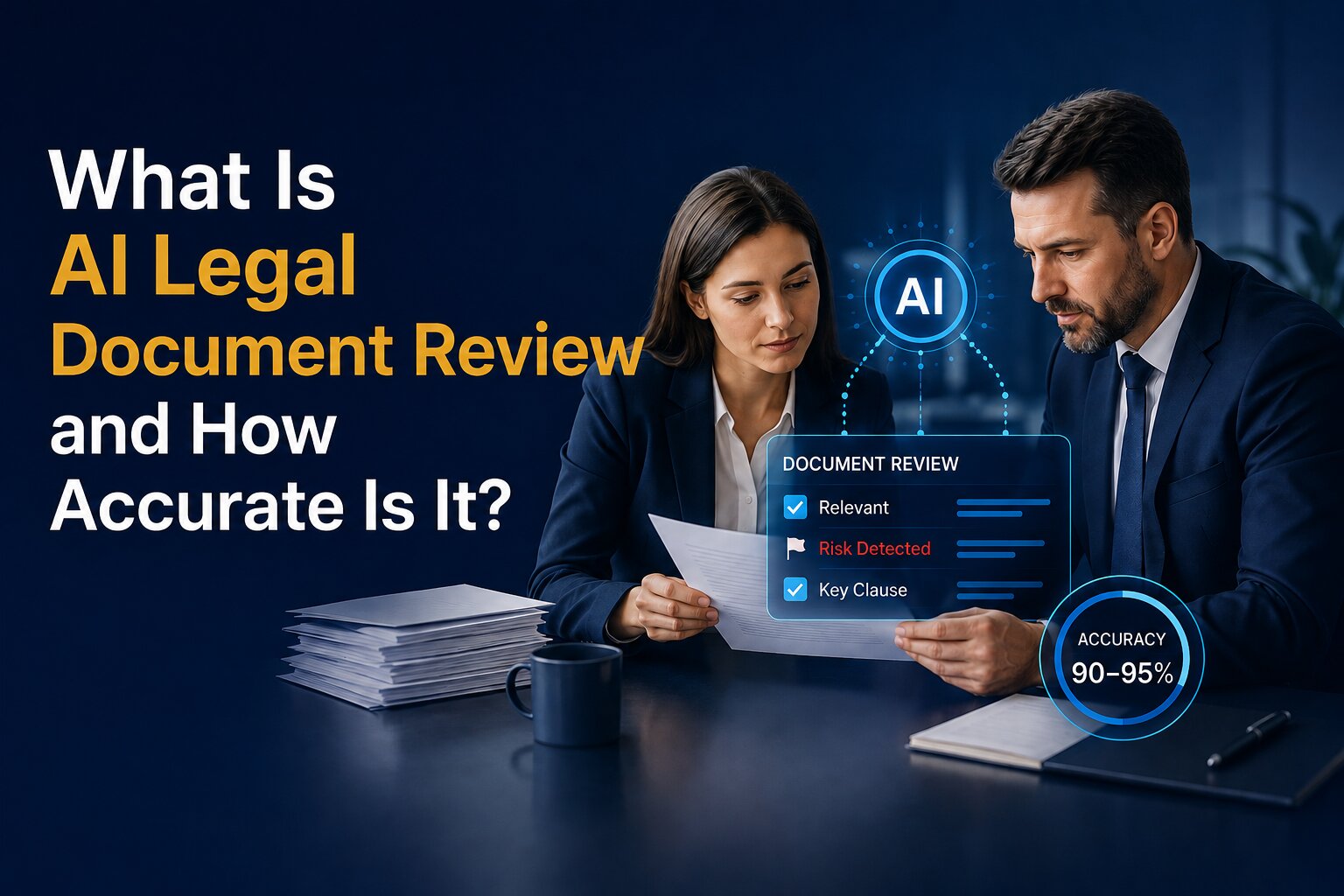
What Is AI Legal Document Review and How Accurate Is It?
Legal teams rarely struggle because they have too few documents to review. The challenge is usually the opposite. Contracts, amendments, NDAs, employment agreements, regulatory documents and case files can quickly add up, especially when several matters are moving at the same time. AI legal document review is increasingly being used to help manage this workload. Instead of relying entirely on a lawyer to read every document from beginning to end, AI can assist with finding clauses, extracting information, comparing language and flagging provisions that may need closer attention.
But speed is only part of the conversation. The more important question is accuracy.
Can AI reliably identify important provisions? What happens when a contract contains unusual language? How well does it handle Arabic and English documents? And where should a lawyer remain involved?
The answer depends on the technology, the documents, the review task and the way the system is used.
AI legal document review is the use of artificial intelligence to analyse legal documents, identify relevant information, compare clauses, extract data and flag potential issues for further human review.
What Is AI Legal Document Review?
AI legal document review refers to using artificial intelligence to assist with analysing the contents of legal documents. In a traditional review, a lawyer or legal professional reads through a document, identifies important provisions, checks them against a preferred position or playbook, and records anything that needs further attention. This remains essential for matters that require legal judgement. AI can support parts of this process by processing large volumes of text and identifying patterns or information based on defined instructions.
For example, a legal team reviewing a set of commercial contracts may want to find:
- Termination clauses
- Governing law provisions
- Liability and indemnity clauses
- Renewal and expiry dates
- Change-of-control provisions
- Data protection obligations
- Assignment restrictions
A conventional keyword search can find a particular word or phrase. AI-assisted review can go further by considering the context in which information appears and helping classify or compare provisions. That distinction matters. A clause does not always use the same wording from one contract to another. A well-designed review system therefore needs to look beyond exact keyword matches. The technology is particularly useful when the same type of review has to be repeated across dozens, hundreds or even thousands of documents.
How Does AI Legal Document Review Work?
The exact technology varies between tools, but the general process is relatively straightforward from a user's perspective. Legal teams can also extend this workflow beyond document analysis by automating document reviews, approvals, and other routine legal processes.
Understanding Legal Language
AI systems can process the text within a document and identify relationships between words, phrases and sections. Modern AI systems can work with language in a more contextual way than traditional keyword-based searches. This can help when two clauses express a similar idea using different wording. However, understanding language is not the same as understanding every legal or commercial implication. The quality of the result still depends on the system, the task and the context available to it.
Identifying and Classifying Clauses
The system can be configured to look for particular types of provisions. For example, a review may identify all termination clauses in a contract collection and organise them according to factors such as notice periods or termination rights. This can give lawyers a structured starting point instead of requiring them to locate every relevant provision manually.
Comparing Documents With Standards and Playbooks
Many legal teams have internal standards for reviewing contracts. A playbook might specify a preferred liability position, an acceptable payment period or language that requires escalation. AI-assisted tools can help compare contract language against these standards and highlight deviations. The important point is that a deviation is not automatically a legal problem. It is a reason for someone to look more closely.
Flagging Potential Risks for Review
Once the system identifies relevant provisions or differences, it can flag them for attention. This might include missing clauses, unusual wording, provisions that fall outside a company's preferred position or information that requires follow-up. The purpose is to reduce the amount of time spent searching for issues manually. The lawyer still needs to decide what the finding actually means in the context of the transaction or matter.
Human Review and Approval
This is where a practical AI review workflow differs from the idea of simply handing a contract to an AI system and accepting whatever it produces. A more appropriate process is:
Upload → Analyse → Flag → Lawyer Review → Approve
The AI handles parts of the first-pass work. A legal professional reviews the findings, considers the wider context and makes the final decision. This human-AI relationship is consistent with broader guidance on trustworthy AI. NIST's AI Risk Management Framework emphasises the importance of defining human roles and responsibilities and documenting human oversight where it is appropriate for the use case.
Where Is AI Legal Document Review Used?
AI-assisted review can be useful across several areas of legal work.
Contract Review and Redlining
Legal teams can use AI to identify clauses that need attention before a lawyer begins detailed review. It can also help compare language with approved templates or internal positions. This does not remove the need for redlining or negotiation. It can simply give the lawyer a more organised starting point.
Due Diligence
Due diligence can involve reviewing large collections of contracts and other documents within a limited timeframe. AI can help identify documents and provisions relevant to issues such as change of control, termination rights, liabilities, obligations and unusual contractual terms.
Compliance and Regulatory Review
Organisations may also use AI-assisted review to check documents against internal policies or defined compliance requirements. The value is particularly clear when the same type of check needs to be performed repeatedly across a large document collection.
Litigation Document Review
Litigation can generate substantial volumes of documents. AI can help categorise and locate potentially relevant information, allowing legal teams to focus their attention on documents that warrant closer examination.
Contract Portfolio Reviews
Reviewing an existing contract portfolio is another practical use case. Rather than waiting for a contract to become relevant during a renewal or dispute, organisations can analyse their agreements to identify important dates, obligations, clauses and potential gaps.
How Accurate Is AI Legal Document Review?
There is no single accuracy percentage that applies to every AI legal document review system. That is one of the most important points to understand before evaluating the technology. Accuracy depends on what the system is being asked to do, what documents it is analysing, how the task is defined, and how the results are evaluated. Recent legal AI benchmarking work has tested systems on real-world legal data extraction tasks rather than relying only on general AI demonstrations. That distinction is important because performance on a controlled example does not necessarily tell a legal team how a system will perform on its own documents.
What Does “Accuracy” Actually Mean?
Accuracy can be measured in several ways.
Precision asks: when the system flags something, how often is that finding actually relevant?
Recall asks: how many of the relevant items did the system successfully identify?
These two measures matter because a system can produce many correct findings while still missing important ones. There are also false positives and false negatives. A false positive occurs when the system flags something that does not actually require attention. A false negative is potentially more serious: an important provision exists, but the system fails to identify it.
For legal teams, consistency also matters. If similar documents are reviewed under the same criteria, the system should produce reasonably consistent results.
What Research and Benchmarks Tell Us
Research into AI used for legal work continues to show that performance varies considerably depending on the task and system. For example, a 2025 peer-reviewed study examining leading AI legal research tools found that large language model-based systems can still produce inaccurate or unsupported outputs, highlighting the risks of relying on AI without appropriate verification in high-stakes legal work.
This does not mean AI cannot be useful for document review. It means legal teams should be careful about what they are measuring. A vendor saying that a system is “highly accurate” is less useful than seeing how that system performs on your own contracts, against clearly defined review criteria.
Where AI Can Perform Strongly
AI-assisted review can be particularly useful for repetitive tasks involving large volumes of relatively structured information.
Examples include:
- Finding specified clause types
- Extracting recurring information
- Comparing similar provisions
- Identifying differences between documents
- Organising large document collections
- Performing consistent first-pass checks
The advantage is often less about replacing expertise and more about helping experienced professionals spend their time where their judgement adds the most value.
Where AI Can Struggle
Legal documents are not always predictable. A clause may look similar to a standard provision but have a different effect because of surrounding language. An unusual negotiated provision may also require commercial knowledge that is not obvious from the text alone.
AI can therefore face challenges with:
- Ambiguous language
- Unusual or heavily negotiated clauses
- Context-dependent interpretation
- Complex commercial relationships
- Jurisdiction-specific legal meaning
- Poor-quality scanned documents
- Incomplete document sets
This is why an AI-generated finding should generally be treated as something to assess, rather than as a final legal conclusion.
What Affects the Accuracy of AI Legal Document Review?
Several factors can influence how well an AI review system performs.
Document Quality
A clean, digitally created document is easier to analyse than a poorly scanned PDF. OCR, or optical character recognition, is the process used to turn text in an image or scan into machine-readable text. If the original document is unclear, errors can enter the process before the AI even begins analysing the language.
Training and Model Quality
Different AI systems are trained and configured differently. Their performance can vary depending on the type of legal language and tasks they were designed to handle. Legal teams should therefore ask vendors for evidence that is relevant to their actual use case rather than relying only on broad claims about AI capabilities.
Jurisdiction and Language
Legal language differs across jurisdictions. This becomes especially relevant for organisations working across the GCC, where contracts may be drafted in English, Arabic or both. A system that performs well on English-language contracts should not automatically be assumed to perform equally well on Arabic documents. Testing with real documents is a better way to establish whether the system meets the team's needs.
Customisation
A review based on a company's own playbook can be more useful than a generic review. For example, one organisation may accept a particular liability position while another may require every deviation to be escalated. The ability to define these internal preferences can therefore affect how useful the output is to the legal team.
Ongoing Evaluation
AI systems and workflows change over time. Legal teams should not treat an initial successful test as permanent proof of performance. Regular testing, feedback and monitoring can help identify where the system is working well and where additional controls are needed.
NIST's AI Risk Management Framework similarly treats AI risk management as an ongoing process involving governance, measurement and management rather than a one-time assessment.
AI Legal Document Review in the GCC: What Should Legal Teams Consider?
The technology has particular considerations for legal teams working in the UAE and Saudi Arabia.
Bilingual Legal Documents
Many organisations in the region work with both Arabic and English documentation. Some agreements may even contain both languages within the same document. This makes language support an important evaluation criterion. Rather than asking whether a tool “supports Arabic” as a simple yes-or-no question, legal teams should test how it handles their actual contracts, including terminology, clause structures and mixed-language documents.
UAE and Saudi Legal Context
A system's ability to process text does not automatically mean that it understands every legal implication within a particular jurisdiction. Legal teams should consider whether the tool and its workflow are appropriate for the laws, contractual practices and business environment in which they operate. Specialised provisions may also require additional human review, particularly where their interpretation depends on wider legal or commercial context.
Data Protection and Confidentiality
Legal documents can contain highly sensitive information, including personal data, commercially confidential terms and privileged communications. In the UAE, the Federal Decree-Law No. 45 of 2021 on the Protection of Personal Data establishes a framework governing personal data processing and includes requirements around confidentiality and protection.
Saudi Arabia's Personal Data Protection Law similarly forms the core of the Kingdom's personal data protection framework, with implementing regulations and rules concerning areas such as transfers outside the Kingdom.
For legal teams, this means security should not be treated as an afterthought. Before uploading sensitive documents to an AI system, organisations should understand where information is processed and stored, who can access it, how it is protected, and what happens to the data after processing.
Auditability and Accountability
Legal teams should also be able to understand what happened during a review.
Who reviewed the document?
What did the AI flag?
What did the lawyer change?
Which issues were accepted or rejected?
Clear records can make AI-assisted workflows easier to monitor and govern.
Why Human Oversight Still Matters
AI can read and process documents quickly, but legal review is not simply a reading exercise. A lawyer may need to understand the commercial relationship between the parties, the purpose of a transaction, previous negotiations, the client's risk tolerance and the consequences of accepting a particular clause.
That context can change how a provision should be interpreted.
Human oversight also creates a clear point of accountability. NIST's guidance specifically notes that organisations should define human roles and responsibilities when using AI systems and consider the loss of context that can occur when complex human judgement is represented through AI systems.
For legal teams, the practical goal is therefore not necessarily “AI instead of lawyers”.It is often AI for speed and consistency, with lawyers providing context, judgement and final verification.
How Should You Evaluate an AI Legal Document Review Tool?
A good evaluation should go beyond a product demonstration.
Accuracy and Transparency
Ask the vendor:
- How is accuracy measured?
- What tasks have been tested?
- What happens when the system is uncertain?
- Can findings be verified against the original document?
- Can you test the system using your own contracts?
Language and Jurisdiction Support
Check whether the system can handle:
- The languages your organisation uses
- Your contract types
- Relevant jurisdictions
- Mixed-language documents
- Your internal terminology
Security and Data Protection
Ask where documents are processed and stored, what security measures are available, who can access the information, and whether uploaded documents are used for purposes beyond the requested review.
Customisation
Find out whether the system can accommodate your own review standards, templates, playbooks and escalation rules. A tool that cannot reflect the way your legal team actually works may create additional review work rather than reduce it.
Integrations and Workflow
Consider how the AI review fits into the rest of the legal process. If lawyers still need to download documents, move information between several systems and manually record every finding, some of the potential efficiency gains may be lost.
Human Review and Audit Trails
Look for features that make human verification straightforward. The system should help reviewers understand what was identified, where it appears in the document and what action was taken.
How to Run a Practical Pilot
A pilot is often more informative than a sales demonstration. Start with a representative set of your own documents. Include different contract types, languages, levels of complexity and examples that your lawyers commonly encounter. Then define what a correct result looks like.
Compare the AI's findings with those of an experienced reviewer. Record both missed issues and unnecessary flags. Also measure the time required to reach a final reviewed document. This gives the legal team a much more realistic picture of whether the technology fits its workflow.
How Smart Legal Counsel by Beveron Supports Legal Document Review
For corporate legal teams, document review is rarely an isolated task. Contracts, matters, compliance activities, litigation, legal requests and related information often form part of the same wider legal operation. Beveron's Smart Legal Counsel is designed to support corporate legal departments with areas such as legal matters, contracts, compliance, litigation, risk, legal expenses and outside counsel management. Within a broader legal workflow, document-related capabilities can help teams organise and analyse information while maintaining visibility over the work surrounding it.
The important distinction is that AI-assisted document analysis is most useful when it fits into a controlled legal workflow. Lawyers still need the ability to review findings, apply context and make the final decisions. For organisations considering AI-assisted legal work, a demonstration using workflows relevant to their own legal operations can be a useful way to understand how the technology fits into practice.
Other Beveron Legal Technology Solutions to Explore
Legal document review is only one part of a broader legal technology workflow. Depending on the organisation and the work being managed, Beveron offers solutions covering law firm operations, contract lifecycle management, debt collection and beneficiary resolution.
Smart Lawyer Office supports law firms with day-to-day practice management, including enquiries, clients, matters, hearings, documents, billing and reporting.
Smart Legal Contract focuses on contract lifecycle management, helping organisations manage contract requests, drafting, review, approvals, signatures, repositories and important contract information.
Together, these solutions reflect a broader approach to legal technology: using connected digital workflows to reduce manual work while keeping people involved in decisions that require professional judgement.
Frequently Asked Questions
Is AI legal document review reliable enough for real contracts?
It can be useful for real legal work, particularly for structured and repetitive review tasks, but reliability depends on the system, document type, language, review criteria and workflow. Important findings should be verified by a qualified legal professional before decisions are made.
Can AI replace lawyers in document review?
AI can automate or assist with parts of document review, but it does not remove the need for legal judgement. Lawyers may need to interpret provisions in the context of a transaction, client relationship, jurisdiction or commercial objective.
How does AI handle Arabic legal documents?
Performance depends on the particular system. Legal teams working with Arabic documents should test the tool using representative contracts rather than assuming that general Arabic language support guarantees reliable legal review.
Is client data safe when using AI legal document review tools?
Security depends on the specific platform and how it is configured. Before using an AI review tool, organisations should examine data processing, storage, access controls, encryption, retention, auditability and applicable data protection requirements.
How long does AI legal document review take?
The time required depends on factors such as document length, number of documents, complexity, file quality and the type of analysis being performed. AI can reduce the time spent on some first-pass tasks, but the final review time will still depend on the level of legal judgement required.
How much time can AI save on contract review?
There is no universal time-saving figure that applies to every legal team. The potential saving depends on the team's existing process, document volume, contract complexity and how much of the initial review can be assisted. A pilot using the team's own documents provides a more meaningful measurement.
Conclusion
AI legal document review can make document-heavy legal work faster, more organised and more consistent. But accuracy should not be treated as a single number. The results depend on the quality of the documents, the review task, language and jurisdiction, system configuration and the way humans interact with the technology. For legal teams, the more useful question is not simply whether AI is accurate. It is whether the system performs reliably enough for a defined task, within a workflow that includes appropriate verification and accountability.
As legal technology continues to develop, the strongest approach is likely to combine AI's ability to process information at scale with the judgement and context that legal professionals bring to the work.
See How AI Can Fit Into Your Legal Workflow
Explore how Smart Legal Counsel by Beveron can help your legal team manage documents, matters, contracts, compliance and other legal work in one connected platform.
[Book a Demo] to see how it can fit your team's workflow.
Best AI legal document review software in the UAE
Best AI document review for law firms in the UAE
Best AI for legal teams in the UAE
If you need a free demo of the best AI legal document review software in the UAE, please fill out the form.