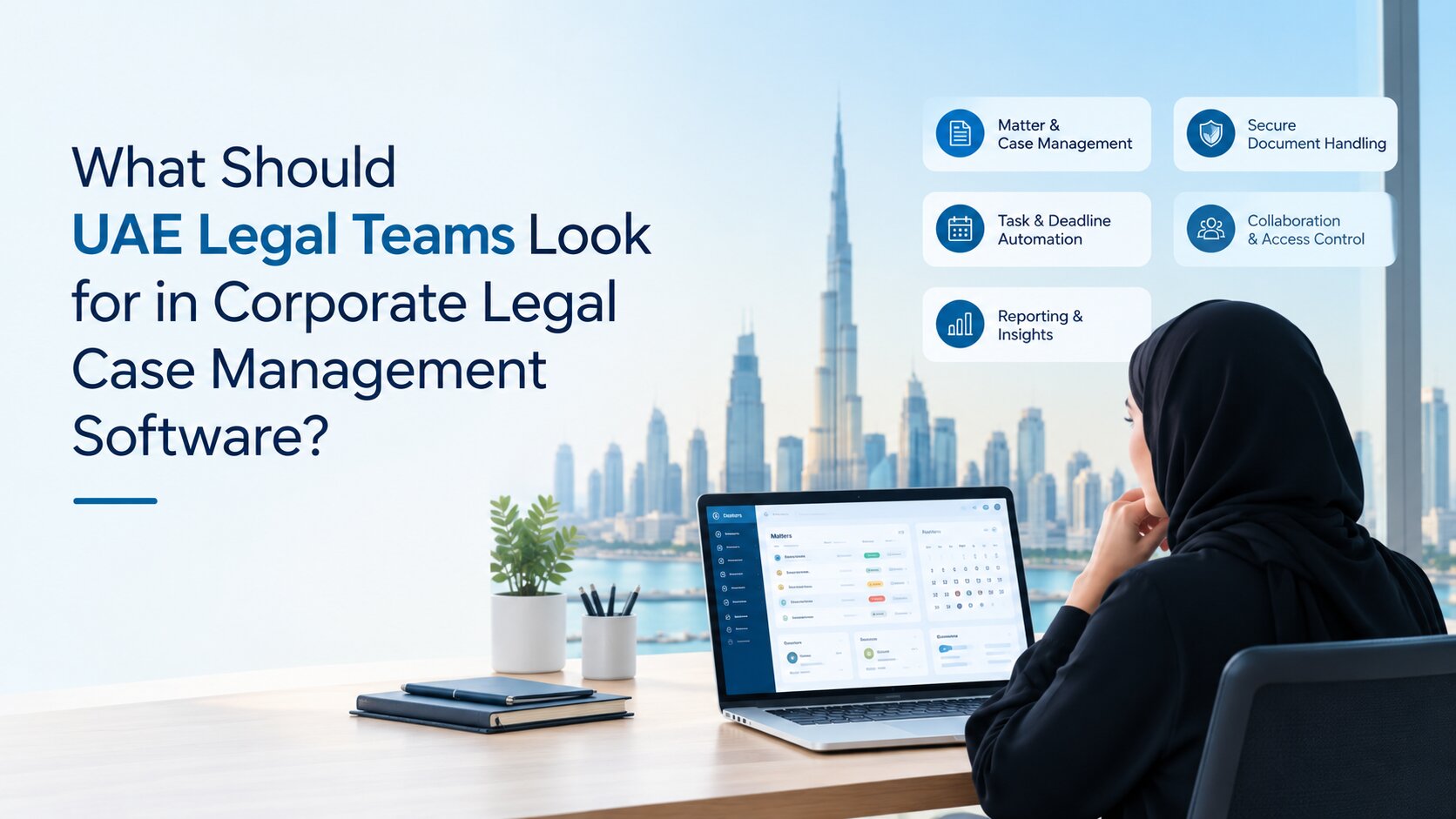
What Should UAE Legal Teams Look for in Corporate Legal Case Management Software?
For an in-house legal team, managing matters rarely means dealing with one case at a time. A single day can involve reviewing a contract, responding to a dispute, preparing for a hearing, following up with external counsel, checking a compliance deadline, and reporting matter status to senior management. When this work is spread across email inboxes, spreadsheets, shared folders, and individual calendars, it becomes difficult to see the full picture. Teams can miss important dates, struggle to locate documents, and turn reporting into a manual exercise.
The challenge can be more complex for UAE legal teams working with Arabic and English documents, different legal forums, and increasing expectations around data protection and information security. That is why choosing corporate legal case management software in the UAE should be about more than counting features. The right system should fit the way the legal team actually works, protect sensitive information, and provide useful visibility across matters.
Why Spreadsheets and Email Are No Longer Enough for UAE Legal Teams
Spreadsheets and email still have a place in legal work. They are familiar, flexible, and easy to start with. The problem appears when they become the main system for managing a growing legal workload. A spreadsheet may show a list of active matters, but it does not necessarily show the latest correspondence, related documents, tasks, approvals, or the complete history of what happened. Similarly, an email inbox may contain important instructions and documents, but finding the right information later can take considerable time.
For an in-house legal department, this creates several practical problems.
Missed hearing dates and deadlines can become a risk when dates are maintained manually across different calendars or spreadsheets. A reminder sitting in one employee's calendar does not necessarily provide visibility to the wider team.
No single view of matter status makes it harder for the General Counsel or legal manager to understand what is happening across the department. They may need to ask several people for updates before preparing a management report.
Weak version control can create uncertainty over which document is the latest version. This becomes particularly problematic when several people are reviewing contracts, pleadings, correspondence, or supporting documents.
There is also the question of auditability. When information is distributed across emails and local files, reconstructing who changed a record, approved an action, or uploaded a document can be difficult.
A legal case management system UAE teams use should therefore bring the relevant information into a structured environment rather than simply replacing one spreadsheet with another.
Core Features to Look For
Not every legal department needs the same configuration. A small legal team handling mostly commercial matters will have different requirements from a large department managing litigation, contracts, compliance, and external counsel. However, several capabilities should form the foundation of a modern legal matter management software platform.
Centralised Case and Matter Management
The starting point is a single record for each matter. The matter record should bring together relevant parties, case information, documents, correspondence, tasks, deadlines, notes, and activity history. Instead of asking team members to search through several systems, the legal department can start with one place to understand the matter.
For example, a dispute involving a supplier could contain the supplier's details, related agreements, correspondence, court information, upcoming hearings, assigned lawyers, supporting documents, and internal tasks within the same matter.
This also makes handovers easier. If a lawyer is unavailable, another team member should be able to understand the current position without relying entirely on a verbal update.
Deadline, Hearing, and Task Tracking
Legal work is highly deadline-driven. Hearing dates, filing deadlines, renewal dates, internal review dates, and follow-ups all need to be monitored. Look for software that allows the team to assign tasks, set due dates, create reminders, and track progress. Calendar integration can be useful where lawyers already manage their schedules through an existing calendar system.
The important point is not simply having a calendar. The system should connect dates to the relevant matter and make responsibility clear.
For example, instead of a generic calendar entry saying "court hearing", the legal team should be able to see the hearing date within the relevant matter, along with the assigned person, related documents, previous activity, and outstanding preparation tasks.
Document Management and Version Control
Legal matters generate large volumes of documents. Contracts, notices, pleadings, correspondence, evidence, internal notes, and court documents may all relate to the same matter. A case management platform should make these documents easy to organise and retrieve while maintaining version history.
This is especially important when multiple people collaborate on the same document. The team should be able to identify the latest version and understand relevant changes without relying on filenames such as "final", "final-new", or "final-approved". Search is another important consideration. A system that allows users to locate matters and documents using relevant information can reduce the time spent searching through folders and inboxes.
Contract and Case Linkage
Legal disputes rarely exist in isolation. A case may arise from a contract, purchase order, employment agreement, lease, financing arrangement, or another business relationship. For this reason, it can be useful to connect contract information with related legal matters.
Suppose a company enters into a construction agreement and later faces a dispute concerning delivery or performance. The legal team may need to review the original agreement, amendments, correspondence, notices, and related proceedings together. Linking the underlying contract with the matter gives the legal team better context and reduces the need to search across separate repositories.
Reporting and Dashboards
Legal departments increasingly need to explain their workload to business leadership. A useful reporting function can turn individual matter information into a broader view of the department.
Depending on the organisation, useful reports may cover:
- Active and closed matters
- Matter categories and status
- Upcoming deadlines and hearings
- Lawyer workload
- External counsel activity
- Matter costs and expenses
- Litigation trends
- Compliance-related work
The objective is not to produce dashboards simply because dashboards are available. Reports should answer practical management questions.
For example: How many disputes are currently active? Which matters require attention this month? Which external counsel are handling the largest number of matters? Where is the internal legal team's workload increasing?
Workflow Automation and AI Assistance
Legal teams also need to consider how routine work can be made more consistent. Legal workflow automation can help with activities such as matter intake, task assignment, approval routing, notifications, and follow-ups. Instead of manually forwarding an email every time a new matter arrives, a structured workflow can guide the request through the required steps.
AI assistance adds another layer. Depending on the platform and its controls, AI may support activities such as summarising information, extracting relevant details, or helping users review large volumes of content.
The market is also moving towards more advanced forms of AI, sometimes described as agentic AI. These systems are designed to handle a sequence of tasks rather than simply respond to one prompt. For legal teams, however, the important question is not whether a vendor uses the latest AI terminology. It is whether the technology has clear controls, appropriate access restrictions, human oversight, and a practical use case.
UAE-Specific Requirements That Generic Tools Miss
A platform can have a long feature list and still be poorly suited to a UAE legal department. Local requirements should therefore be part of the evaluation from the beginning.
Arabic and English Support
Many UAE organisations operate in both Arabic and English. Legal teams may therefore need to work with bilingual records, correspondence, agreements, and supporting documents.
Ask vendors what "Arabic support" actually means.
Does the interface support Arabic? Can users work with right-to-left text? Can Arabic documents be stored and searched effectively? Can reports handle Arabic content? Can users maintain Arabic and English information within the same matter? These details matter more than simply seeing an Arabic language option on a product page.
Data Protection and Residency
Data protection should be considered before sensitive legal information is moved into any cloud platform. For UAE organisations, the UAE Personal Data Protection Law (PDPL) is an important consideration, but compliance should not be reduced to a single checkbox. The organisation should understand how the platform stores, processes, protects, and transfers data.
Questions about hosting location, international transfers, access controls, retention, encryption, backups, and data deletion should form part of the vendor assessment.
The legal team should also involve its IT, security, and compliance stakeholders before approving a platform for confidential matters.
Fit With UAE Court and Legal Processes
A UAE legal department may deal with different legal forums and types of proceedings. Depending on the organisation, matters may involve onshore UAE courts as well as specialist jurisdictions such as the Dubai International Financial Centre (DIFC) or Abu Dhabi Global Market (ADGM). The software does not necessarily need to reproduce every feature of every court system. What matters is whether its matter structure, hearing management, document handling, task tracking, and reporting can accommodate the team's actual processes.
Ask vendors to demonstrate a real workflow rather than giving a generic product tour.
Regional Scalability
Many businesses operating in the UAE also have activities elsewhere in the GCC. If the legal department expects to expand into Saudi Arabia, Qatar, or other markets, it is worth asking whether the platform can support multiple jurisdictions, languages, users, and business units. This does not mean buying the most complex system available. It means considering whether today's choice will still work if the legal department grows.
Security, Access Control, and Confidentiality
Legal departments handle information that may be commercially sensitive, legally privileged, or confidential. Security should therefore be evaluated separately from general functionality.
Role-based access allows organisations to control who can see or edit particular information. Not every employee needs access to every legal matter.
For example, a sensitive employment dispute may need to be restricted to a small group, while general commercial matters can have wider access.
Audit logs can provide a record of important user activity, such as changes to records, document uploads, or other actions within the system.
Encryption is another basic consideration. Ask how information is protected both while it is being transmitted and while it is stored.
The vendor should also be able to explain its approach to backups, user authentication, access management, incident handling, and data retention. For legal teams, security is not simply an IT issue. It is part of protecting the organisation's legal and commercial information.
Integration and Ease of Adoption
Even a capable platform can struggle if lawyers and support staff find it difficult to use. Before choosing a legal case management system UAE organisations can rely on, consider how it will fit into existing working habits. Email and calendar integration can reduce the need to move repeatedly between applications. Integration with existing document storage can also make adoption easier.
Migration is another important area. If the organisation already has years of case records in spreadsheets, folders, and other systems, ask how that information will be transferred. A vendor should be able to explain what can be migrated, how data quality will be checked, and what happens to the original records.
Training matters too. Legal professionals should not need to become technology specialists to manage everyday matters. Ask about onboarding, training materials, administrator support, and local assistance. For GCC organisations, support availability during relevant working hours can also make a practical difference.
Questions to Ask Vendors Before You Buy
A vendor demonstration should be treated as an opportunity to ask difficult questions, not just watch a list of features.
Consider asking:
- Where is our data hosted? Ask for details about hosting locations, backup locations, and any international data transfers.
- How does the platform support Arabic and English? Ask for a live demonstration rather than relying on a written claim.
- Can workflows be customised? Your legal department may have approval and escalation processes that differ from another organisation.
- How long does implementation take? Ask what the timeline includes and what responsibilities sit with your organisation.
- What support is available during GCC working hours? Clarify response times and escalation procedures.
- How is pricing calculated? Understand whether pricing is based on users, matters, modules, storage, or another model.
- What happens to our data if we leave? Ask about data export formats, timelines, and any associated costs.
- Can you migrate our existing data? Understand what can be imported and how the migration will be validated.
- What integrations are available? Check compatibility with email, calendars, Microsoft applications, document storage, and other systems already used by the business.
- Can you demonstrate our actual workflow? Give the vendor a realistic scenario and ask them to show how the system handles it.
The last question can reveal more than a standard product demonstration.
Common Mistakes When Choosing Case Management Software
One common mistake is choosing a system based on the number of features rather than how well those features fit the legal team's workflow. A platform may have dozens of functions that the department never uses, while making a basic daily task unnecessarily complicated. Another mistake is overlooking adoption. If lawyers and paralegals continue to maintain separate spreadsheets because the new system feels difficult to use, the organisation will end up with two systems instead of one.
Data residency and compliance are also sometimes considered too late. These questions should be addressed before implementation, not after confidential information has already been migrated.
Finally, the evaluation should not be left entirely to management or IT. Lawyers, paralegals, legal operations staff, and other regular users can identify practical requirements that may not appear in a procurement checklist. The best evaluation is therefore collaborative. Define the team's most important workflows, test them in the system, and collect feedback from the people who will use it every day.
How Beveron's Smart Legal Counsel Addresses These Needs
Beveron's Smart Legal Counsel is designed for in-house legal and corporate legal teams managing matters across areas such as litigation, contracts, compliance, risk, expenses, and external counsel. Its matter management capabilities provide a central environment for organising legal work and monitoring matters. The platform also supports reporting and dashboards, helping legal teams maintain visibility into their workload and ongoing activities.
For organisations already using Microsoft tools, Smart Legal Counsel can work with Microsoft Office and SharePoint, while Microsoft Entra ID single sign-on can support controlled user access. These integrations can help reduce unnecessary switching between systems.
For a UAE legal team, another consideration is the ability to work across Arabic and English environments. Beveron positions Smart Legal Counsel for GCC legal teams, with capabilities intended to support regional legal operations.
A simple example would be an in-house team managing a commercial dispute arising from an existing supplier contract. Rather than keeping the contract in one folder, correspondence in email, hearing information in a spreadsheet, and follow-up tasks in individual calendars, the team can organise the matter and its related activities within a structured legal management environment.
The appropriate configuration will depend on the organisation's processes, security requirements, and existing systems. A vendor demonstration is therefore useful for confirming how specific workflows would work in practice.
FAQs
1. What is corporate legal case management software?
Corporate legal case management software is a system that helps an in-house legal department organise and manage legal matters in one place. Depending on the platform, it can include matter records, documents, tasks, deadlines, hearings, workflows, reporting, expenses, and external counsel information.
2. How is it different from contract management software?
Contract management software focuses primarily on the contract lifecycle, including drafting, review, approvals, signing, storage, and renewal tracking. Case management software has a broader focus on legal matters, including disputes, litigation, compliance activities, legal requests, tasks, and related documents. The two systems can complement each other, particularly where a dispute or legal matter is connected to an underlying contract.
3. Does case management software need to support Arabic?
For many UAE organisations, Arabic support can be an important requirement. The exact need depends on the organisation's work. Teams should check whether the platform supports Arabic in the interface, records, documents, search, reporting, and right-to-left display rather than assuming that an Arabic interface alone is sufficient.
4. How long does implementation typically take?
Implementation time varies according to the size of the legal department, the number of matters, data migration requirements, integrations, custom workflows, user roles, and training needs. A straightforward implementation may take less time than a large migration involving several systems. Vendors should provide a timeline based on the organisation's actual requirements.
5. Is cloud-based legal software compliant with UAE data laws?
Cloud software is not automatically compliant or non-compliant simply because it is cloud-based. Organisations should assess the provider's data processing practices, hosting arrangements, international transfers, security controls, retention policies, contracts, and other relevant requirements under applicable UAE law. The organisation's legal, IT, and compliance teams should.
Choosing Corporate Legal Case Management Software in the UAE
Selecting corporate legal case management software is ultimately a workflow decision rather than a feature-counting exercise. For a UAE legal team, three areas deserve particular attention: how well the platform fits the team's day-to-day legal processes, how securely it handles confidential information, and how well it supports the UAE and wider GCC operating environment.
A useful evaluation starts with real problems. Take a current matter, map how information moves from intake to resolution, and ask each vendor to demonstrate how its system would handle that process.
If your organisation is evaluating a legal management platform for its in-house team, you can explore how Beveron's Smart Legal Counsel could fit your requirements and discuss your workflows with the team.
Book a demo of Smart Legal Counsel to see the platform in action.
Best corporate legal case management software in the UAE
Best in-house legal software for legal teams in the UAE
Best legal department management software for corporates in the UAE
If you need a free demo on the best corporate legal case management software in the UAE, please fill out the form.