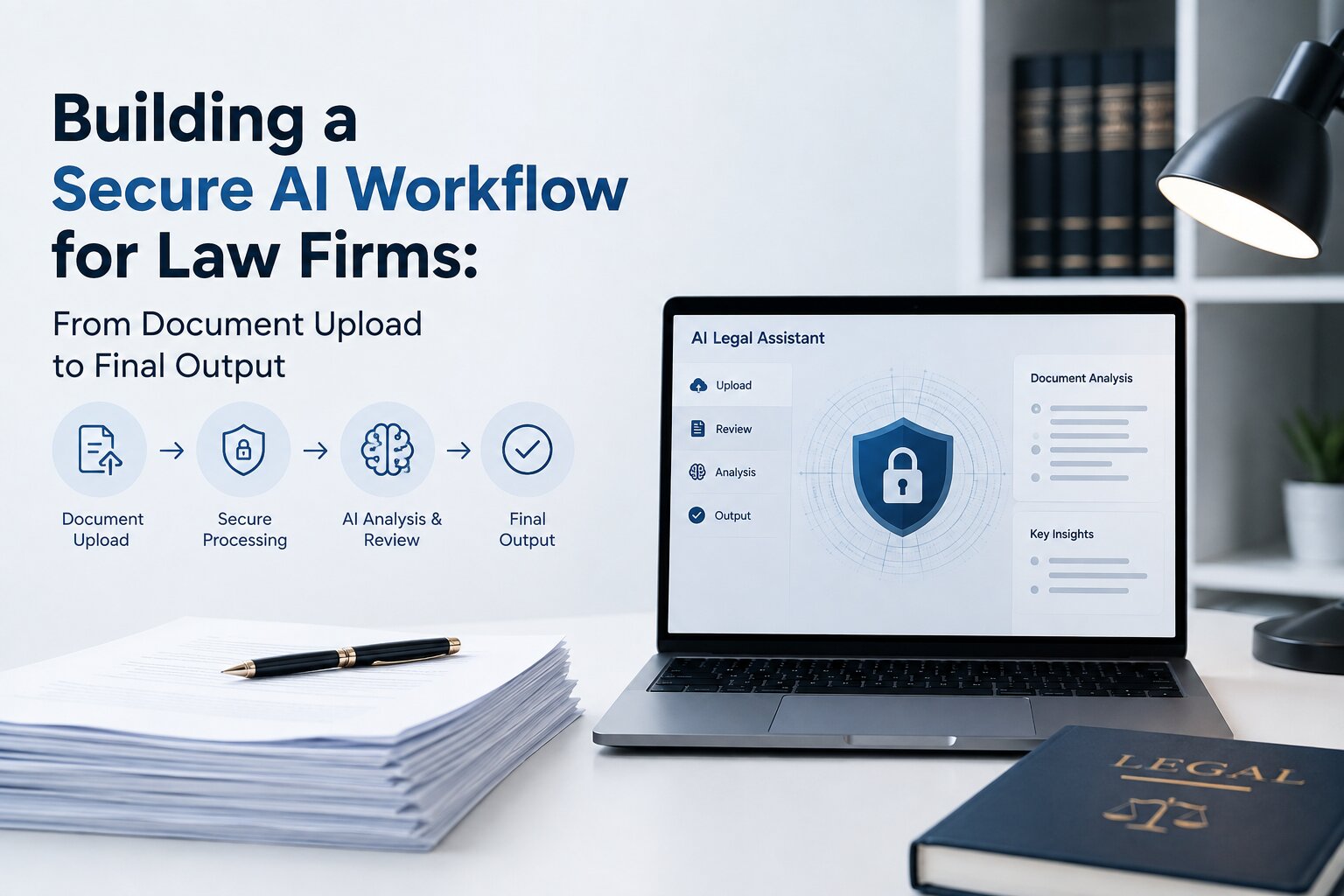
Building a Secure AI Workflow for Law Firms: From Document Upload to Final Output
Introduction
Artificial intelligence is becoming a practical part of legal work. Law firms are using AI to review documents, summarise lengthy files, search for relevant information, draft content, and support day-to-day legal operations.
But there is another side to this shift.
Legal documents often contain highly confidential information. A single file could include a client's personal details, financial records, legal strategy, contracts, evidence, or information protected by attorney-client privilege. Sending that information to an AI system without understanding how it is stored, processed, or used can create serious security and compliance concerns.
That is why building a secure AI workflow matters just as much as choosing a capable AI solution.
A secure legal AI workflow should protect information from the moment a document is uploaded until the final output is reviewed, stored, or shared. This means looking beyond the AI model itself and considering access controls, encryption, data handling, human review, audit trails, and the overall environment in which the AI operates.
This guide walks through that complete document lifecycle and explains where law firms should build security into their AI workflows.
Why Security Must Be Built Into Legal AI Workflows
For a law firm, an AI security issue is not simply an IT problem. It can quickly become a client confidentiality, compliance, or reputation issue.
Legal teams work with information that clients expect them to protect. That includes case files, contracts, correspondence, financial information, personal data, and confidential legal advice. Depending on the jurisdiction and type of information involved, firms may also have specific data protection and regulatory obligations.
The National Institute of Standards and Technology (NIST), for example, recommends considering factors such as privacy, security, transparency, accountability, and human oversight throughout the AI lifecycle rather than treating them as concerns that can be addressed only after deployment.
What Is Really at Stake?
One of the biggest concerns is confidentiality.
Imagine a lawyer uploading a confidential client agreement into a general-purpose AI tool because they want a quick summary. If the lawyer does not know how that platform handles uploaded information, where the information is stored, or whether it may be retained or used for other purposes, the firm may be taking an unnecessary risk.
There are several areas law firms need to consider:
- Attorney-client privilege and confidential communications
- Personally identifiable information and sensitive client data
- Case documents and evidence
- Contracts and commercially sensitive information
- Conflicts of interest
- Regulatory and data protection requirements
- Data residency requirements in certain jurisdictions
- Reputational damage following a security incident
For firms operating in the UAE, for example, the UAE Personal Data Protection Law provides a framework governing the processing of personal data and includes specific provisions around when processing is permitted. Firms should therefore assess their AI workflows against the requirements that apply to their particular activities and circumstances.
Common Security Gaps Law Firms Often Miss
The biggest problems are not always complicated. Sometimes, the risk starts with something as simple as uploading a confidential document into an unapproved AI application.
Other common gaps include:
- Sharing legal documents through unmanaged file-sharing tools
- Using personal AI accounts for professional work
- Giving employees access to documents they do not need
- Keeping sensitive files indefinitely
- Having no clear record of who viewed or changed a document
- Exporting AI-generated content without access controls
- Not knowing where client data is physically stored
- Assuming that every AI provider treats customer data in the same way
These gaps become more difficult to manage as a firm adopts more AI tools. Instead of one controlled workflow, information can end up moving between several unrelated platforms.
The Legal Document Lifecycle: Where Security Risks Can Appear
A secure AI workflow should protect information throughout its entire journey. Think about a typical legal document. A lawyer uploads it, the AI processes it, the lawyer reviews the result, and the final output is stored or shared. Every one of these steps presents different security considerations.
Stage 1 — Uploading and Ingesting Documents
Security starts before the AI does any analysis. When a lawyer uploads a contract, case file, or client document, the system should establish who is allowed to upload it and where that information will go. Basic safeguards should include controlled user access, encryption while information is being transferred, and appropriate file validation. The system should also prevent unauthorised users from accessing documents simply because they happen to be stored in the same workspace.
This is particularly important for firms handling multiple clients and matters. A lawyer working on one case should not automatically have access to every document in the firm's system. A good legal AI workflow should therefore answer simple questions clearly:
Who uploaded the document?
Who can access it?
Where is it stored?
What happens to it next?
If these questions cannot be answered easily, there may already be a gap in the workflow.
Stage 2 — Processing and AI Analysis
Once the document reaches the AI system, the next question is how the information is processed. Law firms should understand whether their information is kept separate from other customers, whether submitted data is retained, and whether it is used to train AI models. This distinction matters because not all AI environments operate in the same way.
For a deeper look at why law firms need a controlled environment for handling confidential client information, see our guide on Private AI for Law Firms: Why Client Data Needs a Secure AI Environment
A legal team should look for an environment where client information is handled according to clearly defined rules. Sensitive documents should not become part of an uncontrolled pool of information. The firm should also understand where processing takes place and where the underlying information is stored. This becomes particularly relevant for organisations operating in countries or regions with specific data protection and residency requirements.
Data minimisation can also help. If the AI only needs certain information to complete a task, there may be no reason to expose unrelated client information. For highly sensitive documents, firms may also consider redaction before processing. Redaction means removing or hiding specific sensitive information that the AI does not need.
Stage 3 — Lawyer Review and Human Validation
AI can make legal work faster, but faster does not automatically mean safer. A lawyer should still be able to review important AI-generated results before they are relied upon. This is especially important when the output could influence legal advice, client communication, contracts, or other significant decisions. Human review also gives firms a chance to catch mistakes.
For example, an AI system might misunderstand a clause, overlook an important exception, or produce a summary that lacks necessary context. A lawyer who reviews the result can identify these issues before the output moves further through the workflow. NIST's guidance on generative AI also highlights the value of additional human review, tracking, documentation, and oversight when managing AI-related risks.
A secure workflow can support this process through:
- Role-based access
- Version control
- Review and approval stages
- Lawyer sign-off checkpoints
- Records of changes
- Clear ownership of final outputs
The goal is not to remove lawyers from the process. It is to give them better tools while keeping appropriate human judgement in place.
Stage 4 — Generating, Storing and Sharing the Final Output
Security should not stop when the AI produces an answer. The final output may be just as sensitive as the original document. A generated case summary, contract review, legal opinion, or client communication can contain confidential information and should be protected accordingly.
Law firms should consider:
- Encryption when documents are stored
- Retention and deletion policies
- Access permissions
- Secure downloads
- Controlled exports
- Secure document sharing
- Backup protection
For example, if an AI-generated contract review is automatically saved in a shared folder where everyone in the organisation has access, the original security controls around the uploaded document have effectively been weakened. The complete workflow needs to remain controlled from beginning to end.
What a Secure AI Workflow Needs
Security is not one feature that can simply be switched on. It is a combination of controls working together.
A Clear Data Governance Framework
Data governance simply means having clear rules for how information is collected, accessed, used, stored, and deleted. For a law firm, those rules should define who can access different types of legal information and under what circumstances. A junior employee, external consultant, partner, and IT administrator may all require different levels of access.
The principle should be straightforward: people should only have access to the information they need to do their work. These rules should also cover AI usage. Firms should establish which AI tools are approved, what types of documents can be processed, and which information should never be entered into an unapproved system.
Encryption at Every Important Stage
Encryption protects information by converting it into a form that cannot easily be read without the appropriate access. For legal AI workflows, firms should consider encryption both while information is being transferred and while it is stored.
This is commonly described as:
- Encryption in transit: protecting information as it moves between systems
- Encryption at rest: protecting information while it is stored
Encryption alone does not solve every security problem, but it is an important part of protecting sensitive information.
Audit Logs and Traceability
When something goes wrong, a firm needs to know what happened. Audit logs create a record of important activity. Depending on the system, this could include who accessed a document, when it was accessed, what changes were made, and which actions were performed.
This visibility can help firms investigate incidents, monitor unusual activity, and demonstrate accountability. It is also useful for everyday work. If several lawyers collaborate on a document, being able to see its history can make it easier to understand how the final version was created.
Careful Vendor and Platform Due Diligence
Choosing an AI vendor should involve more than asking, "How good is the AI?" Security and data handling should be part of the buying decision from the beginning.
Before adopting a platform, legal teams should ask:
- Where is our data hosted?
- Where is our data processed?
- Can we choose the hosting location?
- Is customer data used to train AI models?
- Who can access our information?
- How are user permissions managed?
- What security certifications does the provider have?
- How are backups protected?
- How long is information retained?
- Can information be permanently deleted?
- What happens if there is a security incident?
- Can the solution be deployed within our own infrastructure?
The answers should be clear and documented rather than based on assumptions.
Common Legal AI Security Problems—and How to Solve Them
Problem: Confidential Client Data Goes Into Public AI Tools
One of the easiest ways for a security problem to occur is for someone to copy confidential legal information into a public or unapproved AI tool. The solution is not necessarily to stop using AI altogether. Instead, firms can establish approved AI environments with appropriate controls around confidential information.
A purpose-built private AI environment can give firms greater control over how sensitive information is processed and accessed.
For a deeper comparison of these approaches, read 5 Reasons Legal Teams Should Choose Private AI Over Public AI.
Problem: Lawyers Cannot Understand or Review AI Results
AI-generated answers can sound convincing even when they are incomplete or incorrect. For legal teams, this makes review particularly important. The solution is to build human review into important workflows. Lawyers should be able to check outputs, validate important information, make corrections, and approve final content before it is used.
Where appropriate, systems should also provide enough information to help users understand how an output was produced or what source material informed it.
Problem: Legal Teams Use Too Many Disconnected Tools
A typical legal workflow can involve email, cloud storage, document management, AI tools, spreadsheets, case management software, and messaging platforms. Every additional handoff can create another opportunity for information to be copied, shared, or accessed incorrectly.
A more unified workflow can reduce unnecessary movement of information. Instead of moving a document between several systems, firms can manage document processing, AI analysis, review, storage, and access within a more controlled environment.
How to Evaluate a Secure AI Workflow for Your Law Firm
The best AI solution for one law firm may not be the right choice for another. The decision should depend on the firm's practice areas, data sensitivity, infrastructure, regulatory requirements, and internal security policies.
Questions to Ask AI Vendors
Before signing up for an AI platform, ask direct questions about how your information will be handled.
Data and privacy
- Where is client data stored?
- Where is it processed?
- Is customer information used for AI model training?
- How long is information retained?
- Can the firm request deletion?
Access and security
- How are user permissions managed?
- Are role-based access controls available?
- Are activities recorded in audit logs?
- How is data encrypted?
- How are backups protected?
Compliance
- Which security certifications does the provider maintain?
- What privacy requirements does the platform support?
- Can the vendor explain its approach to data residency?
- What happens if regulations or organisational requirements change?
Incident response
- How does the provider detect security incidents?
- How quickly are customers notified?
- What happens to affected data?
- Is there a documented incident-response process?
Deployment
- Is the solution cloud-based?
- Is a private deployment available?
- Can it run within the firm's own infrastructure?
- What level of control does the firm have over the environment?
These questions can reveal more about a platform than a long list of AI features.
Red Flags to Watch For
Be cautious if a provider cannot give clear answers about:
- Data ownership
- Data retention
- AI training practices
- Hosting locations
- User access
- Security controls
- Audit logs
- Incident response
- Data deletion
Another warning sign is when a provider focuses heavily on how impressive its AI is but gives little information about how customer data is protected. For legal teams, both capabilities matter. The AI needs to be useful, but the environment around it needs to be trustworthy.
Secure On-Premise AI for Legal Teams: Keeping Sensitive Data Under Your Control
For some law firms and legal departments, the question is not simply whether AI is secure enough. It is also about how much control they want over the environment in which their data is processed. This is where on-premise AI can become an important option.
What Is On-Premise AI?
On-premise AI refers to an AI solution deployed within an organisation's own infrastructure rather than relying entirely on a shared external environment. In simple terms, the organisation has greater control over where the AI system operates and how sensitive information moves through that environment.
This approach can be particularly relevant for legal teams dealing with highly confidential client information, strict internal security policies, or specific data-residency requirements. It does not mean that security is automatically guaranteed. The organisation still needs strong access controls, encryption, monitoring, maintenance, and appropriate governance. But an on-premise deployment can provide a different level of control over the AI environment.
Why Law Firms May Prefer an On-Premise Approach
There are several reasons a legal organisation may consider on-premise AI.
- Greater control over sensitive information - Instead of sending confidential documents to a general public AI service, firms can keep processing within a controlled environment.
- More control over access - The organisation can establish its own policies around who can access the AI system and the information connected to it.
- Support for internal compliance requirements - Some organisations have strict requirements around how sensitive information is stored and processed. An environment under greater organisational control can make it easier to align AI use with those requirements.
- Reduced dependence on external AI environments - For firms with particularly sensitive workloads, reducing the number of external systems involved in processing client information can be an important consideration.
How Beveron's Secure On-Premise AI Supports Legal Teams
Beveron's Secure On-Premise AI for Legal Teams is designed for organisations that want to bring AI into their legal workflows while maintaining greater control over sensitive information. Instead of relying on public AI tools for confidential legal work, organisations can use a private AI environment that supports stronger control over how legal data is processed, accessed, and managed.
Beveron brings AI capabilities into different areas of legal operations through its purpose-built legal technology solutions. Smart Lawyer Office, Smart Legal Counsel, and Smart Legal Contract can support AI-powered legal workflows while also being available within a secure on-premise environment, depending on the organisation's deployment requirements.
These solutions can support different legal teams and workflows:
- Smart Lawyer Office (SLO): AI-powered case and practice management for law firms, helping legal professionals manage matters, documents, tasks, and case-related workflows.
- Smart Legal Counsel (SLC): AI-powered legal matter management for in-house legal teams, helping organisations manage legal requests, matters, documents, and collaboration with greater efficiency.
- Smart Legal Contract: AI-powered contract management that helps legal and business teams manage contracts, streamline workflows, and gain better visibility across the contract lifecycle.
When deployed through a secure private or on-premise AI environment, these solutions can help organisations maintain greater control over sensitive legal information while using AI to improve everyday legal work.
Depending on the organisation's requirements, a secure private AI approach can help support:
- Private processing of legal information
- Controlled access to sensitive documents
- AI-assisted legal and contract workflows
- Greater control over the AI environment
- Protection of confidential legal and client information
- Secure management of AI-powered legal operations
For firms and corporate legal teams evaluating private AI, the important question is not simply whether AI can perform a task. It is whether the AI workflow can fit within the organisation's broader approach to confidentiality, security, governance, and compliance. Explore Beveron's Secure On-Premise AI for Legal Teams and discover how private AI can support secure, AI-powered legal operations.
Practical Steps for Implementing Secure AI in a Law Firm
Adopting secure AI does not mean changing every legal workflow overnight. In fact, a gradual approach can make adoption easier to manage.
Start With a Controlled Pilot
Choose one practice area or workflow and begin with a limited pilot. For example, a firm might start with document summarisation or internal document review rather than immediately introducing AI across every client-facing process. This gives the firm an opportunity to understand how the technology performs, identify security gaps, gather feedback from lawyers, and improve its internal policies.
Once the workflow has been tested successfully, the firm can consider expanding it.
Train Lawyers and Staff
Even the most secure AI platform can be used incorrectly. People need to understand what they can and cannot do with AI.
Training should cover:
- Which AI tools the firm has approved
- What information can be uploaded
- What information should not be entered into public AI tools
- How to review AI-generated content
- When lawyer approval is required
- How to report a security concern
The goal should not be to make everyone an AI expert. It is to make secure AI use part of everyday legal work.
Review Security and Compliance Regularly
AI technology and regulatory expectations continue to evolve. A security review that makes sense today may need to be updated later. Firms should therefore regularly review user permissions, vendor policies, data handling practices, retention rules, and AI usage. They should also monitor changes to relevant privacy and regulatory requirements in the jurisdictions where they operate.
NIST's AI Risk Management Framework is one example of a broader approach that treats AI risk management as an ongoing activity across the design, deployment, use, and evaluation of AI systems.
Conclusion
A secure AI workflow for law firms is about much more than protecting the AI model. Security needs to follow the entire journey of legal information—from the moment a document is uploaded and processed to the point where an AI-generated result is reviewed, stored, and shared. Law firms should therefore look closely at access controls, encryption, data governance, audit trails, human review, retention policies, vendor practices, and deployment options before introducing AI into sensitive workflows.
For organisations handling particularly confidential information, private or on-premise AI can help you maintain greater control over the environment in which legal data is processed. The goal is not to choose between innovation and security. With the right workflow and safeguards in place, legal teams can use AI to work more efficiently while keeping confidentiality and responsible data handling at the centre of their technology strategy.
Frequently Asked Questions
What is a secure AI workflow for law firms?
A secure AI workflow for law firms protects sensitive legal information throughout its entire lifecycle, from document upload and AI processing to lawyer review, output generation, storage, and sharing. It can include access controls, encryption, audit logs, data governance, human review, and secure deployment.
Why is private AI important for law firms?
Private AI can give law firms greater control over how confidential legal information is processed and accessed. It can help organisations reduce reliance on public AI environments and align AI workflows with their internal security, privacy, and governance requirements.
What should law firms ask an AI vendor about data security?
Law firms should ask where data is stored and processed, whether customer data is used to train AI models, how access is controlled, what encryption is used, how long data is retained, whether audit logs are available, what security certifications the vendor has, how incidents are handled, and whether private or on-premise deployment is available.
What is on-premise AI for legal teams?
On-premise AI is an AI solution deployed within an organisation's own infrastructure rather than relying entirely on an external shared environment. It can provide greater organisational control over where AI operates and how sensitive legal information is processed, accessed, and managed.
How can law firms implement AI securely?
Law firms can begin with a controlled pilot, establish clear AI usage and data governance policies, limit access according to user roles, train lawyers and staff, require human review for important outputs, monitor AI activity, and regularly review security and compliance requirements.
What are the benefits of secure on-premise AI for law firms in the UAE?
Secure on-premise AI can give UAE law firms greater control over sensitive legal information, access permissions, AI processing environments, and internal security policies. Firms should still assess the solution against their specific legal, regulatory, privacy, and information-security requirements.
Best private AI for law firms in the UAE
Best on-premise AI for legal teams in the UAE
Best secure on-premise AI for law firms in the UAE
If you need a free demo of the best private AI for law firms in the UAE, please fill out the form.