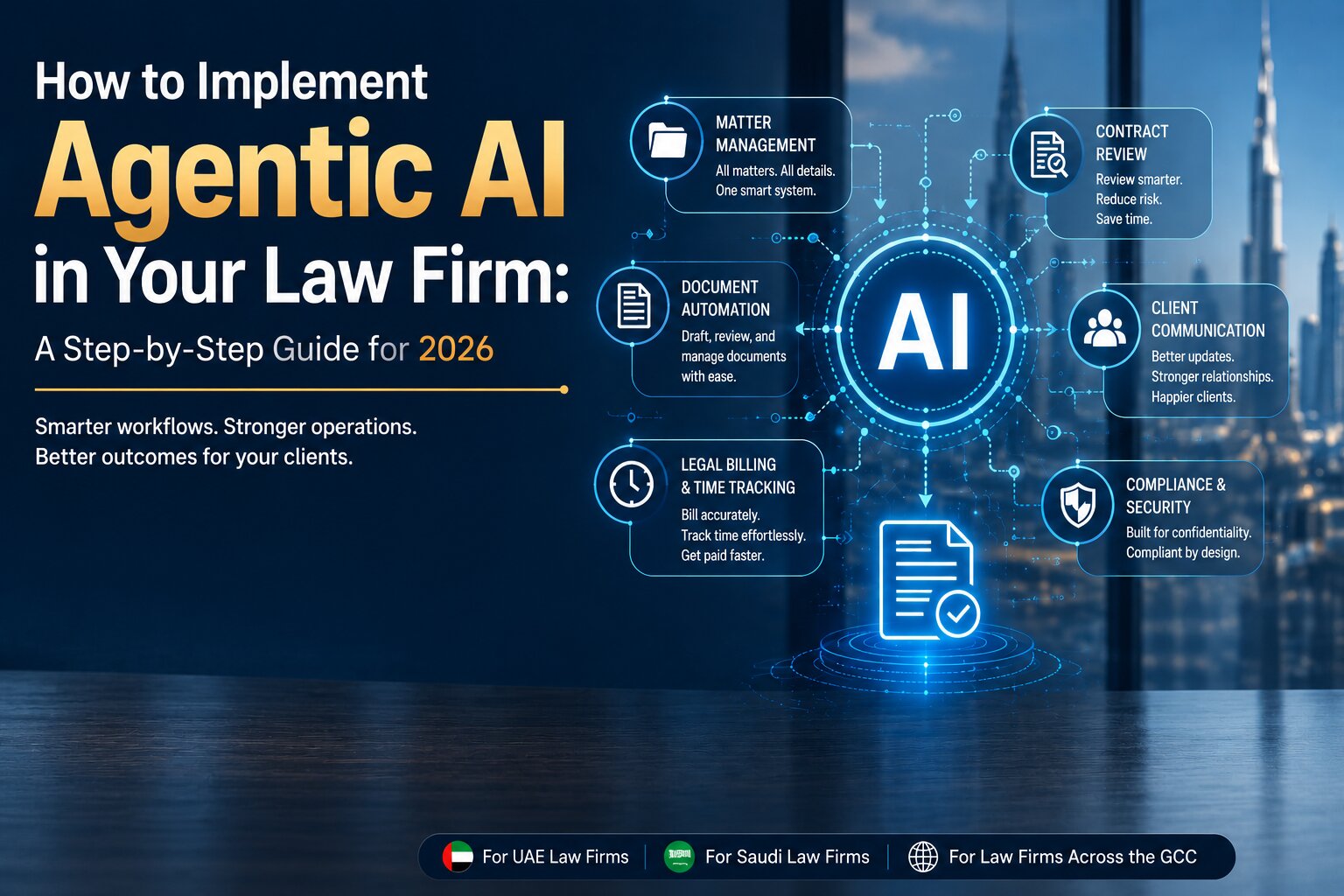
How to Implement Agentic AI in Your Law Firm: A Step-by-Step Guide for 2026
Artificial intelligence has moved beyond simply generating text or answering questions. Today's AI can handle connected tasks, make decisions within defined rules, and complete entire workflows with minimal human input. This new approach is known as Agentic AI, and it is changing how law firms operate.
For law firms across the UAE, Saudi Arabia, and the wider GCC, 2026 is set to be a key year for AI adoption. Clients expect quicker responses, legal teams are managing heavier workloads, and firms need smarter ways to improve efficiency without compromising the quality of legal services. Agentic AI helps by taking over routine work, allowing lawyers to focus on legal strategy, client relationships, and complex decision-making.
This guide explains how to implement Agentic AI step by step, helping your firm build a secure and practical foundation for long-term success.
Key Takeaways
- Agentic AI automates connected legal workflows while keeping lawyers in control.
- Successful adoption starts with improving workflows, not simply introducing AI.
- Security, confidentiality, and compliance should be built into the implementation from the beginning.
- A modern legal practice management platform provides the foundation for effective AI adoption.
What Is Agentic AI and Why Does It Matter for Law Firms?
Agentic AI is a form of artificial intelligence that can plan, carry out, and monitor a series of connected tasks to achieve a specific goal, while still operating under human supervision. Before implementing Agentic AI, it can be helpful to understand its growing role in legal operations. Learn more in our guide on the rise of Agentic AI in legal operations.
Unlike traditional AI tools that respond to one prompt at a time, Agentic AI can move through an entire workflow, making decisions within predefined rules as each step progresses.
The difference becomes clearer when compared with other legal technologies. If you're comparing Agentic AI with traditional legal automation, our guide on Agentic AI vs Traditional Legal Automation explains the key differences, practical use cases, and how each approach supports modern legal workflows. Traditional legal automation follows fixed instructions. For example, it can send payment reminders, route documents for approval, or move files once certain conditions are met. These systems are useful but cannot adapt beyond their programmed rules.
Generative AI works differently. It creates content such as contract summaries, legal drafts, or research notes based on prompts. However, it depends on users to tell it what to do each time. Agentic AI combines these capabilities. It can review a contract, identify missing clauses, notify the responsible lawyer, update the matter status, schedule the next task, and prepare a progress report as part of one continuous workflow.
Common legal use cases include:
- Monitoring ongoing legal matters
- Supporting contract review workflows
- Tracking legal billing activities
- Managing debt recovery follow-ups
- Assisting with compliance monitoring
The goal is not to replace lawyers. Instead, Agentic AI handles repetitive administrative work so legal professionals can spend more time advising clients, solving complex legal issues, and making informed decisions.
Step 1: Assess Your Law Firm's Workflow Readiness
Before introducing Agentic AI, take a close look at how your firm operates today. Many firms invest in AI without understanding where their biggest inefficiencies lie, leading to disappointing results.
Start by identifying repetitive tasks that take up valuable time, such as:
- Matter management
- Document approvals
- Billing reconciliation
- Client follow-ups
- Legal research support
- Internal reporting
Next, identify workflow bottlenecks. These often include disconnected systems, duplicate data entry, manual document handling, and limited visibility into the progress of legal matters. If information is scattered across spreadsheets and multiple applications, AI will struggle to deliver reliable results because it depends on accurate and organised data. Mapping your workflows helps you understand how work moves through the firm, who is responsible at each stage, and where delays occur. It also shows which processes are suitable for automation and which still require human judgement.
The objective isn't to automate everything immediately. It is to understand where AI can deliver the greatest value before investing in new technology.
Step 2: Start with Clear Use Cases
A common mistake is trying to automate every legal process at once. Successful AI adoption begins with one clearly defined use case that solves a real business problem.
Focus on repetitive, high-value activities such as:
- Legal billing automation
- Contract clause extraction
- Client onboarding
- Document generation
- Litigation tracking
- Debt recovery follow-ups
These processes are structured, repeatable, and well suited to Agentic AI.
For example, instead of automating every aspect of matter management, begin with contract review notifications or billing reminders. Measure the time saved, gather feedback from your team, and refine the workflow before expanding AI to other areas. Starting small reduces implementation risk, builds user confidence, and provides practical insights that will make future AI projects more successful.
Step 3: Prioritise Data Security and Confidentiality
Security is often the first concern for law firms considering AI—and for good reason. Legal professionals manage highly confidential information that must remain protected at every stage. Before moving forward with AI implementation, it's worth understanding the security practices that protect confidential legal information. Our guide to secure AI for law firms explores the key safeguards every legal team should consider. Before implementing Agentic AI, review your firm's data governance policies and ensure they align with internal requirements as well as relevant regulations across the UAE, Saudi Arabia, and the wider GCC.
When evaluating an AI platform, ask questions such as:
- Where is legal data stored?
- Who has access to confidential information?
- Are permissions managed through role-based access controls?
- Does the platform maintain detailed audit trails?
- How is sensitive client data protected?
Choosing a platform with strong security features helps safeguard client information while giving legal teams the confidence to adopt AI responsibly. It's equally important to remember that AI should support legal professionals, not replace them. Lawyers should continue reviewing legal advice, approving documents, and making decisions that require professional judgement and ethical responsibility.
Step 4: Choose a Secure Legal Platform That Supports Agentic AI
Once you have identified your workflows and security requirements, the next step is choosing the right technology. Some firms consider building their own AI solutions, while others rely on standalone AI tools. Although these options can work, they often require technical expertise, ongoing maintenance, and complex integrations.
For most law firms, adopting AI through a legal practice management platform is the more practical approach. These platforms already organise legal data, manage workflows, and provide the structured environment Agentic AI needs to perform effectively.
If your firm requires complete control over sensitive legal information, Beveron's Secure On-Premise AI for Legal Teams solution enables you to implement AI while maintaining data privacy, security, and compliance within your own infrastructure.
When comparing platforms, look for features such as:
- Matter management
- Secure document management
- Workflow automation
- Legal billing and time tracking
- Reporting and analytics
- Integration with existing business systems
- Strong security controls
- Scalability as your firm grows
A platform built specifically for legal professionals is better equipped to support legal workflows than a general-purpose AI solution.
Step 5: Run a Pilot and Prepare Your Team
Technology alone does not guarantee success. People play an equally important role in AI adoption. Start with a pilot project rather than deploying Agentic AI across the entire firm. Choose one workflow, such as document approvals, legal billing, or client onboarding. A smaller rollout allows you to test the system, identify issues, and improve the process before expanding.
Training is just as important. Lawyers and support staff should understand what the AI can do, where human review is required, and how it fits into their daily work. This builds confidence and encourages responsible use. It also helps to appoint internal champions who can guide colleagues during the transition. Regular feedback sessions will highlight what's working and where workflows can be improved. Involving your team from the beginning makes long-term adoption much easier
Step 6: Measure Results and Scale Gradually
Once your pilot is delivering results, measure its impact before expanding AI across the firm.
Track key performance indicators such as:
- Time saved per legal matter
- Faster document preparation
- Improved billing efficiency
- Reduced administrative workload
- Shorter client response times
- Higher user adoption
These metrics help determine whether Agentic AI is delivering measurable business value. If the results are positive, extend AI to additional teams and workflows in stages. A gradual rollout gives employees time to adapt while allowing management to monitor performance and resolve issues early.
Remember that AI implementation is an ongoing process. Reviewing workflows regularly, refining processes, and gathering user feedback will help your firm continue improving as business needs evolve.
Common Pitfalls to Avoid
Agentic AI can deliver significant benefits, but avoiding common mistakes is just as important. One of the biggest mistakes is trying to automate legal judgement instead of repetitive administrative work. AI should support lawyers, not replace their expertise.
Another common issue is overlooking employee training. Without proper guidance, even the best AI tools may be underused or misunderstood. Law firms should also avoid relying on generic AI applications that are not designed for legal workflows. Purpose-built legal platforms provide the structure, security, and workflow management needed for successful AI adoption.
Poor-quality or disorganised data can also reduce AI performance. Keeping matters, client records, and legal documents organised improves the accuracy and reliability of AI-powered workflows. Finally, don't try to automate everything at once. Start with one successful use case, measure the results, and expand gradually.
Why Beveron Smart Lawyer Office Is a Strong Foundation for Agentic AI
Successfully implementing Agentic AI requires more than introducing new technology. It also depends on having organised legal data, structured workflows, and secure processes. Without this foundation, even the most advanced AI tools may struggle to deliver consistent results.
As part of its LegalTech portfolio, Beveron helps the legal sector by providing purpose-built solutions that support digital transformation, improve operational efficiency, and modernise legal workflows for law firms and corporate legal teams.
Beveron Smart Lawyer Office provides that foundation by bringing together matter management, document management, billing, and legal workflows within a single platform. This creates a structured environment where Agentic AI can operate more effectively while supporting lawyers throughout their daily work.
Centralised Matter Management
Agentic AI relies on accurate and well-organised information to perform connected tasks. By centralising matters, client records, documents, and case information in one place, Beveron Smart Lawyer Office ensures AI can access up-to-date legal data, reducing duplication and improving workflow accuracy.
Workflow Automation
Many legal processes involve repetitive administrative work, such as assigning tasks, sending reminders, tracking deadlines, and updating matter statuses. Beveron Smart Lawyer Office automates these routine activities, allowing legal teams to spend more time on client service, legal analysis, and strategic decision-making.
Secure Document Management
Legal documents contain highly sensitive information that must be handled carefully. Beveron Smart Lawyer Office provides secure document management with controlled access, helping firms protect confidential client information while supporting efficient collaboration across legal teams.
Legal Billing and Time Tracking
Accurate billing is essential for every law firm. By simplifying time tracking and billing processes, the platform reduces manual effort, improves billing accuracy, and allows lawyers to focus on delivering value to clients instead of administrative tasks.
Better Visibility into Legal Operations
Real-time dashboards and reporting provide a clear view of ongoing matters, team workloads, and workflow performance. These insights help law firms identify bottlenecks, measure operational efficiency, and make informed decisions as they expand their use of Agentic AI.
Built to Grow with Your Firm
As AI adoption increases, legal technology should be able to grow alongside your business. Beveron Smart Lawyer Office offers a scalable platform that supports both current operational needs and future AI-driven workflows, helping firms modernise with confidence while maintaining security, compliance, and efficiency.
Whether your firm is taking its first steps towards Agentic AI or expanding existing digital initiatives, Beveron Smart Lawyer Office provides the organised legal operations and secure foundation needed to support long-term success.
Conclusion
Agentic AI is shaping the next generation of legal technology by helping law firms automate connected workflows while keeping lawyers in control of legal decisions and client relationships.
A successful implementation begins with understanding your current processes, identifying valuable use cases, protecting confidential data, choosing the right legal platform, preparing your team, and measuring results before scaling further.
Firms that take a structured, step-by-step approach will be better positioned to improve productivity, reduce administrative work, and deliver a better client experience throughout 2026 and beyond. Rather than replacing legal professionals, Agentic AI gives them more time to focus on delivering trusted legal advice and solving complex legal challenges.
Ready to Build an AI-Ready Law Firm?
Adopting Agentic AI starts with a strong operational foundation. Beveron Smart Lawyer Office helps law firms centralise matter management, organise legal documents, automate routine workflows, simplify billing, and improve collaboration within a secure legal practice management platform.
Whether your firm is just beginning its AI journey or expanding existing digital initiatives, Beveron provides the tools needed to support efficient, secure, and future-ready legal operations.
Book a personalised demo today and discover how Beveron Smart Lawyer Office can help your law firm prepare for the future of legal practice.
Frequently Asked Questions
1. What is Agentic AI in a law firm?
Agentic AI is a type of artificial intelligence that manages connected legal tasks, such as reviewing documents, tracking matters, sending follow-ups, and updating workflows, while lawyers remain responsible for important legal decisions.
2. How is Agentic AI different from generative AI?
Generative AI creates content such as legal drafts, summaries, and responses based on prompts. Agentic AI goes further by planning and completing multiple connected tasks within a workflow with minimal human intervention.
3. Is Agentic AI secure enough for confidential legal work?
Yes, provided law firms choose platforms with strong security features such as role-based access controls, audit trails, secure document management, and robust data protection measures that support compliance requirements.
4. Which legal processes should law firms automate first?
Start with repetitive, structured processes such as matter management, document workflows, legal billing, client onboarding, and follow-up reminders. These areas typically deliver quick wins and make future AI adoption easier.
5. Why choose Beveron Smart Lawyer Office for Agentic AI adoption?
Beveron Smart Lawyer Office brings together matter management, workflow automation, secure document management, legal billing, and collaboration in one platform. This organised foundation helps law firms improve efficiency today while preparing for more advanced Agentic AI capabilities in the future.
Best agentic AI for law firms in the UAE
Best AI for law firms in the UAE
Best AI-powered law firm management in the UAE
If you need a free demo of the best agentic AI for law firms in the UAE, please fill out the form below.