The Agentic AI Era: How Law Firms Can Lead the Future of Legal Practice
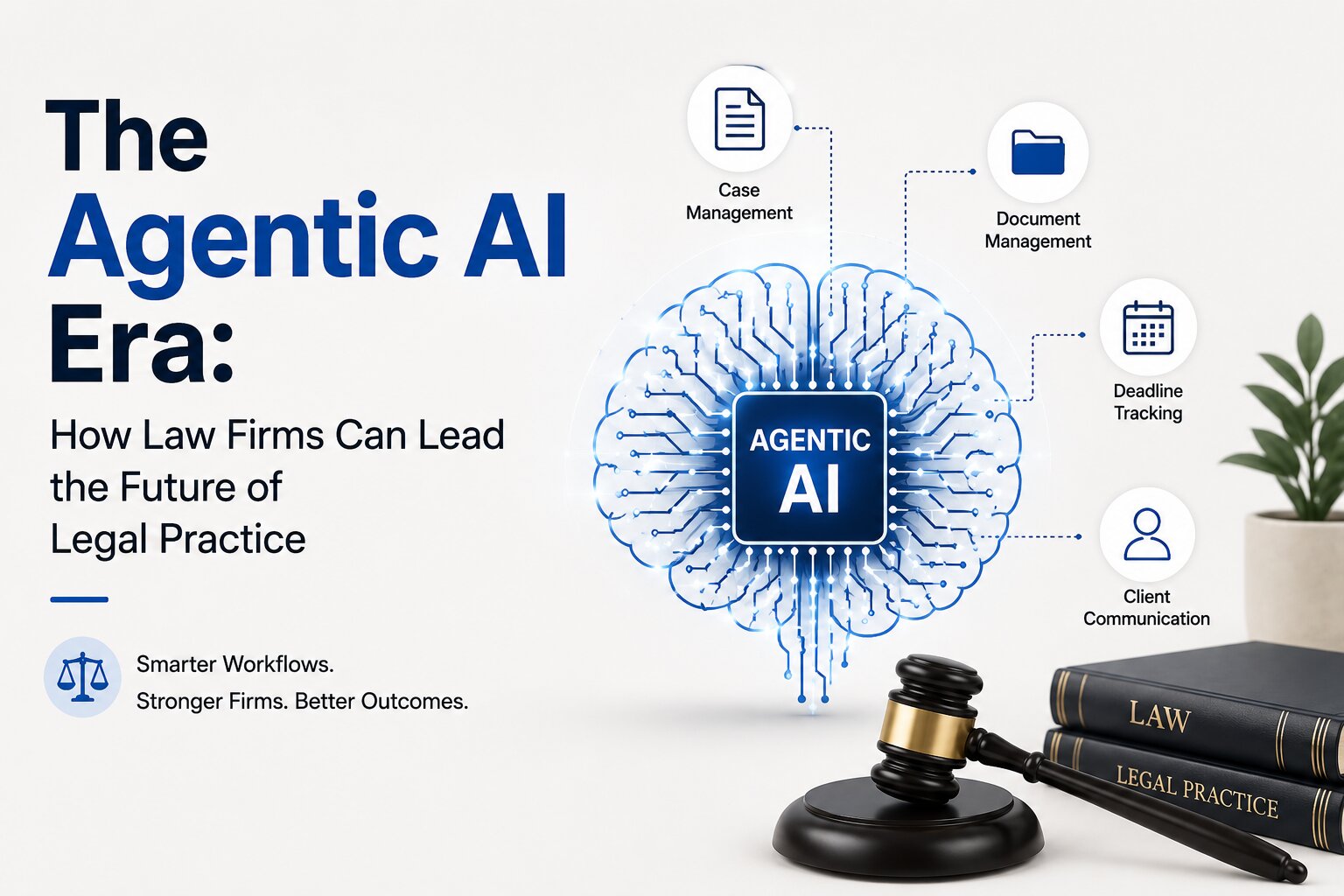
Artificial intelligence is already changing the way legal professionals work. Lawyers can use AI to summarise documents, assist with drafting, find information and reduce time spent on repetitive tasks.
But the next stage is different.
Instead of simply responding to a prompt, agentic AI can work towards a goal, plan a sequence of actions and carry out multiple steps with limited human instruction. This could eventually change how law firms manage everything from research and document review to case workflows and client communication. The Law Society describes this as a significant shift from traditional generative AI, while also highlighting the need for strong human oversight and accountability.
For law firms, the opportunity is not about replacing lawyers with AI. It is about building smarter legal workflows where technology handles more of the routine work, while lawyers remain focused on judgement, strategy and clients.
What Is Agentic AI, Really?
Agentic AI is designed to do more than answer a question or generate content. It can be given a broader objective and potentially determine the steps required to move towards that objective. Consider a simple contract review. With a traditional generative AI tool, a lawyer might ask:
“Summarise this contract and identify the key risks.”
The AI responds, and the lawyer decides what to do next.
An agentic system could potentially take a broader instruction and work through several connected stages: review the document, identify relevant clauses, flag potential issues, prepare suggested changes and move the matter to the appropriate review stage. The difference is not simply that the AI is “smarter”. It is that the workflow becomes more connected and action-oriented.
That distinction matters in legal work because many activities involve several steps. Agentic AI could eventually help coordinate these steps while keeping human approval at important points.
And that last part is important. Agentic AI should not mean handing over legal judgement completely. The legal profession still needs clear boundaries around confidentiality, accuracy, accountability and professional responsibility.
Why Does Agentic AI Matter to Law Firms?
A law firm's work involves much more than legal analysis.
There are case files to organise, documents to manage, deadlines to monitor, hearings to track, tasks to assign, clients to update and information to retrieve. When a firm handles a high volume of matters, even small administrative tasks can consume significant time.
This is where the shift towards more intelligent automation becomes interesting.
Legal case management software already helps firms bring information such as client details, documents, deadlines, billing and communication into a centralised system. It can also automate routine tasks and reduce the administrative burden on legal professionals.
Agentic AI could take this idea further by helping systems work across multiple connected steps rather than simply storing information or completing one isolated task.
For firms operating in the GCC and other rapidly developing legal markets, this shift is particularly relevant. As matters become more complex and firms manage larger volumes of information, having a structured digital workflow can make it easier to introduce more advanced forms of automation.
The firms that prepare early may have an advantage—not because they automate everything, but because they build an environment where new technology can actually work effectively.
How Agentic AI Could Reshape Legal Practice
Agentic AI has the potential to influence several parts of legal practice. The biggest opportunity may be in the everyday processes surrounding legal work.
1. Smarter Contract and Document Workflows
Contract and document management often involves a chain of activities. A document needs to be received, reviewed, classified, assigned, updated and sometimes approved. Important dates may need to be tracked afterwards. An agentic workflow could potentially connect these steps. Instead of asking AI to perform each action separately, a firm could define a broader process with appropriate approval points.
For example, a system could identify a document requiring attention, extract relevant information, flag issues based on predefined criteria and send the task to the right team member. The lawyer remains responsible for the legal decision. Technology simply reduces some of the coordination around it.
2. More Connected Legal Research and Drafting
Legal research is another area where AI is moving beyond simple question-and-answer interactions. Rather than asking separate questions throughout a research process, agentic systems could potentially support a sequence of activities—from identifying relevant information to organising findings and helping prepare a draft.
This does not remove the need for lawyers to verify sources and apply legal reasoning. In fact, accuracy becomes even more important when AI can perform multiple actions quickly.
The value lies in reducing repetitive work and helping lawyers move through a research process more efficiently.
3. Better Case and Matter Management
This is where the future of AI connects directly with a very practical problem faced by law firms. A legal matter can involve dozens—or even hundreds—of files, tasks, dates, communications and related activities. If these are spread across email inboxes, spreadsheets, folders and separate applications, managing the matter becomes harder than it needs to be.
A structured case management system gives the firm a central place to organise this information.
Smart Lawyer Office is built around this need, bringing case information, documents, deadlines, tasks and other legal activities into a connected environment. Beveron's own product information also highlights centralised case files and deadlines, automated task tracking, document management and deadline alerts.
That kind of structured workflow can become an important foundation for more advanced AI-assisted processes.
4. More Proactive Client Communication
Client communication is another area where legal teams can spend considerable time on routine follow-ups. A client may need an update about a matter, a reminder about a document or information about the next stage of a case. A more connected workflow can help teams track what needs to happen and when. Over time, AI could potentially assist with identifying routine communication needs and preparing appropriate updates for human review.
The goal is not to send every client message automatically.
It is to make sure important communication does not depend entirely on someone remembering to follow up manually.
The Risks of Waiting Too Long
The biggest risk for law firms may not be that AI suddenly replaces traditional legal practice. It may be that firms using better technology simply become more organised, more responsive and more efficient. A firm that spends less time searching for documents, checking deadlines and coordinating routine tasks has more time for legal analysis and client relationships.
Still, adopting agentic AI without proper controls would be a mistake.
Legal information is sensitive. AI can make errors. Automated actions can create problems if they are not properly monitored. The Law Society has specifically highlighted concerns around privacy, confidentiality, liability, professional judgement and the possibility of errors being repeated across multiple matters.
So the objective should not be maximum automation. It should be responsible automation. Law firms need to decide which tasks can be automated, which require review and which should always remain under direct human control.
How Can Law Firms Lead the Agentic AI Shift?
Law firms do not need to transform their entire operation overnight. A practical starting point is to improve the workflows that already create friction. Before adopting more advanced agentic workflows, firms can start by using AI to improve everyday efficiency. Our practical guide to improving law firm productivity with AI in 2026 explores practical ways legal teams can use AI to work more efficiently.
If you are ready to move from understanding agentic AI to putting it into practice, explore our step-by-step guide on how to implement agentic AI in your law firm.
Start With High-Volume, Repetitive Work
Look at areas such as:
- Case and matter management
- Document organisation
- Deadline tracking
- Task assignment
- Client follow-ups
- Routine administrative work
Ask a straightforward question: Which processes take up valuable time but do not require constant legal judgement?
Those are often the best candidates for smarter automation.
Build AI Literacy Across the Firm
AI adoption should not be left entirely to the IT team. Partners, associates, paralegals and administrative teams all need to understand what AI can do, where it can make mistakes and when human review is necessary.
The firms that benefit most will likely be those that combine technology with legal expertise, rather than treating AI as a replacement for professional judgement.
Build the Right Digital Foundation
This is often overlooked. It is difficult to introduce sophisticated automation when case information is scattered across disconnected systems. Before asking what an AI agent can do, firms should ask whether their existing legal workflows are organised enough for automation to work properly.
That is where purpose-built legal practice management software becomes valuable.
How Smart Lawyer Office Helps Law Firms Prepare for Smarter Legal Workflows
The move towards agentic AI does not mean that law firms need to build an autonomous AI system from scratch. The first step is often much more practical: organising the work that happens every day.
This is exactly where Smart Lawyer Office fits.
Beveron also provides purpose-built technology solutions for the legal sector, helping law firms modernise case management, workflows and other day-to-day legal operations. Explore Beveron’s legal technology solutions for the legal sector to see how these solutions can support a more connected and future-ready legal practice.
Smart Lawyer Office by Beveron is designed for legal practices managing high volumes of case files, deadlines and documents. It brings core legal activities into a centralised system, helping firms manage cases, documents, tasks, deadlines and related workflows more efficiently. Beveron's published product information also highlights features such as automated task tracking, deadline alerts, secure document management and centralised case information.
This matters when thinking about the future of agentic AI.
AI works best when the information and processes it needs are organised. A firm with structured case data, clearly defined tasks and connected workflows is in a much stronger position to adopt more advanced automation as the technology develops.
So Smart Lawyer Office is not about replacing the lawyer.
It is about creating a more organised digital environment in which lawyers can manage their work more effectively—and prepare for the next generation of legal technology.
Conclusion: The Future of Legal Practice Is Already Taking Shape
Agentic AI represents a shift from AI that simply responds to instructions towards systems that can potentially plan and carry out multiple steps towards a defined goal. That could have a significant impact on how legal work is organised. But law firms do not need to chase every new AI trend. The smarter approach is to start with the basics: organise information, improve workflows, automate repetitive work responsibly and keep human judgement at the centre.
For firms managing large volumes of case files, documents and deadlines, that journey starts with having the right digital foundation. The future of legal practice may be agentic, but the firms best prepared for it will be the ones that get their workflows right today.
Ready to Build a More Future-Ready Law Firm?
The future of legal practice will not be defined by AI alone. It will be shaped by how effectively law firms combine technology, organised workflows and human legal judgement. If your team is still managing case files, documents, deadlines and client-related tasks across disconnected tools, now is a good time to rethink how that work gets done.
Smart Lawyer Office helps law firms bring their everyday legal operations into one connected environment, giving teams a stronger foundation for efficiency today and smarter automation tomorrow.
Explore Smart Lawyer Office and modernise your legal workflow →
Frequently Asked Questions
1. What is agentic AI in legal practice?
Agentic AI refers to AI systems that can work towards a defined goal by planning and carrying out multiple steps with limited human instruction. In legal practice, this could support workflows involving document management, research, task coordination and other structured processes. Human oversight remains important for decisions requiring professional legal judgement.
2. How can agentic AI benefit law firms?
Agentic AI could help reduce repetitive administrative work, coordinate multi-step workflows and improve how legal teams manage routine processes. Its real value will depend on how well it is integrated with existing legal workflows and how carefully firms manage accuracy, confidentiality and human oversight.
3. How does Smart Lawyer Office help law firms?
Smart Lawyer Office helps legal practices manage core activities such as case files, documents, tasks, deadlines and other legal workflows in a centralised environment. Its case management and workflow features are designed to reduce administrative effort and help legal teams stay organised.
4. Why is legal practice management software important for the future of AI?
AI can only be as useful as the workflows and information around it. Legal practice management software helps organise case information, documents, deadlines, billing, communication and tasks in a structured system. That gives law firms a stronger foundation for adopting more advanced automation as AI technology develops
Best agentic AI for law firms in the UAE
Best agentic AI for legal practice in the UAE
Best law firm automation software for lawyers in the UAE
If you need a free demo of the best agentic AI for law firms in the UAE, please fill out the form below.