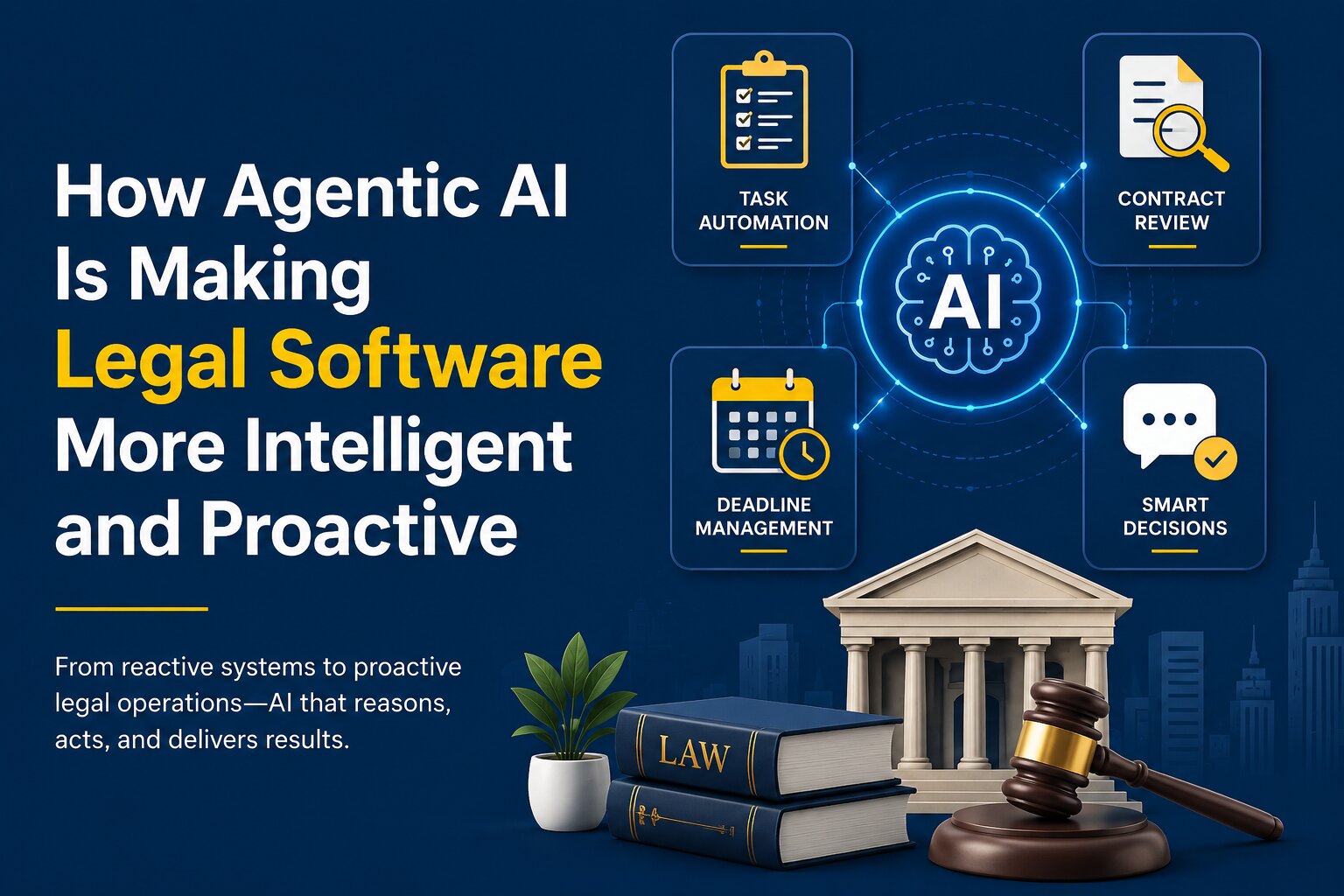
How Agentic AI Is Making Legal Software More Intelligent and Proactive
Legal software has come a long way.
For years, most legal technology has worked in a fairly predictable way: a lawyer or legal team enters information, selects an action, and the software performs it. Create a task. Upload a contract. Set a reminder. Generate a report.
That model has delivered enormous efficiency gains, but it still leaves much of the decision-making and follow-up to people.
Agentic AI introduces a different idea.
Instead of simply waiting for instructions, an agentic system can work toward a defined goal, break that goal into steps, use connected tools, evaluate what happens, and determine what needs to happen next. In legal software, that could mean moving from simply notifying a lawyer about an approaching deadline to helping identify the work required, checking its status, escalating delays, and coordinating the next steps.
This does not mean AI is replacing lawyers or independently making legal judgments. Rather, it points towards software that can take on more of the operational work surrounding legal decisions.
That distinction matters.
1. From Software That Waits to Software That Acts
Traditional legal software is generally reactive. A contract management system might send a renewal reminder because a date has been entered. A case management platform might show that a task is overdue. A compliance system might generate an alert when a predefined condition is met. These capabilities remain valuable. But they depend heavily on rules, triggers and human intervention.
Agentic AI changes the relationship between the user and the software. Instead of asking, "What should I click next?", a legal professional could increasingly say, "Review the outstanding matters that need attention this week and prepare the next steps." The system could then gather relevant information, assess the workflow, identify incomplete tasks, prioritise them, and present actions for approval.
The important word here is proactive. A proactive legal system does not simply tell a legal team what has already happened. It helps them understand what may happen next and what action could be taken now. This is where agentic AI becomes particularly interesting for legal technology.
2. The Technology Behind Agentic Behaviour
Agentic AI is not simply a more advanced chatbot.
A conventional AI interaction might look like this:
Prompt → response
An agentic workflow is more like:
Goal → planning → actions → evaluation → next action → completion or escalation
That difference creates several important capabilities.
Goal-directed reasoning
An agent can be given an objective rather than a single isolated instruction.
For example, instead of asking an AI system to summarise a contract, a legal team could eventually give it a broader operational objective such as identifying agreements approaching renewal, checking the relevant obligations, and preparing a list of contracts requiring human review. The system still needs boundaries and permissions, but the task is no longer limited to generating a single answer.
Planning and multi-step execution
Legal work rarely consists of one action. Consider a contract renewal. A team may need to locate the agreement, identify the renewal date, check the relevant obligations, review the current status, contact the responsible business owner, obtain approval and document the outcome.
Agentic systems are designed to handle this kind of multi-step workflow by coordinating different actions rather than treating every step as a separate user request.
Memory and context
Context is another important part of agentic behaviour. Legal teams work with matters over weeks, months or even years. A useful system needs to understand what has already happened rather than treating every interaction as a completely new conversation. Context retention can allow an AI system to work from previous tasks, documents, instructions and workflow states, subject to the system's permissions and data controls.
That is what makes the idea of an AI that can "pick up where it left off" possible.
Decision loops
An agentic system can also evaluate the result of an action before deciding what to do next. Suppose an automated workflow requests an approval but receives no response. A conventional system may simply wait or send another predefined reminder. A more advanced agent could recognise that the task remains unresolved, check the workflow rules, determine whether escalation is appropriate, and recommend or initiate the next permitted step.
This is a significant shift from simple automation.
Tool use and orchestration
Agents become much more useful when they can work with other systems. Legal operations rarely happen inside one application. A legal team may use contract management software, email, calendars, document repositories, financial systems, CRM platforms and compliance tools.
Agentic AI can potentially orchestrate actions across these connected systems. That is one reason integrations and APIs are becoming increasingly important in legal technology. The intelligence of an agent is only as useful as the information and tools it can access safely.
3. Reactive vs. Proactive: What Actually Changes?
The easiest way to understand agentic AI is to compare it with traditional automation.
| Traditional / Reactive Software | Agentic / Proactive Software |
|---|---|
| Waits for a trigger | Works towards a defined goal |
| Follows predefined rules | Can plan multiple steps |
| Performs a specific action | Coordinates a sequence of actions |
| Reports what happened | Can evaluate what happens next |
| Requires users to initiate many tasks | Can identify and initiate permitted actions |
| Primarily executes workflows | Can reason within workflow boundaries |
Traditional automation and Agentic AI are not simply two versions of the same technology; they approach legal workflows differently. To explore this distinction in more detail, read our guide on Agentic AI vs Traditional Legal Automation: What's the Difference?, which breaks down how rule-based automation compares with context-aware, goal-oriented AI.
Consider a missed legal deadline. A traditional system might identify that a deadline has passed and send an alert. A more proactive system could identify that a deadline is approaching, check whether the required task has been completed, determine whether the assigned person has taken action, and escalate the matter if the workflow permits.
The distinction is subtle but important.
The first system tells you there is a problem.
The second attempts to help prevent the problem from happening in the first place.
Of course, that does not mean an agent should be allowed to make unrestricted legal decisions. For high-stakes matters, human review remains essential.
The goal is not autonomous legal judgement.
The goal is autonomous operational assistance within clearly defined boundaries.
4. Why Agentic AI Is Becoming Possible Now
The idea of intelligent software is not new. What has changed is the combination of technologies now available.
Better reasoning models
Modern AI models have become increasingly capable of handling complex instructions and multi-step reasoning. This makes them more suitable for workflows that require context, planning and evaluation rather than a single response.
They are still imperfect, but the underlying capabilities are significantly broader than earlier generations of AI systems.
Better integration layers
An AI system cannot be truly useful in legal operations if it exists in isolation. Modern integration technologies allow software to connect with other applications, databases and business workflows. This creates the foundation for AI systems that can retrieve information and perform actions across multiple tools.
For legal teams, that could eventually mean an AI layer that connects matters, contracts, documents, tasks, calendars and compliance processes.
Better evaluation and controls
Agentic AI also requires stronger safeguards. Legal technology deals with confidential documents, privileged information, regulatory obligations and decisions that can have significant consequences. As a result, autonomy needs to be accompanied by access controls, audit trails, approval mechanisms, monitoring and clear escalation paths.
The future is therefore not simply about making AI more autonomous.
It is about making AI more capable while keeping it controlled, explainable and accountable.
5. How Agentic AI Could Transform Everyday Legal Work
The most interesting impact of agentic AI may not come from one dramatic capability. It may come from dozens of small improvements across everyday legal operations.
Matter management
An agent could monitor the status of active matters, identify stalled tasks, surface important changes and help prioritise work. Instead of lawyers manually reviewing every matter to determine which needs attention, the system could provide a more focused view of exceptions and priorities.
Contract management
Contracts contain dates, obligations, approvals, renewals and dependencies. Agentic technology could help monitor these elements continuously.
For example, it could identify agreements approaching renewal, check whether relevant obligations have been completed, surface unusual clauses for review and prepare the information needed for a renewal decision. Existing legal software already uses automation, alerts, search and analytics to make contract management more proactive. Agentic AI could take this further by coordinating multiple steps around those workflows.
Compliance monitoring
Compliance is another area where proactive technology can be valuable. Legal teams often need to track regulatory obligations, internal policies, filings, deadlines and evidence of compliance. An intelligent system could continuously monitor relevant workflows, identify potential gaps and bring exceptions to the attention of the appropriate person.
This does not remove the need for legal interpretation. It reduces the amount of manual monitoring required before a lawyer can make that interpretation.
Legal research and information gathering
Agentic AI could also change how legal professionals approach research. Rather than returning a single answer, an AI agent could potentially break a research assignment into smaller tasks, gather information from approved sources, organise findings and prepare a structured research package for review. For a closer look at how AI is being applied to legal research in the region, see our guide on AI in Legal Research: What Law Firms in the GCC Need to Know.
Human verification remains critical, particularly where legal authorities, citations or jurisdiction-specific interpretations are involved.
Deadline and task management
This may be one of the most practical applications. Legal teams deal with hundreds of dates and dependencies. Existing legal management systems can already automate reminders, task assignments and deadline tracking.
Agentic systems could make these workflows more context-aware by considering the status of related tasks and identifying where intervention may be required.
Risk identification
Legal technology is also moving towards better risk visibility. Analytics can highlight patterns in contracts, disputes, compliance activities and workloads. AI can help interpret those patterns and identify areas that deserve closer attention.
The important shift is from asking, "What happened?" to also asking, "What might require attention next?"
6. How Beveron Technologies Is Advancing Legal Technology
This shift towards intelligent and proactive legal operations is already influencing how legal software is being designed. Beveron Technologies is one example of a legal technology company building software around the operational realities of law firms, corporate legal departments and related legal functions. Its product portfolio covers different parts of the legal workflow, from legal practice and corporate legal management to contracts, intellectual property and debt collection.
What makes this approach relevant to the agentic AI conversation is not simply the presence of AI. It is the broader focus on automation, centralised information, workflow management, analytics and proactive monitoring. Those capabilities provide the operational foundation on which more advanced agentic functionality can be built. For law firms considering this transition, understanding how to introduce Agentic AI in a structured way is equally important. Our guide on How to Implement Agentic AI in Your Law Firm: A Step-by-Step Guide for 2026 explains the practical steps involved, from assessing workflow readiness and choosing suitable use cases to protecting data and measuring results.
Smart Legal Counsel
Smart Legal Counsel is designed for corporate and in-house legal teams. It brings together areas such as matter management, contracts, compliance, tasks, reporting and legal workflows. Beveron's materials describe capabilities including automated workflows, centralised tracking, dashboards, collaboration and deadline management.
For an in-house legal department, the value is straightforward: less fragmented tracking and greater visibility into what is happening across the legal function. That foundation becomes especially important as legal teams move towards more proactive and AI-assisted workflows.
Smart Lawyer Office
Smart Lawyer Office focuses on law firm and legal practice management. It is intended to help firms organise matters, clients, documents, tasks and other operational activities in a centralised environment. Legal practice management platforms can reduce the administrative burden associated with manual case tracking, document management and day-to-day coordination.
For law firms, this creates a structured digital environment where automation and intelligent assistance can be applied across everyday practice operations.
Smart Legal Contract
Smart Legal Contract focuses on contract lifecycle management. Contract management is particularly suited to intelligent automation because contracts contain structured information such as parties, dates, obligations, clauses, approvals, renewals and compliance requirements. Beveron's contract management materials highlight capabilities such as centralised contract storage, advanced search, analytics, automated alerts, obligation tracking and AI-enabled insights.
These capabilities can help legal teams move from simply storing contracts to actively managing the risks and obligations contained within them.
Smart Debt Collection
Smart Debt Collection extends Beveron's technology portfolio beyond traditional legal practice management into receivables and debt recovery operations. It is designed to help organisations manage collection workflows, cases, communication, payments and reporting in a more structured way.
This is relevant to the broader agentic AI discussion because debt recovery, like legal operations, involves many connected steps, decisions and follow-ups. The more those processes can be organised digitally, the greater the opportunity for intelligent workflow automation.
Taken together, these products show an important principle: agentic AI works best when it has a structured operational environment to work within.
AI alone is not the complete solution. The underlying data, workflows, permissions, integrations and auditability matter just as much.
7. Where Legal Software Is Headed
The next phase of legal software is unlikely to be defined by a single AI feature. Instead, we are likely to see a gradual shift from individual automation features towards connected, end-to-end workflows.
Today, a legal professional might use separate tools for contracts, matters, documents, email and reporting.
Tomorrow, increasingly intelligent systems may sit across these processes and help coordinate them.
The interaction model could change as well. Instead of operating software one screen at a time, legal professionals may increasingly delegate well-defined tasks.
For example:
"Identify contracts requiring renewal within the next 90 days, prioritise those with unresolved obligations, and prepare a review list."
Or:
"Review our open matters, identify those with upcoming deadlines and unresolved tasks, and prepare an action summary for the team."
The software would not simply produce an answer. It could potentially gather the required information, work through a series of permitted steps and return a result for human review.
That is a very different experience from traditional software. But there is an important caveat. Legal technology cannot treat autonomy as an excuse to remove oversight. A mature agentic legal system will need clear permissions, human approval points, auditability, data security and mechanisms for escalation. The higher the legal or financial risk, the more important those safeguards become.
Legal professionals should therefore watch not only how intelligent AI becomes, but also how reliably it can operate within controlled environments.
8. Conclusion: A New Operating Model for Legal Technology
Agentic AI is not simply a bigger chatbot or another layer of automation. It represents a potential change in how software behaves. Traditional software waits for instructions. Automation follows predefined rules. Generative AI produces information. Agentic AI attempts to connect reasoning, planning, tool use and action around a defined objective.
For legal teams, that could mean software that does more than store information and send reminders. It could help identify priorities, coordinate workflows, monitor obligations, surface risks and prepare the next action before a problem becomes urgent.
The technology is still developing, and legal professionals should approach autonomy with appropriate caution. Not every legal task should be delegated to an AI agent, and human judgement will remain central to high-stakes legal work.
But the direction is clear.
Legal software is moving from systems that help people operate processes towards systems that can increasingly participate in those processes.
Companies such as Beveron Technologies are already building the digital foundations around legal workflows, automation, analytics, contracts, matters, IP and collections. As agentic capabilities mature, those foundations could become increasingly important in creating legal technology that is not only intelligent, but genuinely proactive.
The future of legal software may not be about asking technology to do more on command. It may be about giving technology a clearly defined goal — and allowing it to help move the work forward.
Ready to Move from Reactive Legal Workflows to Proactive Legal Operations?
Give your legal team smarter tools to manage matters, contracts, deadlines, compliance and everyday workflows.
Explore Beveron’s Legal Technology Solutions
Best agentic AI in legal software in the UAE
Best agentic AI for legal technology in the UAE
Best AI-powered legal operations for legal teams in the UAE
If you need a free demo of the best debt collection management software for finance teams in the UAE, please fill out the form below.