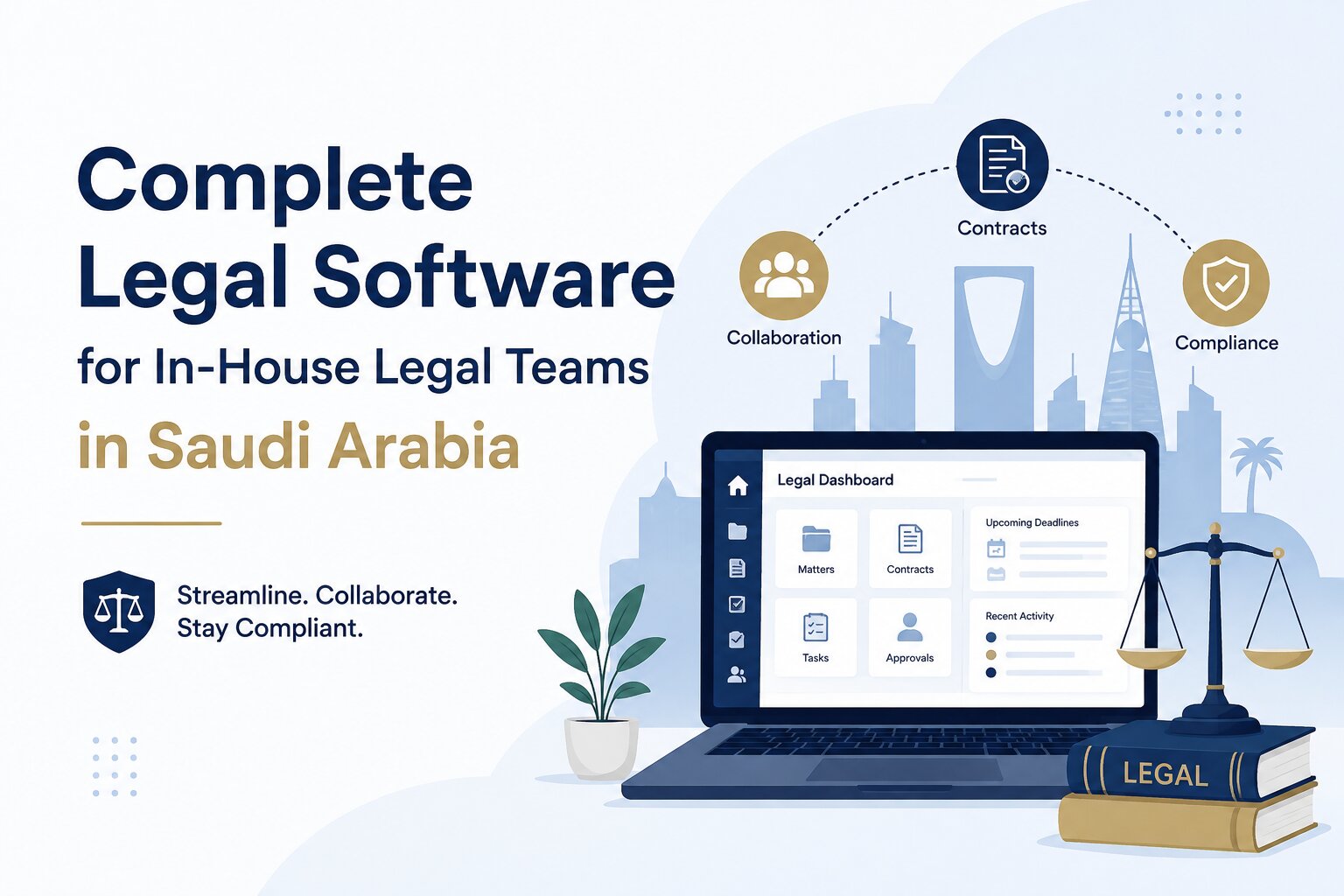
Complete Legal Software for In-House Legal Teams in Saudi Arabia
For many businesses in Saudi Arabia, the legal team is involved in far more than reviewing contracts. In-house lawyers may handle agreements, legal requests, corporate documents, compliance tasks, disputes, approvals, deadlines and communication with different departments. When all of this is managed through emails, spreadsheets, shared folders and separate systems, it can quickly become difficult to keep track of what is happening. A contract may be sitting in someone's inbox, an important renewal date may be missed, or a legal request may have no clear owner.
This is where legal software for in-house legal teams can make a practical difference.
A centralised legal platform gives teams one place to manage matters, contracts, documents, tasks and workflows. For Saudi businesses going through digital transformation and managing increasingly complex regulatory requirements, the right platform can help make legal operations more organised, visible and easier to manage.
This guide explains what to look for when choosing complete legal software for in-house legal teams in Saudi Arabia and the questions to ask before investing in a platform.
Why In-House Legal Teams in Saudi Arabia Need Dedicated Software
Legal work tends to grow as a business grows. More employees, suppliers, customers, contracts and business relationships mean more legal work to coordinate. Yet many legal teams still depend heavily on email and spreadsheets to manage that workload.
Some common challenges include:
- Contracts stored across different folders and email accounts
- Difficulty finding the latest version of a document
- Missed contract renewal or expiry dates
- Manual approval and review processes
- Limited visibility into ongoing legal matters
- Repeated follow-ups between legal and business teams
- No central record of actions and decisions
- Time-consuming reporting
If you are comparing solutions for your legal department, our guide to in-house legal department software for Saudi businesses explores the key capabilities and considerations to evaluate before choosing a platform.
These issues may seem manageable when the legal team is small. As the volume of work increases, however, they can create unnecessary delays and increase the risk of mistakes.
For Saudi businesses, keeping up with changing regulations and compliance requirements is an ongoing responsibility. Legal teams often need to track important documents, deadlines, approvals and internal processes, which can become difficult when everything is managed manually.
Legal software does not automatically make an organisation compliant with these requirements. However, a well-designed platform can help legal teams organise compliance-related tasks, maintain records, set reminders and create a clearer audit trail.
For businesses investing in digital transformation as part of Saudi Arabia's broader Vision 2030 agenda, bringing legal operations into a digital workflow can also help reduce reliance on disconnected manual processes.
Key Features to Look for in Legal Software for Saudi Businesses
Not every legal software platform offers the same capabilities. Before choosing one, in-house legal teams should focus on the features that address their actual day-to-day problems.
1. Contract Lifecycle Management
Contracts often move through several stages before and after they are signed. A legal team may need to draft an agreement, review changes, coordinate approvals, negotiate terms, store the final document and monitor its renewal date. Contract lifecycle management (CLM) brings these stages together in a structured process.
Contract lifecycle management (CLM) brings these stages together in a structured process. For a closer look at how legal software can simplify contract processes, explore our guide to streamlining contract management with in-house legal department software.
Look for features such as:
- Contract drafting and review
- Approval workflows
- Version control
- Document storage
- Renewal and expiry reminders
- Contract status tracking
- Search and retrieval
This reduces the need to search through long email threads or multiple folders to understand where a contract stands.
2. Legal Matter Management
Legal teams handle much more than contracts. They may manage disputes, legal requests, corporate matters, external counsel, compliance activities and other ongoing work. Legal matter management software gives teams a central place to track these matters.
Useful capabilities include assigning matters to team members, recording deadlines, storing related documents, tracking activities and monitoring progress. This creates better visibility across the legal department and helps team members understand what needs attention.
3. Compliance and Regulatory Tracking
Compliance-related work can involve multiple deadlines, documents, responsibilities and follow-ups. A legal management platform can help teams record obligations, assign tasks, set reminders and maintain supporting documentation. For a broader look at common compliance challenges and how businesses can strengthen their compliance processes, see our guide to why compliance programmes fail and how to identify the warning signs.
For Saudi businesses, this can be particularly useful when legal teams are coordinating activities connected to areas such as data protection, corporate requirements and tax-related obligations. The platform should support the organisation's compliance process rather than replace legal advice or regulatory review.
4. Arabic and English Support
Saudi businesses often work across Arabic and English, particularly when dealing with local authorities, employees, customers, suppliers and international partners. For this reason, in-house legal software in Saudi Arabia should support the language needs of the organisation.
When evaluating a platform, check whether it can effectively accommodate Arabic and English documents and workflows. If bilingual operations are part of your daily work, this should be treated as a practical requirement rather than an optional feature.
5. Workflow Automation
Legal teams spend a surprising amount of time following up on simple tasks. A contract may need approval from procurement, finance and management before it reaches the legal team again. Without a structured workflow, these steps can become a chain of emails.
Workflow automation can help route requests to the right person, send notifications, assign tasks and keep work moving. For a deeper look at how automation can improve legal processes, explore our guide to legal workflow automation for corporate legal departments in Saudi Arabia
The goal isn't to remove human decision-making. It is to reduce repetitive administrative work so lawyers can spend more time on matters that require their expertise.
6. Reporting and Audit Trails
Legal leaders need to know what the team is working on.
A useful legal management solution should make it easier to answer questions such as:
- How many legal matters are currently open?
- Which contracts are approaching renewal?
- What requests are waiting for approval?
- How much work is assigned to each team member?
- What actions have been taken on a particular matter?
An audit trail can also provide a record of activities, helping teams understand what happened and when.
7. Security, Data Governance and Integrations
Legal departments deal with sensitive business information, including contracts, corporate records, personal information and confidential communications. When assessing legal software in Saudi Arabia, ask the vendor about access controls, security measures, data handling and hosting arrangements. If your organisation has specific data residency or regulatory requirements, these should be reviewed with your legal and IT teams before selecting a platform.
It is also worth checking whether the software can integrate with existing systems such as ERP platforms, document management systems and email.
Questions to Ask Before Choosing Legal Software in Saudi Arabia
A product demonstration can look impressive, but the right choice depends on how well the software fits your actual legal workflow.
Before making a decision, ask:
Does it support Arabic and English workflows?
This matters if your team regularly manages bilingual documents or communicates with local and international stakeholders.
Can it manage contracts and legal matters in one platform?
Having related information in one system can reduce unnecessary switching between applications.
How does it handle sensitive legal information?
Ask about user permissions, security, hosting and data handling.
Can it scale with the business?
The platform should be able to accommodate increasing contract volumes, matters, users and business requirements.
How difficult is implementation?
Understand the expected timeline, data migration process, training requirements and ongoing support.
Does the vendor understand the GCC market?
Local and regional experience can be useful when the legal team's workflows have specific requirements.
How Smart Legal Counsel Fits the Checklist
For businesses seeking corporate legal management software in Saudi Arabia, Smart Legal Counsel by Beveron Technologies is designed to centralise key legal operations in a digital environment. The platform can be considered against the same criteria discussed above, including legal matter management, document management, contract-related workflows, task tracking, reporting and collaboration. Instead of keeping information across disconnected emails, spreadsheets and folders, an integrated legal platform can give the in-house team a clearer view of its ongoing work.
For organisations evaluating a platform, it is still important to assess the product against their own security, integration, language and regulatory requirements before making a purchasing decision. Beveron's ISO 9001 certification can also provide an additional quality-management trust signal when evaluating the vendor.
A Simple Implementation Checklist
Choosing legal software is only the first step. A structured implementation can make adoption much easier.
Start with these steps:
- Review your current process — Identify where contracts, matters, documents and requests are currently stored.
- List the biggest problems—look for missed deadlines, repeated manual work, poor visibility and approval delays.
- Define must-have features — Separate essential requirements from features that would simply be nice to have.
- Shortlist two or three platforms — Compare them against the same criteria.
- Request a demonstration—Ask vendors to demonstrate real workflows rather than only showing individual features.
- Run a small pilot — Start with one contract type or a specific legal workflow.
- Train the team—Make sure users understand how the platform fits into their daily work.
- Measure the results—Track improvements in turnaround time, visibility, document organisation and administrative effort.
Frequently Asked Questions
Is legal software compliant with Saudi data protection law?
Using legal software does not automatically make a business compliant with Saudi data protection requirements. Organisations should assess the platform's security, data handling and hosting arrangements alongside their own obligations under applicable laws, including the PDPL.
Can in-house teams manage bilingual contracts on one platform?
This depends on the software. Businesses that regularly work in Arabic and English should confirm that the platform can support their document, workflow and collaboration requirements in both languages.
How long does legal software implementation take?
Implementation time varies depending on the size of the organisation, the number of users, data migration needs, integrations and the complexity of existing workflows. A small pilot can often be a practical starting point before wider deployment.
What should Saudi businesses consider when choosing legal software?
Start with your team's actual needs. Consider legal matter management, contract management, workflow automation, reporting, security, bilingual requirements, integrations, scalability and the vendor's implementation and support capabilities.
Conclusion
For Saudi businesses, legal teams are becoming increasingly involved in complex contracts, compliance activities and day-to-day business decisions. Managing all of this through email and spreadsheets can make it harder to maintain visibility and keep work moving. The right legal software for in-house legal teams can bring contracts, matters, documents, tasks and workflows into one organised environment.
When comparing platforms, look beyond the feature list. Consider how the software fits your team's existing processes, whether it supports your Arabic and English requirements, how it handles sensitive information, whether it can scale and how easily your team can adopt it. For businesses exploring a more organised approach to legal operations, Smart Legal Counsel offers a platform to centralise and manage key legal activities.
Book a Smart Legal Counsel demo to explore how your in-house legal team can manage legal matters, documents, contracts and workflows in one place.
Best in-house legal management software in Saudi Arabia
Best legal department software in Saudi Arabia
Best corporate legal management software in Saudi Arabia
If you need a free demo of the best in-house legal management software in Saudi Arabia, please fill out the form below.