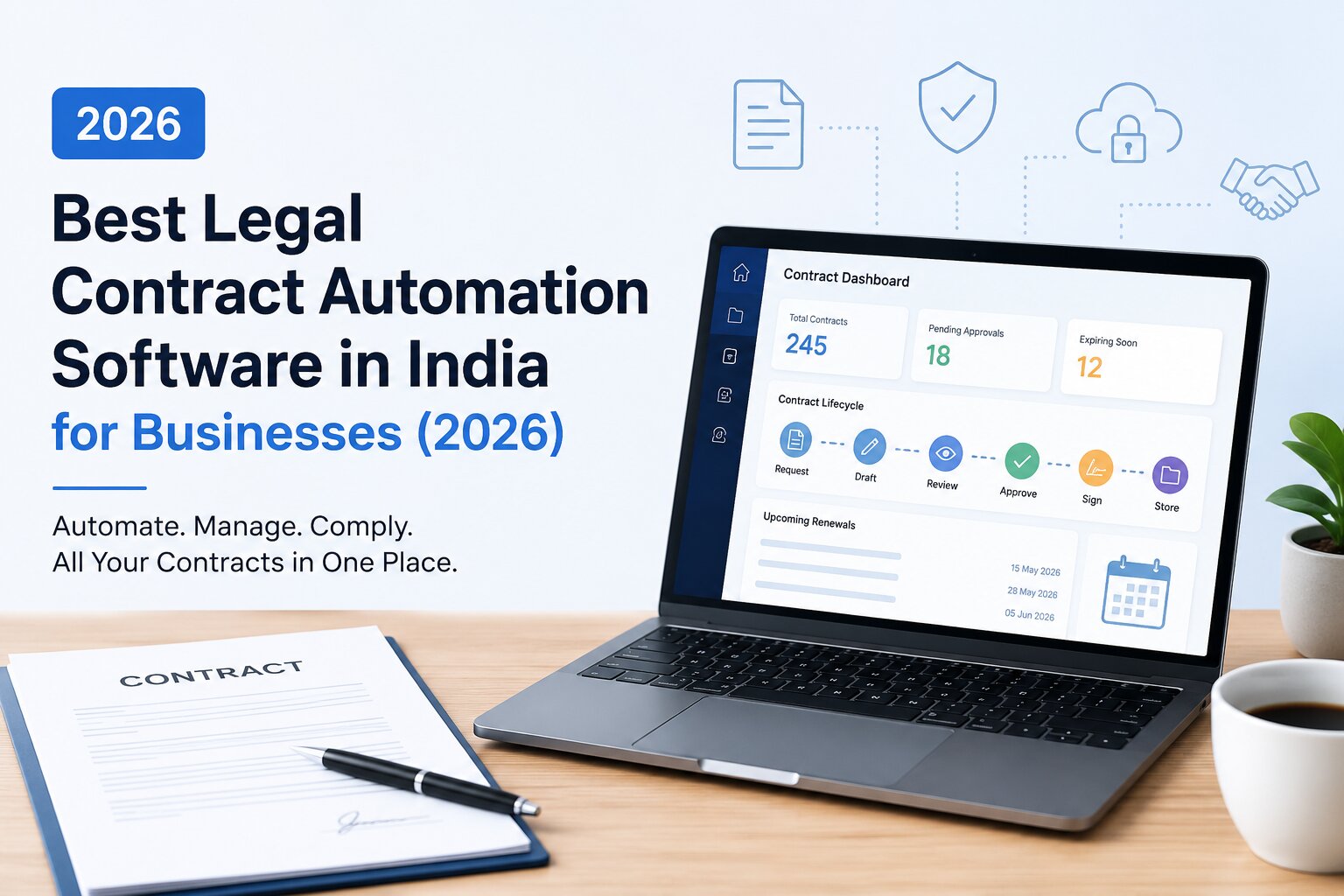
Best Legal Contract Automation Software in India for Businesses (2026)
Introduction
Contracts are the backbone of every business relationship. Whether you're onboarding a new employee, signing a vendor agreement, negotiating with suppliers, or closing a customer deal, contracts define responsibilities, reduce risks, and protect business interests.
As businesses across India continue to grow, so does the volume and complexity of contracts they manage. Start-ups are expanding into new markets, SMEs are building larger supplier networks, and enterprises are handling thousands of contracts across multiple departments. Managing these agreements manually using emails, spreadsheets, and shared folders is becoming increasingly difficult.
Manual contract management often leads to delayed approvals, misplaced documents, missed renewal dates, inconsistent contract language, and compliance risks. These issues not only slow business operations but can also result in financial losses and legal disputes.
This is where legal contract automation software makes a significant difference.
Instead of relying on time-consuming manual processes, businesses can automate contract creation, approvals, storage, tracking, and renewals through a single digital platform. The result is faster workflows, improved compliance, better collaboration, and greater visibility across the entire contract lifecycle.
In this guide, we'll explore what legal contract automation software is, why Indian businesses are increasingly adopting it, the essential features to look for, and how choosing the right solution can improve operational efficiency while reducing legal risk.
What is Legal Contract Automation Software?
Legal contract automation software is a digital solution that simplifies and automates the entire process of creating, reviewing, approving, signing, storing, and managing contracts.
Rather than preparing every contract from scratch, legal teams can use pre-approved templates, clause libraries, and automated workflows to generate consistent agreements within minutes. The software also tracks contract milestones, renewal dates, obligations, approvals, and amendments throughout the agreement's lifecycle.
Unlike simple document generation tools, contract automation software manages the complete contract lifecycle—from the initial request through drafting, negotiation, approval, execution, renewal, and eventual expiry.
For example, consider an Indian manufacturing company onboarding a new supplier. Instead of exchanging multiple email versions of the agreement, the procurement team can initiate a request within the software. The system automatically selects the correct contract template, inserts business-specific information, routes the agreement to the relevant approvers, collects electronic signatures, stores the final contract securely, and sends reminders before renewal deadlines.
This reduces manual effort while ensuring every contract follows the organisation's approved legal and compliance standards.
Why Indian Businesses Need Contract Automation
Indian organisations are operating in an increasingly fast-moving business environment. Companies are working with more vendors, customers, partners, and employees than ever before, resulting in a steady increase in contract volumes.
Managing these agreements manually becomes challenging as businesses scale.
Some of the most common issues organisations face include:
- Contracts scattered across emails and shared folders
- Slow approval cycles involving multiple departments
- Difficulty locating the latest version of an agreement
- Missed renewal or termination deadlines
- Inconsistent legal clauses across contracts
- Limited visibility into contractual obligations
- Increased compliance and audit risks
These challenges affect businesses across industries.
These operational inefficiencies don't just delay contract approvals—they also reduce productivity across legal and business teams. If you'd like to explore the impact in more detail, read our guide on why corporate legal teams in India lose productivity without contract automation, which explains how manual contract processes create bottlenecks and slow business operations.
- Technology companies manage software licensing agreements, NDAs, and service contracts.
- Manufacturing firms oversee supplier agreements, procurement contracts, and logistics partnerships.
- Healthcare organisations handle vendor contracts, service agreements, and regulatory documentation.
- Banks and financial institutions manage lending documents, compliance records, and customer agreements.
- Retail businesses coordinate supplier contracts, franchise agreements, and commercial partnerships.
As India's digital economy continues to expand, businesses are increasingly investing in technologies that improve operational efficiency while supporting governance and compliance.
Legal contract automation software enables organisations to achieve exactly that by replacing fragmented manual processes with structured, transparent, and automated workflows.
For many organisations, contract automation is the first step towards a complete contract lifecycle management (CLM) strategy. If you're exploring how businesses are replacing manual contract processes with end-to-end lifecycle management, read our guide on why law firms are moving from manual processes to contract lifecycle management automation.
Key Features to Look for in the Best Legal Contract Automation Software in India
Not every contract automation platform offers the same capabilities. The right solution should do much more than simply generate documents. It should help legal, procurement, finance, HR, and business teams collaborate efficiently throughout the contract lifecycle. Here are some of the essential features businesses should look for.
Contract Templates
Pre-approved templates allow teams to generate contracts quickly while maintaining consistency. Instead of creating agreements from scratch, users can select the appropriate template for employment contracts, vendor agreements, sales contracts, or service agreements. This saves time and reduces drafting errors.
Clause Library
A centralised clause library gives legal teams access to approved legal language for common contractual terms. Standardising clauses helps minimise legal risk and ensures every agreement aligns with organisational policies.
Automated Document Generation
Once business details are entered, the software automatically generates contracts by populating the relevant information into approved templates. This significantly reduces repetitive manual work while improving accuracy.
Workflow Automation
Modern contract automation software routes agreements through predefined approval workflows. For example, a procurement contract may require approval from procurement, finance, legal, and senior management before execution. Automation eliminates unnecessary follow-ups and keeps approvals moving efficiently.
Version Control
Contract negotiations often involve multiple revisions. Version control allows users to track every modification, compare previous drafts, and maintain a complete history of document changes. This prevents confusion over which version is the latest.
Secure Central Repository
Instead of storing contracts across multiple locations, all agreements are securely organised within a searchable repository. Users can retrieve contracts instantly using keywords, contract numbers, customer names, or specific clauses. This improves accessibility while strengthening governance.
AI-Powered Search and Contract Intelligence
Artificial intelligence is making contract management considerably smarter.
Modern platforms can automatically identify clauses, summarise lengthy agreements, extract key obligations, and highlight unusual contract terms that may require legal attention. This allows legal teams to review contracts more efficiently without reading every page manually.
Alerts and Renewal Reminders
Missing a contract renewal or expiry date can lead to unnecessary costs or business disruption. Automated alerts notify stakeholders before important milestones, ensuring sufficient time for renegotiation, renewal, or termination decisions.
Audit Trails
Every contract action—from drafting and editing to approvals and signatures—is automatically recorded. Comprehensive audit logs improve transparency, support internal governance, and simplify regulatory audits.
Role-Based Access Controls
Sensitive contracts often contain confidential commercial information. Role-based permissions ensure employees only access the contracts relevant to their responsibilities, strengthening information security across the organisation.
Integration with Existing Business Systems
The best contract automation software integrates seamlessly with existing business applications such as ERP, CRM, HRMS, Microsoft 365, and document management systems. This reduces duplicate data entry while improving collaboration across departments.
Reporting and Analytics
Built-in dashboards provide valuable insights into contract performance. Businesses can monitor approval times, contract status, upcoming renewals, workload distribution, and compliance metrics, enabling better operational decision-making.
Benefits of Legal Contract Automation for Indian Businesses
Implementing legal contract automation software is about more than reducing paperwork. It helps businesses create a more organised, efficient, and compliant way of managing contracts from start to finish. As organisations grow, the benefits become even more significant.
Faster Contract Creation
Preparing contracts manually can take hours or even days, especially when multiple stakeholders are involved. Automation enables teams to generate legally approved agreements in minutes using pre-built templates and clause libraries.
This allows legal professionals to spend less time on repetitive drafting and more time on strategic legal work.
Improved Compliance
Businesses in India must comply with various legal, regulatory, and industry-specific requirements. Contract automation helps standardise legal language, maintain approval records, and ensure that only approved clauses are used. This reduces the likelihood of compliance issues while supporting stronger corporate governance.
Better Collaboration Across Teams
Contracts rarely involve just the legal department. Procurement, finance, HR, sales, and business leaders often participate in the review and approval process. A centralised contract management platform enables every stakeholder to collaborate in real time without relying on lengthy email chains or multiple document versions.
Reduced Operational Costs
Manual contract administration consumes valuable employee time and increases the risk of costly mistakes.
By automating repetitive administrative tasks, businesses reduce operational expenses while improving productivity across departments.
Greater Visibility and Control
One of the biggest advantages of automation is complete visibility into every contract.
Decision-makers can quickly identify:
- Contracts awaiting approval
- Upcoming renewals
- Expiring agreements
- Outstanding obligations
- Contract performance metrics
Having this information readily available enables faster and more informed business decisions.
Stronger Risk Management
Missed renewal dates, inconsistent contract language, and unauthorised amendments can expose businesses to unnecessary legal and financial risks.
Automation introduces standardised workflows, approval controls, audit trails, and document versioning, helping organisations minimise these risks while maintaining accountability.
Common Use Cases for Legal Contract Automation
Different departments manage different types of agreements. Contract automation brings consistency and efficiency to each business function.
Business Function | Contract Type | Automation Benefit |
Human Resources | Employment contracts, Offer letters | Faster employee onboarding and standardised documentation |
Procurement | Supplier agreements, Purchase contracts | Quicker approvals and improved vendor compliance |
Sales | Customer contracts, Service agreements | Faster deal closures and improved contract visibility |
Finance | Payment agreements, Loan documentation | Better compliance and renewal tracking |
Legal | NDAs, Commercial agreements, Litigation documents | Centralised contract management and reduced manual drafting |
Compliance | Regulatory agreements | Improved audit readiness and document governance |
Vendor Management | Vendor onboarding and renewals | Automated reminders and supplier lifecycle management |
How AI is Improving Legal Contract Automation
Artificial intelligence is transforming contract automation from a document management tool into an intelligent legal assistant.
Instead of simply storing contracts, AI can analyse, organise, and interpret legal documents, allowing businesses to work more efficiently while reducing manual effort.
Some of the most valuable AI capabilities include:
Intelligent Clause Detection
AI automatically identifies important clauses such as confidentiality, indemnity, liability, termination, payment terms, and dispute resolution.
This allows legal teams to review contracts much faster.
Contract Risk Analysis
While AI can significantly improve contract review, it's equally important to understand its limitations and implement appropriate governance. Learn about the common contract management mistakes corporate legal teams in India should avoid when using AI to ensure your AI-powered contract workflows remain accurate, compliant, and secure.
Smart Search
Rather than searching through folders manually, users can simply ask questions such as:
- Which supplier contracts expire next month?
- Show contracts containing unlimited liability.
- Find all agreements with automatic renewal clauses.
AI retrieves the relevant contracts within seconds.
Contract Summarisation
As AI capabilities continue to evolve, more legal departments across India are using AI-powered contract management solutions to speed up reviews, improve decision-making, and reduce manual work. Learn why Indian legal teams are turning to AI contract management software for faster decisions and how AI is transforming everyday legal operations.
Obligation Tracking
AI continuously monitors contractual commitments and sends reminders before important milestones such as renewals, payment deadlines, reporting obligations, or service-level commitments.
This helps businesses avoid missed obligations and unexpected penalties.
As AI continues to evolve, legal contract automation is becoming increasingly proactive rather than reactive, helping organisations identify risks before they become costly problems.
How to Choose the Best Legal Contract Automation Software in India
With numerous contract management solutions available, selecting the right platform requires careful evaluation. Rather than focusing solely on features, businesses should assess how well the software supports their existing workflows and future growth.
Some important factors to consider include:
Ease of Use
A user-friendly interface encourages faster adoption across legal and business teams.
Security
Look for enterprise-grade security features including encryption, role-based permissions, audit logs, and secure data storage.
Workflow Flexibility
Every organisation has different approval processes.
The software should allow businesses to customise workflows based on their internal policies.
Integration Capabilities
The platform should integrate seamlessly with existing ERP, CRM, HRMS, Microsoft 365, and document management systems.
Scalability
If you're comparing different solutions before making a decision, our guide to the best contract management software for Indian enterprises in 2026 explains the key features, capabilities, and evaluation criteria businesses should consider when selecting a contract lifecycle management platform.
AI Capabilities
Modern AI features such as contract intelligence, clause extraction, smart search, and automated summaries can significantly improve legal productivity.
Vendor Expertise
Technology is only part of the solution.
Selecting a provider with extensive experience in legal technology ensures smoother implementation, better support, and solutions designed specifically for legal and business teams.
Why Businesses Choose Beveron Smart Legal Contract
Choosing the right contract automation platform isn't just about ticking off a list of features. It should fit the way your legal and business teams work, simplify everyday processes, and continue to support your organisation as it grows.
Beveron Smart Legal Contract is a comprehensive contract lifecycle management (CLM) solution designed to help businesses automate and manage contracts from creation to renewal. Built by Beveron Technologies, the platform is designed for organisations that want greater control over contracts while reducing manual work, improving compliance, and accelerating approvals.
Instead of relying on disconnected emails, spreadsheets, and shared folders, teams can manage the entire contract lifecycle through a single, secure platform. Whether it's a vendor agreement, customer contract, employment agreement, or commercial contract, Smart Legal Contract helps keep every stage organised and transparent.
Some of the key capabilities include:
- Automated contract creation using pre-approved templates and standardised clause libraries.
- Configurable approval workflows that route contracts to the right stakeholders automatically.
- AI-powered contract intelligence to extract key information, identify important clauses, summarise lengthy agreements, and support faster contract reviews.
- Centralised contract repository that makes contracts easy to search, retrieve, and manage from one secure location.
- Renewal reminders and obligation tracking to help teams stay ahead of important deadlines and contractual commitments.
- Version control and complete audit trails to maintain transparency throughout the contract lifecycle.
- Role-based access controls that protect sensitive contract information while enabling secure collaboration.
- Integration with existing business systems, including ERP, CRM, Microsoft 365, and other enterprise applications, helping reduce duplicate work across departments.
Because every organisation has its own approval processes and compliance requirements, the platform offers configurable workflows that adapt to existing business practices rather than forcing teams to change the way they work.
Whether you're a growing business managing hundreds of agreements or a large enterprise handling thousands of contracts across multiple departments, Beveron Smart Legal Contract provides the automation, visibility, and governance needed to manage contracts more efficiently while reducing legal and operational risk.
Conclusion
Contracts play a vital role in every organisation, but managing them manually is no longer practical in today's fast-paced business environment.
As Indian businesses continue to expand, contract volumes, compliance requirements, and operational complexity will only increase. Relying on disconnected spreadsheets, emails, and paper-based processes can slow growth, increase legal risks, and reduce operational efficiency. Legal contract automation software provides a smarter approach by streamlining contract creation, approvals, storage, renewals, and compliance through a single integrated platform.
When combined with AI capabilities, businesses gain greater visibility, stronger governance, faster decision-making, and improved collaboration across departments. The right solution is not simply the one with the most features—it's the one that aligns with your organisation's workflows, supports future growth, and enables legal teams to deliver greater value to the business.
If your organisation is exploring ways to modernise contract management, Beveron Technologies offers purpose-built legal solutions designed to help businesses automate legal workflows, strengthen compliance, and manage contracts with confidence.
Book a personalised demo to discover how intelligent contract automation can simplify legal operations and support your organisation's digital transformation.
Frequently Asked Questions
What is legal contract automation software?
Legal contract automation software is a digital platform that automates the creation, review, approval, signing, storage, and management of contracts, helping businesses improve efficiency while reducing legal and administrative risks.
How does contract automation benefit Indian businesses?
It speeds up contract creation, improves compliance, reduces manual work, enhances collaboration between departments, provides better visibility into contractual obligations, and minimises legal risks.
Can small and medium-sized businesses use legal contract automation software?
Yes. Many contract automation solutions are scalable, making them suitable for startups, SMEs, and large enterprises. Smaller businesses often benefit by automating repetitive tasks and reducing administrative costs.
Does legal contract automation software use artificial intelligence?
Many modern platforms include AI-powered features such as contract summarisation, clause extraction, intelligent search, obligation tracking, and risk identification to improve productivity and decision-making.
How secure is legal contract automation software?
Enterprise-grade contract automation platforms typically include encryption, role-based access controls, audit trails, secure cloud or on-premise deployment, and compliance features to protect sensitive business information.
What is the best legal contract automation software in India?
The best solution depends on your organisation's size, workflows, security requirements, and integration needs. Businesses should look for software that offers automation, AI capabilities, strong security, scalability, and legal workflow expertise. Platforms such as Beveron Technologies are designed specifically to help organisations streamline contract lifecycle management while maintaining governance and compliance.
Best legal contract automation software in India
Best AI contract management software India
Best enterprise contract management software in India
If you need a free demo of the best AI-powered software for law firms in the UAE, please fill out the form below.