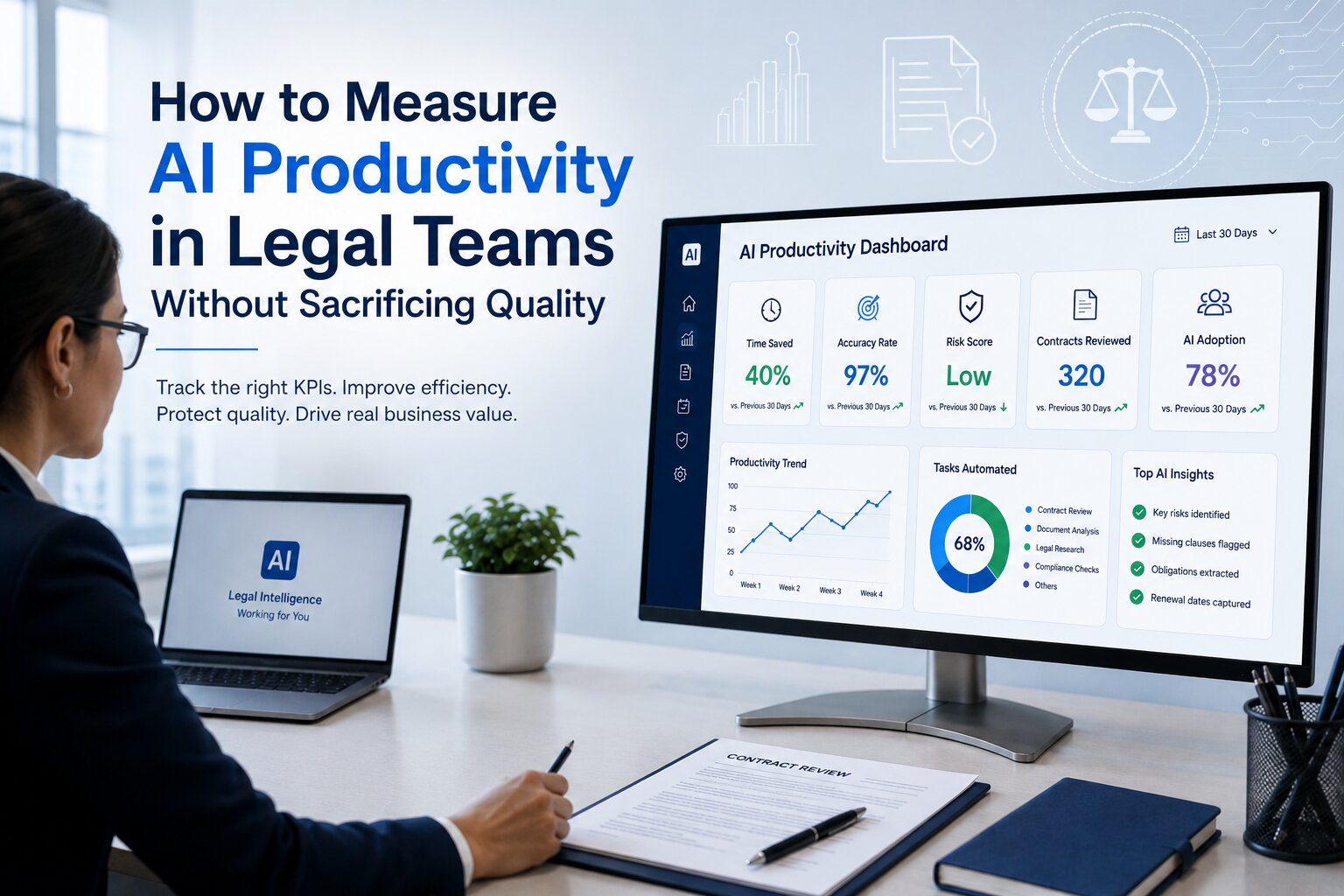
How to Measure AI Productivity in Legal Teams Without Sacrificing Quality
Artificial intelligence is changing the way legal teams handle everyday work. Tasks that once consumed hours—reviewing contracts, summarising documents, researching legal information and identifying obligations—can now be completed much faster with the right AI tools.
As businesses across sectors continue to accelerate digital transformation, many corporate legal departments in the UAE are increasingly exploring AI to improve efficiency, manage growing workloads and support faster decision-making.
But speed alone does not guarantee better results.
A legal department may process twice as many documents with AI and still face challenges if the output contains errors, requires extensive corrections or introduces additional compliance risks. In legal operations, productivity is not measured by speed alone. Accuracy, quality, risk management and business value are equally important, particularly in highly regulated business environments.
This raises an important question: How can legal teams measure AI productivity without compromising the quality of legal work?
The answer lies in using a balanced set of key performance indicators (KPIs) that evaluate both efficiency and outcomes, helping legal teams understand whether AI is truly improving legal operations or simply increasing the speed of work.
Why Traditional Legal Productivity Metrics Are No Longer Enough
For years, legal departments have measured productivity using metrics such as:
- Hours worked
- Matters completed
- Turnaround time
- Billable hours
- Documents processed
These measurements still have value, but AI changes how they should be interpreted. Take contract review as an example. A lawyer might spend several hours manually reviewing a group of agreements. With AI assistance, the first review could be completed much faster, allowing the team to process more contracts in the same amount of time.
However, simply counting the number of contracts reviewed tells only part of the story.
Did the AI identify all critical clauses? How much time did lawyers spend validating its findings? Were significant corrections required? Did the faster process reduce risk or create new challenges?
These questions show why measuring AI productivity in legal teams requires a broader perspective.
The real goal is not simply to complete more work. It is to deliver better legal outcomes with greater efficiency.
What Should Legal Teams Measure When Using AI?
A practical AI productivity framework should focus on six key areas:
- Productivity: How much additional work can the team complete?
- Speed: How much time does AI save?
- Accuracy: How reliable are AI-generated results?
- Quality: Does the final output meet legal standards?
- Risk: Does the process create compliance or operational concerns?
- Business value: Does AI generate meaningful benefits for the organisation?
Looking at these areas together gives legal leaders a much clearer understanding of whether AI is genuinely improving legal operations.
8 Key KPIs for Measuring AI Productivity in Legal Teams
1. Time Saved Per Legal Task
The most straightforward way to measure AI productivity is to compare how long tasks take before and after AI adoption.
Legal teams can track time spent on:
- Contract review
- Legal research
- Document drafting
- Matter summarisation
- Compliance checks
- Document analysis
For example, if reviewing a set of contracts previously required ten hours but now takes six hours with AI assistance, the team has reduced task time by 40%. Time savings are valuable, but they should be viewed as only one piece of the puzzle rather than the ultimate measure of success.
2. Legal Work Output
Another important metric is the amount of work completed during a specific period.
Depending on the department, this could include:
- Contracts reviewed
- Matters processed
- Documents drafted
- Legal requests handled
- Compliance checks completed
Imagine an in-house legal team that previously reviewed 200 supplier contracts each month. After introducing AI-assisted contract analysis, the team now reviews 320 contracts without increasing working hours. At first glance, productivity has improved significantly. However, increased output only matters if the quality of the work remains consistent.
3. AI Accuracy Rate
Accuracy is especially important when AI supports legal work.
Teams should regularly assess how often AI correctly identifies:
- Contract clauses
- Key obligations
- Important dates
- Legal risks
- Relevant information
- Supporting documents
One practical approach is to review a sample of AI-generated results and compare them with the conclusions reached by legal professionals. For example, if an AI system correctly identifies 97 out of 100 critical clauses, the team gains a clearer understanding of where the technology performs well and where human review remains essential.
4. Human Correction Rate
AI may generate useful summaries, draft documents or risk assessments, but lawyers often need to make adjustments before the work is finalised. Tracking the correction rate reveals how much human effort is still required after AI has completed its part of the process. If most AI-generated contract summaries require only minor edits, the technology is creating real value. On the other hand, if lawyers spend hours rewriting every document, the apparent productivity gain may be far smaller than expected.
The objective is not simply to shift work from one stage to another. AI should reduce repetitive effort, not create an additional layer of review.
5. Legal Turnaround Time
Turnaround time measures how quickly legal work moves from request to completion.
AI can help reduce delays in activities such as:
- Contract review
- Document preparation
- Legal research
- Compliance checks
- Internal legal requests
For instance, if contract approval cycles drop from ten days to six days, business teams can move faster without sacrificing legal oversight. The goal is not to rush legal work. It is to eliminate unnecessary delays so lawyers can focus on complex matters that require judgement and expertise.
6. Quality and Error Rate
This is where legal AI productivity differs from traditional workplace productivity. A process that is twice as fast is not necessarily successful if it also produces twice as many errors.
Legal teams should monitor:
- Missed clauses
- Incorrect information
- Inaccurate legal references
- Missed deadlines
- Compliance issues
- Additional review requirements
Consider a team that cuts contract review time by 50% but experiences a sharp increase in missed risks. The efficiency gains quickly lose their value. The objective should always be faster and more accurate, not simply faster.
7. AI Adoption Rate
Simply purchasing AI software does not mean people will use it.
Legal departments should measure:
- Percentage of eligible tasks using AI
- Number of active users
- Frequency of usage
- AI-assisted matters
- Most-used features
Low adoption often points to deeper issues. The technology may be difficult to use, poorly integrated into existing workflows or simply not solving the team's actual problems. Adoption is therefore a critical indicator of whether an AI investment is delivering value.
8. Cost and Business Value
Ultimately, legal leaders need to understand whether AI improves the department's overall contribution to the organisation.
Useful measurements include:
- Cost per legal task
- Cost per contract reviewed
- Internal hours saved
- Reduction in external legal spend
- Operational cost savings
- Faster contract turnaround
These metrics connect legal AI initiatives to business outcomes instead of treating technology as an isolated investment.
A Practical AI Productivity Scorecard for Legal Teams
Rather than relying on a single metric, legal departments can build a balanced scorecard.
| Area | KPI | What It Measures |
|---|---|---|
| Productivity | Tasks completed | Work output |
| Speed | Time saved | Efficiency |
| Accuracy | Error rate | Reliability |
| Quality | Correction rate | Human effort |
| Risk | Compliance issues | Legal exposure |
| Adoption | AI usage | Technology acceptance |
| Business value | Cost savings | Financial impact |
Teams can even assign status indicators to each metric:
- Green: Performing well
- Yellow: Needs improvement
- Red: High risk
This approach prevents one impressive number from hiding another problem.
For example, a 60% reduction in contract review time sounds excellent. But if lawyers spend significantly more time correcting AI-generated outputs, the actual productivity gains may be much smaller.
Benchmark Metrics Legal Teams Can Track
Although every organisation is different, these benchmarks can provide a useful starting point:
| KPI | Example Benchmark |
|---|---|
| AI accuracy rate | 95–98% |
| Correction rate | Less than 15% |
| Turnaround improvement | 30–50% |
| AI adoption rate | More than 70% |
| Reduction in review time | 25–50% |
These figures should not be treated as universal targets. Instead, they provide a baseline that legal teams can adapt to their own workflows and risk requirements.
How to Measure AI Productivity Without Sacrificing Quality
The most effective approach starts with establishing a baseline. Before implementing an AI solution, record how long common tasks take, how much work is completed and what the existing error and correction rates look like. Without this baseline, it becomes difficult to measure improvement accurately.
Next, measure AI performance by specific use case rather than grouping all AI activities.
Contract review, legal research, document drafting and compliance management each have different requirements and should be assessed separately.
Human review also remains essential, particularly for high-impact legal work. AI can support legal professionals, but important decisions and final legal judgement still require appropriate supervision. Responsible AI practices are equally important when implementing productivity metrics. Legal departments must establish clear governance frameworks, maintain human oversight and ensure that AI-generated recommendations align with ethical and compliance standards. Read our article on Responsible AI in LegalTech: Balancing Innovation, Ethics and Compliance to understand how organisations can adopt AI responsibly.
Most importantly, efficiency metrics should always be paired with quality metrics.
For example:
- Time saved ↔ Error rate
- Contracts reviewed ↔ Missed clauses
- Documents generated ↔ Correction rate
- AI adoption ↔ User satisfaction
This balanced approach provides a more realistic picture of AI's true impact.
Common Mistakes When Measuring AI Productivity
Many legal teams make the mistake of focusing on a single metric.
Some of the most common pitfalls include:
- Measuring only time saved: A faster process has little value if quality declines.
- Counting AI output instead of useful output: Producing more drafts does not necessarily mean delivering more legal value.
- Ignoring human review: Time spent validating and correcting AI outputs must be included in productivity calculations.
- Overlooking risk: Confidentiality, compliance, data security and accuracy should always be part of performance measurement.
- Using identical KPIs for every task: Contract review, legal research and matter management require different evaluation methods.
Avoiding these mistakes helps organisations develop a more accurate understanding of AI's contribution.
The Future of Legal Productivity Is About Outcomes
As AI becomes more common, legal departments are likely to rethink how productivity is defined. Instead of asking, "How many hours did the legal team work?", organisations will increasingly ask, "What valuable legal outcomes did the team deliver?"
Future legal KPIs are likely to focus more heavily on:
- Accuracy and risk reduction
- Faster decision-making
- Quality of legal service
- Business impact
- Stakeholder satisfaction
As legal departments redefine productivity, General Counsel are also rethinking how their teams, processes and technology should evolve in an AI-driven environment. Building a strong foundation for AI adoption requires more than new tools; it requires the right governance, workflows and operational strategy. Explore our article, Building an AI-Ready Legal Department: What General Counsel Should Do First, to learn the practical steps legal leaders can take to prepare their organisations for the future.
AI is not replacing legal expertise. Its greatest value lies in giving lawyers more time to focus on strategy, negotiation and the complex decisions that require human judgement.
How Beveron Technologies Supports Modern Legal Teams
As legal departments adopt AI and data-driven workflows, measuring productivity becomes much easier when all legal activities are managed from a single platform. This is where Beveron Technologies helps organisations, including businesses across the UAE, bring together legal operations, contract management, compliance and matter management into one connected ecosystem. Explore how Beveron supports legal professionals across different practice areas on our Legal Sector Solutions page.
Beveron Technologies develops legal technology solutions designed for corporate legal departments, law firms and compliance teams. Its portfolio includes solutions for legal operations management, contract lifecycle management, case management, intellectual property management and debt collection, helping organisations in the UAE and beyond improve visibility, streamline workflows and make better decisions.
Beveron Smart Legal Counsel: AI-Powered Legal Operations Software
Beveron Smart Legal Counsel is Beveron's comprehensive legal operations and corporate legal management platform built to help in-house legal teams manage matters, contracts, approvals, legal requests and compliance activities from a single workspace.
As legal departments in the UAE and other markets handle growing workloads, fragmented processes and increasing compliance obligations, measuring productivity becomes more complex. Smart Legal Counsel provides legal teams with the visibility and operational insights needed to track performance while maintaining quality and reducing risk.
The platform enables legal teams to:
- Manage legal matters and requests in a centralised system
- Track contract lifecycles from drafting to renewal
- Monitor obligations, approvals and key deadlines
- Automate repetitive legal workflows and notifications
- Improve collaboration between legal and business teams
- Store and organise legal documents securely
- Analyse legal workloads and turnaround times
- Generate reports and productivity metrics for legal leadership
With AI-powered capabilities, Smart Legal Counsel can support legal professionals in areas such as:
- Contract review and clause analysis
- Legal document summarisation
- Legal research assistance
- Obligation and risk identification
- Intelligent search across legal documents
- Workflow recommendations and automation
More importantly, the platform helps legal departments measure the KPIs discussed in this article, including:
- Time saved per legal task
- Contract turnaround times
- AI adoption rates
- Legal work output
- Error and correction rates
- Compliance and risk indicators
- Operational efficiency and cost savings
Rather than replacing legal expertise, Smart Legal Counsel is designed to reduce administrative work and give lawyers more time to focus on strategic decision-making, negotiations and complex legal analysis. For organisations looking to improve productivity without compromising legal quality, Beveron's Smart Legal Counsel provides a structured foundation for building more efficient, measurable and AI-enabled legal operations.
Beveron's Legal Technology Ecosystem
Beveron's broader legal technology ecosystem includes:
- Smart Legal Counsel - Legal operations and corporate legal management software for in-house teams.
- Smart Lawyer Office - Case and matter management software for law firms and legal practices.
- Smart Legal Contract - AI-powered contract lifecycle management and contract review software.
- Smart Debt Collection - Debt recovery and collections management software for banks, financial institutions and collection agencies.
Together, these solutions help legal and finance teams streamline operations, improve visibility, reduce risk and make data-driven decisions across the entire legal lifecycle.
Conclusion
Measuring AI productivity in legal teams is about far more than counting hours saved or documents processed.
A successful AI-enabled legal workflow should deliver more useful work in less time while maintaining accuracy, quality and strong risk controls. The most effective legal teams will not necessarily be those using the most AI. They will be the teams that understand where AI creates value, where human expertise remains essential and how to measure the difference.
To track these KPIs effectively, legal departments need visibility into contracts, approvals, workloads and legal operations. Platforms such as Beveron's Smart Legal Counsel help teams centralise legal work, improve operational visibility and create more measurable workflows.
Ready to improve legal efficiency without compromising quality?
Discover how Beveron's Smart Legal Counsel can help your team streamline legal operations and make smarter decisions. Book a demo today.
Best AI-powered legal operations software in the UAE
Best AI-assisted legal research tools for legal teams in the UAE
Best AI-powered in-house legal counsel software in the UAE
If you need a free demo of the best AI-powered legal operations software in the UAE, please fill out the form below.