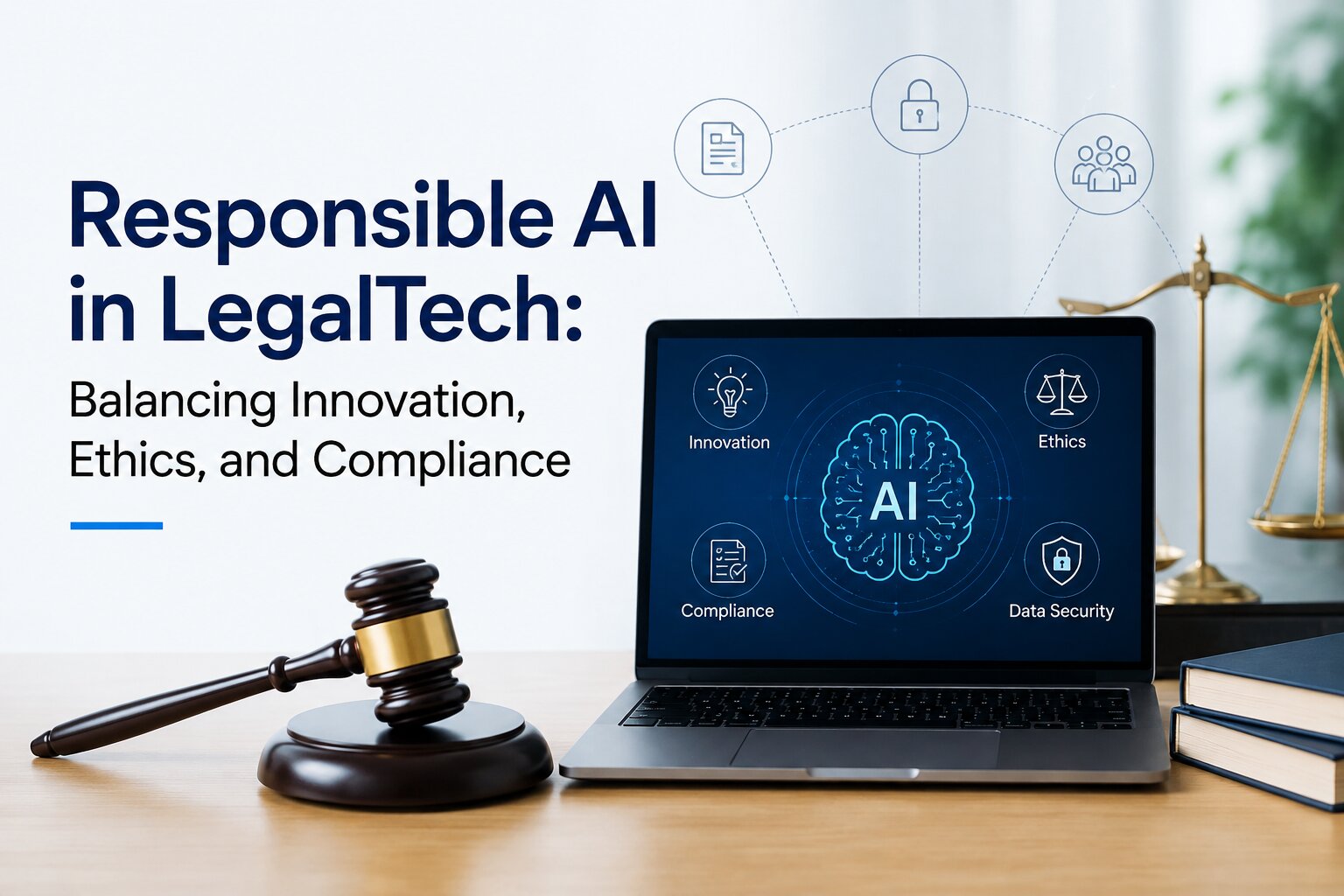
Responsible AI in LegalTech: Balancing Innovation, Ethics, and Compliance
Artificial intelligence is becoming a practical part of modern legal work. Legal teams are using AI-powered tools to review contracts, organise documents, search information, manage legal matters, and reduce repetitive administrative work. The appeal is obvious. AI can help legal professionals get through large volumes of information faster and spend more time on work that requires experience and judgement.
But legal teams cannot approach AI adoption in the same way they might adopt an ordinary productivity tool. Legal work often involves confidential client information, sensitive business data, personal information, and decisions that can have serious consequences.
That makes responsible AI in LegalTech more than a technology issue. It is about finding the right balance between innovation, ethics, security, human judgement, and compliance.
What Does Responsible AI Mean in LegalTech?
Responsible AI means using artificial intelligence in a way that is safe, transparent, fair, accountable, and aligned with relevant rules and organisational policies. For legal teams, this is particularly important because AI can influence how information is reviewed, classified, summarised, or prioritised. A responsible approach does not mean avoiding AI. Instead, it means understanding where AI can add value and where human involvement is still essential.
Several principles sit at the heart of responsible LegalTech adoption:
- Transparency: Legal professionals should have a reasonable understanding of how AI is being used and what it is contributing.
- Human oversight: AI should support professional judgement rather than make important legal decisions without review.
- Data privacy and security: Confidential legal and client information must be protected throughout the process.
- Accuracy: AI-generated information should be checked, particularly when it could influence legal advice or decisions.
- Fairness: Organisations should consider the possibility of bias in AI systems and their underlying data.
- Accountability: There should be clear responsibility for reviewing and acting on AI-supported outputs.
- Compliance: AI use should fit with applicable laws, regulations, contractual obligations, and internal policies.
In simple terms, responsible AI asks a straightforward question: Can we use this technology without losing control over the information, decisions, and risks involved?
How AI Is Transforming Modern Legal Technology
AI is already changing how legal professionals approach everyday work.
AI-powered legal research
Legal research can involve reviewing large amounts of information. AI tools can help lawyers find relevant information, summarise material, and organise research more efficiently. For law firms operating across the GCC, AI in legal research can offer valuable insights into how AI is changing research workflows and what legal teams should consider before adopting these tools.
However, faster research does not remove the need for professional verification. Legal professionals still need to assess whether the information is accurate, relevant, and appropriate for the matter at hand.
AI contract review and management
Contract management is another area where AI can make a noticeable difference. AI-assisted tools can help identify clauses, highlight potential risks, compare contract language, and support the review process. For a deeper look at how this works in practice, explore AI legal contract review in the UAE and how businesses can use AI to make contract reviews faster and more accurate.
This can reduce some of the repetitive work involved in handling large numbers of agreements.
The important distinction is that AI can assist with contract review, while legal professionals remain responsible for interpreting the legal and commercial implications.
AI in legal case and matter management
Legal teams also spend considerable time organising matters, tracking deadlines, managing documents, and following up on tasks. For teams looking to understand the fundamentals, this beginner’s guide to corporate legal case management tools explains how these platforms can help organisations manage legal matters more efficiently.
LegalTech platforms can bring these activities into a more structured workflow. AI can further assist by helping teams identify information, automate routine processes, and improve visibility across matters.
AI-assisted document management
Finding the right document at the right time should not require searching through folders and email threads. AI-supported document management can help classify, organise, and retrieve information more efficiently. For legal teams dealing with thousands of documents, this can save significant time.
Across all these applications, one principle remains important: AI should empower legal professionals, not replace their judgement.
The Ethical Challenges of AI Adoption in Legal Teams
The benefits of AI are clear, but responsible adoption also means being honest about its limitations.
Protecting confidential legal information
Legal teams routinely handle confidential contracts, client details, case documents, financial records, and business information. Sending such information to an AI system without understanding how it is stored, processed, or accessed can create unnecessary risks.
Before adopting an AI-powered LegalTech solution, organisations should understand its data handling practices and security controls.
Dealing with inaccurate AI outputs
AI systems can sometimes produce information that appears convincing but is incorrect. This is particularly concerning in legal work. An AI-generated summary or recommendation should not automatically be treated as fact simply because it is written confidently.
Legal professionals should have processes for checking important outputs before relying on them.
Addressing bias
AI systems can reflect biases present in their training data or design. While the impact will vary depending on the system and use case, legal teams should consider whether an AI tool could produce unfair or inconsistent outcomes.
Regular review and human oversight can help identify potential issues.
The problem of limited transparency
It is not always easy to understand why an AI system produced a particular result. That can become a problem when legal professionals need to explain or defend a decision. Legal teams should therefore consider how much visibility a system provides into AI-assisted processes.
Establishing accountability
Perhaps the most important question is simple: Who is responsible when something goes wrong? Introducing AI should not create a situation where responsibility becomes unclear. Legal teams should establish who reviews AI-generated work, who approves important decisions, and how errors or concerns are reported.
Compliance Considerations When Implementing LegalTech AI
Responsible AI adoption also requires attention to compliance. The exact requirements will depend on the organisation, jurisdiction, industry, and type of information being processed. Still, several areas deserve particular attention.
- Data protection and privacy: Understand what information the system collects, processes, and stores.
- Client confidentiality: Make sure the technology does not compromise confidential client information.
- Access controls: Not every employee should necessarily have access to every legal matter or document.
- Data retention: Understand how long information is retained and what happens when it is no longer required.
- Audit trails: Where appropriate, organisations should be able to track relevant activities and changes.
- Regulatory requirements: AI use should be assessed against the laws and regulations that apply to the organisation and its operations.
- Internal AI policies: Legal teams should establish clear rules for acceptable AI use, human review, and handling AI-generated content.
The goal is not to create unnecessary barriers. It is to ensure that innovation happens with appropriate safeguards in place.
How Can Legal Teams Adopt AI Responsibly?
There is no need to transform every legal process overnight. A gradual approach can be more practical.
1. Start with the right workflows
Identify repetitive, time-consuming tasks where AI can provide genuine value. Contract review, document organisation, legal research support, and routine administrative work may be suitable starting points.
2. Understand the data involved
Before introducing AI into a workflow, determine what type of information the system will handle. Sensitive legal information requires stronger controls than ordinary business information.
3. Evaluate LegalTech providers carefully
Do not choose a platform based solely on how impressive its AI features appear. Look at its approach to data security, privacy, user permissions, activity tracking, integration, and overall governance.
4. Keep humans involved
Human oversight should remain part of important legal processes. AI can identify information, summarise content, or suggest possible actions. A qualified professional should decide whether the output is correct and what should happen next.
5. Create an internal AI policy
Legal teams should establish clear guidelines for using AI.
The policy can cover approved tools, confidential information, human review, acceptable use cases, accountability, and how employees should report potential problems.
6. Train the legal team
AI adoption is not simply about buying software. Employees need to understand what the technology can do, where it can make mistakes, and when human review is necessary.
7. Monitor performance over time
AI adoption should not be treated as a one-time project. Teams should periodically review accuracy, security, user behaviour, compliance, and business outcomes to make sure the technology continues to deliver value safely.
Responsible AI in LegalTech: Innovation Without Losing Human Oversight
There is often a tendency to frame AI adoption around one question: How much work can AI automate? For legal teams, a better question may be: Which parts of legal work can AI improve while keeping professional judgement at the centre?
That shift in thinking matters.
A lawyer brings context, experience, legal reasoning, professional responsibility, and an understanding of a client's specific situation. AI brings speed, pattern recognition, and the ability to process large volumes of information. Used together, these strengths can complement each other.
The future of LegalTech is therefore unlikely to be about simply replacing lawyers with AI. It is more likely to involve legal professionals working alongside increasingly capable technology while maintaining appropriate oversight.
How Beveron Technologies Supports Modern LegalTech Adoption
For organisations looking to modernise their legal operations, the technology itself is only one part of the equation. A useful LegalTech platform should also help teams create more organised, controlled, and visible workflows. Beveron Technologies provides technology solutions designed to support different areas of legal operations, including law firm management, corporate legal management, and contract management. Its solutions include Smart Lawyer Office, Smart Legal Counsel, and Smart Legal Contract, each designed around specific legal workflows.
Smart Lawyer Office
Smart Lawyer Office is designed for law firms and legal practices that need to manage day-to-day operations more efficiently. It can help bring case information, documents, tasks, and other legal activities into a more organised environment. For law firms, this can reduce dependence on disconnected manual processes and give teams better visibility into their work.
Smart Legal Counsel
Corporate legal teams often have to manage a wide range of matters while responding to requests from different departments. Smart Legal Counsel is designed to help in-house legal teams organise and manage legal matters more systematically. It can support better coordination, information management, workflow visibility, and control across corporate legal operations.
Smart Legal Contract
Contracts can become difficult to manage when agreements are spread across emails, folders, and different systems. Smart Legal Contract focuses on contract management and helps organisations bring greater structure to contract-related processes. By centralising legal workflows and improving visibility, Beveron's LegalTech solutions can support organisations as they move towards more technology-driven legal operations.
Who Can Benefit from Beveron Technologies?
Beveron's solutions can be useful for:
- Law firms managing cases, clients, documents, and daily legal operations
- In-house legal teams handling corporate legal matters
- General Counsel offices seeking better visibility across legal work
- Corporate legal departments managing contracts, compliance, and internal legal requests
- Businesses looking to reduce manual legal administration and modernise their legal workflows
The broader value is not simply automation. Better organisation, controlled access, clearer workflows, and improved visibility can help create a stronger foundation for responsible technology adoption.
Questions to Ask Before Choosing an AI-Powered LegalTech Platform
Before investing in an AI-powered LegalTech solution, legal teams should look beyond the product demo.
Ask:
- How is confidential legal data protected?
- Who can access sensitive information?
- Does the platform provide appropriate activity tracking?
- Can legal professionals review AI-supported outputs?
- How transparent are AI-assisted processes?
- Can the system integrate with existing workflows?
- Does it support the organisation's compliance requirements?
- Can it scale as the legal team grows?
- What training and support does the provider offer?
These questions help shift the focus from “Does this platform have AI?” to “Can we use this AI responsibly in our legal environment?”
The Future of Responsible AI in LegalTech
AI adoption in legal operations is likely to continue growing. As legal teams become more comfortable with AI-assisted workflows, the conversation will increasingly move beyond experimentation. The next stage is structured adoption. Legal teams will need clear policies, stronger data controls, practical governance, and defined responsibilities around AI use. They will also need to assess whether new AI features genuinely improve legal work rather than simply adding another layer of technology.
This is where responsible AI becomes important.
The strongest legal teams may not be the ones using the most AI. They may be the ones that understand where AI adds real value, where human judgement is essential, and how to keep both working together.
Conclusion: Building a More Responsible LegalTech Future
AI can make legal work faster, more organised, and less repetitive. But efficiency should never come at the cost of confidentiality, accuracy, ethics, security, or accountability. Responsible AI in LegalTech is ultimately about balance. Legal teams need to embrace useful technology while maintaining human oversight and strong safeguards around sensitive information. The right LegalTech platform can support this transition by bringing structure, visibility, and control to everyday legal workflows.
As AI continues to evolve, responsible adoption will become less of an optional approach and more of a fundamental part of modern legal operations.
The goal is not simply to make legal teams more automated. It is to make them smarter, more efficient, and better equipped to use technology without losing the human judgement at the heart of legal work.
Ready to Make LegalTech Smarter and More Responsible?
Explore how Beveron Technologies can help your legal team modernise operations with secure, efficient, and technology-driven solutions.
Best AI for legal teams in the UAE
Best AI-powered legal technology in the UAE
Best AI-powered legal technology solutions in the UAE
If you need a free demo of the best AI for legal teams in the UAE, please fill out the form below.