How Two-Factor Authentication in Digital Signature Software for Legal Contracts Strengthened Security for a Dubai Bank
Securing Legal Contract Signing for a Leading Dubai Bank
Banks in the UAE handle thousands of legally binding documents every month, from loan agreements to compliance disclosures. For one Dubai-based bank, the risk of unauthorized access to these contracts had become a growing concern. Existing e-signature workflows lacked a strong identity verification layer, leaving room for potential fraud and compliance gaps. The bank needed a way to secure every signing event without slowing down operations.
The Challenge: Weak Authentication in Legal Contract Signing Workflows
The bank's legal and compliance teams identified a critical gap: signature authentication relied on basic email verification alone. This created three specific risks:
- Identity fraud exposure — signatures could be initiated without confirming the signer's true identity.
- Regulatory non-compliance — UAE financial regulations increasingly require multi-layered identity verification for contract execution.
- Audit trail weaknesses — incomplete verification logs made it difficult to prove signer authenticity during disputes or regulatory reviews.
Without a stronger authentication layer built into digital signature software for legal contracts, the bank faced rising operational and legal risk with every contract signed.
The Solution: Beveron Smart Legal Contract with Two-Factor Authentication
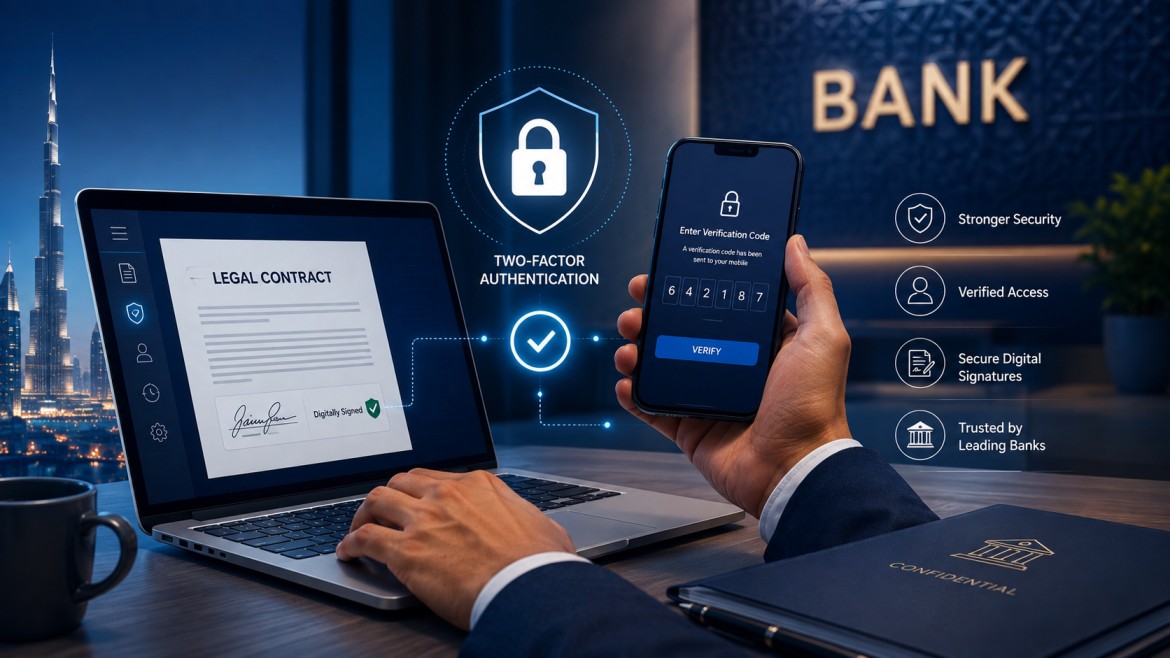
Beveron Technologies' Smart Legal Contract platform addressed this gap directly by embedding two-factor authentication (2FA) into the digital signing process. Every signer is required to verify their identity through a second authentication step—typically an OTP sent via SMS or email—before a signature is finalized.
Key features that resolved the bank's core challenges include:
- Two-factor authentication at the point of signing, ensuring only verified individuals can execute contracts.
- Encrypted audit trails that timestamp every authentication event, creating a defensible compliance record.
- Role-based access controls, limiting document visibility and signing rights to authorized personnel only.
- Tamper-evident digital certificates, which detect and flag any post-signature modifications.
This approach aligns with the same principles Beveron applied in a separate engagement, detailed in the case study on how cloud-based contract management software with e-signature integration helped a Doha real estate firm reduce legal risk, where stronger identity verification also played a central role in reducing exposure.
Implementation: A Phased Rollout Across Banking Operations
Beveron worked with the bank's IT and compliance teams to deploy the solution in three phases:
- Assessment and configuration — mapping existing contract workflows and identifying signer roles requiring 2FA enforcement.
- Pilot rollout — testing the authentication layer on a subset of loan and account-opening contracts to validate performance and user experience.
- Full deployment — extending two-factor authentication across all legal contract categories, including internal compliance documents and client-facing agreements.
Staff training accompanied each phase to ensure smooth adoption across legal, compliance, and customer-facing teams. For banks evaluating similar compliance-driven upgrades, this blog on the best legal contract automation software for compliance management in Qatar outlines comparable evaluation criteria relevant to the wider GCC region.
The Results: Measurable Security and Compliance Gains
Within six months of full deployment, the bank recorded the following outcomes:
- Zero unauthorized signing incidents since 2FA enforcement began.
- 35% faster compliance audits, due to complete and verifiable authentication logs.
- 100% signer verification rate across all legal contracts processed through the platform.
- Reduced dispute resolution time by 28%, as tamper-evident audit trails provided clear, admissible evidence of signer identity.
These results reflect a broader pattern Beveron has seen across regulated industries. A similar risk-reduction outcome is explored in the case study on how a UAE engineering firm reduced contract disputes using AI-based risk detection in contract lifecycle management software, where stronger verification and monitoring directly reduced legal exposure.
Client Perspective
"Two-factor authentication gave us the confidence that every signature on a legal contract is genuinely tied to the right individual. It's now a non-negotiable part of how we operate." — Head of Legal Operations, Dubai Bank
Why This Matters for Financial Institutions Across the Region
As financial regulators across the GCC tighten identity verification requirements, banks and lending institutions are re-evaluating their contract execution infrastructure. Organizations exploring procurement-related compliance needs can also explore the complete guide to the best procurement contract management software in Saudi Arabia for 2026 for a broader view of regional compliance standards.
Frequently Asked Questions
What is two-factor authentication in digital signature software for legal contracts?
Two-factor authentication (2FA) requires signers to verify their identity through a second step, such as an OTP sent via SMS or email, before a legal contract signature is finalized. This adds a verification layer beyond basic email confirmation.
Why do banks need two-factor authentication for digital signatures?
Banks handle legally binding, high-value contracts where identity fraud and regulatory non-compliance carry significant financial and legal risk. Two-factor authentication ensures only verified individuals can execute contracts, reducing fraud exposure and strengthening audit trails.
Does two-factor authentication slow down the contract signing process?
No. When implemented through platforms like Beveron's Smart Legal Contract, 2FA adds a brief verification step without disrupting overall signing speed or user experience.
Is two-factor authentication required for regulatory compliance in the UAE?
UAE financial regulators increasingly expect multi-layered identity verification for contract execution. While specific requirements vary by institution and regulation, 2FA helps banks meet rising compliance expectations and produce defensible audit records.
Can two-factor authentication help resolve contract disputes?
Yes. Encrypted audit trails tied to 2FA verification provide clear, timestamped evidence of signer identity, which can shorten dispute resolution timelines and support legal proceedings.
Ready to Strengthen Your Contract Security?
Two-factor authentication is no longer optional for institutions handling sensitive legal contracts. Beveron's Smart Legal Contract platform gives banks and financial institutions a verifiable, audit-ready way to secure every signature.
Curious how Beveron's Smart Legal Contract can secure your bank's next signature? Visit www.beveron.com or write to info@beveron.com to find out.
Best digital signature software for legal contracts in the UAE
Best AI contract lifecycle management software in the UAE
Best cloud-based contract management software in the UAE
If you need a free demo of the best digital signature software for legal contracts in the UAE, please fill out the form below.