Legal Case Management vs Legal Practice Management Software: What's the Difference?

Legal Case Management vs Legal Practice Management Software: What's the Difference?
Law firms today have no shortage of technology options. Yet one question continues to create confusion during software evaluations: what is the difference between legal case management software and legal practice management software? The two terms are often used interchangeably, and many vendors blur the distinction even further. As a result, firms can end up investing in software that addresses only part of their operational challenges.
Whether you are running a small practice, managing a growing litigation team, or modernising legal operations across multiple offices, understanding the difference is essential before making a purchasing decision.
If you're exploring the broader role of legal technology, our complete guide to legal case management software for modern law firms in 2026 provides a deeper look at how these platforms are transforming legal operations.
What Is Legal Case Management Software?
Legal case management software is designed to help legal professionals organise, track, and manage matters from initiation to closure. Its primary focus is the legal work itself rather than the business administration of the firm. At its core, legal case management software acts as a central hub for all matter-related activities.
Instead of searching through emails, shared drives, spreadsheets, and paper files, lawyers can access everything related to a case from a single location. The goal is straightforward: improve visibility, reduce administrative effort, and ensure legal work progresses efficiently.
Core Functions
Most legal case management platforms include capabilities such as:
- Matter and case tracking
- Document management
- Deadline and court date monitoring
- Task assignment and workflow automation
- Internal collaboration tools
- Legal intake management
- Communication tracking
- Reporting and analytics
For example, when a new litigation matter is opened, the system can automatically create tasks, assign responsibilities, organise documents, and establish milestone reminders without requiring manual setup.
Who Typically Uses It?
Legal case management software is particularly valuable for:
- Litigation firms
- Corporate legal departments
- Personal injury practices
- Employment law firms
- Real estate legal teams
- Firms handling high volumes of matters
Any legal team that relies heavily on structured case workflows can benefit significantly from dedicated case management capabilities.
What Is Legal Practice Management Software?
Legal practice management software takes a broader approach. Rather than focusing solely on legal matters, it helps firms manage the overall business side of legal operations. Think of legal practice management software as the operational backbone of a law firm.
While case management focuses on legal work, practice management focuses on running the business efficiently. It combines administrative, financial, and client management functions into a single platform.
Core Functions
Typical features include:
- Time tracking
- Billing and invoicing
- Trust accounting
- Expense management
- Client relationship management
- Resource allocation
- Financial reporting
- Staff productivity monitoring
For many firms, these capabilities are critical because profitability often depends on accurate time recording and streamlined billing processes.
Who Typically Uses It?
Legal practice management software is commonly used by:
- Small and mid-sized law firms
- General practice firms
- Managing partners
- Legal administrators
- Finance and operations teams
Firms looking to improve business performance often prioritise practice management capabilities alongside legal workflows.
Legal Case Management vs Legal Practice Management Software: Key Differences
Although there is overlap between the two categories, several important differences exist.
Primary Focus
Legal case management software focuses on managing legal matters.
Legal practice management software focuses on managing the firm itself.
One helps lawyers execute legal work. The other helps the organisation operate efficiently as a business.
Workflow Management
Case management platforms typically support legal workflows such as:
- Matter intake
- Document reviews
- Contract approvals
- Litigation milestones
- Compliance processes
Practice management systems focus more on:
- Billing cycles
- Resource planning
- Financial processes
- Staff utilisation
- Business operations
Matter and Document Control
Case management software generally offers deeper matter-level organisation. Users can track every document, communication, deadline, and activity associated with a specific case.
Practice management platforms often include document storage but may not provide the same depth of matter-specific workflow control.
Reporting and Visibility
Reporting capabilities differ significantly.
Case management reporting focuses on:
- Matter status
- Workflow bottlenecks
- Legal team productivity
- Case progression
Practice management reporting focuses on:
- Revenue
- Billable hours
- Collections
- Financial performance
- Operational efficiency
User Groups
Case management software is used primarily by:
- Lawyers
- Paralegals
- Legal assistants
- Legal operations teams
Practice management software is often used by:
- Managing partners
- Firm administrators
- Finance teams
- Operations managers
Side-by-Side Feature Comparison
While both solutions help legal professionals manage their work more effectively, their primary objectives and feature sets differ significantly. The table below highlights the key distinctions:
Feature | Legal Case Management Software | Legal Practice Management Software |
Matter Tracking | ✓ | ✓ |
Litigation Management | ✓ | Limited |
Document Management | ✓ | ✓ |
Workflow Automation | ✓ | ✓ |
Billing & Invoicing | Limited | ✓ |
Time Tracking | Limited | ✓ |
Compliance Reporting | ✓ | Limited |
Client Management | Limited | ✓ |
Financial Management | Limited | ✓ |
Legal Operations Reporting | ✓ | Limited |
The most significant difference lies in the software's purpose. Legal case management software is designed to help legal teams manage matters, workflows, compliance obligations, and legal operations. Legal practice management software, on the other hand, focuses on running the business side of a law firm, including billing, time tracking, financial management, and client administration.
As legal technology continues to evolve, some platforms now combine elements of both categories. However, understanding these core differences can help organisations select the solution that best aligns with their operational requirements and long-term objectives.
Areas Where Both Systems Overlap
The distinction between the two categories is becoming less clear as legal technology continues to evolve.
Shared Capabilities
Many modern platforms include features such as:
- Calendar management
- Task tracking
- Document storage
- Internal collaboration
- Client communication tools
As a result, firms may encounter software that appears to belong to both categories.
Why the Categories Often Get Confused
Today's legal software market is increasingly moving toward unified platforms. Vendors recognise that law firms do not want multiple disconnected systems. They want a single source of truth that supports both legal work and operational management. This shift explains why many modern solutions now blend case management and practice management functionality into one platform.
Which Solution Is Right for Your Firm?
The right choice depends on the problems your firm is trying to solve.
Choose Legal Case Management Software If You Need
Legal case management software is typically the better fit if your priorities include:
- Improving matter visibility
- Standardising legal workflows
- Managing large document volumes
- Tracking deadlines and milestones
- Reducing administrative work
For example, a litigation practice handling hundreds of active matters will often benefit more from advanced case tracking capabilities than from expanded accounting features.
Choose Legal Practice Management Software If You Need
Practice management software may be the stronger option if your challenges involve:
- Billing inefficiencies
- Time tracking accuracy
- Financial reporting
- Resource planning
- Profitability analysis
Many smaller firms begin their digital transformation journey with practice management software because administrative efficiency directly impacts revenue.
When You Need an Integrated Legal Operations Platform
In practice, many law firms and in-house legal teams eventually need both case management and practice management capabilities. As organisations grow, it becomes difficult to separate legal work (matters, cases, workflows) from business operations (billing, reporting, and resource management). This is where integrated platforms become important.
What is Beveron’s Smart Lawyer Office?
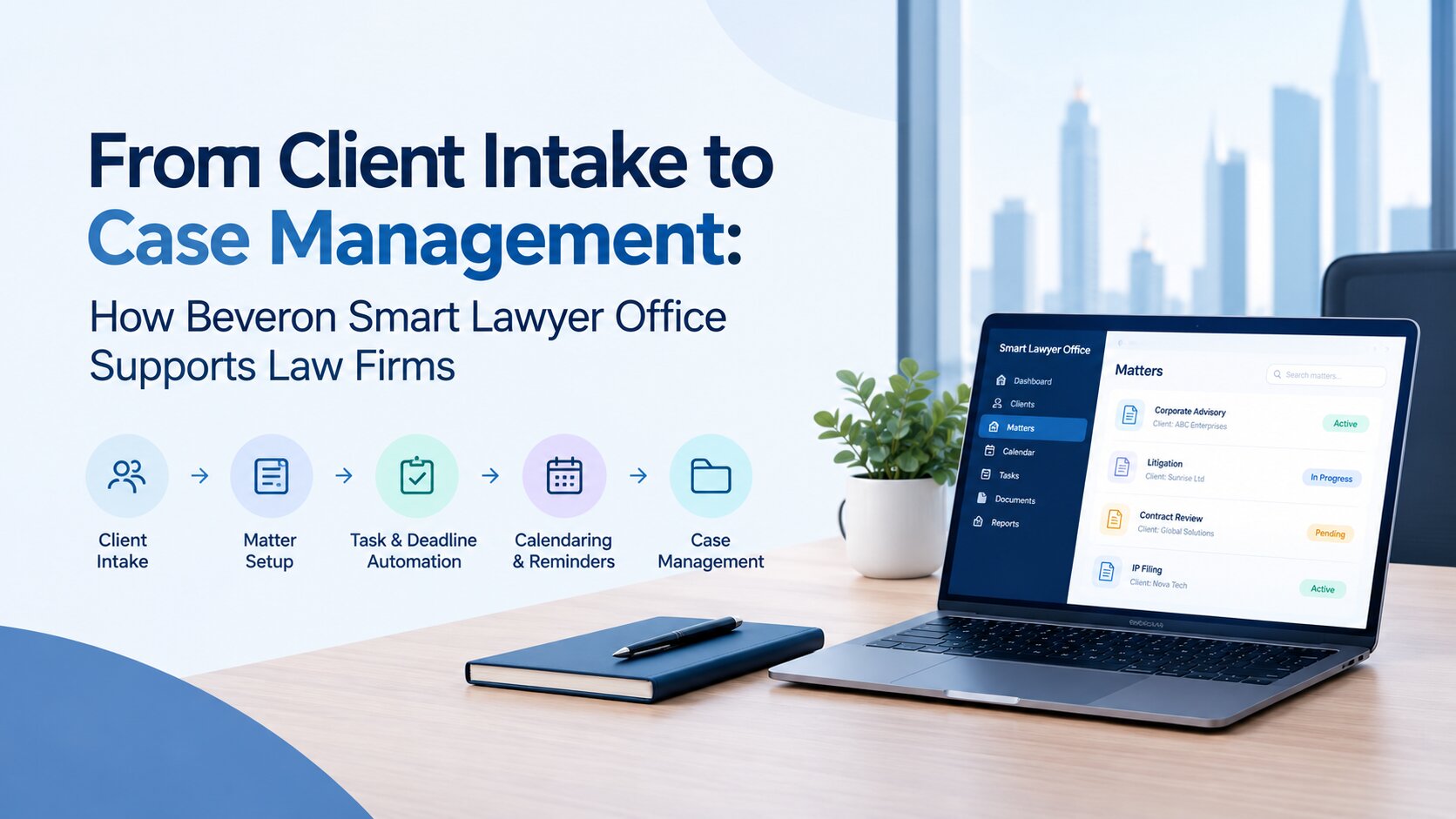
Beveron's Smart Lawyer Office is an integrated legal management system designed to bring legal work and operational management into one unified platform. Instead of using separate tools for matters, documents, workflows, and firm operations, it provides a single environment where legal teams can manage everything in one place.
How it helps legal teams
Centralised matter management: Keeps all cases, documents, and updates organised in one system, reducing scattered emails and files.
Improved visibility: Gives legal teams and managers a clear view of matter status, progress, and workload.
Better collaboration: Enables smooth communication between lawyers, paralegals, and operations teams within the same workspace.
Operational efficiency: Combines workflow management with reporting and tracking to reduce manual coordination.
Stronger governance: Helps maintain consistency, accountability, and audit-ready records across legal processes.
Why this approach matters
Instead of choosing between case management and practice management tools, integrated platforms like Smart Lawyer Office allow firms to handle both legal execution and operational control together. This reduces system fragmentation and supports more scalable, efficient legal operations as the organisation grows.
Questions to Ask Before Selecting Legal Software
Before comparing vendors, firms should take a step back and evaluate their actual operational needs.
What Problem Are We Trying to Solve?
Software should solve a business problem, not create another system for staff to learn. Identify the biggest operational bottlenecks first.
Which Processes Consume the Most Time?
Look at areas where lawyers and support staff spend excessive time on administrative tasks. These often represent the highest automation opportunities.
How Important Is Workflow Automation?
Automation has become a major priority for firms looking to scale efficiently. Tasks such as matter intake, document routing, deadline management, and approval workflows can often be automated.
Will the Platform Scale as the Firm Grows?
The legal technology market is evolving rapidly. Choose a solution that can support future growth rather than just current requirements.
Can It Integrate with Existing Systems?
Integration capabilities have become increasingly important as firms adopt specialised legal technologies. A disconnected software ecosystem often creates more work than it eliminates.
For a deeper evaluation framework, firms should also explore how to choose legal case management software and review the essential legal case management software features that support long-term growth.
Why Legal Software Selection Matters More Than Ever
Law firms are operating in a more demanding environment than ever before. Clients expect faster responses, greater transparency, and more efficient service delivery. At the same time, legal teams face increasing workloads, growing compliance requirements, and pressure to control costs.
According to recent legal technology trends, firms are investing more heavily in automation, workflow optimisation, AI-assisted processes, and operational visibility initiatives throughout 2025 and 2026.
The firms gaining the greatest advantage are not necessarily those buying the most software. They are the ones selecting technology that aligns closely with their operational goals. As legal technology continues to mature, software selection is becoming less about individual features and more about creating connected, scalable legal operations.
Conclusion
The debate around legal case management vs legal practice management software ultimately comes down to focus. Legal case management software is designed to help legal teams organise, track, and execute legal work more effectively. Legal practice management software helps firms manage the business side of operations, including billing, finances, and resource management.
Many firms will find that they need elements of both. The key is understanding where your biggest operational challenges exist and selecting a solution that addresses those needs while supporting future growth.
If your firm is looking to improve case tracking, automate workflows, simplify document management, and reduce administrative workload, it may be time to explore a modern legal operations platform.
Discover how Beveron's Smart Lawyer Office helps legal teams gain greater visibility, streamline matter management, improve collaboration, and operate more efficiently in an increasingly complex legal environment.
FAQs
What is the difference between legal case management software and legal practice management software?
Legal case management software focuses on managing legal matters, documents, deadlines, and workflows. Legal practice management software focuses on business operations such as billing, accounting, time tracking, and firm administration.
Can legal case management software handle billing and invoicing?
Some legal case management platforms include billing features, but their primary focus remains matter management. Firms with complex financial requirements may require dedicated practice management capabilities.
Do small law firms need both systems?
Not always. Smaller firms may initially prioritise practice management or case management depending on their operational needs. As firms grow, integrated solutions often become more valuable.
Is legal practice management software suitable for litigation firms?
Yes, but litigation firms often require advanced case tracking, document management, and workflow automation capabilities that are typically found in legal case management software.
How do I choose between the two types of software?
Start by identifying your biggest operational challenges. If legal workflows and matter management are the priority, case management software may be the better choice. If billing and firm administration are the main concerns, practice management software may be more appropriate.
Can one platform provide both case management and practice management capabilities?
Yes. Many modern legal technology platforms combine case management and practice management features, allowing firms to manage legal work and business operations from a single system.
Best legal case management software in the UAE
Best legal practice management software in the UAE
Best matter management software in the UAE
If you need a free demo of the best legal case management software in the UAE, please fill out the form below.