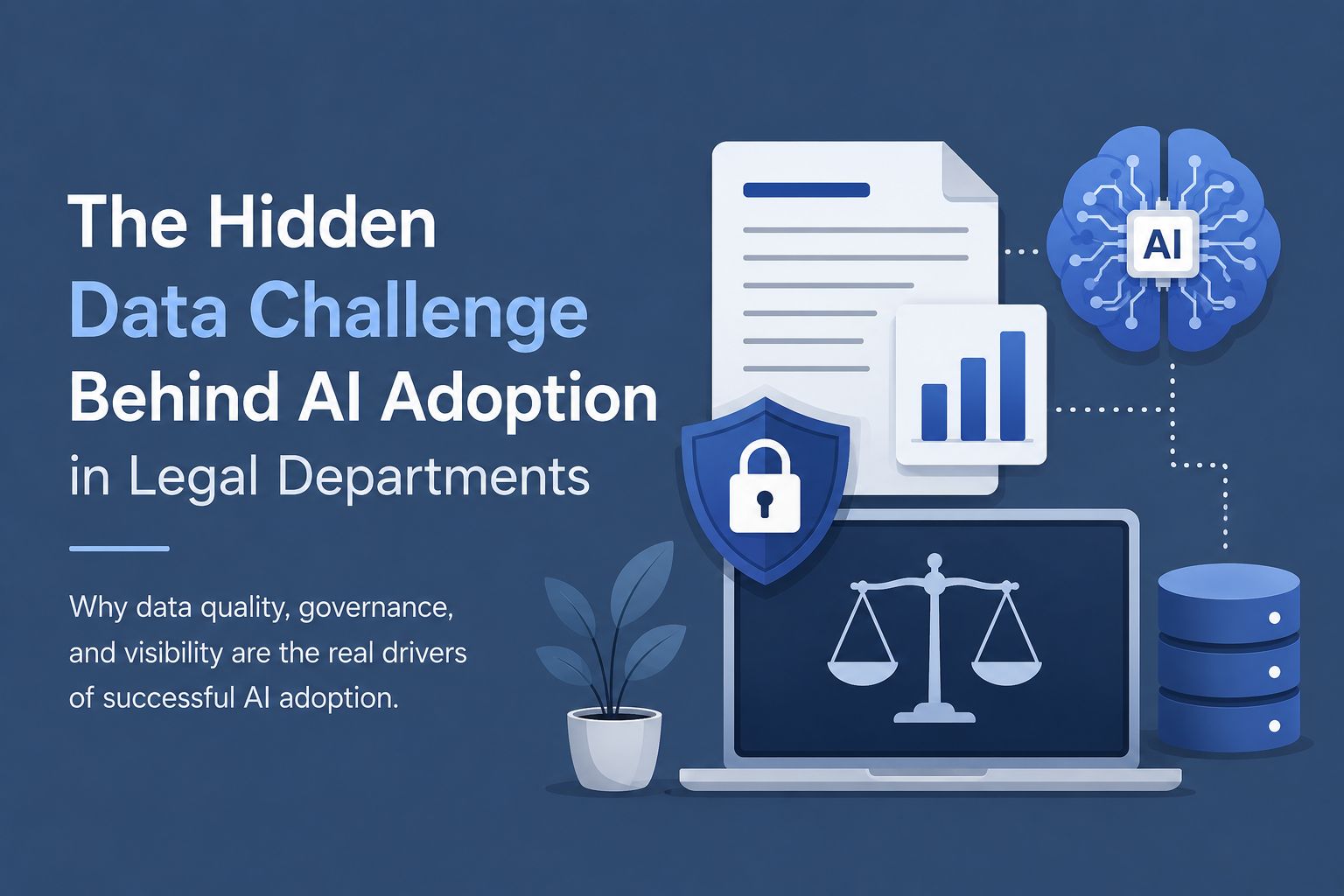
The Hidden Data Challenge Behind AI Adoption in Legal Departments
Artificial intelligence is rapidly moving from a future consideration to a present-day priority for corporate legal departments. Legal teams are exploring AI to improve efficiency, streamline workflows, reduce administrative burdens, and gain faster access to critical information.
From contract analysis and legal reporting to workload forecasting and matter management, the opportunities appear significant. Yet many legal departments discover that AI implementation is far more challenging than expected.
The reason is often not the AI technology itself.
Instead, the biggest obstacle is hidden beneath the surface: data.
Many organisations invest considerable time evaluating AI tools without first examining whether their legal data is ready to support them. As a result, projects that initially show promise may struggle to deliver meaningful outcomes.
For legal leaders looking to maximise the value of AI, understanding the data challenge is essential.
Why AI Is Becoming a Priority for Legal Departments
Corporate legal departments are under increasing pressure to do more with existing resources. Legal teams must manage growing workloads, support business objectives, oversee compliance requirements, and provide strategic guidance, often without proportional increases in headcount.
At the same time, business stakeholders expect faster responses and greater visibility into legal operations.
AI offers a compelling solution. By automating routine tasks, analysing large volumes of information, and generating insights more quickly, AI has the potential to help legal teams operate more efficiently.
This growing interest is reflected across numerous legal functions. Organisations are exploring AI-powered legal reporting, contract review, legal research, workflow automation, and resource planning initiatives.
For example, legal departments looking to improve resource allocation are increasingly evaluating AI-enabled approaches to forecasting workloads and balancing team capacity. Organisations interested in this area may find additional insights in this article on How-AI-Powered-Work-Allocation-Helps-Legal-Teams-Improve-Resource-Planning
However, AI can only perform as well as the information it receives.
The Data Foundation AI Depends On
Every AI system relies on data.
Within a legal department, data exists in many forms, including contracts, legal requests, matters, compliance records, policies, litigation files, emails, reports, and historical legal decisions.
Some of this information is structured, meaning it follows a consistent format that can be easily searched and analysed. Other information is unstructured, existing as documents, emails, notes, or scanned files.
For AI to generate useful outputs, it must be able to access accurate, relevant, and organised information.
When legal data is fragmented, inconsistent, or difficult to locate, AI systems face significant limitations. Instead of generating reliable insights, they may produce incomplete or inaccurate results.
This is why data readiness has become one of the most important factors influencing AI success within legal operations.
Common Data Problems That Undermine AI Adoption
Many legal departments have accumulated data over years of growth, organisational changes, and technology adoption.
As a result, information is often spread across multiple systems. Contracts may reside in one platform, matter records in another, compliance documents in shared drives, and legal requests within email inboxes. These information silos create immediate challenges for AI initiatives.
In addition to fragmented storage, legal teams frequently encounter inconsistencies in how information is recorded. Similar matters may use different naming conventions. Contract records may contain missing fields. Historical data may lack standardised classifications.
Duplicate records create further complications. When multiple versions of the same document exist, AI systems may struggle to determine which information is accurate and current.
Even relatively small data quality issues can become significant when AI is applied at scale.
The Risks of Using AI on Poor-Quality Legal Data
The phrase "garbage in, garbage out" is particularly relevant when discussing AI.
If the underlying legal data contains inaccuracies or inconsistencies, AI-generated outputs may also be flawed.
This creates several risks.
First, legal professionals may lose confidence in AI-generated recommendations if outputs appear unreliable. Trust is a critical factor in successful technology adoption, particularly within legal environments where accuracy is essential.
Second, poor data quality can introduce compliance and governance concerns. AI systems that access outdated, incomplete, or improperly managed information may increase organisational risk rather than reduce it.
Third, operational inefficiencies can persist despite AI investment. Teams may spend additional time validating outputs, correcting errors, or searching for missing information.
In such situations, AI becomes another layer of complexity rather than a productivity enhancer.
Why Data Governance Matters Before AI Implementation
Strong data governance provides the foundation for effective AI adoption.
Data governance refers to the policies, standards, and processes that ensure information remains accurate, secure, consistent, and properly managed.
For legal departments, governance begins with accountability.
Teams need clear ownership of legal data, including responsibility for maintaining quality, updating records, and ensuring consistency across systems.
Standardisation is equally important. Consistent classifications of matter, contract categories, metadata structures, and naming conventions help create an environment in which AI can interpret information more effectively.
Governance also supports compliance requirements. As organisations increasingly rely on AI, maintaining appropriate controls over confidential and sensitive legal information becomes even more important.
Without governance, AI initiatives may struggle to achieve sustainable success.
Preparing Legal Data for Successful AI Adoption
Before implementing AI, legal departments should assess the current state of their data environment.
A legal data audit is often an effective starting point. This process helps identify where information resides, how it is managed, and what quality issues may exist.
Once visibility is established, organisations can begin addressing fragmentation by centralising legal information wherever possible.
Modern legal operations platforms play an important role in this process by bringing contracts, matters, requests, and reporting data into a more unified environment.
Standardising workflows and record structures also improves data consistency. When information is captured in a structured and repeatable manner, it becomes easier for AI systems to analyse and interpret.
Improved visibility across legal activities creates an additional benefit. Legal leaders gain clearer insights into workloads, performance, risk exposure, and operational trends.
These insights are often valuable even before AI capabilities are introduced.
The Role of Legal Operations in Building AI Readiness
Legal operations teams are uniquely positioned to support successful AI adoption.
Their focus on process improvement, technology management, reporting, and operational efficiency aligns closely with the requirements of AI readiness.
Rather than viewing AI as a standalone technology initiative, legal operations leaders can help organisations evaluate the broader ecosystem that supports AI success.
This includes assessing data quality, identifying process gaps, defining governance frameworks, and establishing performance metrics.
The emergence of agentic AI further highlights the importance of strong operational foundations. As AI systems become more capable of performing tasks autonomously, the quality of underlying legal data becomes increasingly critical.
Legal professionals interested in this evolving area can explore additional perspectives in this article on The-Rise-of-Agentic-AI-in-Legal-Operations-What-Corporate-Legal-Teams-Need-to-Know
Practical Steps Legal Departments Can Take Today
Legal departments do not need to wait for a major transformation programme before improving AI readiness.
Several practical actions can be taken immediately.
Start by identifying the most valuable legal data sources. Contracts, matter records, legal requests, compliance documentation, and reporting data often provide the strongest foundation for future AI initiatives.
Next, work to reduce information silos. Consolidating legal information improves accessibility and creates a more complete view of legal operations.
Establish governance policies that define ownership, quality standards, retention requirements, and security controls.
Finally, begin with focused AI use cases that address specific operational challenges. Smaller initiatives often generate valuable lessons while minimising implementation risk.
Organisations exploring AI-driven reporting capabilities may also benefit from understanding how data quality influences reporting outcomes. Additional insights can be found in this article: The-Business-Case-for-AI-Powered-Legal-Reporting-in-Corporate-Legal-Departments
Similarly, legal teams evaluating AI applications in legal research can learn more about data-related considerations in this article: AI-in-Legal-Research-What-Law-Firms-in-the-GCC-Need-to-Know
How Modern Legal Platforms Support Data Readiness
Technology alone cannot solve data challenges, but the right platform can provide significant support. Modern legal operations solutions help centralise information, standardise workflows, improve reporting, and increase visibility across legal activities.
By creating a more unified data environment, these platforms make it easier for legal departments to establish the consistency and governance required for AI initiatives.
For example, platforms such as Beveron Smart Legal Counsel can help organisations consolidate legal information into a single operational framework, supporting both reporting and future AI readiness efforts.
The key advantage is not simply having more data. It has better-organised, more accessible, and more reliable data. That foundation ultimately determines how much value AI can deliver.
Conclusion
AI has the potential to transform corporate legal departments, but successful adoption depends on far more than selecting the right technology The quality, accessibility, governance, and consistency of legal data play a decisive role in determining outcomes.
Legal teams that prioritise data readiness position themselves to achieve more accurate insights, stronger operational efficiency, and greater long-term value from AI investments.
Those who overlook the data challenge may find that even the most advanced AI solutions struggle to deliver meaningful results.
As legal departments continue their digital transformation journeys, the most important question may not be which AI tool to adopt next. It may be whether the underlying data foundation is ready to support it.
Ready to Build a Stronger Foundation for Legal AI?
AI success starts with the right data foundation. Beveron Technologies helps corporate legal departments centralise legal information, improve data visibility, strengthen governance, and create the operational readiness needed for successful AI adoption. Whether you're managing contracts, legal matters, compliance activities, or reporting,
Beveron Technologies provides the structure and visibility legal teams need to maximise the value of AI.
Discover how Beveron can help your legal department build a smarter, more AI-ready future.
Frequently Asked Questions
Why does data quality matter for legal AI?
AI systems rely on the information they receive. Poor-quality data can lead to inaccurate outputs, reduced trust, and weaker decision-making.
What types of legal data are most important for AI initiatives?
Contracts, matter records, legal requests, compliance documentation, legal research data, and reporting information are often among the most valuable sources.
How can legal departments assess their AI readiness?
A data audit is usually the best starting point. Organisations should evaluate data quality, accessibility, governance practices, and system integration before implementing AI solutions.
What are the biggest data challenges facing legal teams today?
Common challenges include fragmented information, inconsistent records, duplicate data, limited visibility, and a lack of standardised governance practices.
Can AI still provide value if legal data is incomplete or inconsistent?
AI can still offer benefits, but results may be less accurate and reliable. Improving data quality significantly increases the likelihood of successful AI adoption.
Best AI adoption in legal departments in the UAE
Best AI implementation in corporate legal teams in the UAE
Best AI-powered legal operations in the UAE
If you need a free demo of the Best AI adoption in legal departments in the UAE, please fill out the form below.