From Case Files to Legal Insights: How Private AI Can Transform Law Firm Workflows
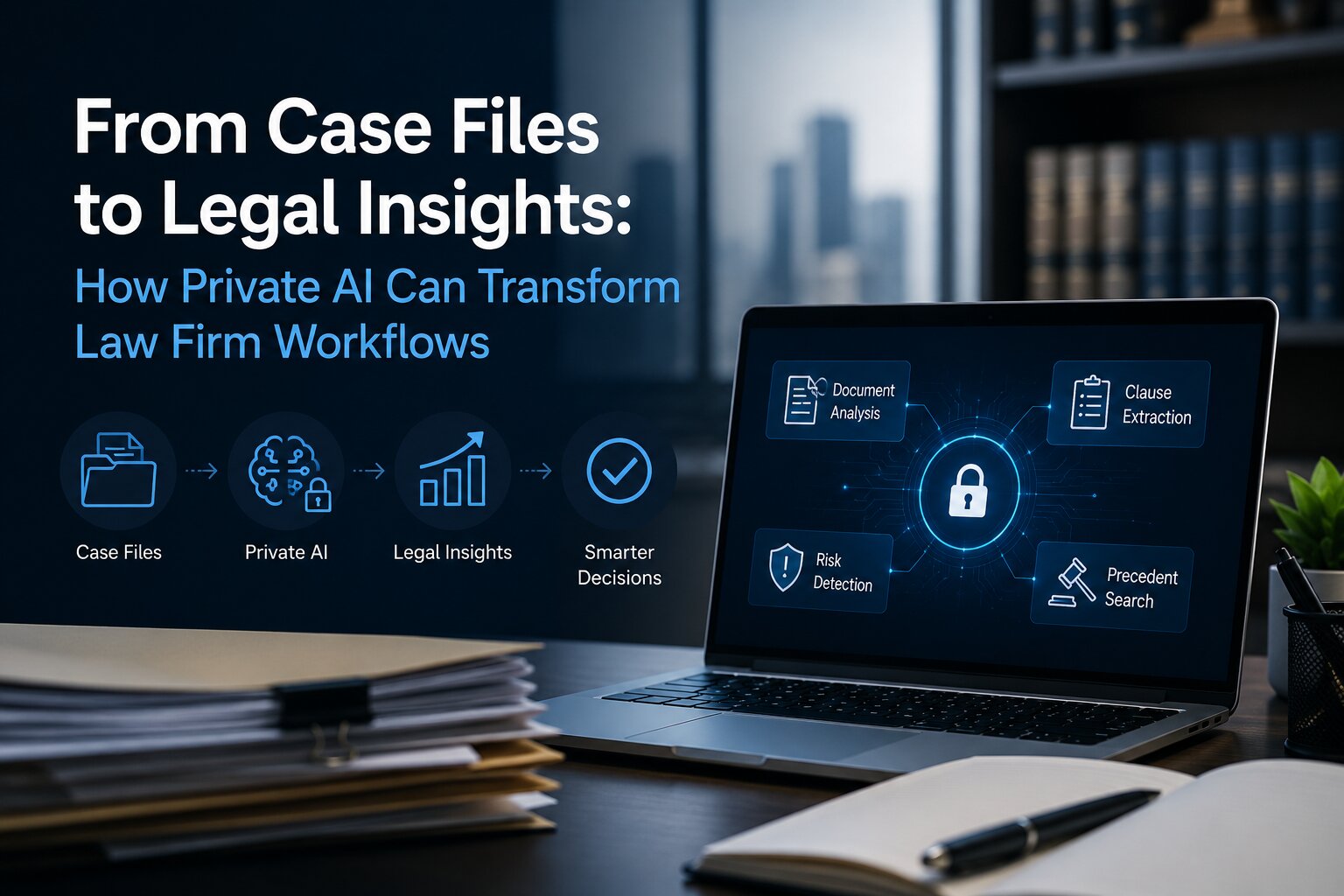
Law firms have never had a shortage of information. The challenge has always been finding the right information at the right time.
A single matter can involve contracts, court documents, emails, evidence, client correspondence, research notes and billing records. Much of this information is sensitive, and it may sit across different folders, systems and applications. As artificial intelligence (AI) becomes more capable, law firms have an opportunity to make this information easier to manage and use.
But there is an important question: How can firms use AI without losing control over the legal data they are trusted to protect?
This is where private AI becomes particularly relevant. Instead of treating AI as a general-purpose tool that sits outside the firm's existing environment, firms can explore controlled AI environments designed around their own data, users and workflows.
The goal is not to replace lawyers. It is to help them spend less time searching, sorting and repeating routine work—and more time on legal judgement, strategy and client service.
The Data Problem at the Heart of Legal Work
Legal work depends heavily on information. Lawyers need to review documents, understand case histories, research legal issues, track deadlines and retrieve information from previous matters. Yet the information they need is not always organised in a way that makes this easy. A relevant clause may be buried in a lengthy contract. A key fact may sit inside an old case document. A useful precedent may be difficult to locate. An important email may be sitting in a separate mailbox.
This creates a simple but expensive problem: lawyers can spend too much time finding information instead of using it.
Why Legal Data Needs More Protection
Legal information is rarely ordinary business data. Case files can contain confidential client communications, personal information, financial records, contracts, evidence and sensitive business information. That makes data handling particularly important when introducing AI into legal workflows.
General-purpose AI tools can be useful for many everyday tasks, but firms need to understand how a particular service handles submitted information, where data is processed or stored, who can access it, and what controls are available. For a law firm, these are not minor technical details. They can directly affect confidentiality, internal policies and client trust.
For a practical look at how AI can improve efficiency across everyday legal work, see Beveron’s A Practical Guide to Improving Law Firm Productivity With AI in 2026. For a law firm, these are not minor technical details. They can directly affect confidentiality, internal policies and client trust.
AI Has Potential, but Legal Teams Have Good Reasons to Be Cautious
The benefits of AI are easy to see. It can help summarise documents, find information, organise content and support research. But legal teams also have legitimate concerns about privacy, accuracy, confidentiality and control. That tension explains why some firms are taking a more cautious approach. The question is no longer simply whether AI can help lawyers. It is how firms can introduce AI in a way that fits their security requirements, existing systems and professional responsibilities.
What Does Private AI Actually Mean for Law Firms?
Private AI generally refers to an AI environment where an organisation has greater control over how its data, users and AI systems are managed. The exact setup can vary. A firm might use an on-premise environment where the technology operates on its own infrastructure, a private cloud environment, or another isolated setup designed to keep access and data within defined boundaries. The important point is not the label. It is the level of control the firm has over the environment.
What Makes an AI Environment Private?
In a controlled environment, a law firm can establish rules around who can use the AI system and what information different users can access. For example, a partner may have access to certain matter information that should not be available to everyone in the firm. Similarly, a team working on a confidential transaction may need different access from another practice group.
The AI system should fit these existing requirements rather than creating a separate information environment that is difficult to manage.
On-Premise, Private Cloud and Isolated AI Environments
These terms describe different ways of deploying AI. On-premise AI operates within an organisation's own infrastructure. This can give the organisation a high level of control over the environment, although it also means taking responsibility for the infrastructure and maintenance involved.
Private cloud AI operates in a dedicated or controlled cloud environment rather than on the firm's physical premises. It can provide flexibility while maintaining stronger organisational controls than a typical public service.
Isolated AI environments are designed to separate an organisation's AI workloads and data from other users or systems. The right approach depends on factors such as the firm's security requirements, existing infrastructure, budget, IT capabilities and integration needs.
Why Control Matters When AI Handles Legal Information
Control becomes increasingly important as AI becomes part of everyday legal work.
Firms may need to consider:
- Where information is stored and processed
- Who can access particular matters and documents
- How user activity is recorded
- Whether actions can be reviewed through audit trails
- How information is protected
- How the AI environment fits internal governance policies
These controls should not exist simply to satisfy a checklist. When designed properly, they can help AI become part of the firm's normal way of working.
Public AI vs. Controlled AI Environments: What Changes?
The difference is easiest to understand by looking at what happens to data and how the system is managed.
For a deeper comparison of the two approaches, see Beveron’s 5 Reasons Legal Teams Should Choose Private AI Over Public AI, which explains how private AI can provide greater control over confidential legal information, access, governance and auditability.
Area | General-Purpose AI | Controlled AI Environment |
|---|---|---|
Data handling | Depends on the provider's policies and configuration | Can be managed according to the organisation's environment and controls |
Access | Controlled through the platform | Can be aligned with internal roles and permissions |
Data control | More dependent on the provider | Greater organisational control may be possible |
Auditability | Depends on the service | Can be designed around internal requirements |
Legal system integration | May require separate tools or processes | Can be tailored to existing workflows |
This does not mean every public AI service is unsuitable for legal work, or that every private deployment is automatically secure. The actual controls, configuration and provider practices still need to be assessed.
Data Doesn't Have to Leave the Firm's Controlled Environment
For firms handling highly sensitive matters, keeping information within a controlled environment can be an important consideration. Instead of moving documents between unrelated tools, AI capabilities can be introduced closer to the firm's existing information and workflows.
This can make it easier to establish clear rules around how sensitive information is handled.
Access Can Follow Existing Roles and Permissions
Not every person in a law firm needs access to every matter. A well-designed AI workflow should respect these distinctions. User permissions can help ensure that AI-assisted searches and information retrieval follow the same access principles already used by the firm.
Visibility and Audit Trails Become Part of the Workflow
When AI is used for important legal work, firms need to know more than just the answer it produces. They may also need visibility into who accessed information, what actions were taken and how the system is being used. Audit trails can help provide this visibility and support internal review.
Security Should Support Productivity, Not Get in the Way
Security should not turn every AI task into another administrative burden. The better approach is to build security into the workflow itself. Lawyers should be able to access the information they are authorised to use without constantly working around disconnected systems.
Where AI Can Make a Difference Across the Legal Workflow
Private AI becomes much more useful when it is connected to real legal work rather than treated as a standalone chatbot. From the moment a matter arrives to the point where lawyers review documents and prepare advice, there are several areas where AI can reduce repetitive work.
Intake and Case File Organisation
The beginning of a matter often involves collecting information from clients, emails and documents. AI can assist with organising this information, identifying document types and extracting basic details such as names, dates, matter references and other relevant information. Instead of manually sorting every document, legal teams can start with a more structured case file.
Making Large Case Files Easier to Search and Understand
Large matters can generate hundreds or even thousands of documents.
AI can help lawyers work through this volume by:
- Summarising lengthy documents
- Identifying key facts and dates
- Extracting information from relevant files
- Helping users search across case materials
- Highlighting information that may require closer review
This does not remove the need for a lawyer to examine important documents. It simply reduces the amount of manual searching involved.
Legal Research and Precedent Analysis
Legal research can involve reviewing large amounts of information before a lawyer reaches the relevant material. AI can support this process by helping users search internal knowledge, identify potentially relevant previous matters and organise research findings.
The lawyer remains responsible for assessing whether a source is legally relevant, reliable and applicable to the matter.
That human review is especially important because AI systems can produce inaccurate or incomplete information.
Contract Review and Clause Extraction
Contracts are another area where AI can reduce repetitive work. A system can help identify clauses, extract key terms and compare language across documents. It may also flag provisions that deserve closer attention based on rules or criteria defined by the legal team.
The value comes from helping lawyers get to the important parts faster, not from allowing AI to make final legal decisions on their behalf.
Drafting Support and Internal Knowledge Retrieval
Law firms already have a large amount of knowledge stored in previous work. AI can help lawyers locate relevant documents, previous matter information and internal resources. It can also assist with first drafts, summaries and routine written material.
Instead of starting from a blank screen, a lawyer can begin with information that is relevant to the task and then apply their own judgement.
From Scattered Case Files to Actionable Legal Insight
The bigger opportunity goes beyond saving a few minutes on individual tasks. When information across matters becomes easier to search and understand, firms can start seeing patterns that are difficult to spot when information remains scattered across separate files.
Turning Unstructured Information into Searchable Knowledge
Much of a firm's knowledge exists in documents written for specific matters. AI can help make this information easier to find by extracting relevant details and connecting them to searchable concepts.
Over time, this can make the firm's existing knowledge more useful instead of allowing valuable experience to remain buried in old case files.
Finding Patterns Across Matters
When information from multiple matters can be analysed appropriately, firms may be able to identify recurring issues.
For example, they could look for:
- Repeated legal or contractual issues
- Common risk areas
- Similar case patterns
- Frequently negotiated clauses
- Recurring workflow bottlenecks
These insights can support better planning and more consistent legal operations.
Giving Legal Leaders a Clearer View of Operations
AI can also support the operational side of legal work. Leadership teams may gain better visibility into matter workloads, case progress, document bottlenecks and other workflow patterns. This can help firms identify where resources are being used and where processes could be improved.
Moving from Finding Information to Understanding It
This is where the real promise of AI lies. The goal is not simply to ask an AI system a question and receive an answer. The bigger opportunity is to make the firm's own information easier to understand and use. AI can help turn large volumes of legal information into insights that support human decision-making.
What Should a Law Firm Consider Before Adopting AI?
Choosing an AI solution should not begin with a list of impressive features. A better starting point is the firm's existing workflow. What takes too much time? Where is information difficult to find? Which processes involve repetitive manual work? And what information must receive the highest level of protection?
Security and Data Governance
Before adopting an AI system, firms should understand how it handles their information.
Questions worth asking include:
- Where is data stored?
- Where is it processed?
- Who can access it?
- What user permissions are available?
- Are activities recorded?
- What security measures are in place?
- Can the system support the firm's internal policies?
These questions should be answered clearly before sensitive legal information is introduced.
Integration with Existing Legal Systems
AI should not become another isolated tool.
Ideally, it should work alongside systems the firm already uses, such as:
- Case management software
- Document management systems
- Contract management platforms
- Internal knowledge repositories
- Other legal operations tools
Good integration reduces the need to constantly move information from one system to another.
Getting Lawyers and Paralegals Comfortable with AI-Assisted Work
Technology adoption is also a people issue. Lawyers need to understand where AI can help and where they still need to apply their own judgement. Teams should know how to review AI-generated content and what to do when the system produces an uncertain or incorrect result.
Starting with practical, low-risk use cases can help teams build confidence before AI is introduced into more complex workflows.
Measuring Whether It Is Actually Making Work Better
AI adoption should produce measurable improvements.
Firms can track indicators such as:
- Time spent reviewing documents
- Time required to find information
- Reduction in repetitive administrative work
- Speed of matter intake
- Search and retrieval efficiency
- Number of manual errors
- Overall matter visibility
The best measure is not how advanced the AI sounds. It is whether lawyers can do meaningful work more efficiently without compromising quality or control.
Building a More Secure AI-Ready Legal Workflow with Beveron
Once a firm understands its data, workflow and security requirements, the next step is choosing an approach that fits those needs.
Why Legal AI Needs to Fit the Way Firms Already Work
AI works best when it becomes part of the existing legal workflow rather than another destination lawyers have to visit. That means the technology should work with the firm's information, users and processes. Security should be built into the environment, while the experience remains practical enough for everyday use.
For legal teams, this balance is particularly important. A solution can have powerful AI capabilities, but if it creates new data silos or makes everyday work harder, adoption will suffer.
Beveron's Approach to Secure AI for Legal Teams
From AI Experimentation to a Controlled Legal AI Strategy
The most useful question for a law firm is not, “Where can we add AI?”
It is, “Which parts of our workflow would benefit from AI, and what controls do we need to use it responsibly?”
Starting with that question helps firms avoid adopting technology simply because it is new. Instead, they can identify practical use cases, establish appropriate safeguards and gradually expand AI across their legal operations.
The Road Ahead: AI as Part of Modern Legal Infrastructure
AI is moving beyond simple question-and-answer tools. As the technology develops, it is likely to become more closely connected to the systems where organisations already store and manage information.
From AI Assistants to Agentic Legal Workflows
The next stage involves AI systems that can support multi-step processes rather than handling one task at a time. For example, an AI assistant could potentially help gather information, organise documents, identify relevant material and prepare a summary for lawyer review. These workflows can become increasingly automated, but human oversight remains essential for important legal decisions.
Why Controlled AI Environments May Become Standard
As firms use AI across more areas, the need for appropriate control will grow. Legal teams will continue to deal with growing volumes of information while facing expectations around confidentiality, data protection and professional responsibility. A controlled AI environment can help firms balance these requirements with the need to work faster and use their information better.
The Future Is Not Lawyers vs AI
The most useful way to think about AI in legal work is not as a replacement for lawyers. AI can handle information-heavy and repetitive tasks. Lawyers bring legal judgement, strategy, context, professional responsibility and an understanding of the client.
The firms that benefit most may be those that combine both effectively: allowing AI to handle more of the work around the legal decision while giving lawyers more time to focus on the decision itself.
Frequently Asked Questions
What makes AI private compared with using ChatGPT for legal work?
The main difference is the environment in which the AI operates and the level of control an organisation has over its data, access and configuration. A general-purpose AI service is managed according to its provider's policies and settings, while a private or controlled deployment can be designed around an organisation's specific requirements.
However, firms should always review the actual security, privacy and data-handling practices of any AI provider rather than assuming that a particular label guarantees security.
Is private AI only practical for large law firms?
No. The right approach depends on the firm's needs, available infrastructure and the sensitivity and volume of its information.
Large firms may have more complex requirements, but smaller practices can also benefit from controlled AI environments where they have a clear business need for stronger data control.
Is on-premise AI different from private cloud AI?
Yes. On-premise AI generally operates on infrastructure managed within the organisation's own environment. Private cloud AI operates in a controlled cloud environment.
Both approaches can provide stronger control than a typical public AI service, but their costs, maintenance requirements and implementation models can differ.
Can AI work with a firm's existing case management and document systems?
It can, depending on the AI solution and the integration options available.
Integration is important because lawyers should ideally be able to use AI alongside the systems where their case and document information already exists, rather than repeatedly moving information between disconnected applications.
Does private AI eliminate the need for human review?
No. Privacy and deployment control do not make AI infallible.
AI can still produce inaccurate, incomplete or misleading results. Lawyers should review important outputs and remain responsible for legal judgement, advice and final decisions.
What should a law firm look for when choosing a secure AI solution?
Firms should look beyond AI features and evaluate the whole environment. Important considerations include data handling, access controls, deployment options, security, auditability, integration with existing systems, ease of use, human oversight and measurable workflow benefits.
The best solution is one that improves legal work without asking the firm to compromise the control and trust that legal practice depends on.
Best private AI for law firms in the UAE
Best secure AI for law firms in the UAE
Best on-premise AI for law firms in the UAE
If you need a free demo of the best private AI for law firms in the UAE, please fill out the form.